Deload Weeks After 40: When They Actually Help
This article may contain affiliate links. If you buy through them, we may earn a small commission at no extra cost to you. See our Affiliate Disclosure and Medical Disclaimer.
Somewhere around week six of a hard training block, a familiar thought shows up: maybe I should take it easier this week. For lifters over 40, that thought usually arrives with company — a cranky elbow, a hip that clicks going down stairs, a bench press that hasn’t moved in a month. The question is whether backing off on purpose, a “deload week,” actually does anything useful, or whether it’s just an excuse dressed up in training jargon. A 2024 controlled trial gave a surprisingly clear, if slightly inconvenient, answer.
What a Deload Week Actually Is (and Isn’t)
A deload is a planned, short period — usually 5 to 7 days — where you deliberately reduce training stress below your normal level, typically by cutting your sets by roughly half, your load by 40-60%, or stopping resistance training altogether for a week. It is not the same as a rest day (24-48 hours between sessions, which every program already includes) and it is not the same as detraining, which is what happens when you stop training for long enough that fitness actually declines. A deload sits in between: a scheduled dip meant to let tendons, joints, and your nervous system catch up with the fatigue your muscles have been quietly accumulating.
The logic behind programming them is reasonable on paper. Muscles adapt to hard training within days. Tendons, ligaments, and cartilage adapt far more slowly, on the order of weeks to months, because they have a much lower blood supply. Train hard for long enough and you can end up with muscles that are ready for more while your joints are quietly falling behind — a mismatch that shows up as nagging aches, not sudden injury. A deload, in theory, lets the slow-adapting tissues close that gap.
Why “After 40” Changes the Calculus
None of the controlled trials on deloading were run exclusively in people over 40 — the 2024 trial discussed below, like most of this literature, studied younger resistance-trained adults. So some of what follows for the 40+ crowd specifically is a reasonable extrapolation rather than a directly tested fact, and it’s worth being upfront about that distinction.
What is well established, from the broader aging and exercise literature, is that connective tissue recovery slows with age even when muscular recovery doesn’t slow nearly as much. A review of resistance exercise prescriptions for people with sarcopenia concluded that two structured sessions per week, using 1-3 sets taken to a high but not maximal level of effort, is enough to drive meaningful strength and muscle gains in older adults — meaningfully less total work than many younger lifters assume they need (Hurst et al., 2022, Age and Ageing). A separate analysis of 151 trials and over 6,000 participants found that even a low training volume produces a significant improvement in lean body mass and hypertrophy in adults over 60, with higher volumes needed mainly to maximize strength rather than muscle size (Radaelli et al., 2025, Sports Medicine). Put together, these findings suggest that lifters over 40 generally need less total training stress to keep progressing than they may assume, which is exactly the kind of margin that makes a periodic deload easier to afford without losing ground.
Free download
🔥 The Metabolism Starter Kit
3 honest guides: a 7-day reset plan, a foods cheat-sheet and 12 metabolism myths debunked. No spam — unsubscribe anytime.
What the Research Actually Shows About Deloading
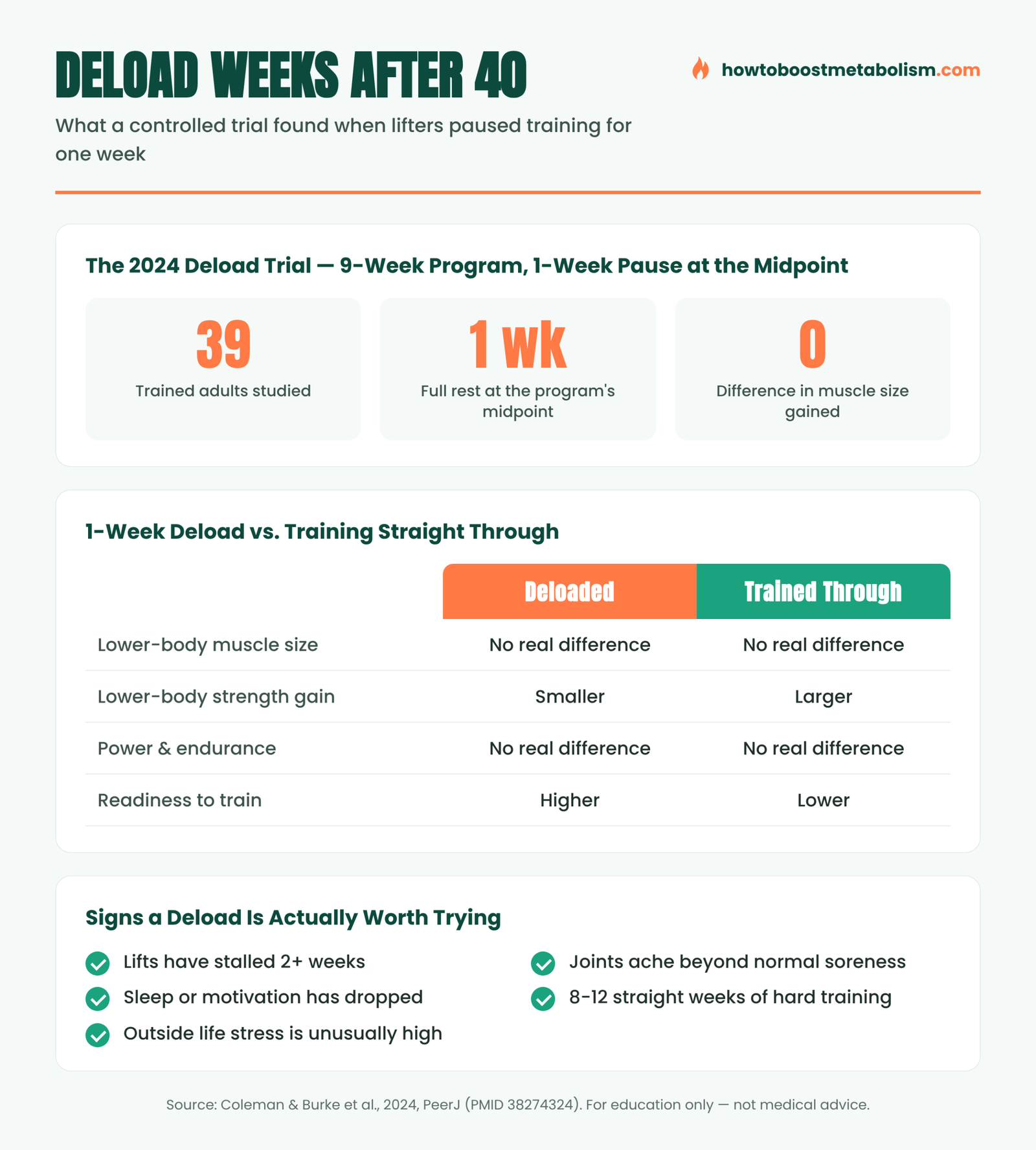
The most directly relevant evidence comes from a 2024 study that randomly assigned 39 resistance-trained men and women to one of two groups for a 9-week program: one group trained continuously throughout, and the other took a full week of complete rest from resistance training at the program’s midpoint (Coleman & Burke et al., 2024, PeerJ). The idea being tested was that a brief pause might “re-sensitize” muscle to the anabolic signal of training, producing a rebound that makes up for the lost week.
| What Was Measured | Result |
|---|---|
| Lower-body muscle size | No meaningful difference between groups |
| Lower-body strength (isometric and dynamic) | Continuous-training group gained more |
| Muscular power and local endurance | No meaningful difference between groups |
| Self-reported readiness to train | Slightly better in the deload group |
The honest summary: the deload didn’t boost muscle growth the way the “re-sensitization” idea predicted, and the group that trained straight through actually came out slightly ahead on strength. The one place the deload group won was psychological — they reported feeling more ready and willing to train afterward, which matters for long-term adherence even if it didn’t show up on a strength test in this particular study. That’s a meaningfully different conclusion from the common claim that deloads “supercharge” your next block. The evidence here says a deload is, at best, neutral for size and slightly costly for strength in the short term — its real value is recovery and sustainability, not a hidden gains hack.
When a Deload Actually Pays Off
- Joint or tendon niggles that don’t resolve with a normal rest day — ongoing elbow, knee, or shoulder irritation that’s been building for weeks, not a single sore muscle.
- A stalled lift that won’t budge for 2-3 straight weeks despite consistent effort and food intake — a common sign of accumulated fatigue outrunning recovery.
- Sleep quality or motivation that has noticeably dropped alongside hard training — both are common early markers of overreaching, well before performance collapses.
- 8-12 straight weeks of hard training without a planned break, especially if life stress (work deadlines, poor sleep, travel) has been stacking on top of training stress.
- Coming back from a minor injury or illness, where a lighter week bridges the gap between “cleared to train” and “back to full intensity” safely.
When You Probably Don’t Need One Yet
If your lifts are still moving up session to session, your joints feel normal, and you’re sleeping and recovering the way you expect to, there’s no evidence that forcing in a deload on a fixed schedule does anything for you — and per the 2024 trial above, it may cost you a bit of strength progress in the short term. Deloading is a tool for managing fatigue you can actually point to, not a ritual to perform out of habit. If you genuinely don’t know whether you need one, that uncertainty itself usually resolves within a week or two: either a lift breaks through on its own, or the stall persists and the case for backing off gets stronger.
How to Structure a Deload Week
- Pick a trigger before you start, not during. Decide in advance that you’ll deload after, say, 8 weeks of hard training or at the first sign of a stalled lift plus joint irritation — deciding mid-session, when motivation is already low, is a recipe for deloading too often.
- Cut volume before you cut intensity. Dropping your sets by about half while keeping the weight on the bar close to normal tends to preserve the movement pattern and keep the joints moving through a full range, compared to stopping entirely.
- Or cut load and keep moving. The alternative approach — same sets and reps, roughly 40-60% less weight — keeps blood flowing to the joints and tendons without the fatigue cost of heavy loading.
- Keep sleep and protein steady. A deload is not a license to also eat and sleep worse; the entire point is to let recovery catch up, and that still depends on the same basics.
- Come back at your previous working weights, not below them. One week off a full program is not enough time to lose meaningful strength, so there’s usually no need to “re-ramp” slowly after a single deload week.
Looking for a structured strength program built around your 40s and 50s rather than a 20-year-old’s recovery capacity? Old School New Body (the F4X method) lays out a full progression for lifters over 40 — worth a look if you want the planning done for you.
Check Availability →Affiliate link — we may earn a commission at no extra cost to you. Disclosure
Fair note on that program: its sales page uses some dramatic statistics about aging and muscle loss that aren’t backed by a cited source, so treat those specific numbers as marketing rather than science. The underlying training structure — organized progression for lifters over 40 — is the part worth evaluating on its own merits.
Common Deload Mistakes
- Deloading every single week “just in case.” That’s not a deload, that’s your normal training volume being too low to drive progress in the first place.
- Treating it as a free pass to stop moving entirely. Light activity and continued, lighter training generally beat total inactivity for how you feel afterward.
- Skipping it indefinitely because “I feel fine.” Joint and tendon fatigue often builds silently and shows up as a nagging ache weeks after the training that caused it.
- Expecting a strength or size jump immediately after. Per the research above, the benefit of a deload is feeling ready to train hard again, not an automatic rebound in numbers.
Deloading pairs naturally with how you structure the rest of your training. If you haven’t locked down the basics of adding weight or reps over time, start with our guide to progressive overload after 40, or, if you’re new to lifting altogether, our strength training for beginners guide. For a sense of how much muscle is realistically on the table at this stage of life, see how much muscle you can build after 50, and if your joints are part of what’s driving the deload conversation, our comparison of resistance bands vs. free weights covers a lower-impact way to keep training through a cranky joint.
Free download: our Metabolism Starter Kit — a protein calculator, a 7-day meal framework, and a one-page supplement checklist, with zero hype.
Get the Free Starter Kit →Related: Choosing which reps to push hardest on during a deload? Here’s what the research says about rep range for muscle vs. fat loss.
Related: If recovery and session length are both on your mind, our breakdown of supersets vs. straight sets covers how set structure affects fatigue and results.
Related: A lighter week doesn’t have to mean doing nothing — see how isometric training can protect joints while keeping you moving, including a surprising blood pressure benefit.
Related: Looking for a lighter-load option during a planned lighter week? Blood flow restriction training can keep the muscle-building stimulus going with much less load.
Related: A deload week is also a good time to check in on left-right differences — our strength imbalance self-test guide shows you how.
Frequently Asked Questions
Do I need a deload week if I’m not sore or tired?
Not necessarily. A deload is a planned response to accumulated fatigue, stalled progress, or joint irritation, not a fixed calendar event. If your lifts are still climbing, your joints feel fine, and you’re sleeping and recovering normally, there’s no research-backed reason to force a deload in. Some lifters do well scheduling one every 6-10 weeks regardless, mainly as insurance against overreaching they haven’t noticed yet.
How long should a deload week last?
Most programs use 5-7 days. The 2024 trial discussed above used a full week of complete rest from resistance training at the midpoint of a 9-week program. Other common approaches keep training but cut the volume (fewer sets) or the load (lighter weight, same reps) by 40-60% for a week instead of stopping entirely. Either version gives connective tissue and the nervous system a break without a full week of total inactivity.
Will a deload week make me lose muscle?
A single week off, or a week of reduced-volume training, is very unlikely to cause meaningful muscle loss in someone who has been training consistently. Measurable muscle loss from detraining generally takes multiple weeks of complete inactivity to show up on scans. The 2024 trial found no difference in muscle size between the group that deloaded and the group that trained straight through.
Is a deload the same as a rest day?
No. A rest day is 24-48 hours between sessions, built into every normal training week. A deload is a longer, planned reduction in overall training stress, usually lasting several days to a week, used after a block of hard training to let joints, tendons, and the nervous system catch up with the muscle fatigue you’ve been accumulating.
Should people over 40 deload more often than younger lifters?
There isn’t a trial that directly tested deload frequency by age group, so this is a reasonable inference rather than a settled fact: tendons and cartilage recover more slowly with age even when muscle recovery is similar, and most lifters over 40 are also juggling more outside stressors (work, sleep, family) that add to total fatigue. That combination is why many coaches suggest a shorter interval between deloads after 40 (roughly every 4-6 weeks of hard training) rather than waiting until something actually hurts.
This article is for educational purposes only and is not medical advice. Talk to a doctor or physical therapist before changing your training if you have a joint injury, chronic condition, or are recovering from surgery. See our full Medical Disclaimer.