Strength Training on Ozempic: A Muscle-Protecting Plan
This article may contain affiliate links. If you buy through them, we may earn a small commission at no extra cost to you. See our Affiliate Disclosure and Medical Disclaimer.
If you’re losing weight on semaglutide (Ozempic, Wegovy) or tirzepatide (Mounjaro, Zepbound), the number on the scale doesn’t tell you what you actually lost. Research consistently finds that a meaningful share of that weight is lean mass — muscle, not just fat — and losing muscle while losing fat is the opposite of what most people actually want from the medication. Here’s what 2026 research says about preventing that, and a practical training plan built from it.
Why GLP-1 Weight Loss Includes So Much Muscle
A 2024 review of six randomized trials covering 1,541 participants (Bikou et al., 2024) found that lean mass accounted for anywhere from 0% to 40% of total weight lost on GLP-1 therapy, depending on the study and population. That’s a wide range, but even the low end means some people are losing real muscle tissue alongside fat — and the mechanism makes sense: these drugs work partly by sharply reducing appetite and food intake, and a large, sustained calorie deficit without enough protein or resistance-training stimulus will pull from muscle stores regardless of what’s driving the deficit.
A newer 2026 clinical review in Diabetes, Obesity and Metabolism (Sukurica et al., 2026) frames this directly as “weight loss or muscle loss” — arguing that the cellular mechanisms behind GLP-1-driven appetite suppression create a particular risk for sarcopenic-pattern weight loss unless clinicians and patients actively intervene with exercise and nutrition strategy, rather than treating the medication as a complete solution on its own.
What Actually Happens When You Add Structured Training
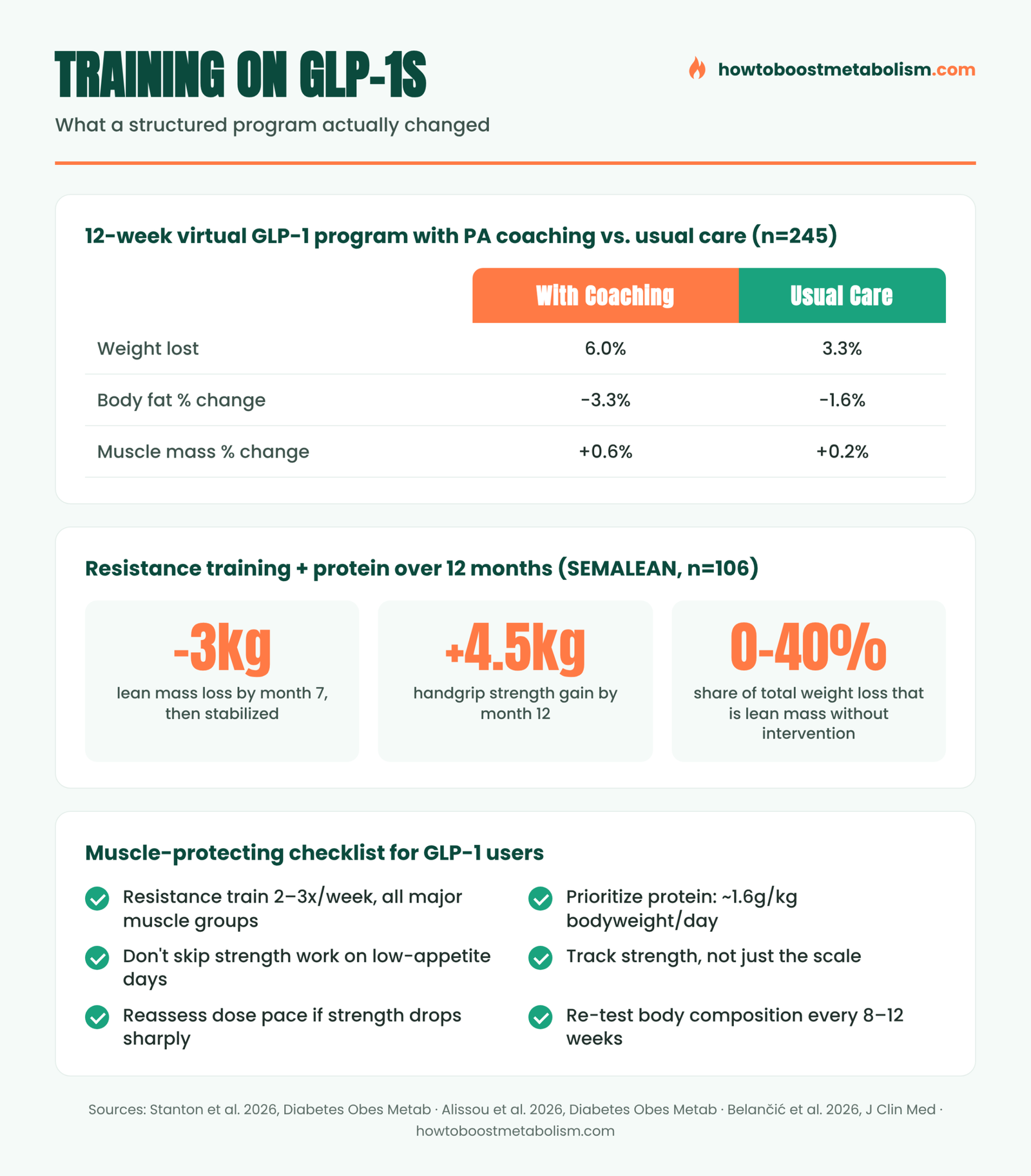
The best direct evidence we found comes from a 2026 quasi-experimental trial (Stanton et al., 2026, Diabetes, Obesity and Metabolism) that followed 245 adults starting GLP-1 therapy. One group (151 people) got a 12-week virtual lifestyle program with personalized, strength-focused physical activity coaching; the other 94 received usual care. Both groups lost weight — but the coached group lost more of it (6.0% of body weight vs. 3.3%), lost more body fat specifically (−3.3 percentage points vs. −1.6), and gained muscle mass percentage instead of losing it (+0.6% vs. +0.2%). That last number is the one that matters most: structured activity coaching didn’t just slow muscle loss, it reversed the direction entirely relative to usual care.
A separate 12-month trial of a resistance-training-plus-protein protocol in people on semaglutide (Alissou et al., 2026, “SEMALEAN”, n=106) found lean mass dropped by about 3kg through month 7 and then stabilized — while handgrip strength, a proxy for functional muscle quality, actually increased by 4.5kg by month 12. Translation: some lean mass loss during the steepest weight-loss phase may be hard to fully prevent, but a structured resistance program can still leave you meaningfully stronger than when you started, even while losing significant weight.
A 2026 narrative review focused specifically on preventing sarcopenia during GLP-1 therapy (Belančić et al., 2026, Journal of Clinical Medicine) lists the same core levers: baseline body-composition assessment, individualized resistance and multicomponent exercise, adequate protein intake, and periodic re-testing of strength and body composition — with extra emphasis on older adults, people with low baseline muscle mass, and anyone losing weight unusually fast.
Free download
🔥 The Metabolism Starter Kit
3 honest guides: a 7-day reset plan, a foods cheat-sheet and 12 metabolism myths debunked. No spam — unsubscribe anytime.
Infographic: Training Changes the Outcome
A Practical Strength Training Plan
Frequency and structure
Aim for 2–3 resistance-training sessions per week, hitting all major muscle groups (legs, back, chest, shoulders, arms, core) across the week rather than isolating one muscle per session. Full-body sessions 2–3x/week work well for most people and are easier to stay consistent with than a 5-day split, especially if appetite suppression is affecting your energy levels on a given day.
Exercise selection
- Compound lifts first: squats, deadlifts or hip hinges, presses, rows — these recruit the most muscle mass per session
- 6–12 reps per set, 2–4 sets, leaving 1–3 reps “in the tank” (not training to complete failure every session)
- Add isolation work (curls, leg extensions, lateral raises) afterward if time and energy allow
- Progressively add weight or reps over time — the stimulus has to increase for muscle to be preserved, not just “moved”
Protein
Target roughly 1.6 g of protein per kg of bodyweight per day, spread across meals — this is the range most muscle-preservation research in calorie-restricted adults converges on. On GLP-1 medication, appetite suppression often makes this the hardest part of the plan, not the training itself; prioritizing a protein source at each meal you do eat, even a small one, matters more than hitting a perfect number every day.
Low-energy days
On days when appetite suppression leaves you genuinely low on energy, don’t skip training entirely — scale it down instead. A lighter session (fewer sets, lighter loads) still sends a muscle-preserving signal that a missed session doesn’t. If you’re consistently too depleted to train at all, that’s worth discussing with your prescribing clinician, since it may be a sign the dose-escalation pace is outrunning your intake.
| Lever | What research supports | Practical target |
| Resistance training frequency | Stanton 2026 (n=245) | 2–3x/week, full body |
| Protein intake | Belančić 2026 review | ~1.6 g/kg bodyweight/day |
| Reassessment | Belančić 2026 review | Body comp + strength every 8–12 weeks |
| Expect some lean-mass loss early | Alissou 2026 (SEMALEAN) | ~3kg by month 7, often stabilizes |
A sample weekly structure
| Day | Focus | Example |
| Monday | Full body, compound-focused | Squat, bench or push-up, row, plank |
| Wednesday | Full body, slightly different angles | Deadlift or hip hinge, overhead press, pulldown, core |
| Friday | Full body + accessories | Lunge, chest press, row, lateral raise, curl |
| Rest of week | Walking, light cardio, recovery | Aim for daily movement without adding training stress |
This is a template, not a prescription — swap exercises for ones you can do with good form and access to equipment, and scale the load, not the frequency, when you need to adjust for a lower-energy week.
Signs You May Need to Adjust the Plan
Watch for warning signs that the calorie deficit is outpacing what your training and protein intake can protect against: strength dropping session over session for 2–3 weeks in a row (rather than plateauing), unusual fatigue that doesn’t improve with rest, or losing weight unusually fast (more than about 1% of bodyweight per week sustained over multiple weeks). Any of these are worth raising with your prescribing clinician — the dose-escalation schedule, not just the training plan, may need adjusting.
Rate of weight loss matters, too
Faster isn’t automatically better. Rapid weight loss — whether from aggressive dieting or a fast dose escalation — tends to pull a larger share of lean mass along with fat, simply because the body doesn’t have time to adapt. If your clinician is open to it and your weight-loss goals allow for it, a somewhat slower, more gradual dose titration paired with consistent training and protein intake is likely to preserve more muscle over the course of treatment than the fastest possible weight-loss trajectory.
Supporting the Plan With Nutrition
A convenient, high-quality protein source makes hitting daily protein targets realistic when appetite is suppressed and large meals feel unappealing.
Creatine monohydrate is also one of the best-studied supplements for supporting strength and lean mass during a resistance-training program — see our full breakdown in what metabolic age really measures for how muscle quality ties into these numbers.
If you want a structured muscle-building framework
For readers who want a full, structured strength program rather than piecing one together, Steve and Becky Holman’s Old School New Body program (F4X method) is built around exactly the kind of short, compound-lift-focused resistance sessions described above, aimed at adults over 40. We should be direct about one thing: the sales page for this program cites statistics about aging and muscle loss that are not independently sourced, and we don’t repeat those numbers here — treat the program as a structured workout framework, not as a source of those specific claims.
See the Old School New Body F4X training method.
Learn More →Affiliate link — we may earn a commission at no extra cost to you. Disclosure
For the dietary side of protecting muscle on GLP-1 medication, see our guides on what to eat on Ozempic and preventing muscle loss on GLP-1 medication, or our broader guide to boosting GLP-1 naturally.
Free download: our Metabolism Starter Kit — a protein calculator, a 7-day meal framework, and a one-page supplement checklist, with zero hype.
Get the Free Starter Kit →Related: If you’re specifically trying to protect lean mass while losing weight on a GLP-1 medication, see whether HMB supplementation actually helps with that goal.
Frequently Asked Questions
Can you strength train while on Ozempic or Wegovy?
Yes, and research suggests you should — a 2026 study found adults doing structured resistance training while on GLP-1 medication gained muscle mass percentage while losing more fat than those receiving usual care without a training program.
How much muscle do you lose on GLP-1 medication?
Reviews of randomized trials estimate lean mass makes up roughly 0% to 40% of total weight lost on GLP-1 therapy, depending on the study and whether resistance training and adequate protein were part of the plan.
How often should I lift weights on Ozempic?
Most of the supporting research used programs of 2–3 resistance-training sessions per week covering all major muscle groups, which is a realistic target even with medication-related appetite suppression.
How much protein do I need while on GLP-1 medication?
A commonly cited target in the muscle-preservation literature is about 1.6 grams of protein per kilogram of bodyweight per day, spread across meals — though appetite suppression often makes this the hardest part to hit consistently.
Will I lose strength even if I train while on GLP-1 medication?
Not necessarily. A 12-month trial combining resistance training and protein in people on semaglutide found handgrip strength actually increased by 4.5kg over the year, even though some lean mass was lost in the first several months.
This article is for informational purposes and is not medical advice. Work with your prescribing clinician on dose pacing, nutrition, and exercise while on GLP-1 medication. See our Medical Disclaimer.