Creatine Gummies vs Powder: Which Works? (2026)
This article may contain affiliate links. If you buy through them, we may earn a small commission at no extra cost to you. See our Affiliate Disclosure and Medical Disclaimer.
Creatine gummies are everywhere in 2026 — no scooping, no gritty aftertaste, no stirring a cloudy glass of water before your workout. The format makes sense as a convenience play. The question that actually matters is whether it delivers the same creatine your muscles use, in the same amount, for a comparable price. We looked at the chemistry and the label math, not just the marketing.
What Creatine Actually Needs to Do Its Job
Creatine works by replenishing phosphocreatine stores in muscle, which helps regenerate ATP during short, high-intensity efforts. The International Society of Sports Nutrition’s position stand (Kreider et al., 2017) confirms that 3–5 g per day of creatine monohydrate is both effective and safe for long-term use. That number is the baseline every format — powder, capsule, or gummy — needs to hit, consistently, to be worth taking.
The Honest Problem With Creatine in a Moist Matrix
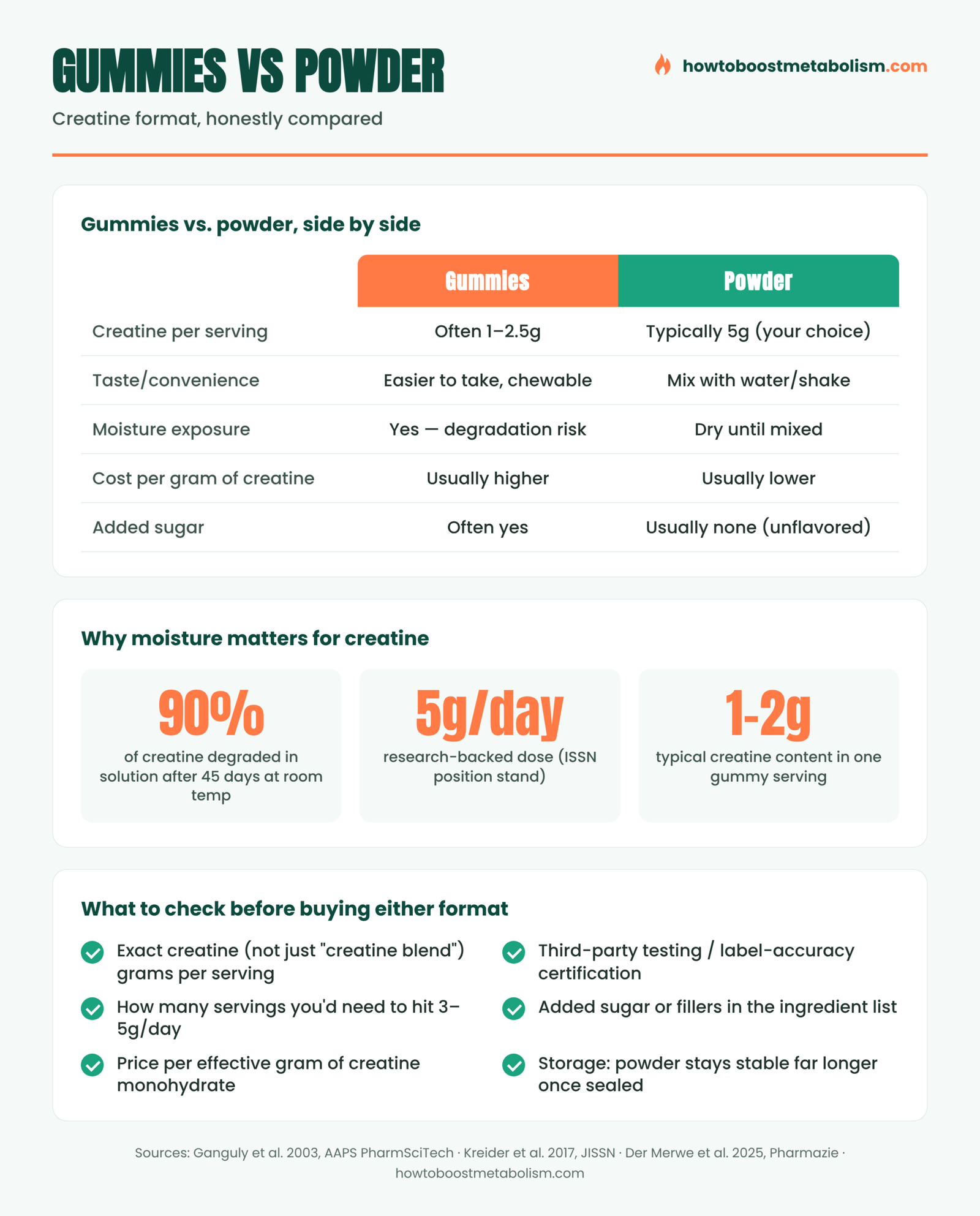
This is the part most gummy marketing pages skip. Creatine is chemically stable as a dry powder, but once it sits in water or any moist environment, it slowly converts to creatinine — a waste product your body simply excretes, with no muscular benefit. A classic stability study (Ganguly, Jayappa & Dash, 2003, AAPS PharmSciTech) dissolved creatine in water and tracked it over 45 days: at room temperature, 90% of the creatine had degraded into creatinine by day 45. Refrigeration slowed but did not stop the process (80% degradation in the same window).
A gummy isn’t a glass of water, and manufacturers who know this chemistry formulate around it — lower water activity, protective coatings, controlled pH, and shorter intended shelf life help limit the degradation. But a gummy’s moist, slightly acidic matrix (most use citric acid for tartness) is still a far less stable environment for creatine than a sealed tub of dry powder. In practice, this shows up as two separate issues: how much creatine actually survives to the point you eat the gummy, and how much of the labeled dose remains if the product sits on a warm shelf for months before you buy it.
Free download
🔥 The Metabolism Starter Kit
3 honest guides: a 7-day reset plan, a foods cheat-sheet and 12 metabolism myths debunked. No spam — unsubscribe anytime.
The Dosing Math Gummies Don’t Advertise Loudly
The bigger practical issue isn’t chemistry — it’s arithmetic. A standard creatine powder serving is 5 g, matching the research dose exactly. Most creatine gummies on the market deliver somewhere between 1 and 2.5 g of creatine per gummy (or per 2–3 gummy serving), because packing more into a chewable without it turning bitter, grainy, or unpleasantly sour is a real formulation constraint. To reach the 3–5 g/day research dose with a typical gummy product, you’d often need to eat 4–8 gummies a day — which usually costs more, and adds meaningfully more sugar, than a single scoop of plain powder.
Label accuracy is its own open question in the supplement industry generally. A 2025 analytical chemistry paper (Der Merwe et al., 2025, Pharmazie) developed a new quantification method specifically because “discrepancies between label claims and actual content have raised concerns about product quality” for creatine and taurine in sports supplements. That concern applies across formats, but it’s worth more scrutiny in a newer, less-standardized format like gummies, where fewer third-party test results are publicly available compared with established powder brands.
| Creatine Gummies | Creatine Monohydrate Powder | |
| Typical creatine/serving | 1–2.5 g | 5 g (full research dose) |
| Servings to hit 5g/day | 2–5 gummies/servings | 1 scoop |
| Degradation risk | Higher (moist matrix) | Low (stays dry until mixed) |
| Added sugar | Common | None (unflavored) |
| Typical cost per 5g dose | Higher | Lower |
Where Capsules Fit Into the Comparison
Capsules are a useful middle ground that most “gummies vs. powder” comparisons skip. A standard creatine capsule holds roughly 0.7–1 g of creatine monohydrate powder in a dry, sealed shell — so it avoids the moisture-degradation issue entirely (the creatine inside stays dry until it dissolves in your stomach), while still requiring 4–5 capsules to hit a full 5 g dose. They cost more per gram than loose powder because you’re paying for the encapsulation, but they solve the taste and portability complaints people have with powder without introducing the degradation risk that comes with gummies. If convenience matters to you but you’re uneasy about the moisture question above, capsules are worth considering as a third option.
The Broader Pattern: Novelty Formats and Supplement Marketing
Creatine gummies are part of a wider 2026 trend of turning plain, cheap, well-studied powders into premium-priced novelty formats — gummies, “fizzy sticks,” flavored liquid shots, and pre-dosed sachets. The pattern is consistent across categories: the active ingredient usually works exactly the same way it always has, the format mostly changes convenience and price, and the marketing copy rarely mentions the per-gram cost difference or the dosing math required to match what plain powder delivers in one scoop. None of that makes a new format a scam — convenience has real value — but it’s worth recognizing when you’re paying a premium for format rather than for a meaningfully different ingredient.
Whichever format you land on, the single most important factor for results is consistency over months, not which delivery mechanism you chose in week one. Creatine’s benefits build gradually as muscle phosphocreatine stores saturate over roughly 2–4 weeks of daily use; switching formats every few weeks chasing the “better” option is more likely to hurt your results than any format-specific downside discussed above.
Our Recommendation, by Use Case
| If you… | Best format | Why |
| Want the cheapest effective dose | Powder | Full 5g/scoop, lowest cost per gram |
| Travel often or dislike mixing drinks | Capsules | Dry storage, no degradation, no taste |
| Struggle with consistency / forget supplements | Gummies | Easiest to remember, treat the dosing math seriously |
| Have kidney disease or take certain medications | None without medical advice | Talk to your doctor regardless of format |
Keep in mind that creatine in any format only pays off when there is resistance training for it to support. Old School New Body is a strength program built for adults over 40 around short full-body sessions and a set progression scheme. Its sales page leans on a few unsourced statistics, so read our full review before you decide.
Infographic: Gummies vs. Powder
A worked example
Say a gummy product lists “2.5g creatine monohydrate per 2 gummies” on the label. To hit a 5g daily dose, you’d need 4 gummies a day — not the 1–2 the front-of-package serving size often implies at a glance. If that product costs, say, $25 for a 30-day supply at the labeled serving size, but you actually need double that serving to match the research dose, your real cost is closer to $50/month for the same creatine a $19 tub of unflavored powder delivers for roughly 90 days. That gap is the part worth checking before you buy — read the supplement facts panel, not just the front label, and do the daily-dose math yourself.
Where Gummies Still Make Sense
None of this makes gummies useless. If the honest alternative is “gummies consistently, every day” versus “powder sometimes, when I remember to pack my shaker,” the gummy wins on adherence — and the research dose only works if you actually take it daily for weeks. For travel, for people who dislike the taste or texture of mixed creatine, or as a backup when you can’t access water and a shaker, gummies are a reasonable compromise, as long as you do the serving-size math and accept the higher cost per effective gram.
Our pick for most people
For anyone optimizing for research-matched dosing and cost, plain creatine monohydrate powder remains the more reliable choice. We’ve used and reviewed California Gold Nutrition’s unflavored creatine monohydrate in our broader coverage of creatine myths — it delivers the full 5g dose per scoop with no sugar or flavoring to interfere with the chemistry.
For more on how creatine behaves in the body, see our breakdown of the creatine water retention myth and our full California Gold creatine review.
Free download: our Metabolism Starter Kit — a protein calculator, a 7-day meal framework, and a one-page supplement checklist, with zero hype.
Get the Free Starter Kit →Related: Before you pick a format, it’s worth knowing whether you need to load creatine at all — the dosing strategy applies to any form you choose.
Frequently Asked Questions
Do creatine gummies actually work?
Creatine gummies can work if you consistently get 3–5g of actual creatine per day from them, which usually means several gummies, not just one. The creatine itself is the same molecule regardless of format — the practical issues are dosing per serving, sugar content, and moisture-related degradation over the product’s shelf life.
Why does moisture matter for creatine?
Creatine slowly converts to creatinine — an inactive waste product — when dissolved in water or exposed to a moist environment over time. A 2003 stability study found 90% of dissolved creatine had degraded within 45 days at room temperature. Dry powder avoids this until the moment you mix it.
How many creatine gummies equal one scoop of powder?
It depends on the brand, but most gummies provide 1–2.5g of creatine each, versus the standard 5g powder scoop. Check the label’s “creatine monohydrate” amount per serving, not just total product weight, and expect to need several gummies to match one scoop.
Are creatine gummies worth the extra cost?
If better adherence means you’ll actually take creatine every day, the convenience may be worth paying more per gram. If you’re comfortable mixing a scoop of powder daily, plain monohydrate powder is more cost-effective and avoids the added sugar most gummies contain.
Is any creatine format bad for you?
Creatine monohydrate — in any well-formulated format — has one of the strongest safety records of any sports supplement, per the ISSN’s position stand, at doses of 3–5g/day for healthy adults. Choose based on dosing accuracy and your budget, not safety concerns.
This article is for informational purposes and is not medical advice. Consult your doctor before starting any new supplement, particularly if you have kidney disease. See our Medical Disclaimer.