Strength Training and Cholesterol After 40: The Data
This article may contain affiliate links. If you buy through them, we may earn a small commission at no extra cost to you. See our Affiliate Disclosure and Medical Disclaimer.
If you’ve heard that lifting weights “fixes” your cholesterol, you’ve heard an oversimplified version of a real finding. Resistance training does measurably improve several lipid markers — but the effect is modest, uneven across different markers, and in at least one analysis, resistance training alone actually lowered HDL (the “good” cholesterol) slightly rather than raising it. Here’s what the largest and most relevant studies actually found, without rounding up.
The Biggest Picture: 148 Trials, 8,673 People
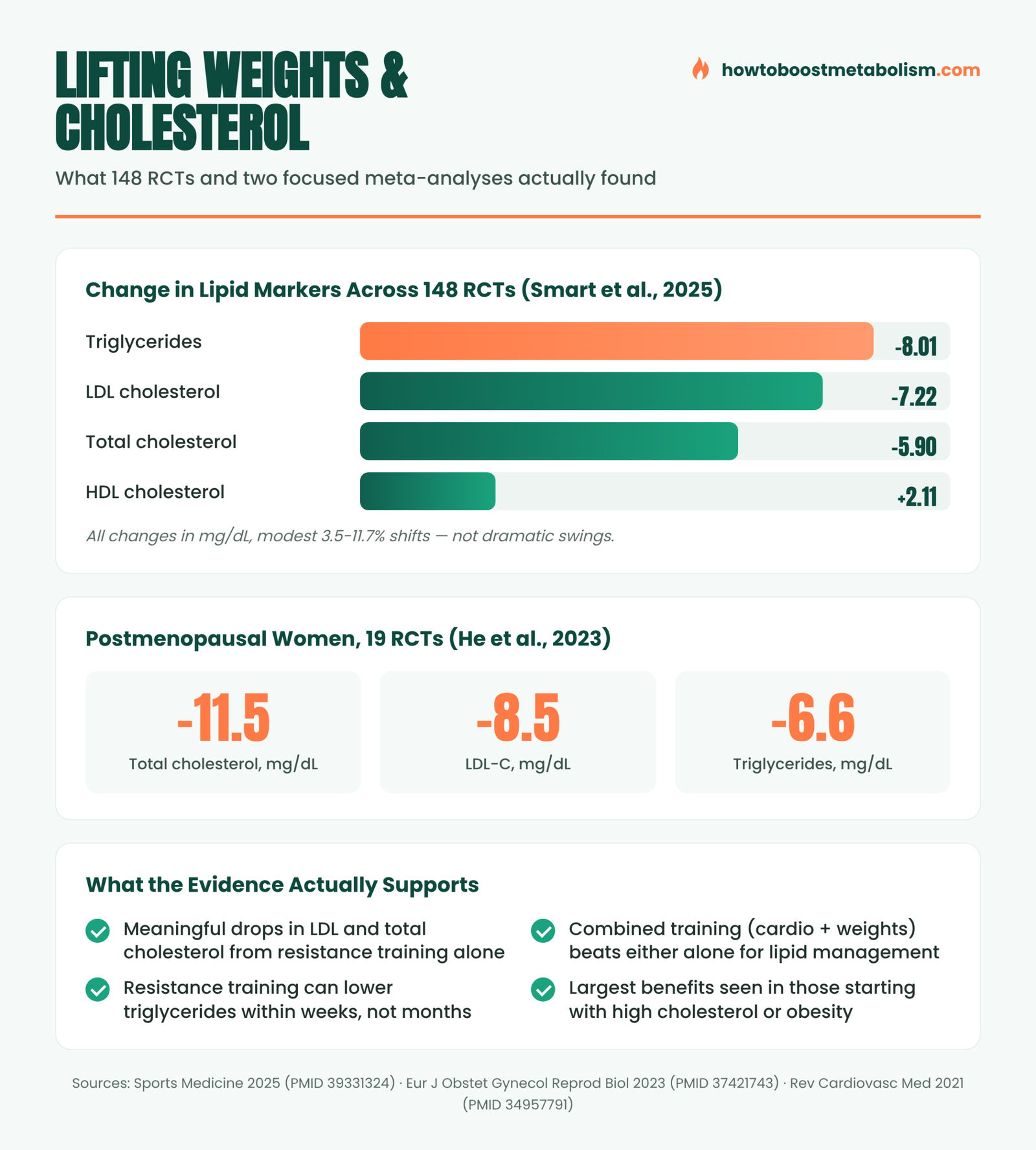
The most comprehensive source we have is a 2025 systematic review and meta-analysis (Smart et al., Sports Medicine) pooling 148 randomized controlled trials and 227 intervention groups — 8,673 participants in total, split between aerobic training (AT), resistance training (RT), and combined training (CT). Across all exercise types combined, the researchers found statistically significant but modest improvements: total cholesterol fell by 5.90 mg/dL, LDL cholesterol by 7.22 mg/dL, triglycerides by 8.01 mg/dL, and VLDL by 3.85 mg/dL, while HDL cholesterol rose by 2.11 mg/dL. Expressed as percentages, these are 3.5% to 11.7% shifts — real, but nowhere near what a cholesterol medication typically achieves.
A trial sequential analysis — a statistical check for whether enough data exists to trust a conclusion — confirmed these five lipid outcomes are backed by sufficient evidence to be considered reliable findings, not statistical flukes. But the same paper’s meta-regression and prediction intervals carry an important caveat: the model suggests total cholesterol, HDL, LDL, and triglycerides are meaningfully improved in roughly only one-quarter of individual studies. In plain terms, this effect is real on average, but it doesn’t show up the same way in every single person or trial.
The paper’s headline practical conclusion: combined training (cardio plus resistance work) was optimal for dyslipidemia management — not resistance training alone, and not cardio alone.
Resistance Training Alone, Specifically in Women Over 40
Because the 148-trial analysis blends ages, sexes, and training types, a narrower 2023 meta-analysis (He et al., European Journal of Obstetrics, Gynecology, and Reproductive Biology) is more directly useful for this site’s audience: 19 randomized controlled trials isolating resistance training specifically in postmenopausal women. The pooled results showed resistance training reduced total cholesterol by a weighted mean difference of 11.47 mg/dL, LDL cholesterol by 8.48 mg/dL, and triglycerides by 6.61 mg/dL — all larger average effects than the mixed-population analysis above, concentrated in a population that frequently sees lipid profiles worsen around menopause.
Subgroup analysis found the biggest cholesterol drops in women who started with hypercholesterolemia (total cholesterol fell 12.36 mg/dL) or obesity (19.35 mg/dL), and in shorter trials under 16 weeks — suggesting an initial, front-loaded improvement rather than one that keeps compounding indefinitely.
The Part That Doesn’t Fit the Marketing: HDL Went Down
Here’s the honest complication. In this same analysis, resistance training reduced HDL cholesterol by a weighted mean of 2.97 mg/dL — the opposite of what you’d want, since higher HDL is generally considered protective. This HDL reduction was specifically observed in women with obesity. The authors describe the overall impact of resistance training on HDL as “small,” but it’s a useful reminder that resistance training is not a universal lipid-improvement tool — it’s selectively good at lowering LDL, total cholesterol, and triglycerides, and comparatively weak (or even counterproductive in some subgroups) for raising HDL.
Free download
🔥 The Metabolism Starter Kit
3 honest guides: a 7-day reset plan, a foods cheat-sheet and 12 metabolism myths debunked. No spam — unsubscribe anytime.
So Which Exercise Mode Actually Raises HDL?
A separate 2021 network meta-analysis (Liang et al., Reviews in Cardiovascular Medicine) comparing aerobic, resistance, and combined exercise across 15 RCTs found a pattern that explains the HDL gap: aerobic exercise was the most effective mode specifically for raising HDL-C and improving BMI, while resistance exercise was the most effective mode for improving body fat, LDL-C, and systolic blood pressure. The analysis found no statistically significant difference between exercise groups for weight, waist circumference, HDL-C, LDL-C, total cholesterol, insulin, or blood pressure when looking at direct pairwise comparisons — combined exercise came out ahead as the single best option across the most outcomes, including glucose, triglycerides, and total cholesterol.
Put the three analyses together and a consistent, honest picture emerges: resistance training is a legitimate, evidence-backed tool for improving LDL cholesterol, total cholesterol, and triglycerides — especially in people who start with elevated numbers — but if raising HDL specifically is your goal, aerobic exercise does that job better on its own, and a combination of both outperforms either alone.
| Marker | Typical change | What it means |
|---|---|---|
| Total cholesterol | ↓ 5.9-11.5 mg/dL | Resistance training works; combined training works better |
| LDL (“bad”) | ↓ 7.2-8.5 mg/dL | One of resistance training’s strongest lipid effects |
| Triglycerides | ↓ 6.6-8.0 mg/dL | Can drop within weeks, especially in short trials |
| HDL (“good”) | ↑ 2.1 mg/dL overall, but ↓ in postmenopausal women with obesity | Aerobic exercise is the better tool for raising HDL specifically |
If You’re Already on a Statin
A question that comes up constantly after 40: does resistance training make a prescribed statin unnecessary, or does it interact badly with one? Neither of the meta-analyses discussed above was designed to answer the statin-interaction question directly, so we won’t overstate what they show. What’s well established in the broader medical literature, separate from the trials cited here, is that statins are prescribed based on overall cardiovascular risk, not solely on a single lipid panel number, and exercise-driven improvements of the magnitude reported here (roughly 5-11% shifts) are generally viewed by physicians as a complement to medication, not a basis for discontinuing it without medical supervision. If your cholesterol improves meaningfully after adopting a consistent training program, that’s useful information to bring to a follow-up appointment — it’s not a decision to make unilaterally.
Setting Realistic Expectations for the Timeline
One thing all three analyses have in common: none of them promise instant results, and none of them promise results that hold without continued training. The He et al. subgroup analysis found some of the largest average effects in trials under 16 weeks — but that’s a description of what researchers measured during active, supervised training periods, not evidence that the improvement is permanent once training stops. Lipid metabolism responds to ongoing exercise habits much like cardiovascular fitness does: the adaptation fades over weeks to months of inactivity. Treat a favorable lipid-panel change as a sign your current training and diet pattern is working, not as a one-time fix you can bank and then abandon.
It’s also worth noting what these studies don’t tell us: none of the three analyses isolated the effect of resistance training from simultaneous changes in diet or body weight that often happen when someone starts a new training program. Some portion of the lipid improvement in real-world trials is plausibly attributable to modest weight loss or incidental dietary changes that accompany starting an exercise habit, not to the muscle-building stimulus itself. This doesn’t make the finding less useful — the combined effect of training-plus-lifestyle-change is exactly what you’ll experience in practice — but it’s a reason to avoid over-attributing the entire effect to the mechanical act of lifting a weight.
Exercise moves LDL less than diet does. For the food side of the equation, from cutting saturated fat to oats, psyllium and plant sterols, see our evidence-based guide on how to lower cholesterol naturally.
Who Should Talk to a Doctor Before Relying on This
- Anyone already on cholesterol-lowering medication (statins or otherwise) — exercise is a complement to treatment, not a substitute, and medication changes should never be made without medical guidance.
- Anyone with familial hypercholesterolemia or very high baseline LDL — lifestyle changes alone are typically insufficient for this specific condition.
- Anyone with uncontrolled hypertension or a recent cardiac event — get clearance before starting a new resistance training program, heavy or otherwise.
Does the Type of Resistance Training Matter?
None of the three analyses cited here isolated specific training variables — load, rep range, rest periods, or exercise selection — as predictors of the lipid response. The trials pooled into these meta-analyses used a wide range of protocols, from machine-based circuits to free-weight programs, and the overall effect held up across that variety. This is actually useful information in its own right: it suggests the lipid benefit isn’t narrowly tied to one specific style of resistance training, which means you don’t need a specialized “cholesterol-lowering” program. A consistent, properly progressed resistance training routine covering the major muscle groups — whichever style you’ll actually stick with — appears to be what drives the effect, not any particular set-and-rep scheme.
Triglycerides tend to respond more to cardio, weight loss and diet than to lifting alone. For the full picture, see our evidence-based guide on how to lower triglycerides.
A Practical Way to Apply This
Based on the evidence above, a reasonable approach after 40 is 2-3 resistance training sessions per week covering major muscle groups, plus regular aerobic activity (brisk walking, cycling, or similar) on most other days — mirroring the “combined training” approach that consistently outperformed either method alone across all three analyses cited here. Diet still matters enormously for lipid management; exercise is one lever among several, not a replacement for addressing saturated fat intake or overall dietary pattern.
If you’re starting from zero, there’s no evidence in any of these trials that more is automatically better in a linear way — the Smart et al. meta-regression found diminishing and sometimes inconsistent returns as duration and frequency increased, and the studies showing the largest effects in the He et al. analysis were often under 16 weeks, not the longest trials available. The practical message is to start with a sustainable, moderate frequency you can maintain for months, rather than assuming an aggressive 6-day-a-week program will produce proportionally larger lipid changes.
If you’d rather follow a structured eating pattern alongside your training than guess at dietary changes, The Mediterranean Diet plan is built around the dietary pattern most consistently associated with favorable lipid profiles in long-term research, with a quiz-based entry point to personalize the plan. Note: this program includes a recurring subscription charge after the initial purchase — check the current terms before enrolling.
Learn More →Affiliate link — we may earn a commission at no extra cost to you. Disclosure
Related Reading
For the cardiovascular side of this equation, see our breakdown of strength training and blood pressure after 40. If you’re deciding how to split your week between modes, does cardio cancel out your strength gains? is directly relevant. And for the cardio side of lipid and VO2max improvements specifically, see VO2 max and longevity.
Free download: our Metabolism Starter Kit — a protein calculator, a 7-day meal framework, and a one-page supplement checklist, with zero hype.
Get the Free Starter Kit →Related: For more on the metabolic ripple effects of lifting, see what resistance training does to your gut microbiome after 40.
Frequently Asked Questions
Can strength training replace cholesterol medication?
No. The improvements documented in these studies (roughly 5-11% shifts in various lipid markers) are real but far more modest than what prescription medication typically achieves. Exercise is a legitimate complement to medical treatment, never a substitute — don’t stop or adjust medication without talking to your doctor.
Why did resistance training lower HDL in one study?
In the He et al. 2023 meta-analysis of postmenopausal women, resistance training reduced HDL by a small average amount (2.97 mg/dL), particularly in women with obesity. The exact mechanism isn’t fully settled, but it highlights that resistance training’s lipid benefits are concentrated in LDL, total cholesterol, and triglycerides rather than HDL specifically.
Should I do cardio or weights for my cholesterol?
Based on the available network meta-analysis, aerobic exercise is more effective specifically for raising HDL, while resistance training is more effective for lowering LDL and body fat. Combined training outperformed either single mode across the most outcomes in a 2025 meta-analysis of 148 trials.
How soon will my lipid panel change after starting strength training?
The He et al. meta-analysis found some of the largest average effects in trials lasting under 16 weeks, suggesting meaningful change can appear within a few months of consistent training — though individual results vary substantially.
Does it matter how much weight I’m lifting?
The studies cited here used varying resistance-training protocols rather than isolating a single load or volume prescription, so we can’t point to one specific “dose” for lipid improvement. Consistency across 2-3 sessions per week covering major muscle groups is the common thread across the trials included in these analyses.