Kettlebell Training After 40: What the Research Shows
This article may contain affiliate links. If you buy through them, we may earn a small commission at no extra cost to you. See our Affiliate Disclosure and Medical Disclaimer.
Kettlebells have a marketing problem. Scroll social media and you’ll see claims that a single 20-minute kettlebell session “melts” more fat than an hour on a treadmill, or that swings alone can rebuild the strength you lost in your 30s. Neither claim holds up well under scrutiny. But that doesn’t mean kettlebells are useless after 40 — the actual research on kettlebell training, including a trial designed specifically for older, insufficiently active adults, shows real and measurable benefits. They’re just more modest, and more conditional, than the marketing suggests.
What Kettlebell Training Actually Is
A kettlebell is a cast-iron or steel weight shaped like a ball with a handle, used for ballistic, momentum-driven movements (swings, snatches, cleans) as well as more controlled strength work (goblet squats, Turkish get-ups, presses). The ballistic lifts are what set kettlebell training apart from standard dumbbell or barbell work: they combine a strength demand with a cardiovascular one, which is part of why the format gets marketed as an “all-in-one” workout.
That dual demand is also exactly why kettlebell technique matters more after 40 than it did at 25. The hip-hinge pattern that powers a proper swing is unforgiving of poor form, and a rushed introduction to heavy ballistic swinging is a common way people acquire a low-back flare-up that has nothing to do with the kettlebell itself and everything to do with skipping the technique step.
The Best Direct Evidence: The BELL Trial
Most kettlebell research is done on young, already-fit populations — collegiate athletes, CrossFit competitors, military recruits — which tells you very little about what happens to a 55-year-old who hasn’t lifted anything heavier than groceries in a decade. The most relevant study we have is the BELL trial (Meigh et al., 2022, BMC Geriatrics), a pragmatic controlled trial that recruited 32 insufficiently active men and women aged 59 to 79 and put them through 3 months of progressive, supervised hardstyle kettlebell training after a 3-month baseline period of their usual activity.
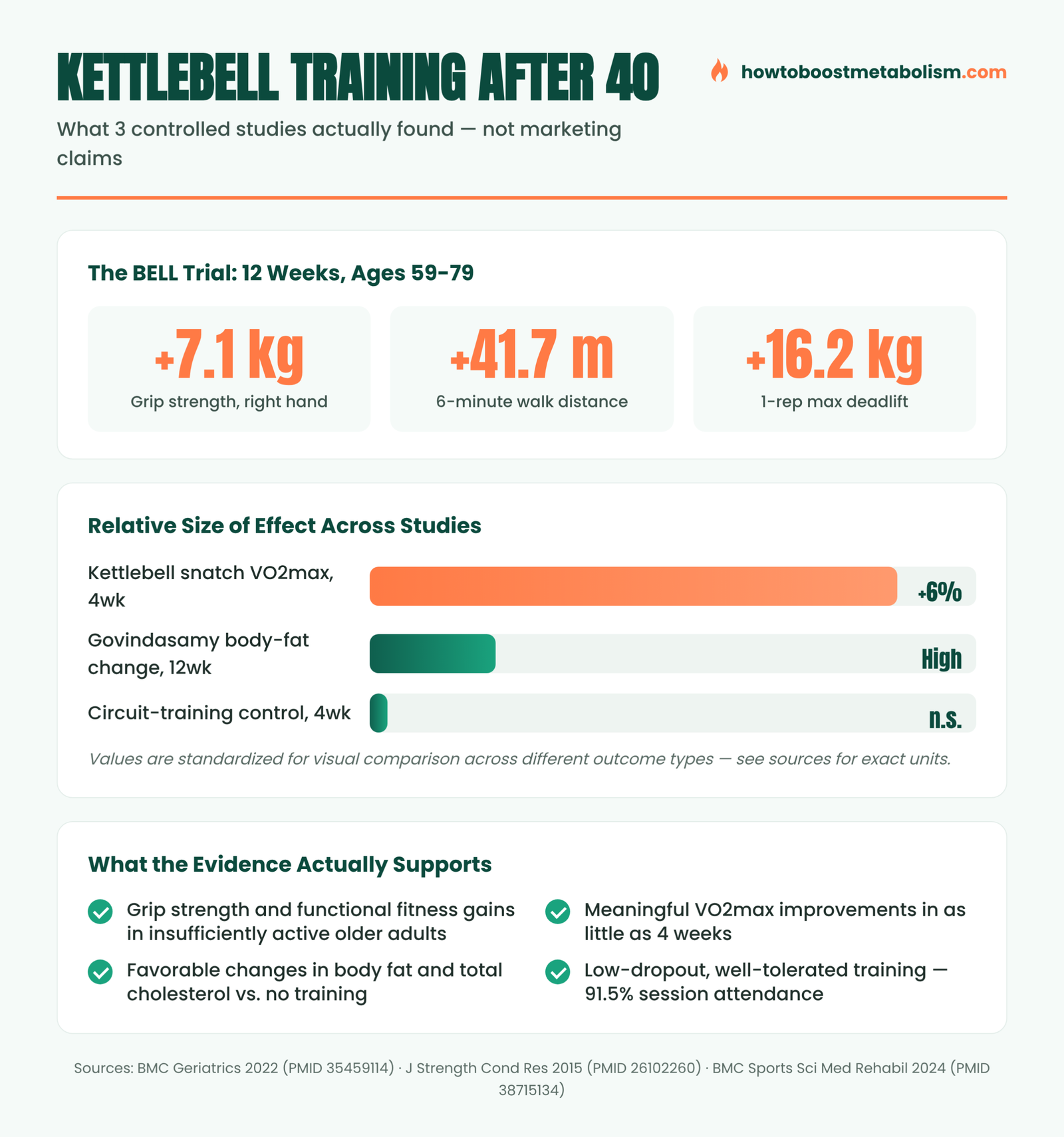
The results, compared to each participant’s own baseline period, were consistent across almost every measure: grip strength improved by a mean of 7.1 kg on the right hand and 6.3 kg on the left; six-minute walk distance improved by 41.7 meters; one-rep-max deadlift rose by 16.2 kg; 30-second sit-to-stand performance improved by 3.3 reps; and resting heart rate dropped by 7.4 beats per minute. Appendicular skeletal lean mass, measured by DXA scan, increased by 0.65 kg. Adherence to the supervised sessions was 91.5%, and there were four non-serious adverse events across the entire trial — no serious injuries reported.
That combination — real strength and functional gains, in a genuinely sedentary older population, with high adherence and a clean safety record under supervision — is the strongest single piece of evidence that kettlebell training is a reasonable, evidence-backed option after 40. It is also, importantly, a single trial with 32 participants and no separate control group trained a different way during the intervention phase, so treat the exact numbers as a reasonable estimate, not a guarantee.
Free download
🔥 The Metabolism Starter Kit
3 honest guides: a 7-day reset plan, a foods cheat-sheet and 12 metabolism myths debunked. No spam — unsubscribe anytime.
The Cardio Claim: Does It Hold Up?
A smaller, older study — Falatic et al., 2015, Journal of Strength and Conditioning Research — tested whether kettlebell snatches could substitute for traditional cardio. Seventeen female collegiate soccer players trained 3 days a week for 4 weeks, split between a kettlebell-snatch interval protocol (15 seconds of work, 15 seconds of rest, for 20 minutes) and a circuit weight-training control group. VO2max rose by an average of 2.3 ml/kg/min — roughly a 6% gain — in the kettlebell group, with no significant change in the control group.
That’s a real effect, but the population (young, already-trained athletes) and duration (4 weeks) make it a poor stand-in for “kettlebells replace cardio for a deconditioned 45-year-old.” It shows that high-intensity kettlebell intervals can drive a measurable aerobic adaptation quickly in people who can already tolerate that intensity — not that they’re the optimal cardio choice for everyone after 40.
Kettlebells vs. Bodyweight Training: A More Useful Comparison
A 2024 randomized controlled trial (Govindasamy et al., BMC Sports Science, Medicine and Rehabilitation) directly compared 12 weeks of kettlebell resistance training against bodyweight resistance training in 60 sedentary, obese young men, against a no-training control group. Both intervention groups saw significant, similarly large reductions in body fat (effect sizes of 1.43 for kettlebells and 1.53 for bodyweight training) and significant increases in VO2max. Both groups also saw reductions in total cholesterol and LDL cholesterol compared to the control group.
The honest takeaway from this trial isn’t “kettlebells are superior” — it’s that kettlebells and bodyweight training produced statistically indistinguishable improvements in body composition and fitness. If you dislike bodyweight circuits and enjoy kettlebell work (or vice versa), the research gives you permission to pick whichever one you’ll actually stick with.
Who Should Use Caution
- Shoulder issues: overhead kettlebell presses and snatches load the shoulder in a position many people with existing impingement or rotator cuff irritation should avoid or modify.
- Low back history: the hip-hinge pattern under a ballistic swing is technique-sensitive; if you’ve had disc issues, get the movement pattern checked by a coach or physical therapist before adding load or speed.
- Uncontrolled high blood pressure: ballistic, high-intensity intervals briefly spike heart rate and blood pressure; check with your physician first if you have a cardiovascular condition.
- Complete beginners to hip-hinging: one or two sessions with a qualified instructor to groove the swing pattern is a small investment that meaningfully lowers injury risk.
A Sensible Way to Start
None of the three studies above used wildly heavy kettlebells. The BELL trial progressed load gradually over 12 weeks under supervision; the obesity trial used a 12-week progressive program with set volumes tailored to the individual. A reasonable starting template after 40, once your hip-hinge technique is solid:
- 2-3 sessions per week, non-consecutive days
- Start with goblet squats, deadlifts, and controlled (not maximal-speed) swings before adding snatches or presses
- Pick a kettlebell light enough that your last rep of a set looks like your first — fatigue breaks down swing technique fast
- Progress load or volume by roughly 5-10% every 1-2 weeks, not session to session
| Study & population | What changed |
|---|---|
| BELL trial (older, inactive adults, 12wk) | Grip +7.1kg, 1RM deadlift +16.2kg, 6MWD +41.7m, low dropout |
| Falatic 2015 (young athletes, 4wk) | VO2max +6% with high-intensity snatch intervals |
| Govindasamy 2024 (obese young men, 12wk) | Body fat ↓, VO2max ↑, TC and LDL ↓ — matched by bodyweight training |
The Technique Mistakes That Cause Most Injuries
None of the three studies above reported serious injuries, which is a point in kettlebell training’s favor — but it’s worth being specific about why, because the “why” is the part people skip when they learn from a video instead of a coach. The hardstyle swing used in the BELL trial is a hip-hinge movement: the power comes from forcefully extending the hips, not from squatting down and standing up, and not from using the arms or lower back to muscle the weight upward. The three most common mistakes that turn a safe exercise into a back-pain generator are squatting the swing instead of hinging, “catching” the kettlebell with rounded shoulders and a rounded lower back at the top of a swing or snatch, and simply using too much weight before the hinge pattern is automatic. All three are coachable in a single session, which is exactly why a short investment in instruction pays off disproportionately relative to its cost.
A useful self-check: if you can do 10 kettlebell deadlifts (no swing, just standing up and down with the weight) with a flat, neutral spine and your hips clearly doing the work, you’re probably ready to add the ballistic swing. If your lower back rounds on a simple deadlift, that’s the skill to fix first — with a lighter kettlebell or no load at all — before adding speed or momentum.
How Kettlebells Compare to Other Tools for a Metabolism-Focused Goal
If the goal driving your interest in kettlebells is metabolic — fat loss, better insulin sensitivity, general “boost my metabolism” outcomes — it’s worth being clear-eyed about what kettlebells add beyond standard resistance training. The Govindasamy 2024 trial found kettlebell training and bodyweight resistance training produced statistically similar improvements in body fat and VO2max. Kettlebells are not metabolically superior to other forms of resistance training in the evidence we have; their main practical advantage is combining strength and conditioning work in less total time, and giving some people more variety and enjoyment than a standard barbell or machine-based routine — which matters enormously for long-term adherence, even though it isn’t a separate physiological mechanism.
In other words: if you already enjoy and stick with free weights, dumbbells, or resistance bands, there’s no strong evidence you need to add kettlebells specifically. If you’ve struggled to stay consistent with traditional gym routines and the ballistic, varied nature of kettlebell training sounds appealing, the research above supports it as a safe and effective option after 40 — provided the technique groundwork described above is in place first.
Pairing Kettlebell Training With a Structured Program
If you’d rather follow a structured, age-appropriate strength template than design your own kettlebell progression from scratch, Old School New Body lays out a specific F4X training framework built around adults training in their 40s and beyond, with clear progression rules you can apply to kettlebell work or standard free weights. (Note: some marketing claims on the sales page about age-related muscle loss rates are not independently sourced — judge the program on its training structure, not those numbers.)
Check Availability →Affiliate link — we may earn a commission at no extra cost to you. Disclosure
Related Reading
If grip strength is a priority, our deep dive on grip strength as a longevity marker covers more direct training methods. If you’re unsure whether single-leg kettlebell work belongs in your routine, see our guide to unilateral training after 40. And if you’re building a home setup rather than relying on a gym’s kettlebell rack, our budget home gym guide covers what’s actually worth buying first.
Free download: our Metabolism Starter Kit — a protein calculator, a 7-day meal framework, and a one-page supplement checklist, with zero hype.
Get the Free Starter Kit →Related: Ready to buy your first bell? Our buying guide compares cast iron, powder coat, vinyl, competition and adjustable models and explains what weight to start with: Best Kettlebells for Over 40 (2026 Guide).
Frequently Asked Questions
Can kettlebell training alone build noticeable muscle after 40?
It can contribute to measurable strength and lean-mass gains, as shown in the BELL trial, but most research uses kettlebells as part of a broader program rather than as the sole training tool. Treat kettlebells as one effective option among several, not a replacement for progressive overload principles.
Is kettlebell training safe if I’ve never lifted weights before?
The BELL trial specifically recruited insufficiently active older adults and saw a strong safety record under supervision — but that supervision matters. If you’re new to both weight training and hip-hinge movement patterns, a session or two with a qualified instructor before training alone meaningfully reduces injury risk.
Do kettlebells really replace cardio?
High-intensity kettlebell interval work can produce a real VO2max improvement, as shown in young athletes over 4 weeks. Whether that generalizes to replacing dedicated cardio for your specific goals depends on intensity, frequency, and your starting fitness level — it’s a reasonable supplement, not a guaranteed substitute.
What’s a safe starting weight for someone over 40?
There’s no single right number — it depends on your training history. A practical test: choose a weight light enough that you can perform a controlled swing or goblet squat for 10-12 reps with textbook form on your last rep, not just your first.
How quickly can I expect to see results?
The BELL trial saw measurable strength and functional improvements within 12 weeks in previously inactive older adults, and the aerobic-capacity study saw a VO2max change in 4 weeks in younger athletes. Expect meaningful, measurable change on a similar timeline if you train consistently — not within days.