Glute Bridge vs. Hip Thrust After 40: What EMG Shows
This article may contain affiliate links. If you buy through them, we may earn a small commission at no extra cost to you. See our Affiliate Disclosure and Medical Disclaimer.
Walk into any commercial gym after 7 a.m. and you’ll see the same argument playing out in slow motion: one person loading a barbell across their hips for a hip thrust, another lying flat on the floor doing a glute bridge with nothing but body weight or a light dumbbell. Fitness forums treat this like a rivalry with a clear winner. The actual electromyography (EMG) research is more useful than that — and more interesting, because the two exercises don’t do quite the same job.
If you’re past 40 and trying to build or simply keep glute and hip-extensor strength (which matters for gait, stair climbing, and reducing fall risk, not just aesthetics), the real question isn’t “which exercise is better” — it’s which one fits your equipment, your joints, and your week. Here’s what the comparative EMG data, a systematic review of 16 hip-extension exercises, and a 2025 hypertrophy meta-analysis actually say, instead of what a 30-second reel claims.
What Each Exercise Actually Is
Both movements train hip extension — driving the hips forward against resistance — and both put the gluteus maximus in a biomechanically efficient position to do that work. The difference is almost entirely about the base of support and the range of motion available at the top.
Barbell Hip Thrust (BHT)
Upper back braced against a bench, feet flat on the floor, a loaded barbell (usually padded) resting across the hip crease. You drive through the heels until the hips are fully extended and the torso is roughly parallel to the floor, then lower under control. Because the shoulders are elevated on a bench, the hips can travel through a larger range of motion than a floor-based version allows.
Barbell Glute Bridge (BGB)
Same loading pattern, but the entire back is on the floor rather than elevated on a bench. The movement path is shorter — the hips can only travel from the floor to full extension, not below parallel the way a hip thrust can — but the exercise needs less equipment and arguably has a gentler learning curve for a first-timer figuring out how to brace a bar across their hips.
What a Direct EMG Comparison Found
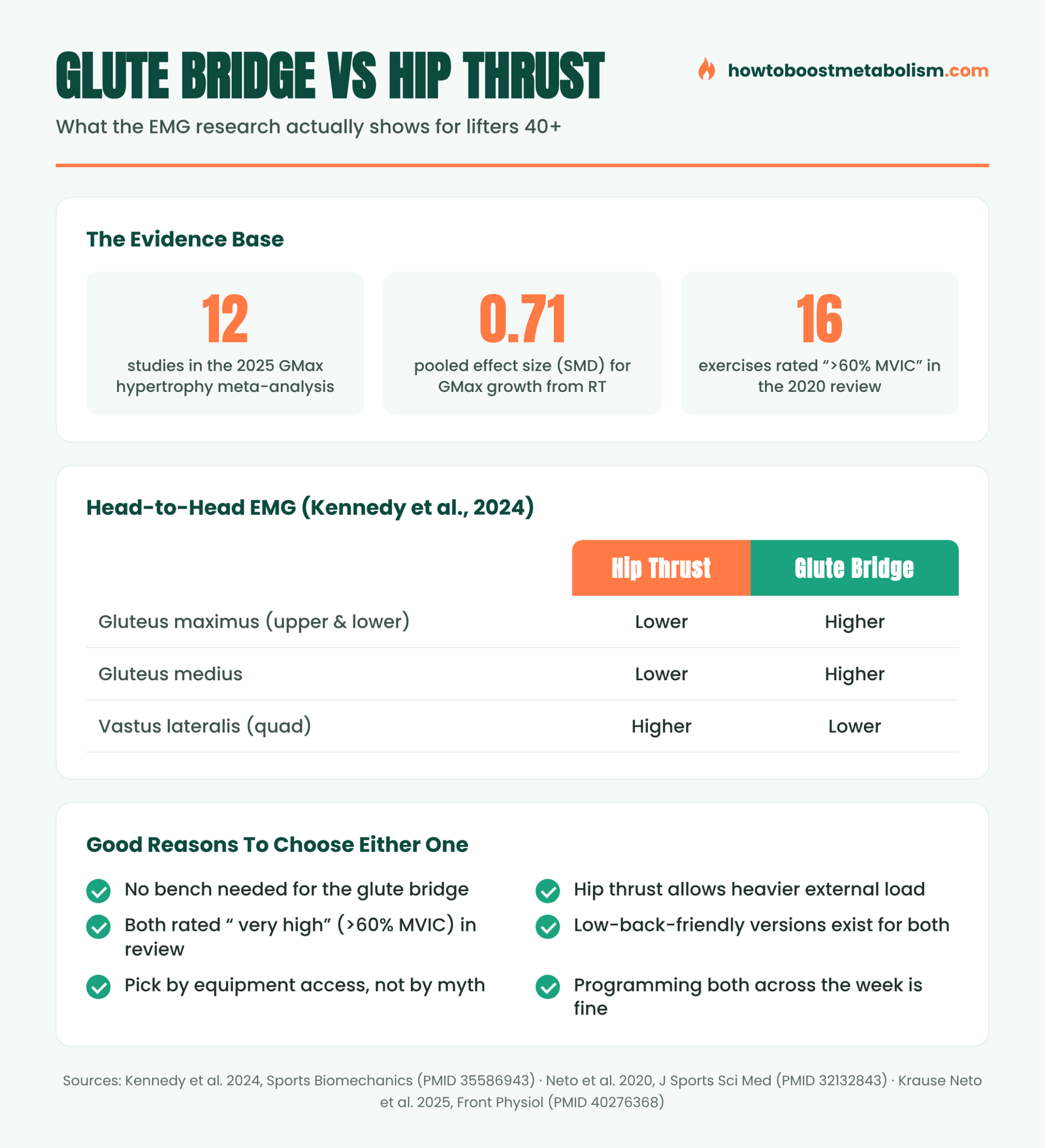
A 2024 study in Sports Biomechanics (PMID 35586943) was the first to put the two exercises head-to-head using surface EMG, specifically to settle whether one produces meaningfully more muscle activity in the hip extensors. Ten participants performed both lifts, and the researchers measured activity in the gluteus maximus (upper and lower portions), gluteus medius, biceps femoris, and vastus lateralis (a quad muscle).
The result split cleanly by muscle group, and it did not favor the exercise most people assume is “harder”. The hip thrust produced significantly greater activity in the vastus lateralis (a quad muscle, not a glute) — unsurprising, since the larger range of motion at the bottom of a hip thrust asks the knee extensors to contribute more. But the glute bridge produced significantly greater peak and mean activity in the upper and lower gluteus maximus, and greater mean activity in the gluteus medius. The authors’ own conclusion was direct: the glute bridge is, at minimum, “a superior substitute for the barbell hip thrust for eliciting a larger magnitude of activity in the gluteus maximus.”
That’s worth sitting with, because it runs against the common assumption that the hip thrust — marketed for over a decade as the definitive glute-builder — automatically out-activates a “simpler” floor exercise. The honest caveat: this was a single study of ten men, measuring muscle activity rather than long-term hypertrophy outcomes directly, and EMG amplitude is a proxy for motor unit recruitment, not a guarantee of equivalent muscle growth over months of training.
Free download
🔥 The Metabolism Starter Kit
3 honest guides: a 7-day reset plan, a foods cheat-sheet and 12 metabolism myths debunked. No spam — unsubscribe anytime.
Where Both Exercises Rank Against Everything Else
Activation numbers mean more in context. A 2020 systematic review in the Journal of Sports Science & Medicine (PMID 32132843) pooled 16 articles measuring gluteus maximus activation (as a percentage of maximal voluntary isometric contraction, or MVIC) across loaded hip-extension exercises. Both the traditional barbell hip thrust and band hip thrust landed in the review’s “very high activation” bucket (over 60% MVIC), alongside step-ups, hex-bar deadlifts, split squats, and conventional deadlifts. The glute bridge wasn’t separately ranked in that particular review, but the 2024 head-to-head study above puts its activation at or above the hip thrust’s, which is consistent with it belonging in the same high-activation tier.
The practical takeaway from that review isn’t “pick the single best exercise” — it’s that a fairly long list of common strength exercises already does the job well. Step-ups and their variations actually topped the list for raw activation, which is a useful reminder that hip thrust and glute bridge are good tools, not the only tools.
Does Higher Activation Actually Mean More Muscle Growth?
Not automatically — EMG is a reasonable but imperfect stand-in for hypertrophy. A 2025 systematic review and meta-analysis in Frontiers in Physiology (PMID 40276368) looked at actual measured gluteus maximus hypertrophy (not just EMG) after resistance training programs. Across 11 studies, resistance training produced a moderate effect on GMax growth (SMD 0.71, 95% CI 0.50–0.91). When the review’s authors specifically asked which single exercise to prioritize if GMax growth is the main goal, their answer was the barbell hip thrust — while also noting that back squats in a full or parallel range of motion, leg press, and kneeling hip extensions all contribute meaningfully, and that combining multiple hip-extension exercises in one program works at least as well as any single movement.
So the two bodies of evidence aren’t actually contradicting each other: the 2024 EMG study found the glute bridge wins on acute muscle activation, while the 2025 hypertrophy review — pooling exercises that mostly weren’t tested against each other directly — still points to the hip thrust as a strong default when loading capacity matters. Neither finding makes the other exercise pointless.
| Hip Thrust | Glute Bridge | |
|---|---|---|
| Equipment needed | Bench + loaded barbell + pad | Loaded barbell + pad (floor only) |
| Learning curve | Moderate — bench setup takes practice | Easier for most first-timers |
| GMax activation (2024 EMG study) | Lower than glute bridge | Higher than hip thrust |
| Quad (vastus lateralis) involvement | Higher | Lower |
| Loadable range of motion | Larger (below-parallel start) | Shorter (floor to lockout) |
| Best when | You want heavier external load over time | You want a simpler, floor-based option |
Which One Should You Actually Pick After 40?
If you’ve read our breakdown of hip thrust vs. squat after 40, you already know hip extension work earns its place alongside squats rather than replacing them. The glute bridge vs. hip thrust decision is a layer underneath that: it’s mostly about access and joints, not about which exercise is objectively superior.
- Limited equipment or a home setup: the glute bridge needs a bar, a pad, and floor space — no bench required. It’s also easier to self-spot since you’re never elevated.
- Training around a cranky lower back: the shorter range of motion in the glute bridge means less lumbar flexion risk for people who round their back trying to reach full hip extension from an elevated position. If you’ve dealt with low-back flare-ups, our guide to strength training with low back pain after 40 covers bracing cues that apply to both exercises.
- Chasing a heavier number on the bar over time: the hip thrust’s longer range of motion and bench support make it easier to progressively overload — see our notes on progressive overload after 40 for how to do that without rushing load increases.
- Knee sensitivity: since the hip thrust recruits more vastus lateralis (quad), someone managing knee irritation from squatting volume may prefer the glute bridge as their primary hip-extension movement on a given day.
- No clear preference either way: program both across a training block. There’s no rule that says you have to choose exactly one for the rest of your life.
Both exercises work best as part of a programmed plan, not a random exercise swap every session. Anabolic Fasting is a structured fasting-plus-training program built around getting more out of the sessions you’re already doing — it’s worth a look if you want a framework rather than another isolated exercise tip.
Check Availability →Affiliate link — we may earn a commission at no extra cost to you. Disclosure
A note on that program: its marketing language about building muscle and losing fat “simultaneously” is a marketing claim, not a guarantee — body recomposition is real but highly individual, and results depend on consistency, training history, and diet adherence, not the program alone.
Common Form Mistakes We See After 40
- Hyperextending the lower back at the top. The goal is full hip extension with a slight posterior pelvic tilt, not an arched lumbar spine. Squeeze the glutes at the top rather than “leaning back” into the position.
- Letting the bar roll during a hip thrust. A thicker pad and a deliberate, braced setup matter more as load increases — a bar that shifts mid-rep is a common reason people quietly stop progressing.
- Chin jutting forward. Keep a neutral neck position (imagine holding a small object under your chin) through both lifts; this is a small cue with an outsized effect on avoiding neck strain.
- Flaring the ribs up at lockout. This is the same lumbar-extension problem as #1 in disguise — exhale and brace through the top rather than pushing the ribs skyward.
- Skipping a deload entirely once the exercise finally feels “easy.” Both lifts respond well to periodized loading — our guide on deload weeks after 40 explains when to back off on purpose.
A Simple Way to Program Both in One Week
You don’t need to pick a permanent winner. A common, sustainable approach for someone training hips and glutes two to three times a week:
| Session | Movement | Focus |
|---|---|---|
| Day 1 | Barbell hip thrust | Heavier load, 3–4 sets of 6–10 reps |
| Day 2 (optional) | Barbell or banded glute bridge | Lighter load, 2–3 sets of 10–15 reps, higher activation focus |
| Day 3 | Squat or deadlift variation | Compound lower-body day; glutes work as a secondary mover |
This isn’t the only valid split — it’s simply one way to get the heavier-loading benefit of the hip thrust and the higher acute activation of the glute bridge inside the same week, without turning either exercise into a daily grind.
Free download: our Metabolism Starter Kit — a protein calculator, a 7-day meal framework, and a one-page supplement checklist, with zero hype.
Get the Free Starter Kit →Frequently Asked Questions
Is the glute bridge really better than the hip thrust for glute growth?
The strongest direct EMG comparison available found the glute bridge produced greater gluteus maximus and gluteus medius activation than the hip thrust, in a small study of ten men. That doesn’t settle the hypertrophy question on its own — a separate 2025 meta-analysis of actual muscle growth still named the hip thrust as a strong single-exercise choice. The honest summary: both are very effective, and the gap between them is smaller than fitness content usually implies.
Which one is safer for a bad lower back?
Neither is inherently unsafe when performed with a neutral spine, but the glute bridge’s shorter range of motion (floor to lockout, rather than starting below parallel on a bench) tends to be more forgiving for people who round their lower back trying to reach full extension from an elevated position. Work with a physical therapist or qualified coach if you have a diagnosed back condition.
Can beginners over 40 start with either exercise using just body weight?
Yes. Both exercises scale down cleanly to body weight or a light dumbbell across the hips before any barbell is involved. Mastering the hip-hinge pattern and avoiding lumbar hyperextension matters more at this stage than how much weight is on the bar.
How much weight should I expect to lift on a hip thrust compared to a squat?
Hip thrust loads are often higher than squat loads for the same person, because the exercise removes balance and bracing demands that limit squat load, and the horizontal pressing angle is mechanically favorable for the hip extensors. Comparing hip thrust numbers to squat numbers isn’t a useful benchmark.
Do I need to do both exercises, or is picking one enough?
Picking one is enough if equipment, joint history, or simple preference points clearly to it. The research doesn’t suggest you’re leaving significant gains on the table by sticking with a single well-executed hip-extension exercise as part of a broader, well-rounded program.
Related comparisons: hip thrust vs. squat after 40, front squat vs. back squat after 40, and sumo vs. conventional deadlift after 40.
This article is for educational purposes and is not a substitute for individualized medical or physical therapy advice. See our full medical disclaimer. If you have an existing hip, knee, or spine condition, check with a qualified professional before adding either exercise to your routine.