Does Zinc Deficiency Slow Your Metabolism?
This article may contain affiliate links. If you buy through them, we may earn a small commission at no extra cost to you. See our Affiliate Disclosure and Medical Disclaimer.
Zinc has a reputation problem. Supplement marketing has quietly folded it into the “metabolism booster” category alongside green tea extract and L-carnitine, implying it helps melt fat or speed up calorie burning. The actual research tells a more specific, more useful story — zinc does real metabolic work, but not the kind most people are hoping for when they add it to a weight-loss stack.
Three separate meta-analyses, pooling more than 80 randomized controlled trials between them, give a consistent and refreshingly clear-cut picture of what zinc supplementation actually changes — and what it doesn’t.
Where Zinc Actually Shows a Meaningful Effect: Blood Sugar
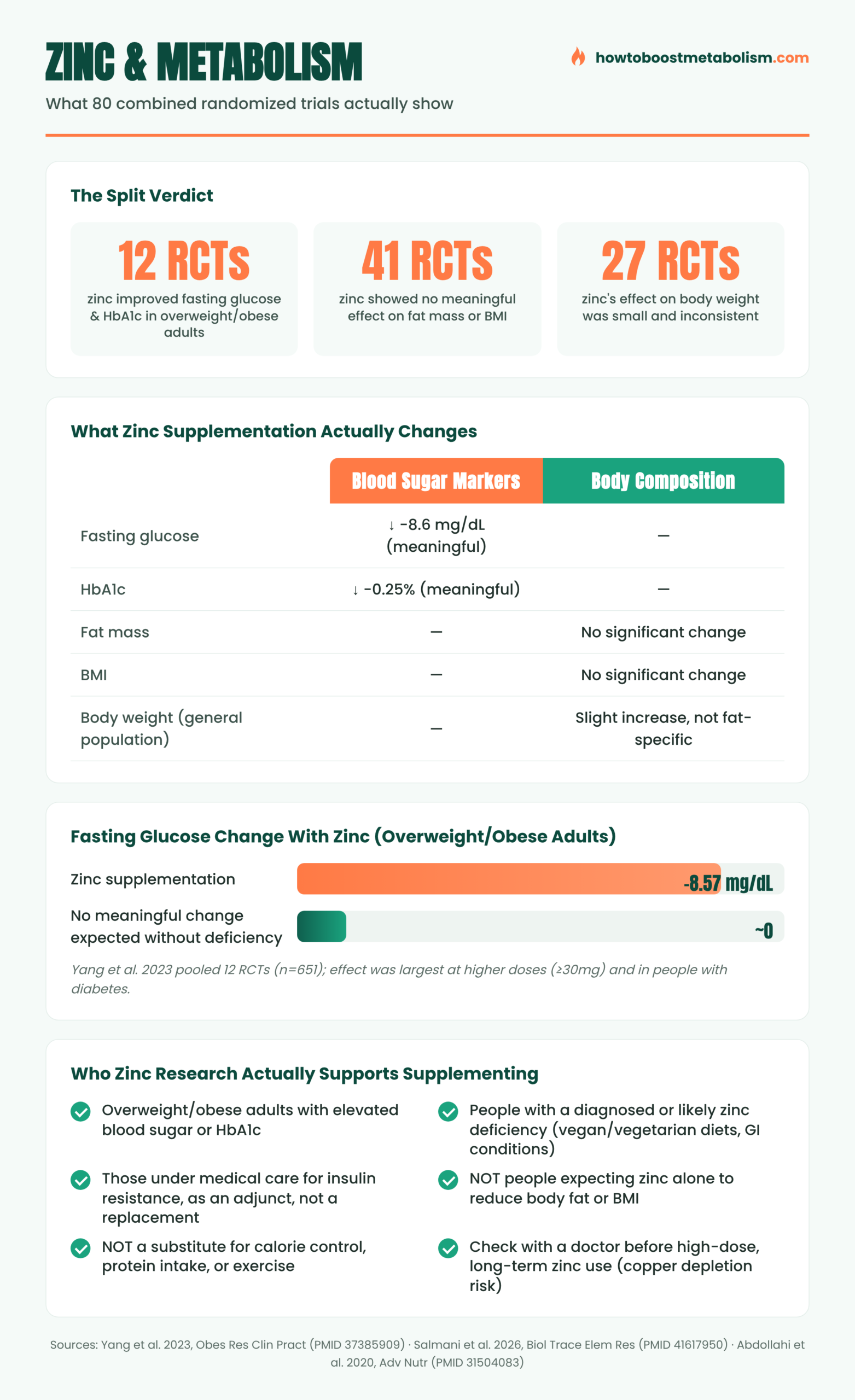
A 2023 systematic review and meta-analysis in Obesity Research & Clinical Practice pooled 12 randomized controlled trials involving 651 overweight or obese participants, specifically looking at blood sugar markers (Yang, Hung, Chuang, Chang, Chen, Wang, Wu & Chen, 2023, Obesity Research & Clinical Practice). The results were consistent across several markers: zinc supplementation significantly reduced fasting glucose (by a weighted mean difference of -8.57 mg/dL), HOMA-IR (a standard insulin-resistance index), HbA1c (-0.25%), and 2-hour post-meal glucose (-18.42 mg/dL), compared with control groups. The effect on fasting glucose was strongest in subgroups using higher doses (30mg or more) and in participants who already had diabetes — suggesting zinc’s blood-sugar benefit shows up most clearly when there’s more room for it to matter.
This lines up with what’s known about zinc’s biology: it’s a required cofactor for insulin storage and release in the pancreas, and for enzymes involved in glucose handling. A real but often-overlooked deficiency in zinc intake — more common than people assume, especially with plant-forward diets or GI conditions that reduce absorption — can plausibly blunt that machinery. Replacing a true shortfall, rather than megadosing on top of adequate intake, is where the blood-sugar signal is strongest.
Where Zinc Does Essentially Nothing: Body Fat and BMI
This is the part supplement marketing tends to leave out. A 2026 systematic review and meta-analysis in Biological Trace Element Research pooled 41 randomized controlled trials (44 effect sizes) specifically examining zinc’s effects on body composition and fat-related hormones (Salmani, Karimi, Asbaghi, Bagheri, Nikbaf-Shandiz, Bakhtiary, Goudarzi, Kazemi, Shouhani, Setayesh, Haghighat & Ashtary-Larky, 2026, Biological Trace Element Research). The findings were unambiguous: no significant effect on BMI, fat mass, fat-free mass, adiponectin, or leptin. The one statistically significant finding went the opposite direction from what a “metabolism booster” claim would predict — a small increase in body weight (+0.68 kg) and a modest reduction in waist circumference (-1.03 cm), both rated with high-to-very-high certainty evidence, but both explicitly described by the authors as too small to be clinically meaningful.
An earlier 2020 dose-response meta-analysis in Advances in Nutrition, pooling 27 trials and 1,438 participants, found the same pattern from a different angle (Abdollahi, Toupchian, Jayedi, Meyre, Tam & Soltani, 2020, Advances in Nutrition): no significant overall change in anthropometric measures. Subgroup analysis found zinc increased body weight in people on hemodialysis and modestly decreased it in overweight/obese but otherwise healthy participants — but after adjusting for study duration, even that overweight/obese subgroup effect disappeared. The study’s own conclusion was worded as cautiously as the data warranted: zinc “may be associated with body weight.”
| Marker | What zinc supplementation did | Evidence base |
|---|---|---|
| Fasting glucose | Meaningful reduction (-8.57 mg/dL) | 12 RCTs, overweight/obese adults |
| HbA1c | Meaningful reduction (-0.25%) | 12 RCTs, overweight/obese adults |
| Insulin resistance (HOMA-IR) | Meaningful reduction | 12 RCTs, overweight/obese adults |
| Body fat mass | No significant change | 41 RCTs, general adult population |
| BMI | No significant change | 41 RCTs, general adult population |
| Body weight | Small increase (+0.68 kg) — not clinically meaningful | 41 RCTs, general adult population |
| Leptin / adiponectin | No significant change | 41 RCTs, general adult population |
Free download
🔥 The Metabolism Starter Kit
3 honest guides: a 7-day reset plan, a foods cheat-sheet and 12 metabolism myths debunked. No spam — unsubscribe anytime.
So Why Does Zinc End Up in “Metabolism Booster” Products?
Likely because of a kernel of truth stretched well past what it supports: zinc genuinely participates in metabolic processes — insulin signaling, thyroid hormone conversion, and hundreds of enzymatic reactions that touch energy metabolism indirectly. That’s accurate, but it’s a long way from “zinc boosts your metabolism and helps you burn fat,” which the body-composition research above does not support. A nutrient being metabolically essential is not the same as a nutrient being a fat-loss lever once your intake is already adequate.
Are You Actually Zinc Deficient?
This is the question that actually matters before supplementing. Zinc deficiency is more common in people eating mostly plant-based diets (phytates in grains and legumes bind zinc and reduce absorption), people with Crohn’s disease or other conditions that impair gut absorption, heavy alcohol users, older adults with reduced intake, and people on certain long-term medications. Common, non-specific signs — reduced sense of taste or smell, slow wound healing, frequent minor infections, hair thinning — overlap heavily with other deficiencies and conditions, so they’re suggestive at best, not diagnostic on their own.
A Reasonable, Evidence-Aligned Approach
| Your situation | What the evidence suggests |
|---|---|
| You eat animal protein regularly and have no GI condition | Deficiency is unlikely; a multivitamin-level amount (if any) is more than enough |
| You’re mostly plant-based, or have a GI absorption condition | Worth discussing a blood test and appropriate dosing with a doctor |
| You have elevated blood sugar or prediabetes markers | The blood-sugar evidence above is where zinc has the clearest, most replicated benefit |
| You’re hoping zinc will reduce body fat on its own | The body-composition evidence does not support this expectation |
One practical caution worth flagging clearly: zinc and copper compete for absorption, and sustained high-dose zinc supplementation (well above 40mg/day for extended periods) can cause a copper deficiency, which carries its own health risks. The trials above used doses typically in the 15-50mg range under monitored conditions — that’s not a reason to self-prescribe indefinite high-dose zinc without medical input, especially long-term.
Getting Zinc From Food First
Before considering a supplement, it’s worth knowing that zinc is reasonably easy to get from a varied diet that includes animal protein. Oysters are the single richest source by a wide margin, but red meat, poultry, eggs, dairy, and shellfish all contribute meaningfully. Plant sources — beans, lentils, nuts, seeds, and whole grains — contain zinc too, but also contain phytates, compounds that bind zinc and reduce how much the body actually absorbs. This is the main mechanical reason plant-forward eaters are at higher risk of a real shortfall even when their diet looks reasonably zinc-rich on paper — it’s an absorption problem more than an intake problem.
| Food source | Zinc content | Practical note |
|---|---|---|
| Oysters | Very high | Far above typical daily needs in a single serving |
| Beef, pork, lamb | High | A standard serving covers a large share of daily needs |
| Poultry, eggs, dairy | Moderate | Reliable contributors with regular intake |
| Beans, lentils, nuts, seeds | Present, but less absorbable | Phytates reduce bioavailability; soaking/sprouting helps somewhat |
If You Do Supplement: Form Matters
Not all zinc supplement forms absorb equally well. Zinc picolinate, citrate, and gluconate are generally considered more bioavailable than zinc oxide, which is cheap and common in lower-quality multivitamins but absorbed relatively poorly. The specific trials behind the blood-sugar findings above used a range of forms and doses, typically 15-50mg of elemental zinc daily — checking a supplement’s “elemental zinc” amount (not just the total compound weight) is the only way to know what dose you’re actually getting.
Zinc Fits Into the Bigger Picture, Not Instead of It
If blood sugar control and metabolic health — not a specific mineral — are the actual goal, zinc is a reasonable piece of a broader approach that includes adequate protein intake (see how much protein you actually need), resistance training, and sleep. It’s a supporting player, not a standalone fix, and none of the research above suggests otherwise.
Free download: our Metabolism Starter Kit — a protein calculator, a 7-day meal framework, and a one-page supplement checklist, with zero hype.
Get the Free Starter Kit →Common Zinc Myths Worth Retiring
| Myth | What the evidence actually shows |
|---|---|
| “Zinc speeds up your metabolism.” | Not supported — 41 pooled RCTs found no effect on fat mass, BMI, or fat-free mass |
| “More zinc is always better for fat loss.” | No dose-response relationship with fat loss was found; high doses carry a copper-depletion risk instead |
| “Zinc deficiency is rare in the U.S., so supplementing is pointless.” | Mild, subclinical shortfalls are more common than assumed, especially with plant-forward diets or GI conditions — though confirming it beats guessing |
| “If a little zinc helps blood sugar, a lot will help more.” | The blood-sugar benefit was clearest in deficient or at-risk groups at moderate doses — it’s a replacement effect, not a linear dial you can keep turning up |
This pattern — a real, specific, well-supported benefit for one outcome (blood sugar in at-risk adults) sitting right next to an absence of benefit for a much more heavily marketed outcome (fat loss) — shows up constantly in supplement research. It’s one reason a single study or a single claim on a label is a weak foundation to build an expectation on; a cluster of large meta-analyses pointing the same direction, as is the case here, is a much sturdier one.
None of this makes zinc a bad nutrient to pay attention to — it’s genuinely essential, and correcting a real deficiency is worthwhile for reasons well beyond metabolism, including immune function and wound healing. The point is narrower: match the expectation to the evidence. If the goal is fat loss, zinc isn’t the lever. If the goal is addressing elevated blood sugar alongside an actual or likely deficiency, it’s one of the more evidence-backed micronutrient interventions available.
At a Glance
| Question | Short answer |
|---|---|
| Does zinc boost metabolism or burn fat? | No — 41 RCTs found no significant effect on body fat, BMI, or fat-free mass |
| Does zinc help blood sugar control? | Yes, in overweight/obese adults — 12 RCTs found meaningful reductions in glucose and HbA1c |
| Who benefits most from supplementing? | People with an actual zinc shortfall or elevated blood sugar markers — not the general population |
| Is more zinc always better? | No — high, sustained doses risk copper deficiency; check with a doctor before long-term high-dose use |
Related: Zinc isn’t the only commonly-deficient nutrient tied to muscle health — see what the trial data actually shows on vitamin D and muscle strength after 40.
Frequently Asked Questions
Does zinc actually boost your metabolism?
Not in the way it’s often marketed. A 2026 meta-analysis of 41 randomized trials found no significant effect of zinc supplementation on body fat, BMI, or fat-free mass. Zinc does participate in metabolic enzyme function, but that doesn’t translate into measurable fat loss or a faster metabolic rate in the research.
Can zinc help with blood sugar or insulin resistance?
Yes — this is where the evidence is strongest. A 2023 meta-analysis of 12 randomized trials in overweight and obese adults found meaningful reductions in fasting glucose, HbA1c, and insulin resistance (HOMA-IR) with zinc supplementation, especially at higher doses (30mg or more).
How do I know if I’m zinc deficient?
There’s no single reliable symptom. Risk factors include mostly plant-based diets, GI conditions that impair absorption (like Crohn’s disease), heavy alcohol use, and older age with reduced dietary intake. A blood test and a conversation with a doctor is the most reliable way to confirm it, rather than guessing from symptoms alone.
Is it safe to take zinc supplements every day?
At moderate doses typical of a multivitamin, generally yes for most healthy adults. Sustained high doses (well above 40mg/day) over long periods can interfere with copper absorption and cause a copper deficiency, so long-term high-dose use should be discussed with a doctor rather than self-prescribed.
Should I take zinc instead of exercising or eating less to lose weight?
No. The research doesn’t support zinc as a fat-loss tool at all — the body-composition meta-analyses found no meaningful effect on fat mass or BMI. Zinc may be worth addressing if you’re deficient and have elevated blood sugar, but it’s not a substitute for a calorie deficit, adequate protein, or resistance training.