The Afterburn Effect: What EPOC Really Does After Lifting
This article may contain affiliate links. If you buy through them, we may earn a small commission at no extra cost to you. See our Affiliate Disclosure and Medical Disclaimer.
“This workout keeps burning calories for 48 hours after you leave the gym.” If you’ve seen that claim on a fitness app, a YouTube thumbnail, or a supplement ad, you’ve met the afterburn effect — more precisely called EPOC, or excess post-exercise oxygen consumption. It’s a real, measurable phenomenon. It’s also one of the most exaggerated numbers in fitness marketing.
Here’s what EPOC actually is, what the controlled research has measured in real kilocalories (not percentages or vague multipliers), and why it matters a lot less to your metabolism than the muscle you’re building in the same workout.
What EPOC Actually Is
When you finish a hard set, you don’t just stop burning extra calories the instant you put the weight down. Your body needs to replenish oxygen debt, clear byproducts like lactate, repair micro-damage in muscle fibers, restock depleted energy stores (ATP and creatine phosphate), and bring your elevated heart rate, breathing rate, and core temperature back down to baseline. All of that costs energy above your normal resting rate — that extra energy cost is EPOC.
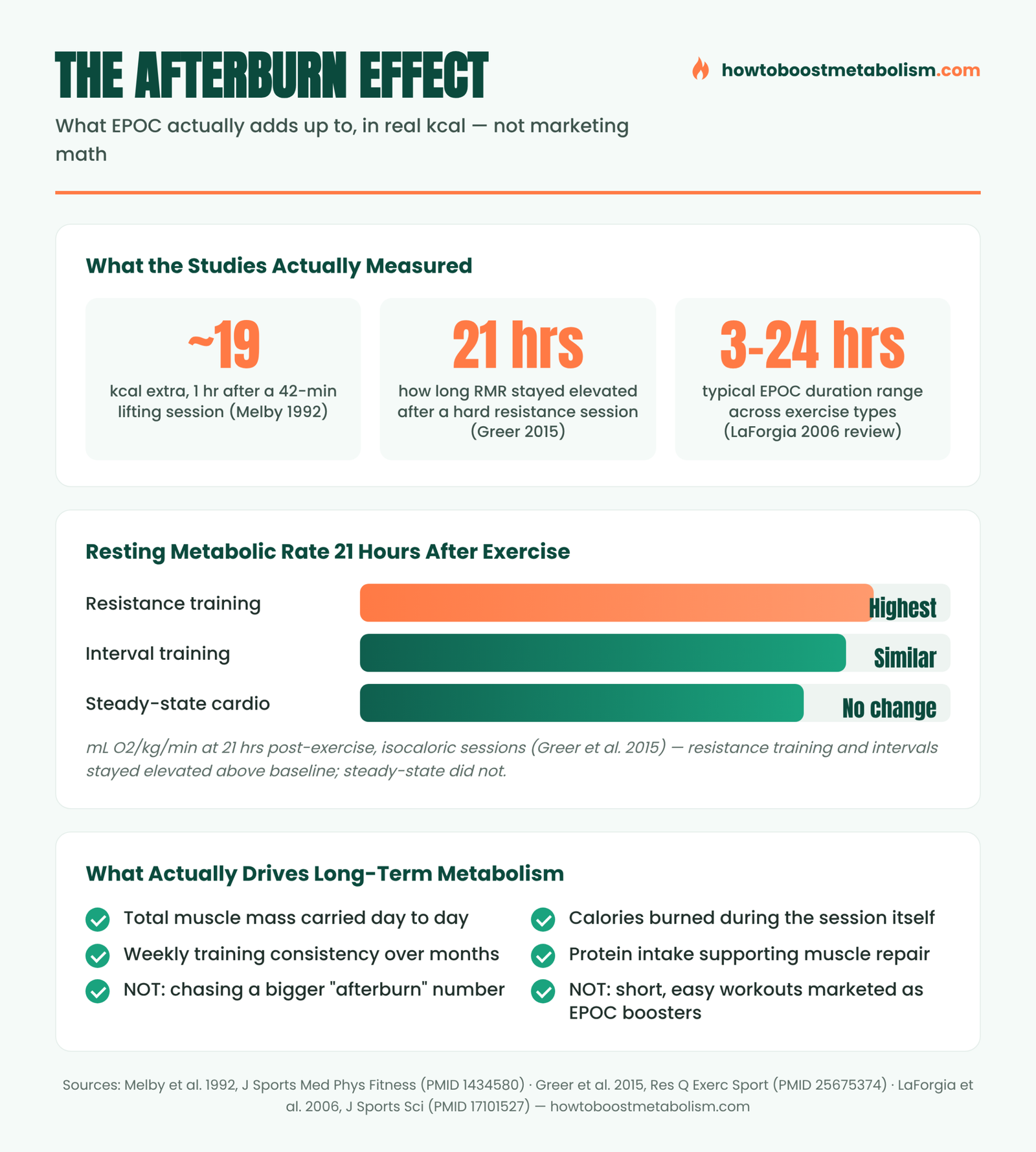
A detailed 2006 review in the Journal of Sports Science traced how our understanding of EPOC has changed over the decades (LaForgia, Withers & Gore, 2006). Early-20th-century researchers reported very long, large EPOC durations and treated it as a major contributor to total daily energy expenditure. Later, more rigorous studies with better equipment scaled that picture down considerably — but confirmed that a genuinely prolonged EPOC (3 to 24 hours) is possible after a sufficiently hard session, roughly 50 minutes at 70%+ of VO2 max for steady efforts, or 6+ minutes at 105%+ of VO2 max for very intense efforts. At the time of that review, the authors noted resistance-exercise EPOC specifically was still under-studied compared to cardio.
What the Actual Numbers Look Like
A Weightlifting Session Added About 19 Extra Calories
One of the most direct measurements comes from an older but carefully controlled study that measured energy expenditure by indirect calorimetry before and after a 42-minute non-steady-state weight training session (Melby, Tincknell & Schmidt, 1992, Journal of Sports Medicine and Physical Fitness). Metabolic rate stayed significantly elevated through a full 60-minute recovery window compared to quiet sitting — but the actual caloric cost of that elevation was approximately 19 extra kcal. For context, that’s roughly the energy in a single bite of an apple. The researchers’ own conclusion was that this caloric cost is “small,” comparable to steady-state cardio of moderate intensity.
Resistance Training Keeps Resting Metabolism Up Longer Than Steady Cardio
A more recent 2015 study in Research Quarterly for Exercise and Sport compared resistance training, steady-state cardio, and high-intensity interval training at matched total calorie cost (Greer et al., 2015). At 12 hours post-exercise, resting metabolic rate was higher after both the resistance session and the interval session than after steady-state cardio. At 21 hours post-exercise, the pattern held — resistance training and interval training were still elevated above baseline and above the steady-state condition, while steady-state cardio showed no meaningful change at either checkpoint. This is good evidence that resistance training produces a real, longer-lasting metabolic elevation than a matched dose of easy cardio — but note the measurement here is rate (mL O2/kg/min), not a running kcal total, and the gap between conditions is a matter of a modest percentage, not a doubling.
Harder, Shorter Intervals Can Edge Out Steady Efforts Too
Separately, interval-style training (both high-intensity and sprint-style) has been shown to produce higher total EPOC over a 3-hour window than continuous steady-state exercise of similar overall effort, even though oxygen consumption in all conditions returned to near-resting levels within the first post-exercise hour. The consistent theme across this body of research: harder efforts produce more EPOC, but the absolute calorie numbers involved stay modest compared to the calories burned during the workout itself.
Why the Studies Disagree on the Exact Size of the Effect
If you’ve read conflicting numbers elsewhere, it’s not because the science is broken — it’s because EPOC is genuinely hard to measure consistently, and small methodological differences move the result a lot. Studies differ in how long they measured recovery (one hour vs. three hours vs. 21+ hours), how hard and how long the exercise bout was, whether sessions were matched for total calories burned, how trained the participants were, and whether “elevated metabolism” was reported as a rate (oxygen use per minute) or converted into a running kcal total. A rate that looks impressively elevated on a chart can still translate into a fairly small number of actual calories once you do that conversion — which is exactly the gap that “48-hour fat-burning furnace” marketing tends to exploit.
Free download
🔥 The Metabolism Starter Kit
3 honest guides: a 7-day reset plan, a foods cheat-sheet and 12 metabolism myths debunked. No spam — unsubscribe anytime.
At a Glance: How the Numbers Stack Up
| What Was Measured | Finding | Source |
|---|---|---|
| Single resistance session (42 min) | ~19 kcal over 1 hour post-exercise | Melby et al., 1992 |
| Resistance training vs. steady cardio | Higher RMR at 12h and 21h post | Greer et al., 2015 |
| General EPOC duration range | 3-24 hours, intensity-dependent | LaForgia et al., 2006 (review) |
Why the “48-Hour Fat-Burning Furnace” Framing Is Misleading
None of this means EPOC is fake. It means the marketing version — a dramatic, standalone calorie-burning window that rivals the workout itself — doesn’t match what’s actually been measured. A few honest caveats worth knowing before you plan around it:
- The biggest EPOC numbers in the research come from genuinely hard, often unsustainably long sessions — not the kind of workout most people over 40 can (or should) do every day
- Most studies measure a rate (oxygen consumption per minute) elevated above baseline, which sounds dramatic — converted into actual extra calories, the total is usually modest
- EPOC is additive to, not a replacement for, the calories you burn during the workout — a hard 45-minute lifting session’s main metabolic impact is still the 45 minutes, not the hours after
- “Metabolism boosting” workout programs that lean heavily on EPOC as their main selling point are usually overselling a real-but-small physiological detail
What Actually Moves Your Metabolism, If Not EPOC
If chasing afterburn isn’t the lever, what is? The research on metabolic health after 40 points consistently toward a few bigger, more durable factors:
- Total muscle mass. Muscle tissue has a meaningfully higher resting energy cost than fat tissue, and it’s the single biggest modifiable piece of your metabolic rate over months and years — see our breakdown of whether building muscle actually boosts metabolism.
- Calories burned during training itself. A harder, longer, more frequent training week burns more total energy than EPOC ever will on its own.
- Consistency over months, not single sessions. One workout’s afterburn is a rounding error; 150+ consistent workouts across a year are not.
- Avoiding unnecessary muscle loss, especially relevant after 40 — our guide on sarcopenic obesity covers why muscle preservation matters more than any single workout’s afterburn.
If your actual goal is losing fat while keeping (or building) muscle, the more useful comparison isn’t “which workout burns more calories after I leave” — it’s HIIT vs. steady cardio for overall metabolic impact, or how your eating window and training combine, which is exactly the body-composition question we cover in our guide to body recomposition after 40.
Common EPOC Myths Worth Retiring
| The Claim | What the Evidence Actually Shows |
|---|---|
| “This workout keeps burning fat for 48 hours” | No controlled study has measured a large, standalone calorie burn lasting 48 hours — most measured windows top out around 21-24 hours, with modest total kcal. |
| “Short, intense workouts burn as much as long ones, because of EPOC” | EPOC is additive on top of the workout’s own calorie cost, not a replacement for it. A 15-minute session’s EPOC doesn’t make up the gap versus a 45-minute session’s actual work. |
| “You need to chase a higher EPOC number for fat loss” | Weekly training volume, consistency, and muscle mass move the needle far more than optimizing for afterburn specifically. |
| “Soreness the next day means more EPOC happened” | Muscle soreness (DOMS) and EPOC are driven by different mechanisms; feeling sore is not a reliable proxy for how much extra energy you burned. |
Does This Change After 40?
There’s no large body of resistance-training EPOC research specifically isolating lifters over 40, so be skeptical of any source that claims otherwise with precise numbers for your age group. What we do know from the broader aging and exercise literature is relevant context, though: recovery between hard sessions generally takes a bit longer as you age, muscle protein synthesis response to a given stimulus can be somewhat blunted (sometimes called “anabolic resistance”), and adequate sleep and protein intake both matter more for how well you actually recover and adapt. None of that changes the core conclusion about EPOC’s modest size — if anything, it’s one more reason to focus on the training variables you can control with confidence (volume, consistency, protein, sleep) rather than an afterburn number that was always a minor player.
Programs built around brief, intense training windows paired with structured eating are popular precisely because they target both sides of the equation — training stimulus and nutrition timing — rather than banking on afterburn alone. Anabolic Fasting pairs a fasting-based eating structure with a resistance training framework aimed at building muscle while managing fat; treat any “burn fat and build muscle simultaneously” claims on its sales page as marketing framing, not a guarantee, and evaluate the actual program structure.
See the Program →Affiliate link — we may earn a commission at no extra cost to you. Disclosure
Free download: our Metabolism Starter Kit — a protein calculator, a 7-day meal framework, and a one-page supplement checklist, with zero hype.
Get the Free Starter Kit →For a deeper look at how rest and recovery between sets factor into total session output (and therefore total calories burned, EPOC included), see our guide on rest periods between sets after 40.
Related: Metabolic effects of training extend beyond the afterburn window — our article on fasted strength training after 40 looks at how meal timing around your workout affects muscle and hormones.
Frequently Asked Questions
What does EPOC stand for?
EPOC stands for excess post-exercise oxygen consumption — the amount your metabolism stays elevated above its resting rate after you finish a workout, as your body restores oxygen stores, clears lactate, repairs tissue, and returns hormones and body temperature to baseline.
Does lifting weights really burn calories for 24-48 hours afterward?
Your metabolic rate can stay measurably elevated for several hours after a sufficiently hard resistance session — one study found resting metabolic rate was still higher than baseline 21 hours later. But “elevated” is not the same as “burning a lot.” The actual extra calories involved are typically in the range of a few dozen to around 100 extra kcal, not the 500+ some marketing implies.
How many extra calories does EPOC actually burn?
It varies with workout intensity and duration, but controlled measurements have found modest numbers — one classic study measured only about 19 extra kcal in the hour after a 42-minute weightlifting session. Harder, longer sessions produce more EPOC, but even generous estimates in the literature put total EPOC well under what a single extra snack would add back.
Is EPOC bigger after resistance training or cardio?
At matched total calorie expenditure, resistance training and high-intensity interval work tend to produce a somewhat larger and longer-lasting elevation in resting metabolic rate than steady-state cardio of the same caloric cost — though the absolute difference in kcal is still fairly small. The honest takeaway is that EPOC is a minor bonus on top of the calories burned during the workout itself, not a separate large source of fat loss.
Should I train specifically to maximize EPOC?
No — chasing EPOC for its own sake is chasing the wrong number. The bigger, more reliable drivers of long-term metabolic health are the muscle you build and maintain, the calories you burn during the session itself, and your overall weekly training consistency. EPOC is a real but small side effect of hard training, not a strategy to build a program around.
This article is for general educational purposes and is not a substitute for individualized medical, nutrition, or exercise advice. Talk with a qualified professional before starting a new training or eating program, especially if you have an existing health condition.