Fasted Strength Training After 40: What Evidence Shows
This article may contain affiliate links. If you buy through them, we may earn a small commission at no extra cost to you. See our Affiliate Disclosure and Medical Disclaimer.
Somewhere between the intermittent-fasting crowd insisting fasted training is a metabolic superpower and the bodybuilding-forum crowd insisting you’ll waste away without a pre-workout shake, there’s an actual answer buried in a handful of recent trials. It’s less dramatic than either camp wants it to be, but if you’re over 40 and trying to decide whether to lift before or after breakfast, it’s worth knowing what the data genuinely shows — including a hormonal finding that doesn’t get mentioned nearly as often as the fat-loss headline.
| Question | What the Evidence Shows |
|---|---|
| Strength & muscle gain over 12 weeks | Statistically similar whether trained fasted or fed |
| Body fat loss | Small meta-analysis found a fasted-state edge — based on only 4 studies, 3 rated high risk of bias |
| Testosterone & IGF-1 (8-week trial) | Dropped significantly with fasted/time-restricted training; strength and muscle were still maintained |
| Resting energy expenditure | Unchanged by time-restricted fasting in the same 8-week trial |
| Bottom line | Both approaches work for building/maintaining muscle; the choice comes down to personal preference and how you feel, not a performance penalty |
The Theory vs. the Actual Trials
The theoretical case against fasted lifting goes like this: without recent carbohydrate intake, muscle glycogen and blood glucose are lower, which should blunt power output and force your body to break down more muscle protein for fuel during the session. The theoretical case for it leans on intermittent-fasting research showing benefits for fat oxidation and insulin sensitivity, extrapolated into the gym. Both arguments sound reasonable on paper. The honest answer is that neither one holds up cleanly once you actually put it to a controlled test over multiple weeks, rather than a single session.
What the Best Available RCT Found: 12 Weeks, Fasted vs. Fed, Nearly Identical Gains
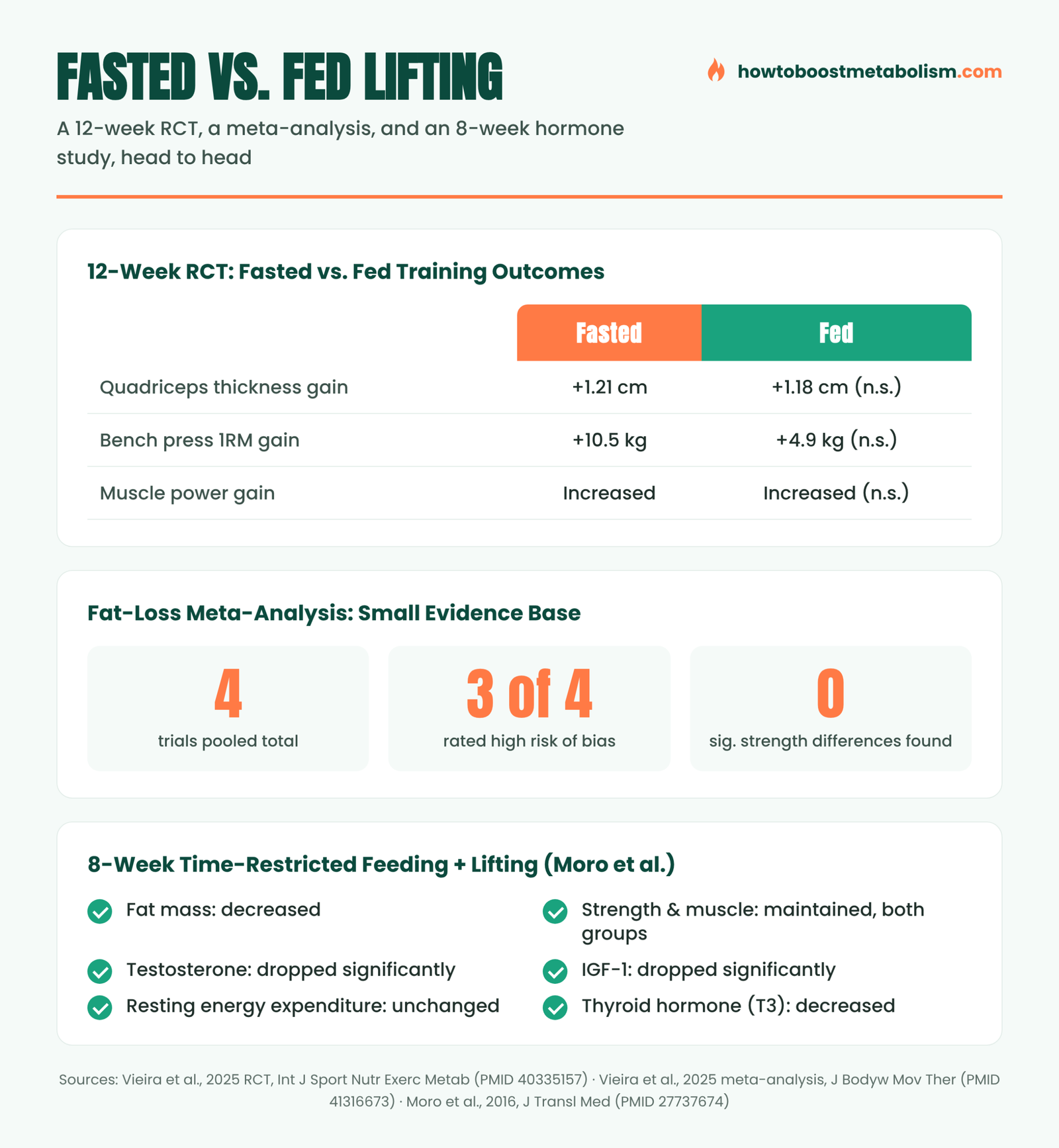
A 2025 randomized clinical trial directly tested this question properly: not a single workout, but 12 weeks of actual training. Participants were randomly split into a group training after an overnight fast and a group training 1–2 hours after a carbohydrate-rich meal, with both groups following isocaloric nutritional guidance otherwise (Vieira et al., 2025, International Journal of Sport Nutrition and Exercise Metabolism). The researchers measured quadriceps muscle thickness by ultrasound, maximum strength via one-repetition-max testing, and muscle power in the bench press and knee extension. Both groups improved meaningfully — quadriceps thickness increased by 1.21 cm in the fasted group and 1.18 cm in the fed group; bench press 1RM rose by 10.53 kg fasted versus 4.89 kg fed; knee-extension power rose in both groups too. None of those between-group differences reached statistical significance. The researchers’ own conclusion was direct: training in a fasted or fed state, twice weekly across 12 weeks, was associated with similar improvements in muscle hypertrophy and neuromuscular performance either way.
That bench-press number (10.53 kg vs. 4.89 kg) is worth a specific honesty flag: it looks like a big gap on the page, but the study explicitly reported it as not statistically significant, meaning with this sample size the difference is consistent with random variation rather than a real fasted-state advantage. This is exactly the kind of number that gets quoted out of context on social media to claim fasted training builds strength faster — the actual paper doesn’t support that conclusion.
Free download
🔥 The Metabolism Starter Kit
3 honest guides: a 7-day reset plan, a foods cheat-sheet and 12 metabolism myths debunked. No spam — unsubscribe anytime.
The Meta-Analysis Confirms the Pattern — With an Important Caveat About Study Quality
A separate 2025 systematic review with meta-analysis pooled multiple clinical trials comparing resistance training performed fasted versus fed (Vieira et al., 2025, Journal of Bodywork and Movement Therapies). Across the pooled data, there were no significant differences between fasted and fed training in fat-free mass, muscle hypertrophy, or strength. There was one significant difference: fasted training was associated with a greater reduction in body fat mass (SMD: −1.001; 95% CI: −1.970 to −0.032; p = 0.043).
Here’s the caveat that matters: this meta-analysis included only four studies, and the review’s own methodological quality assessment rated three of those four as having a high risk of bias. A real statistical signal from four small, mostly low-quality trials is a reasonable hypothesis worth further research — it is not strong enough evidence to restructure your training schedule around. If fat loss is your primary goal and fasted training fits your schedule and preference anyway, this is a mild point in its favor. It is not, based on this evidence, a reason to force fasted training if you don’t enjoy it.
The Hidden Cost: Hormones and Recovery Markers
This is the part of the fasted-training conversation that gets skipped most often. An 8-week trial in already resistance-trained men compared a time-restricted feeding protocol — all calories consumed in an 8-hour afternoon-to-evening window, meaning training and most of the fasting period happened before eating — against a normal three-meals-a-day diet, with both groups following the same resistance training program (Moro et al., 2016, Journal of Translational Medicine). Fat-free mass, muscle area of the arm and thigh, and maximal strength were maintained equally in both groups — consistent with the other trials above. But total and free testosterone dropped significantly in the time-restricted group (p = 0.0476 and p = 0.0397) with no significant change in the normal-diet group, and insulin-like growth factor 1 (IGF-1) dropped significantly too (p = 0.0397). Triiodothyronine (an active thyroid hormone) also decreased in the fasting group. Resting energy expenditure, notably, did not change — the extended fasting window didn’t measurably slow their metabolism.
What should you make of a study where strength and muscle held steady despite a real drop in testosterone and IGF-1? The most honest reading is that 8 weeks wasn’t long enough for that hormonal shift to translate into a visible training deficit — but the study also didn’t run long enough to rule out a larger effect over 6 or 12 months, nor did it test whether recovery between sessions felt different for participants despite the numbers on paper holding up. If you’re over 40 and already tracking hormone levels for other reasons, or recovering more slowly between sessions than you used to, this is worth factoring into how aggressively you combine extended fasting with hard training — not as a reason to avoid fasting altogether, but as a reason not to assume it’s hormonally free.
Who Should Think Twice About Fasted Training After 40
- Anyone on blood-sugar-lowering medication (including insulin or sulfonylureas), where training fasted raises real hypoglycemia risk — talk to your prescribing doctor before changing your training-and-eating timing.
- Anyone prone to dizziness or light-headedness during heavy compound lifts, which can be worse on an empty stomach and carries real fall risk.
- Anyone actively trying to gain or rebuild muscle mass as a priority, where even a modest subjective hit to training quality on fasted days isn’t worth it if it reduces how hard you can actually push.
- Anyone already managing a slow-recovering joint or tendon issue, where the Moro et al. hormonal findings above are one more reason to avoid stacking extended fasting on top of an already demanding recovery load.
- Anyone who has simply tried it and performs noticeably worse or feels worse — the group averages above don’t guarantee your individual response matches the group.
A Practical Decision Framework
- If your main goal is strength or muscle gain, and fasted training doesn’t bother you subjectively, the 12-week RCT above suggests you’re not giving up meaningful progress either way — train whenever fits your schedule.
- If your main goal includes fat loss and you don’t mind training fasted, the small meta-analysis gives a mild, low-confidence reason to lean that direction — but don’t expect a dramatic difference, and don’t force it if it tanks your performance.
- If you’re combining fasted training with an extended time-restricted eating window (not just an overnight fast before a morning session), be aware of the testosterone and IGF-1 findings above, especially if you train hard most days of the week.
- If you feel noticeably weaker, dizzy, or foggy training fasted, trust that signal over the group averages — individual response varies, and the whole point of these trials is that averages don’t guarantee similar strength outcomes, not that fasted training is risk-free for everyone.
- If you’re on medication that affects blood sugar, loop in your doctor before making fasted training a regular habit, full stop.
Common Mistakes People Make With Fasted Training
- Assuming the 12-week RCT’s bench-press number (10.53 kg vs. 4.89 kg) proves fasted training builds strength faster — the study itself reported that gap as not statistically significant.
- Citing the fat-loss meta-analysis as settled science, when it pooled just four studies, three rated high risk of bias.
- Ignoring the testosterone and IGF-1 findings entirely because strength numbers looked fine over 8 weeks — a short study not finding a performance consequence isn’t the same as there being no physiological effect.
- Forcing fasted training out of principle when it consistently makes workouts feel worse — the whole point of the evidence above is that it’s a wash on average, which means personal preference is a perfectly legitimate tiebreaker.
- Combining extended fasting windows with aggressive training volume increases at the same time, rather than changing one variable at a time to see how your body actually responds.
Free download: our Metabolism Starter Kit — a protein calculator, a 7-day meal framework, and a one-page supplement checklist, with zero hype.
Get the Free Starter Kit →If you’re specifically interested in structured fasting windows combined with a training plan designed around that combination, Anabolic Fasting is built around pairing a fasting protocol with resistance training. Worth saying plainly: marketing language promising you’ll “build muscle and burn fat simultaneously” is a sales pitch, not a guarantee — the research above shows fasted training is roughly a wash for muscle and strength versus fed training, with a modest, low-confidence edge for fat loss. Judge the program as a structured way to combine fasting and training, not as a shortcut around the laws of physiology.
See the Program →Affiliate link — we may earn a commission at no extra cost to you. Disclosure
Related Reading
If training timing in general interests you, our comparison of morning vs. evening strength training after 40 covers a related but separate timing question. For the recovery side of training stress, see our piece on overtraining signs and cortisol after 40, and for how sleep interacts with training adaptation, our guide to sleep debt and muscle protein synthesis after 40 covers another variable that can matter more than meal timing alone.
Related: Caffeine is one of the most common additions to a fasted training session — we reviewed the actual performance and fat-oxidation evidence in caffeine before strength training after 40.
Frequently Asked Questions
Does lifting weights fasted burn more fat than lifting fed?
A 2025 systematic review with meta-analysis found a statistically significant edge in body fat mass reduction for resistance training done in the fasted state compared with the fed state. But it pooled only four studies, three of which were rated high risk of bias, and found no significant difference in fat-free mass, hypertrophy, or strength between fasted and fed training. Treat the fat-loss finding as a real but fragile signal from a small evidence base, not a settled fact.
Will training fasted make me lose muscle after 40?
The best current evidence says no, at least not over a period of weeks to a couple of months. A 12-week randomized trial found fasted and fed resistance training produced statistically similar gains in muscle thickness, maximum strength, and muscle power. An 8-week trial in already resistance-trained men found fat-free mass and muscle area were maintained equally in both a time-restricted (mostly fasted) group and a normal-diet group.
Does fasted training lower testosterone?
In one well-controlled 8-week trial, yes — total and free testosterone, along with IGF-1, dropped significantly in the time-restricted-feeding group but not in the normal-diet comparison group, even though both groups maintained muscle mass and strength equally. This is a genuine, measured finding worth knowing about, though the study didn’t test whether that hormonal dip carries any real-world consequence over a longer stretch of months or years.
Is fasted training more dangerous after 40 than at 25?
The hard trial data above comes mostly from younger or middle-aged adult samples, not specifically from older populations, so some caution in extrapolating is reasonable. Practically, the bigger concerns after 40 tend to be blood-sugar regulation if you’re on diabetes medication, dizziness or light-headedness risk during heavy compound lifts, and simply how you personally feel — some people perform fine fasted, others feel noticeably weaker or foggier, and that subjective difference matters for consistency even when average group data looks similar.
What’s a reasonable way to test whether fasted training works for me?
Since the group-level evidence shows roughly similar strength and hypertrophy outcomes either way, this is a genuinely personal choice. Try a few weeks of your normal fed training, then a few comparable weeks fasted, tracking your actual lifted loads, reps, and how you feel during and after sessions, rather than assuming either approach is objectively superior for you based on an average from a study of other people.
This article is for general educational purposes and is not a substitute for personalized medical advice. See our Medical Disclaimer for more information.