Waist-to-Hip Ratio After 40: What It Predicts
This article may contain affiliate links. If you buy through them, we may earn a small commission at no extra cost to you. See our Affiliate Disclosure and Medical Disclaimer.
Step on a scale, calculate a BMI, and you get a single number that treats a powerlifter and a person carrying most of their weight around the waist as the same “risk category.” That blind spot is exactly why cardiologists and epidemiologists keep returning to a much older, low-tech measurement: the ratio of waist circumference to hip circumference. After 40 — when body fat distribution tends to shift toward the abdomen even without a change in weight — waist-to-hip ratio (WHR) turns out to carry information that the scale and even BMI simply don’t capture. Here is what the actual research shows, not the simplified version that circulates on social media.
What Waist-to-Hip Ratio Actually Measures
WHR is exactly what it sounds like: your waist circumference divided by your hip circumference, both measured in the same units. A waist of 38 inches and hips of 42 inches gives a WHR of about 0.90. The number is a crude but useful proxy for where the body is storing fat — more around the abdomen and organs (an “apple” pattern, higher WHR) versus more around the hips and thighs (a “pear” pattern, lower WHR).
This distinction matters because abdominal fat is not metabolically identical to fat stored elsewhere. A meaningful portion of abdominal fat is visceral — packed around the liver, pancreas, and intestines — and visceral fat is more biologically active, more strongly linked to insulin resistance, and more closely tied to cardiovascular risk than fat stored in the hips or thighs. BMI cannot see any of this; it only sees total mass relative to height.
The Evidence: How Strongly Does WHR Predict Risk?
The INTERHEART Study: 52 Countries, Over 27,000 People
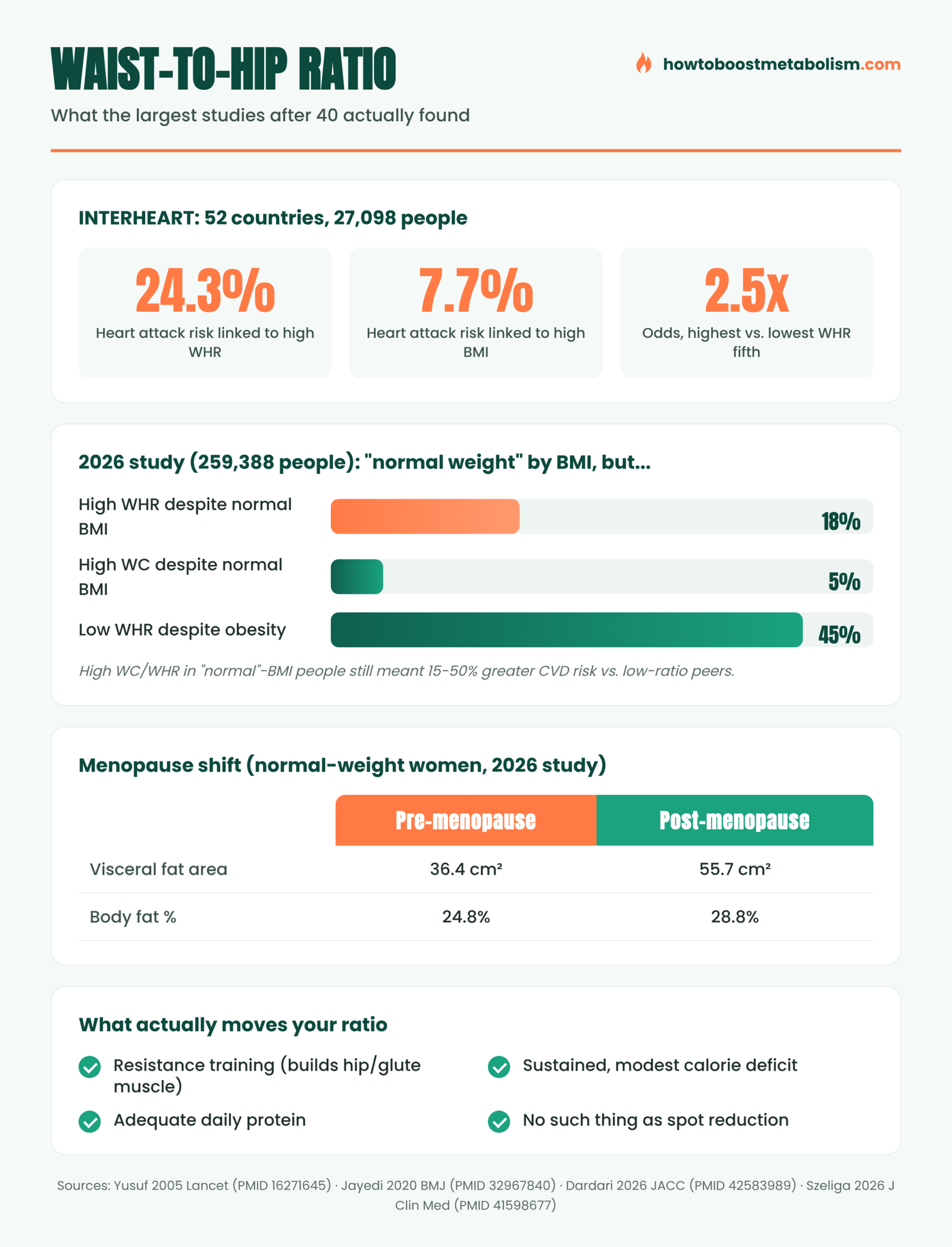
One of the most cited pieces of evidence here is the INTERHEART study, a case-control study of 12,461 people who had just had a heart attack and 14,637 matched controls, across 52 countries. The researchers compared BMI, waist circumference, hip circumference, and WHR as predictors of heart attack risk. The result: BMI showed only a modest association with heart attack risk, and that association became statistically non-significant once other standard risk factors were accounted for. WHR, in contrast, showed a strong, graded relationship — each successive fifth (quintile) of the population carried significantly higher odds than the one before it, up to roughly 2.5-times higher odds comparing the highest fifth to the lowest. The researchers calculated that elevated WHR accounted for an estimated 24.3% of the population’s heart attack risk, compared with only 7.7% attributable to elevated BMI.
A 2020 Meta-Analysis of 72 Prospective Cohort Studies
A dose-response meta-analysis published in The BMJ pooled 72 prospective cohort studies examining several measures of central fatness — waist circumference, hip circumference, waist-to-hip ratio, waist-to-height ratio, and others — against all-cause mortality. Across this very large combined dataset, measures of central fatness, including WHR, showed consistent, graded associations with death from any cause, independent of overall body size. This is the kind of large-scale, pooled evidence that is harder to dismiss as a fluke of any single study population.
A 2026 Look at Over 259,000 People Across 15 Cohorts
The most recent large analysis, published in the Journal of the American College of Cardiology in 2026, pooled data from 15 cohorts (the Cross-Cohort Collaboration) covering more than 259,000 participants with a median follow-up of 20 years, tracking nine separate cardiovascular outcomes. Two findings stand out for anyone in their 40s paying attention to their own numbers. First, central adiposity measures frequently disagreed with BMI category: among people classified as “normal weight” by BMI, 18% still had a high WHR, and among people classified as “overweight,” 40% had a high WHR. Second, that disagreement mattered clinically — people with normal or overweight BMI but elevated WC or WHR carried 15% to 50% greater risk for most cardiovascular outcomes than people in the same BMI category with a lower ratio. Notably, among women specifically, having obesity but a *low* WHR did not fully protect against elevated risk the way it appeared to in men — a reminder that WHR is a strong signal, not a complete substitute for a full risk picture.
| Sex | Lower risk | Increased risk | High risk |
|---|---|---|---|
| Men | < 0.90 | 0.90 – 0.99 | ≥ 1.00 |
| Women | < 0.80 | 0.80 – 0.84 | ≥ 0.85 |
At a glance: commonly cited WHR risk bands (adapted from World Health Organization reference ranges). These are population-level cutoffs used in research, not an individual diagnosis.
Free download
🔥 The Metabolism Starter Kit
3 honest guides: a 7-day reset plan, a foods cheat-sheet and 12 metabolism myths debunked. No spam — unsubscribe anytime.
Why Waist-to-Hip Ratio Often Rises After 40 — Especially Around Menopause
A 2026 study in the Journal of Clinical Medicine measured body composition in 325 women across the menopausal transition — premenopausal, perimenopausal, and postmenopausal — within the same BMI categories. Across every BMI category, postmenopausal women had significantly lower lean body mass and significantly higher visceral fat area, body fat percentage, and waist-to-hip ratio than premenopausal women. The shift was actually most pronounced in normal-weight women: visceral fat area roughly climbed from an average of 36.4 cm² premenopause to 55.7 cm² postmenopause, even though these women were not classified as overweight by BMI at any point. This is a real, hormonally driven redistribution of fat tied to declining estrogen — it is not evidence that someone “let themselves go,” and it will not respond to willpower alone. It responds to the same levers that improve body composition at any age, applied consistently: resistance training, adequate protein, and management of total calorie intake. Related reading: how metabolism and training needs shift specifically around menopause in our guide to boosting metabolism after 50 and through menopause.
Waist-to-Hip Ratio vs. Waist Circumference Alone
A reasonable question is why bother with a ratio at all — why not just track waist circumference by itself? In practice, both measures tend to move together and both independently predict risk in large cohort studies, including the 2026 Cross-Cohort Collaboration analysis above, which tracked both WC and WHR across the same 259,000-plus participants. Waist circumference alone is simpler to measure consistently and is what most clinical guidelines default to for a quick office check. WHR adds a layer of context by normalizing the waist number against your own hip size, which matters because two people with identical waist measurements but very different hip measurements are not carrying the same shape of risk. A tall, narrow-hipped man with a 38-inch waist is in a different risk picture than a wider-hipped woman with the same 38-inch waist. For most people, tracking waist circumference alone over time and knowing your approximate WHR as a periodic check is a practical middle ground — you don’t need both numbers daily.
How to Measure Your Own Waist-to-Hip Ratio
- Stand relaxed, breathe out normally, and measure your waist at the midpoint between the bottom of your ribcage and the top of your hip bone (this is usually just above the belly button, not necessarily the narrowest point of your torso).
- Measure your hips at the widest point around your buttocks.
- Divide the waist measurement by the hip measurement, using the same units for both (inches or centimeters).
- Re-measure under the same conditions every 4–8 weeks — first thing in the morning, before eating — rather than daily; day-to-day bloating and hydration swing the number more than real fat loss does over that short a window.
What Actually Moves the Number (It’s Not Spot Reduction)
No exercise burns fat preferentially from one location, including the waist — a well-established finding across decades of exercise physiology research. What does move WHR over time is a combination of two things: reducing total and especially visceral fat through a sustained, modest calorie deficit with adequate protein, and building muscle in the hips and glutes through resistance training, which can increase the denominator of the ratio. Our comparison of how visceral fat specifically responds to diet and exercise goes into the mechanics in more detail, and sustained elevated cortisol is one well-documented driver of abdominal fat storage worth ruling out if your waist keeps expanding despite consistent habits — see our breakdown of cortisol and weight gain.
A structured, whole-foods eating pattern tends to outperform restrictive fad diets specifically for reducing central/visceral fat over the long run, because it’s sustainable enough to actually stick with past the first few weeks. One widely used structured approach built around this idea is The Mediterranean Diet Plan — worth knowing upfront that, like many digital nutrition programs, it uses a quiz-based funnel and includes a recurring subscription (rebill) component beyond the initial plan, so check the full pricing terms before you buy.
If you want a structured, whole-food eating framework built around the dietary pattern with the strongest long-term evidence for metabolic and cardiovascular health, this is worth a look.
Check Availability →Affiliate link — we may earn a commission at no extra cost to you. Disclosure
What Waist-to-Hip Ratio Does Not Tell You
WHR is a strong population-level signal, not a diagnosis. It can’t distinguish subcutaneous belly fat (just under the skin, lower risk) from visceral fat (around the organs, higher risk) — only imaging like CT, MRI, or DEXA can do that with real precision. It doesn’t account for muscle mass directly, so a very muscular person with wide hips from training can show a WHR that looks more favorable than their actual cardiometabolic risk, and conversely someone can have a technically “normal” BMI and WHR while still carrying meaningful visceral fat. And as the 2026 Cross-Cohort Collaboration data showed, the relationship between body shape and risk isn’t perfectly symmetric between men and women. Use it as one useful, nearly-free data point alongside blood pressure, fasting glucose or HbA1c, and a lipid panel — not as a verdict on its own.
Free download: our Metabolism Starter Kit — a protein calculator, a 7-day meal framework, and a one-page supplement checklist, with zero hype.
Get the Free Starter Kit →Frequently Asked Questions
Is waist-to-hip ratio more accurate than BMI?
For predicting cardiometabolic risk, large cohort studies consistently find waist-to-hip ratio (WHR) carries more information than BMI alone, because it captures where fat sits rather than just how much body mass a person carries. BMI cannot distinguish a muscular 190-lb frame from a 190-lb frame with mostly abdominal fat; WHR, at least partially, can. That said, WHR is not a replacement for a full risk assessment — blood pressure, lipids, blood sugar, and family history still matter.
What is a healthy waist-to-hip ratio after 40?
Widely used thresholds (WHO) flag increased risk above 0.90 for men and above 0.85 for women, with substantially higher risk above about 1.0 (men) or 0.95 (women). These cutoffs were developed mostly in midlife and older adult cohorts, which makes them reasonably applicable after 40, but they are population-level thresholds, not individual diagnoses.
Can you lower your waist-to-hip ratio without losing weight?
Yes, to a degree. Resistance training that builds muscle in the hips and glutes can improve the ratio even with little change on the scale, because it changes the denominator (hip circumference) as well as the numerator. Reducing visceral (abdominal) fat specifically — through a sustained calorie deficit, adequate protein, and regular exercise — moves the numerator. Spot-reduction of fat from the waist alone through ab exercises is not supported by evidence.
Does menopause really change waist-to-hip ratio?
Multiple studies using the same women measured at different reproductive stages show a shift toward more central (abdominal) fat storage and relatively less hip/gluteal fat across the menopausal transition, independent of overall weight change. This is a real, physiologically driven shift tied to declining estrogen, not a personal failure of diet or exercise.
Is a high waist-to-hip ratio dangerous even if I’m not overweight?
The largest reclassification studies to date suggest yes: people classified as normal weight by BMI but with a high waist-to-hip ratio or waist circumference still show meaningfully elevated cardiovascular risk compared with normal-weight people who have a low ratio. This is one of the main practical reasons WHR is worth knowing even for people whose BMI looks fine.
This article is for general educational purposes and is not medical advice. Waist-to-hip ratio is a population-level research tool, not a diagnostic test. Talk to a healthcare provider about your individual cardiovascular and metabolic risk. See our full Medical Disclaimer.