Knee Sleeves for Squatting After 40: Do They Actually Help?
This article may contain affiliate links. If you buy through them, we may earn a small commission at no extra cost to you. See our Affiliate Disclosure and Medical Disclaimer.
Scroll through any gym’s squat rack on a Saturday morning and you’ll see a lot of neoprene: thick, snug sleeves hugging knees that range from 22 to 72 years old. If you’re past 40 and your knees have started announcing themselves on the walk down to depth, it’s a fair question — do knee sleeves actually do anything, or are they just an expensive habit borrowed from Instagram powerlifters? The honest answer, backed by a small but growing body of research, is: a little of both. Here’s what sleeves measurably change, what they don’t, and who after 40 is actually likely to benefit.
| At a Glance | Knee Sleeves for Squatting |
|---|---|
| What they’re for | Compression, warmth, and joint-position feedback around the knee during squats |
| Best-supported benefit | A modest (~3%) boost to squat 1-rep max in controlled testing |
| Not supported by evidence | Injury prevention, broad strength or power gains outside the squat |
| Typical cost | $25-$60 for a quality neoprene pair |
| Who benefits most after 40 | Lifters with knee stiffness, those returning after a break, near-max squatters |
What a Knee Sleeve Actually Does
A knee sleeve is a slip-on neoprene tube, usually 3-7mm thick, worn over the knee joint throughout a training session. Unlike a wrap, it isn’t bound tight immediately before a single maximal lift — it’s simply there, applying mild, constant compression. That compression does three things physiologically: it keeps the joint warmer (neoprene traps body heat), it provides light external pressure that some people interpret as added stability, and it may sharpen proprioception — your brain’s sense of exactly where your knee is in space — which can translate into a more confident, more controlled descent, especially on a knee that already feels a bit unpredictable.
This is a meaningfully different mechanism from a lifting belt, which braces the trunk rather than the knee (we broke down what a belt actually changes in our guide to lifting belts after 40), or from weightlifting shoes, which change the geometry of the ankle and shin rather than compressing the joint itself. Sleeves, shoes, and belts solve different problems — and, as you’ll see below, none of them is a substitute for the other two.
What the Research Actually Shows
The Squat-Specific Strength Bump
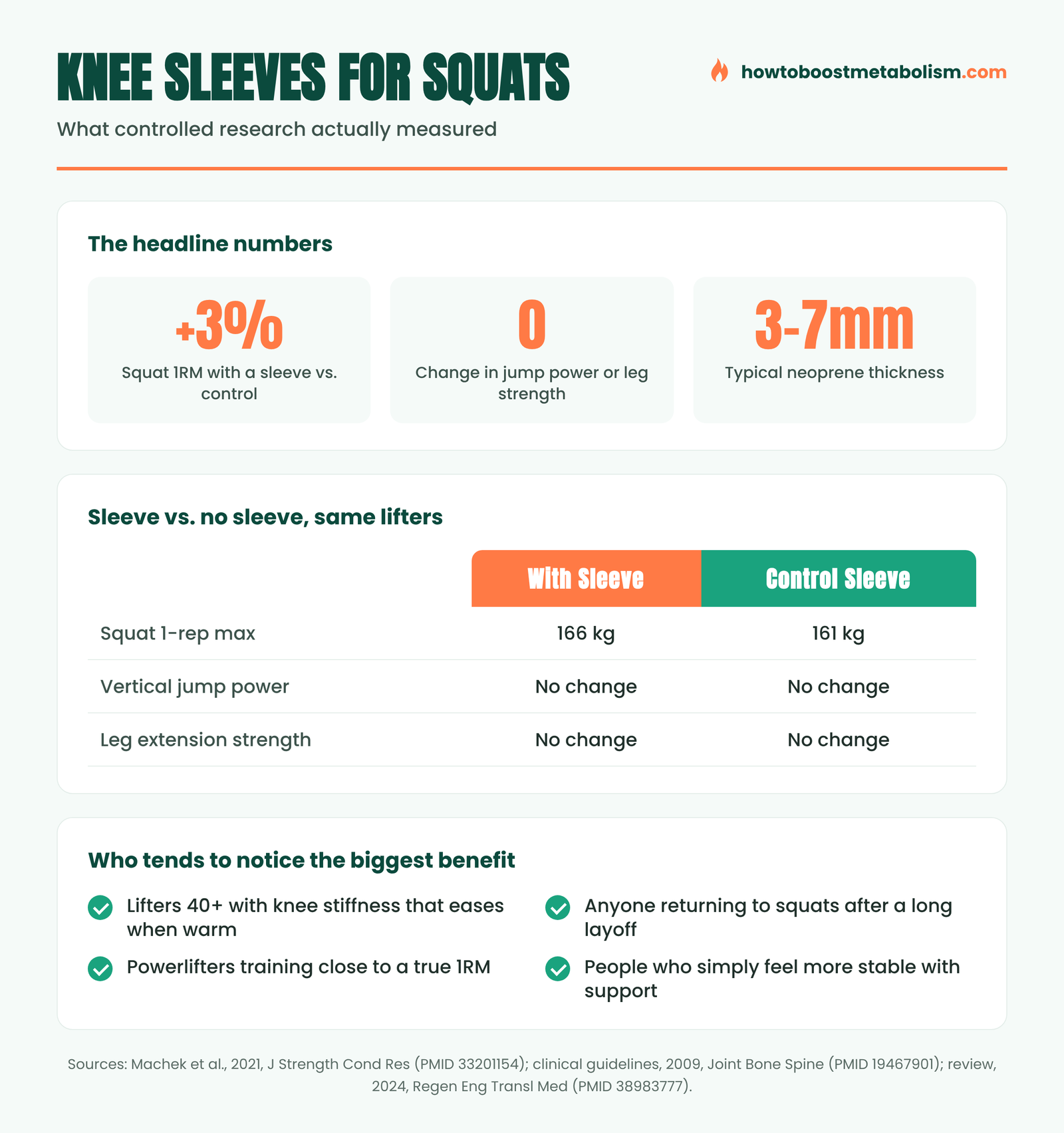
The most directly useful study here is a 2021 trial in the Journal of Strength and Conditioning Research (https://pubmed.ncbi.nlm.nih.gov/33201154/). Fifteen resistance-trained men tested a barbell back squat 1-rep max under three conditions: a minimally supportive control sleeve, a knee sleeve sized to the manufacturer’s normal recommendation, and a knee sleeve one size tighter than normal. Both real knee sleeves let the group squat significantly heavier than the control — about 166 kg versus 161 kg, roughly a 3% increase — with no meaningful difference between the normal-fit and tighter sleeve.
Here’s the part that matters for deciding whether sleeves are worth buying: the same subjects, in the same sessions, also did vertical jump testing (both countermovement and squat jumps, measuring peak and mean power) and single-leg extension testing (1-rep max, reps to failure, total volume). None of those measures improved with the sleeve. In other words, the benefit didn’t show up as some general boost to lower-body strength or power — it showed up specifically on the back squat 1RM test, and nowhere else they measured. The authors’ own conclusion was that this points to an “exercise-specific benefit yet to be fully elucidated,” not a blanket performance enhancement.
Sleeve Tightness and Density: Smaller Effects Than You’d Guess
A newer 2026 study in the Journal of Functional Morphology and Kinesiology (https://pubmed.ncbi.nlm.nih.gov/41718175/) compared low-density and high-density knee sleeves using force-velocity-power testing on the back squat — the kind of analysis that estimates a lifter’s theoretical maximum force, velocity, and power output. The point of studies like this is to pin down whether a stiffer, more compressive sleeve meaningfully changes your mechanics, or whether “more compression” mostly just feels different without moving the needle on actual output. Combined with the 2021 finding that normal-fit and tighter sleeves performed almost identically, the evidence so far suggests you don’t need to chase the most extreme compression level to get the measurable benefit — a properly sized, moderate sleeve appears to do the job.
Knee Sleeves vs. Knee Wraps
It’s worth being precise about the difference, because the two get lumped together constantly. Knee wraps — long elastic bands wound tightly around the knee right before a single competition-style lift — store elastic energy and release it as you drive out of the bottom of the squat, functioning more like a spring-loaded assist. They can add meaningfully more weight to a 1RM than sleeves do, but that extra weight is partly the wrap doing work your muscles didn’t do, which is exactly why wraps are restricted or banned in some raw powerlifting federations. Sleeves don’t store and release energy the same way; their benefit, modest as it is, looks more like genuine joint support and confidence than mechanical assistance.
Do Knee Sleeves Prevent Injury?
This is the claim you’ll see most often in marketing copy, and it’s the one the research actually supports least. None of the controlled studies above tested injury rates — they measured strength, power, and joint mechanics over a single session or a short training block, not whether sleeve-wearers tore fewer ligaments or developed less tendinopathy over months or years of training. That’s an important distinction: “feels more stable” and “is measurably more protected from injury” are not the same claim, and right now only the first one has real evidence behind it. If you’re buying sleeves specifically as injury insurance, it’s worth knowing that promise is mostly untested rather than disproven — the honest position is simply that we don’t know yet.
Free download
🔥 The Metabolism Starter Kit
3 honest guides: a 7-day reset plan, a foods cheat-sheet and 12 metabolism myths debunked. No spam — unsubscribe anytime.
Can Knee Sleeves Help With Joint Pain or Early Arthritis After 40?
This is where a lot of lifters over 40 are actually coming from — not chasing a 1RM personal record, but trying to make a knee that aches on cold mornings feel usable again. Clinical practice guidelines on bracing for knee osteoarthritis (https://pubmed.ncbi.nlm.nih.gov/19467901/) do include knee sleeves as one of several supportive options alongside rest orthoses and unloading braces, which tells you orthopedic and rheumatology specialists take the compression-and-support idea seriously enough to study it formally. But a more recent 2024 review of knee orthoses (https://pubmed.ncbi.nlm.nih.gov/38983777/) is candid about the limits of that evidence: it describes the real-world effectiveness of unloader, patellofemoral, and sleeve-style braces as still “largely debatable,” even though they remain in wide clinical use as a low-risk, nonsurgical option.
The honest takeaway: a knee sleeve is a reasonable, low-cost thing to try if your knee feels stiff or achy and you want more confidence under a loaded bar. It is not a documented treatment for arthritis, a torn meniscus, or any other structural issue, and it won’t reverse the changes that come with 40+ years of use. If knee pain is sharp, swelling, locking your range of motion, or getting worse over weeks rather than better, that’s a conversation for a doctor or physical therapist — not something to squat through in a tighter sleeve.
If your knees — and the rest of your joints — are what’s holding back a return to serious lifting after 40, a structured, beginner-friendly strength program matters more than any single piece of gear. Old School New Body’s F4X method is built specifically around moderate loads and a gradual on-ramp for lifters coming back to training in their 40s, 50s and beyond.
Learn More →Affiliate link — we may earn a commission at no extra cost to you. Disclosure
Note: the program’s marketing claims figures like “your body ages six months faster for every year after 35” and “90% of people over 35 lose muscle” — these are promotional statements on the sales page, not numbers backed by a cited study, so treat them as marketing rather than science. The underlying method — moderate, progressive resistance training for beginners and returning lifters — is a reasonable, well-established approach regardless.
How to Choose a Knee Sleeve
- Thickness: 3mm for general training and warm-ups, 5-7mm for heavier, near-maximal squat sessions.
- Sizing: measure your knee circumference and follow the brand’s chart — a sleeve that’s too loose does almost nothing, and the research above suggests you don’t need to size down further than “normal” to get the benefit.
- Material: look for double-stitched neoprene seams if you’ll be squatting heavy; cheaper single-stitch sleeves tend to tear at the seam first.
- Pair, not single: most lifters wear two for symmetry, though a single sleeve on a specific knee is common if only one side is bothering you.
Caring for Your Sleeves
Neoprene loses some of its compressive snap over time, especially if it’s balled up damp in a gym bag after every session. Rinse sleeves with cool water and let them air dry fully before storing them flat or rolled — not folded in a tight knot, which creases the material along the same lines every time. Most quality neoprene sleeves last one to three years of regular use before the compression noticeably fades; if a sleeve that used to feel snug now slides down your shin mid-set, that’s your sign it’s time to replace it rather than size down again.
Common Mistakes
- Buying a size based on “medium/large/XL” labels instead of the brand’s actual circumference chart — sizing varies a lot between manufacturers.
- Expecting a sleeve to fix pain that’s actually coming from poor squat depth, tight ankles, or weak glutes — a sleeve manages symptoms, it doesn’t correct mechanics.
- Wearing sleeves for every single set, including empty-bar warm-ups, which can make the knee feel stiffer rather than warmer once you take them off.
- Ignoring sharp or worsening pain because “the sleeve usually helps” — compression can mask a signal that needs a professional look, not more training volume.
If your squat setup also needs work on the footwear side, our breakdown of weightlifting shoes and squat depth after 40 covers the other major piece of gear lifters ask about, and our guide to lifting belts after 40 explains the trunk-bracing side of the equation. If joint-friendly training volume is more the issue than any single piece of gear, blood flow restriction training after 40 is worth a look as a lower-load option for sore or cranky joints.
Free download: our Metabolism Starter Kit — a protein calculator, a 7-day meal framework, and a one-page supplement checklist, with zero hype.
Get the Free Starter Kit →Frequently Asked Questions
Do knee sleeves actually increase squat strength?
In one controlled study, a neoprene knee sleeve sized to the manufacturer’s recommendation (or one size tighter) let lifters squat about 3% heavier on a one-rep max test (166 kg vs. 161 kg with a minimally supportive control sleeve). That same study found no improvement in vertical jump, leg extension strength, or endurance — so the benefit looks squat-specific, not a general strength or power boost.
Are knee sleeves the same as knee wraps?
No. Knee wraps are tightly bound around the knee right before a maximal lift to store elastic energy and create a noticeable ‘bounce’ out of the bottom of a squat — effectively increasing how much weight you can move, but at some cost to how much work your muscles actually do. Knee sleeves are slip-on, less constrictive, worn through a whole training session, and work mainly through compression, warmth and joint-position feedback rather than elastic rebound.
Can knee sleeves help with knee pain or early arthritis after 40?
Clinical guidelines list knee sleeves as one option — alongside unloading braces and activity changes — for managing knee osteoarthritis symptoms, and many lifters in their 40s and beyond report that the compression and warmth make a stiff or achy knee feel more stable under load. That said, a 2024 review of knee orthoses concluded their real-world effectiveness is still ‘largely debatable,’ and a sleeve does not treat a structural problem — it is a comfort and confidence tool, not a cure. Persistent or worsening knee pain deserves a medical evaluation, not just a sleeve.
What thickness of knee sleeve should I buy?
Neoprene sleeves are usually sold in 3mm, 5mm, or 7mm thickness. Thinner (3mm) sleeves are common for general training, mobility work, or warm-up sets because they’re less restrictive and breathe better. Thicker 5-7mm sleeves are the powerlifting-competition standard — warmer, more compressive, and more supportive under near-maximal loads, but also tighter to put on and hotter to wear for a full session.
Do I need knee sleeves if I don’t have any knee pain?
Not necessarily. The research doesn’t show sleeves preventing injury, and plenty of pain-free lifters squat heavy for years without them. They’re most worth considering after 40 if you notice knee stiffness that eases once you’re warmed up, you’re returning to squatting after a layoff, or you simply like the extra stability and warmth under heavier loads. If your squat is comfortable and your depth and form are solid, sleeves are optional, not mandatory.