Metformin and Strength Training After 40: The Trade-Off
This article may contain affiliate links. If you buy through them, we may earn a small commission at no extra cost to you. See our Affiliate Disclosure and Medical Disclaimer.
Metformin is the most-prescribed drug for type 2 diabetes on earth, and in the last several years it’s also picked up a second reputation: a cheap, well-tolerated “longevity drug” that some people without diabetes take off-label, hoping it slows aging. At the same time, you’re over 40 and lifting weights specifically to build or keep muscle. Do those two goals clash?
The research says: sometimes, yes — and the data is more specific and more interesting than a simple yes-or-no answer. This is written for general education, not as medical advice about a prescription drug; if you take metformin or are considering it, this is a conversation to have with the doctor who prescribed it, not something to decide from a blog post.
The Study That Settled the Basic Question: The MASTERS Trial
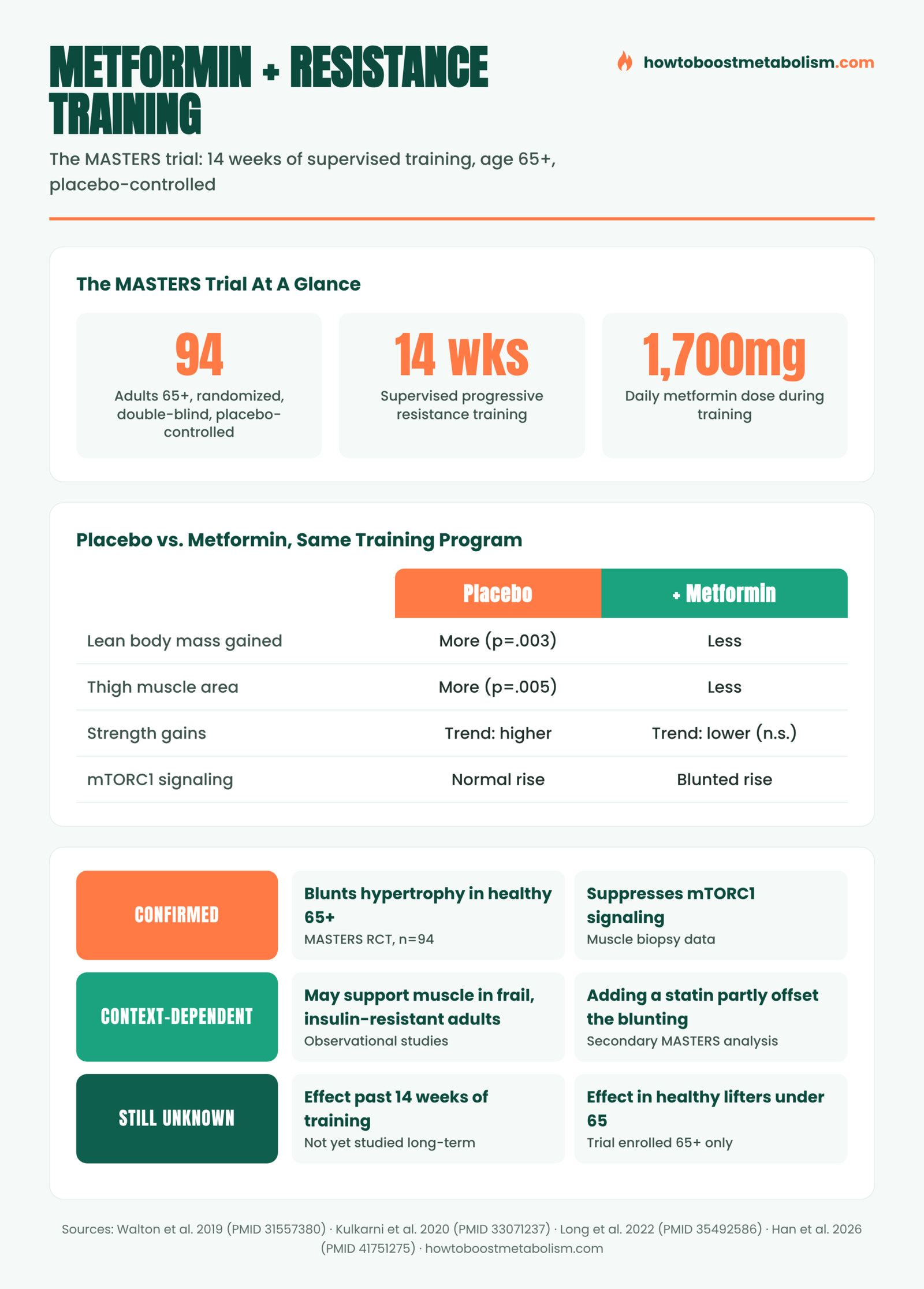
Before 2019, the link between metformin and muscle response to training was mostly theoretical, built on how the drug works at the cellular level (more on that below). The MASTERS trial changed that. Researchers at the University of Kentucky and University of Alabama at Birmingham randomized 94 healthy adults aged 65 and older to take either 1,700 mg/day of metformin or a placebo, then put every participant through 14 weeks of identical, supervised progressive resistance training (Walton et al., 2019, Aging Cell).
The hypothesis going in was that metformin might actually help — it lowers chronic, low-grade inflammation, and inflammation is one theory for why older adults respond unevenly to resistance training. The result was the opposite. The placebo group gained significantly more lean body mass (p = .003) and more thigh muscle mass by CT scan (p < .001) than the metformin group. Increases in thigh muscle area (p = .005) and muscle density (p = .020) were also greater on placebo. Strength gains trended lower with metformin too, though that difference didn't reach statistical significance.
| Outcome after 14 weeks of identical training | Placebo | Metformin |
|---|---|---|
| Lean body mass | Greater gain (p = .003) | Smaller gain |
| Thigh muscle area (CT scan) | Greater gain (p = .005) | Smaller gain |
| Muscle density (CT scan) | Greater gain (p = .020) | Smaller gain |
| Strength | Trend: higher | Trend: lower (not significant) |
| Muscle fiber hypertrophy (biopsy) | No significant difference | No significant difference |
Worth flagging plainly: at the level of individual muscle fibers under the microscope, metformin didn’t block hypertrophy outright — fiber size, satellite cell activity, and macrophage response to training were similar between groups. The gap showed up at the whole-muscle, CT-scan level and in the signaling pathways that drive long-term adaptation, which points to a dampened overall response rather than training being completely cancelled out.
Why: The AMPK/mTOR Tug-of-War
Metformin’s primary mechanism is activating an enzyme called AMPK (AMP-activated protein kinase), which is part of how it improves insulin sensitivity and lowers blood sugar. The problem for muscle building is that AMPK and mTORC1 — the pathway that drives muscle protein synthesis after resistance training — work in opposition. AMPK activation tends to suppress mTORC1 signaling. A 2020 follow-up analysis of the same MASTERS cohort found exactly that pattern in muscle biopsies: metformin was associated with a trend toward blunted mTORC1 signaling increases after training, alongside changes in gene-expression pathways tied to muscle remodeling (Kulkarni et al., 2020, Aging).
That same analysis found something worth not glossing over, though: metformin also nudged several aging-related gene expression patterns in a favorable direction beyond what training alone did. The researchers’ interpretation was blunt about the trade-off — metformin may blunt the hypertrophy signal from training while still offering other aging-relevant benefits at the cellular level. It’s not a simple “metformin is bad for muscle” story; it’s a drug doing two different things at once, and one of them works against what a lifter wants from a training block.
Free download
🔥 The Metabolism Starter Kit
3 honest guides: a 7-day reset plan, a foods cheat-sheet and 12 metabolism myths debunked. No spam — unsubscribe anytime.
An Interesting Wrinkle: Statins Might Offset It
A secondary analysis of the MASTERS data looked at the roughly one-third of participants who were also taking a prescribed statin, and found something unexpected: combined metformin-plus-statin use partially rescued the blunted muscle growth response compared to metformin alone, apparently tied to an increase in a specific type of muscle-repair immune cell (Long et al., 2022, Frontiers in Physiology). Strength outcomes weren’t significantly affected either way. This is a secondary, exploratory finding in a subgroup — not something to act on — but it’s a useful reminder that drug interactions in real patients, who are often on more than one medication, don’t always add up the way single-drug studies suggest.
The Longevity Paradox
A 2026 perspective paper pulls the broader literature together and frames the issue as a genuine paradox rather than a contradiction to explain away. Observational studies in frail, insulin-resistant older adults tend to find metformin use associated with less sarcopenia — likely because, in that population, improving metabolic health and lowering inflammation is doing more good for muscle than the AMPK/mTOR interaction is doing harm. But in metabolically healthy older adults doing structured resistance training — closer to the MASTERS trial population — the balance tips the other way, and the drug’s anti-anabolic signaling effect becomes the dominant story (Han et al., 2026, Biomedicines). Same drug, opposite net effect, depending on who’s taking it and why.
If your goal with training after 40 is body recomposition — building or protecting muscle while managing body fat — pairing a structured hypertrophy-and-fasting framework with consistent training is a more directly muscle-focused lever than any supplement or device claim.
See the Program →Affiliate link — we may earn a commission at no extra cost to you. Disclosure
Marketing language around “building muscle and burning fat simultaneously” is a sales framing, not a guaranteed outcome — treat it as a structured training/nutrition system, not a miracle protocol. See our Affiliate Disclosure.
Does This Mean Fasting Supplements or “Metformin Alternatives” Are Safer?
This research sometimes gets stretched into a pitch for natural “metformin alternatives” — berberine is the most common one, often marketed as “nature’s Ozempic” or a gentler substitute. It’s worth being precise here: berberine and metformin both activate AMPK through overlapping pathways, which means there’s no strong biological reason to assume berberine would dodge the same mTOR-suppressing interaction with resistance training that metformin shows in the MASTERS data — that specific head-to-head hasn’t been run. Swapping one AMPK activator for another isn’t automatically a way around this trade-off; it’s a different intervention with a thinner specific evidence base for this exact question.
The more useful takeaway isn’t “find a substitute drug,” it’s recognizing that any intervention that strongly activates AMPK — whether a prescription, a supplement, or extreme calorie restriction — has at least a plausible mechanism for interacting with your training response. That’s a reason to track your own progress (strength numbers, how recovery feels, a periodic body composition check) rather than assume any single compound is a free pass around basic exercise physiology.
If you are also curious how much weight metformin causes on its own, and why, read our guide to metformin for weight loss.
How Long Is 14 Weeks, Really?
It’s worth sitting with how the MASTERS trial’s timeframe relates to real training. Fourteen weeks is a solid training block — enough time to see a measurable strength and muscle response in previously untrained or detrained older adults — but it’s a fraction of a multi-year training career. Nobody has published data on whether the gap between metformin and placebo narrows, stays constant, or widens over two or three years of consistent training. It’s plausible that consistent effort over a longer horizon partially compensates for a slower per-block response; it’s equally plausible that the gap compounds. Treat the known effect size (roughly a third less thigh muscle area gain over 14 weeks in this specific trial) as the best current estimate, not a guaranteed long-term penalty.
Training Adjustments Worth Considering
None of the cited research tests specific training modifications for people on metformin — this section is reasoned from the underlying mechanism, not direct trial evidence, so treat it as a starting point for discussion rather than a settled protocol.
- Prioritize progressive overload consistently, since the blunted signaling response makes consistent training stimulus more important, not less.
- Hit a solid protein target (research on muscle protein synthesis after 40 generally supports roughly 0.7–1g per pound of bodyweight, spread across meals) since protein-driven anabolic signaling works through a partially separate pathway from the one metformin dampens.
- Don’t assume a slower visible response means training “isn’t working” — the biopsy data showed fiber-level hypertrophy signals were still present, just blunted at the whole-muscle level.
- Track objective numbers (working weights, a simple tape-measure or DEXA check every few months) rather than relying on how fast changes are visible in the mirror.
What This Actually Means If You’re On Metformin and Lifting
- Metformin is not a reason to stop resistance training — in the MASTERS trial, both groups still built meaningful muscle and strength; metformin blunted the gain, it didn’t erase it.
- The dampening effect was shown specifically in healthy adults 65 and older on a fixed 1,700 mg/day dose; it has not been specifically tested in healthy lifters in their 40s and 50s, so the magnitude there is not established.
- If blood sugar control is the reason you’re on metformin, that medical benefit doesn’t disappear — this is a conversation about optimizing training response alongside the drug, not about whether to take a prescribed medication.
- Protein intake and total training volume remain the two levers you fully control, regardless of what’s happening with AMPK and mTOR signaling in the background.
- If you’re taking metformin purely for off-label longevity reasons and muscle is your priority, this research is exactly the kind of trade-off to raise with your prescribing doctor.
The bigger picture: resistance training remains one of the most reliably effective interventions available for preserving muscle and function with age, whether or not someone is on metformin. Nothing in this research is an argument against training, or against metformin where it’s medically indicated — it’s an argument for going in with accurate expectations and tracking your own numbers rather than assuming a drug and a training program simply stack with no interaction at all.
At A Glance
| Question | What the research shows |
|---|---|
| Does metformin stop muscle growth from training? | No — it blunts the response, doesn’t eliminate it (MASTERS trial) |
| Who was studied? | Healthy adults 65+, 14 weeks supervised resistance training, 1,700 mg/day |
| Mechanism | AMPK activation partially suppresses mTORC1, the main muscle-building signaling pathway |
| Does it affect everyone the same way? | No — frail/insulin-resistant adults may see a net muscle benefit instead |
| Bottom line for lifters under 65 | Not directly studied yet; discuss with your prescribing doctor |
Free download: our Metabolism Starter Kit — a protein calculator, a 7-day meal framework, and a one-page supplement checklist, with zero hype.
Get the Free Starter Kit →Related: If metformin interacts with training, what about the other major diabetes drug class? We broke down what the controlled trials show on SGLT2 inhibitors and strength training.
Frequently Asked Questions
Does metformin cause muscle loss?
Not outright — in the controlled MASTERS trial, people taking metformin still gained muscle from resistance training, just measurably less than those on a placebo doing the identical program. It blunts the training response rather than causing loss on its own.
Why does metformin affect muscle building at all?
Metformin activates AMPK, an enzyme involved in energy regulation and blood sugar control. AMPK and mTORC1 — the signaling pathway that drives muscle protein synthesis after resistance training — work in opposition, so activating one tends to dampen the other.
Should I stop taking metformin to build more muscle?
This is a decision for you and your prescribing doctor, not something to decide based on a training goal alone. Metformin is prescribed for real metabolic reasons, and the research shows training still works while on it, just somewhat less efficiently for muscle gain specifically.
Does this research apply to someone in their 40s, not just older adults?
The controlled trial data comes from adults 65 and older. The AMPK/mTOR mechanism is the same across ages, so a similar effect is plausible in your 40s and 50s, but the specific magnitude has not been directly tested in that age group.
Can anything offset metformin’s effect on muscle gains?
A secondary analysis found that combining metformin with a prescribed statin partially restored the muscle growth response compared to metformin alone, through an unexpected immune-cell mechanism. This is an exploratory finding in a subgroup, not a recommendation to add a medication.
Related Reading
- How to protect muscle while losing weight on a GLP-1 medication
- A strength training plan built for GLP-1 users
- Low testosterone after 40: symptoms worth screening for
- Training to failure vs. reps in reserve: which builds more muscle after 40
- HRV and strength training recovery after 40
This article is for general education and is not medical advice. Never start, stop, or adjust a prescription medication based on information in this article — work directly with your doctor. See our Medical Disclaimer.