SGLT2 Inhibitors and Strength Training After 40
This article may contain affiliate links. If you buy through them, we may earn a small commission at no extra cost to you. See our Affiliate Disclosure and Medical Disclaimer.
Metformin isn’t the only diabetes medication that shares a gym bag with resistance training. A newer class of drugs — SGLT2 inhibitors, sold as empagliflozin (Jardiance), dapagliflozin (Farxiga), and canagliflozin (Invokana) — has become a front-line treatment for type 2 diabetes, partly because of genuine cardiovascular and kidney benefits. They also cause weight loss, which raises an obvious question for anyone over 40 who lifts weights and has been prescribed one: does losing weight on an SGLT2 inhibitor mean losing muscle, and does the drug change what resistance training actually does in the body?
This article is not medical advice, and it isn’t a reason to start, stop, or adjust a prescription. It’s a plain look at what the controlled human trials on this specific combination — SGLT2 inhibitors plus exercise — actually measured, including the parts that are more complicated than a simple yes or no.
What SGLT2 Inhibitors Actually Do
Sodium-glucose cotransporter-2 (SGLT2) inhibitors work in the kidney, blocking the reabsorption of glucose so that excess sugar is excreted in urine instead of staying in the bloodstream. That mechanism is unrelated to how metformin or GLP-1 drugs work, and it has two side effects that matter for this discussion: a steady loss of a few hundred calories a day through urinary glucose, and a mild diuretic effect. Both help explain the weight loss these drugs produce, and both are also plausible reasons researchers started asking what happens to muscle and to exercise adaptations on top of the drug.
Does the Drug Itself Cause Muscle Loss?
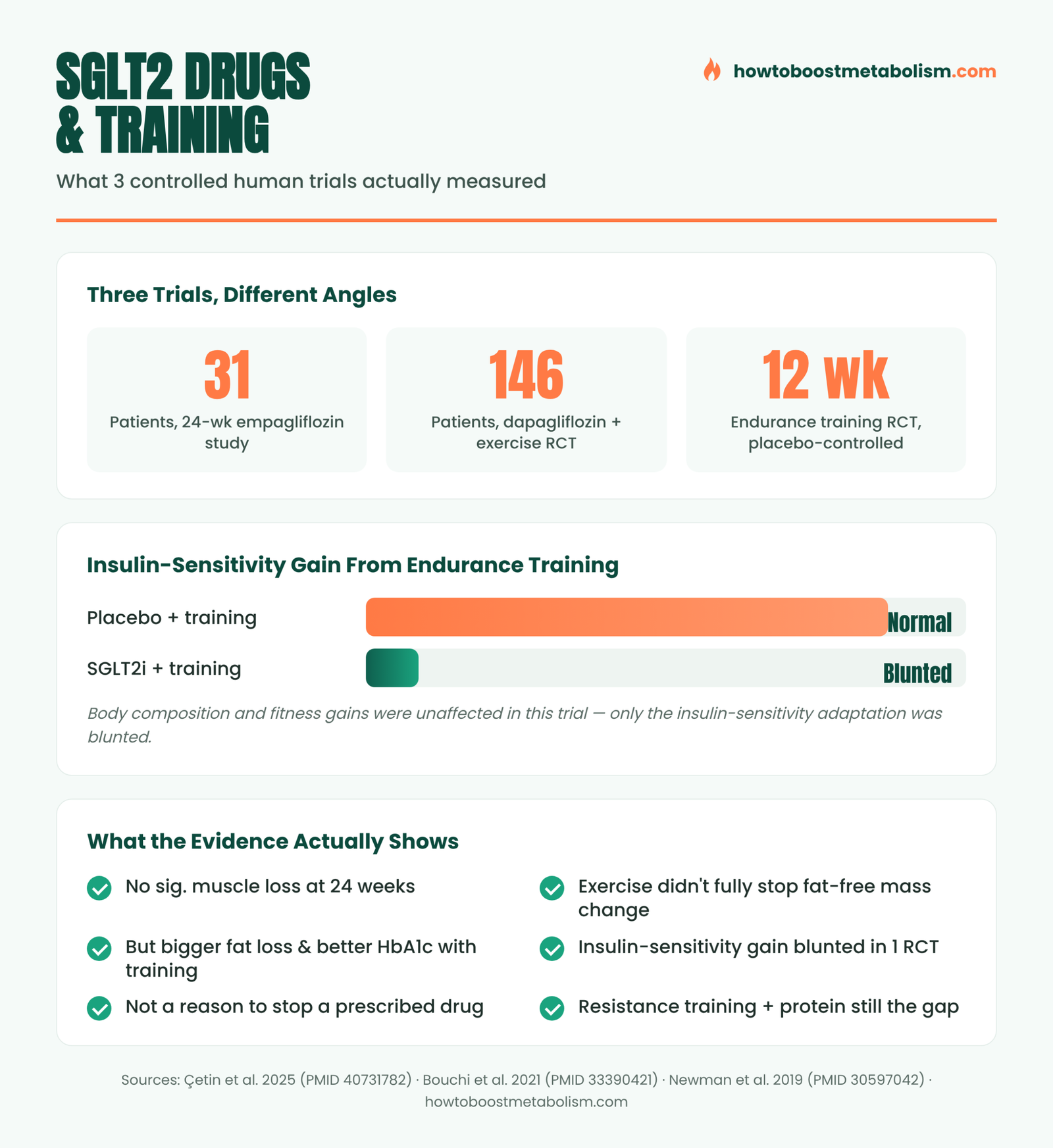
The most directly relevant human study is a 24-week real-world observational study that followed 31 adults with type 2 diabetes, comparing empagliflozin against non-SGLT2i treatment (Çetin et al., 2025, Medicina). None of the participants were on a high-protein diet or a structured resistance program — this was usual care, not an optimized intervention. After six months, the empagliflozin group had significantly improved HbA1c, body weight, and fat mass, but appendicular skeletal muscle mass index barely moved (7.81 to 7.84 kg/m², not statistically significant) and handgrip strength did not change in either group.
Read narrowly, that’s a reassuring result: six months on the drug did not erode muscle mass or strength in this group. But the authors themselves flagged the obvious caveat — their own patients weren’t doing the two things most likely to protect muscle during any weight-loss intervention, and they explicitly recommended that resistance training and adequate protein intake be added for patients at higher sarcopenia risk.
Free download
🔥 The Metabolism Starter Kit
3 honest guides: a 7-day reset plan, a foods cheat-sheet and 12 metabolism myths debunked. No spam — unsubscribe anytime.
What Happens When You Add Resistance Training On Top
A separate, considerably larger randomized controlled trial tested that exact addition. Researchers assigned 146 people with type 2 diabetes to either 24 weeks of dapagliflozin alone, or dapagliflozin plus an intensive exercise program that included resistance training (Bouchi et al., 2021, Endocrine Journal). The primary outcome — change in fat-free mass — showed no significant difference between the groups (a difference of just -0.1 kg). In other words, adding exercise did not fully prevent whatever fat-free mass change happened with the drug.
That sounds discouraging until you look at the secondary outcomes: the exercise group lost significantly more trunk (visceral) fat than the drug-alone group, and higher adherence to the resistance training sessions was associated with better improvements in HbA1c and a marker of chronic inflammation (high-sensitivity CRP). So exercise didn’t win on the single number researchers were most worried about, but it clearly won on the metabolic outcomes that arguably matter more for long-term health.
The Study That Raises a More Specific Flag
The most mechanistically interesting trial didn’t look at resistance training at all — it looked at endurance exercise, but it’s worth including because it shows exactly how a drug can interact with training in a narrow, specific way rather than a blanket one. Thirty sedentary, overweight adults were randomized to 12 weeks of supervised endurance training with either a placebo or dapagliflozin, in a double-blind design (Newman et al., 2019, Journal of Clinical Endocrinology & Metabolism). Exercise training improved body composition, peak oxygen uptake, and skeletal muscle citrate synthase activity equally in both groups — the drug did not blunt any of those classic training adaptations.
What the drug did blunt was something more specific: the improvement in insulin sensitivity that exercise training normally produces. After training, fasting blood glucose was higher and the increase in insulin sensitivity (measured by the Matsuda index) was essentially erased in the SGLT2 inhibitor group compared with placebo. A 2024 mechanistic review of this literature frames the pattern this way: leading antihyperglycemic drugs — metformin, SGLT2 inhibitors, and GLP-1 agonists — each interact with exercise through different, still-incompletely-mapped pathways in skeletal muscle (Newsom & Robinson, 2024, Physiological Reports), and the interactions “tend to be adaptation-specific rather than all-or-nothing.
At a Glance: What Each Trial Actually Measured
| Trial | Muscle/Training Finding | Caveat |
|---|---|---|
| Çetin 2025 (empagliflozin, 24 wks, n=31) | No sig. change in skeletal muscle mass index or handgrip strength | No structured resistance training or high-protein diet in protocol |
| Bouchi 2021 (dapagliflozin + exercise, 24 wks, n=146) | No difference in fat-free mass vs. drug alone; bigger trunk-fat loss with exercise | Exercise group had better HbA1c and CRP trends |
| Newman 2019 (dapagliflozin + endurance training, 12 wks, n=30) | Body comp. and fitness gains unaffected; insulin-sensitivity gain blunted | Narrow, adaptation-specific interaction, not a blanket blunting effect |
What This Means If You’re Lifting on an SGLT2 Inhibitor
- The strongest available evidence does not show SGLT2 inhibitors causing meaningful muscle loss or strength loss over several months, but that evidence comes from patients who weren’t training or eating a high-protein diet in the first place.
- Adding resistance training to an SGLT2 inhibitor did not fully prevent fat-free mass changes in the one trial that tested it directly, but it produced clearly better fat-loss and metabolic outcomes than the drug alone — the point of lifting isn’t only the fat-free mass number.
- The clearest documented interaction so far is narrow: a blunted improvement in insulin sensitivity after endurance training, not a blanket cancellation of training adaptations.
- None of this is a reason to stop a prescribed medication. It’s a reason to make sure resistance training and adequate protein intake are actually part of the plan, since that’s the exact gap the research keeps pointing back to.
Free download: our Metabolism Starter Kit — a protein calculator, a 7-day meal framework, and a one-page supplement checklist, with zero hype.
Get the Free Starter Kit →Why the Loop Diuretic Effect Matters for Lifters Specifically
There’s a practical wrinkle that none of the three trials above were designed to measure directly, but that matters to anyone training hard: SGLT2 inhibitors have a mild diuretic effect, and that effect is strongest in the first few weeks after starting the drug. For a lifter, that can show up as feeling flatter in the gym, slightly lower blood pressure on standing, or more noticeable fatigue during the adaptation period — none of which is the same thing as losing muscle, but all of which can feel similar day to day and get misread as ‘the drug is making me weaker.’ This is also why clinicians commonly advise extra attention to fluid and electrolyte intake around the start of therapy, particularly during hot weather or long training sessions, and it’s a good conversation to have with a prescribing doctor rather than guessing.
It’s worth separating this from the insulin-sensitivity finding in the Newman trial. That blunting effect showed up after 12 weeks of sustained endurance training, well past any initial diuretic adjustment period, which is part of why the researchers interpreted it as a genuine pharmacological interaction with the exercise-adaptation pathway rather than a short-term fluid-shift artifact.
How This Compares to Metformin
Because SGLT2 inhibitors and metformin are often discussed in the same breath, it’s worth being specific about how the two interactions differ. The MASTERS trial, covered in our separate breakdown of metformin and strength training, found that metformin blunted the actual hypertrophy response to 14 weeks of resistance training in adults 65 and older — less muscle and thigh lean-mass gain in the metformin group compared with placebo, alongside suppressed mTORC1 signaling at the cellular level. That’s a direct hypertrophy-pathway interaction. The SGLT2 inhibitor data reviewed here points somewhere different: no clear effect on muscle mass or strength itself, but a narrower hit to the insulin-sensitivity benefit of endurance exercise. Lumping ‘diabetes drugs’ together as one category misses that these two mechanisms are not interchangeable, and a reasonable question for your own prescribing doctor is which class, if either, you’re actually on — not whether ‘diabetes medication’ in general is a problem for the gym.
What We Still Don’t Know
These are still a handful of small-to-moderate trials, mostly 12 to 24 weeks long, in people with established type 2 diabetes — not healthy lifters over 40 taking the drug for off-label metabolic reasons, and not multi-year data on what happens with consistent training over the long run. Whether the insulin-sensitivity blunting seen with endurance training also shows up with resistance training alone has not been directly tested. Until larger, longer trials exist, the honest answer is that this is an active research question, not a settled one.
If a drug interaction is making you think harder about your metabolic baseline, a structured intermittent fasting protocol is one of the better-studied ways to improve insulin sensitivity without medication changes. Eat Stop Eat lays out a simple, research-informed fasting framework (created by a researcher with a master’s degree in applied human nutrition) that many readers use alongside — never instead of — medical care.
Learn More →Affiliate link — we may earn a commission at no extra cost to you. Disclosure
Related reading: our breakdown of metformin and strength training after 40 covers the other major diabetes drug with a documented exercise interaction, and our look at continuous glucose monitors during strength training is useful if you’re trying to see these effects in your own data. For the bigger picture on blood sugar and training, see how strength training improves blood sugar even without weight loss and what to eat on a GLP-1 medication, and our explainer on insulin resistance and metabolism.
Frequently Asked Questions
Do SGLT2 inhibitors cause muscle loss?
The best controlled data so far — a 24-week observational study of empagliflozin in people with type 2 diabetes — found no significant change in appendicular skeletal muscle mass index or handgrip strength after six months, even though body weight and fat mass dropped. That is reassuring, but the study population was not doing structured resistance training or eating a high-protein diet, so it describes what happens without those supports in place, not the best-case scenario.
Does resistance training protect against any downsides?
A 146-person randomized trial added intensive exercise, including resistance training, on top of dapagliflozin. It did not fully prevent the loss of fat-free mass compared with the drug alone, but it did produce a significantly larger drop in trunk fat and was linked to better improvements in HbA1c and inflammation markers. In other words, exercise did not cancel out every effect of the drug, but it still added real, measurable benefit.
Can SGLT2 inhibitors blunt the benefits of exercise training?
One 12-week randomized, double-blind trial in previously sedentary adults found that dapagliflozin did not interfere with the body-composition or fitness gains from endurance training, but it did blunt the improvement in insulin sensitivity that exercise training normally produces. That is a narrower finding than ‘exercise doesn’t work on this drug’ — it points to one specific metabolic adaptation, not all of them.
Should I stop my SGLT2 inhibitor to lift weights more effectively?
No. This article is not medical advice, and no one should change a prescribed diabetes medication based on a blog post. SGLT2 inhibitors are prescribed for real cardiovascular and kidney benefits that generally outweigh a theoretical, still-unsettled interaction with exercise adaptations. Any concern about how a medication interacts with your training should go to the prescribing doctor, not be solved by stopping the drug on your own.
What should someone on an SGLT2 inhibitor actually do differently?
Based on the available trials, the two things that are already recommended for general healthy aging — structured resistance training at least twice a week and adequate dietary protein — are exactly what researchers flagged as the gap in the studies that found no muscle benefit. Nobody has proven that adding them erases every drug interaction, but they are the only levers an individual actually controls, and they are unlikely to do harm.
This article is for educational purposes only and is not medical advice. SGLT2 inhibitors are prescription medications; never start, stop, or change a dose based on information from a website. Talk to your prescribing doctor about how your medication and training plan interact. See our Medical Disclaimer.