Training to Failure vs. RIR After 40: What Wins?
This article may contain affiliate links. If you buy through them, we may earn a small commission at no extra cost to you. See our Affiliate Disclosure and Medical Disclaimer.
“Leave something in the tank” or “go until the bar stops moving”? Few debates in strength training generate as much confident, contradictory advice as whether you should train to complete muscular failure or stop a rep or two short. After 40, the stakes of getting this wrong aren’t just a slightly suboptimal workout — they’re whether you’re still recovered enough to train again in two days, or still nursing a dead, achy set of legs on day four. The research on this is more settled than the gym-floor arguments suggest, and the honest answer is almost disappointing in how unspectacular it is: training to failure barely moves the needle on muscle growth, and it costs you considerably more fatigue to get that tiny edge.
At a Glance
| Outcome | Training to Failure | Stopping With Reps in Reserve |
|---|---|---|
| Muscle hypertrophy, equal training volume | No meaningful advantage | No meaningful advantage |
| Maximal strength gains | Similar, sometimes less | Similar, sometimes more |
| Acute velocity/fatigue loss (same session) | ~22% drop across sets | ~6-9% drop across sets |
| Perceived soreness & discomfort | Highest | Lower, scales with proximity to failure |
| Recovery time needed before next session | Longest | Shortest |
| Best use case | Occasional, isolation-exercise finishers | Default for most working sets |
What the Meta-Analyses Actually Show
The most rigorous answer on hypertrophy comes from a 2023 systematic review and meta-analysis in Sports Medicine by Refalo and colleagues, who pooled 15 studies comparing resistance training performed to momentary muscular failure, to various non-failure definitions, or to different velocity-loss thresholds. Across all definitions of “set failure,” there was a statistically significant but trivial advantage for training closer to failure on muscle hypertrophy (effect size 0.19). When the analysis was narrowed specifically to momentary muscular failure versus clearly non-failure sets, that edge shrank to a non-significant 0.12, and training to high versus moderate velocity-loss thresholds showed essentially no difference either (0.08). In plain terms: going all the way to failure is, at best, worth a sliver of extra muscle growth — and that sliver disappears once you look only at true muscular failure rather than a looser definition of “a hard set.”
A separate 2021 meta-analysis in the Journal of Strength and Conditioning Research by Vieira and colleagues reached a similar conclusion from a different angle: when training volume was equalized between groups, there was no meaningful difference in hypertrophy between training to failure and not training to failure. Where the two approaches did differ was on strength and power — and not in favor of failure training. Training performed to failure showed no advantage, and sometimes a disadvantage, for maximal strength and power output compared with stopping short, particularly when total training volume wasn’t matched between groups.
Free download
🔥 The Metabolism Starter Kit
3 honest guides: a 7-day reset plan, a foods cheat-sheet and 12 metabolism myths debunked. No spam — unsubscribe anytime.
The Fatigue Bill You Actually Pay
If failure training doesn’t reliably build more muscle, what does it reliably do? Cost you more fatigue, immediately and for longer. A 2023 trial in Sports Medicine – Open, again from Refalo and colleagues, had 24 resistance-trained men and women perform barbell bench press to either momentary muscular failure, 1 rep in reserve, or 3 reps in reserve, and tracked bar-velocity loss as an objective fatigue marker. Training to failure produced a 25% drop in lifting velocity measured 4 minutes after finishing, compared with 13% for 1-RIR and just 8% for 3-RIR. Velocity loss from the first set to the final set followed the same pattern — a steep 22% decline for failure training versus 9% and 6% for the two RIR conditions. At 24 hours post-exercise, failure and 1-RIR training still showed measurable velocity deficits, while 3-RIR training had already fully recovered. As lifters got closer to failure, their ratings of discomfort, exertion, and muscle soreness all climbed in step, and perceived recovery got noticeably worse.
That’s the real trade being made at the gym every time someone grinds out a brutal last rep: a measurable, immediate, and next-day fatigue cost, in exchange for a hypertrophy benefit that the best current evidence says is close to zero once you isolate true failure specifically. For someone training three or four times a week around a full-time job, kids, and a body that doesn’t bounce back from a hard squat session as quickly as it did two decades ago, that’s not a neutral trade — it’s a tax on your next two workouts.
Does This Still Apply If You’re Over 40?
A reasonable objection to all of the above: most of these trials were done in younger resistance-trained populations, not specifically in lifters over 40 or 50. That’s a fair caveat, and it’s worth being honest about it rather than papering over the gap. But a 2025 study in Experimental Gerontology by Gómez-Redondo and colleagues speaks directly to this population: it assessed how accurately community-dwelling older adults (average age 68) could predict their own reps in reserve during resistance exercise, compared with their actual measured proximity to failure. The practical implication is reassuring — RIR-based autoregulation isn’t just a young lifter’s tool; older adults can use subjective effort ratings to gauge how close to failure they actually are with reasonable validity, which means the “stop a rep or two short” strategy is something you can actually execute accurately, not just something you’re told to do and have to guess at.
Combine that with what we already know changes with age — slower recovery between hard sessions, generally higher injury risk when technique degrades under extreme fatigue, and more competing life stressors eating into total recovery capacity — and the case for defaulting to reps-in-reserve rather than grinding every set to failure gets stronger specifically for a 40-plus lifter, even though the underlying hypertrophy data wasn’t collected exclusively in this age group.
So When Does Training to Failure Make Sense?
- On single-joint, lower-skill-demand exercises (leg extension, cable lateral raise, biceps curl) where the failure point doesn’t compromise your technique or your joints the way a failed heavy squat rep can.
- On the very last set of a muscle group for the week, when you have no more sets planned and recovery time before your next session on that muscle is generous.
- Occasionally, as a planned test of where your true limits currently sit — not as your default approach to every set of every session.
- When you’re specifically chasing muscular endurance rather than maximal strength, where the fatigue cost may be more worth paying.
A Note on Machines vs. Free Weights
Where you take a set closer to failure matters almost as much as whether you do. A failed rep on a leg press or a chest-supported row simply means the weight stops moving — there’s no balance point to lose. A failed rep on a free-standing barbell back squat or an overhead press means you may need to bail out of the lift safely, ideally with safety pins set at the right height or a spotter present. If you’re going to occasionally push a set to true failure, machines and well-supported exercises are the lower-risk place to do it; save the reps-in-reserve approach for your free-weight compound lifts where a missed rep has real consequences for your joints and your training schedule.
A Practical RIR Framework
| RIR Target | What It Feels Like | Best Use |
|---|---|---|
| 3-4 RIR | Could do 3-4 more reps with good form | Warm-up sets, technique work, deload weeks |
| 1-2 RIR | One more rep might be sloppy, two is a hard stop | Most working sets, most weeks, most lifts |
| 0 RIR (failure) | Literally cannot complete another rep | Occasional finisher set, isolation exercises only |
If you’ve never rated your own RIR before, it takes a few weeks to calibrate — most lifters underestimate how many reps they actually have left early in a set and overestimate it as fatigue builds. The Gómez-Redondo study above found predictions were reasonably valid in older adults, but “reasonably valid” still means some error in both directions, so treat your first RIR estimates as a rough guide you refine over time, not a precise instrument from day one.
Periodizing Proximity to Failure Across a Training Block
Treating “reps in reserve” as a single fixed number for months at a time misses how useful it is as a dial, not a switch. A common approach among coaches working with lifters in their 40s and beyond is to start a training block at 3-4 RIR in the first week or two — partly to groom technique, partly to ease connective tissue into the block — then gradually tighten toward 1-2 RIR as the block progresses and work capacity builds. The final week before a planned deload is a reasonable place to flirt with 0-1 RIR on a couple of key lifts, precisely because a lower-fatigue week follows immediately after to let the accumulated cost settle. This mirrors the logic in the deload research covered elsewhere on this site: fatigue management works best as a planned, cyclical strategy, not a daily judgment call made set to set with no larger structure behind it.
This also gives you a built-in self-check against the most common failure-training trap: using maximal effort as a substitute for a progression plan. If every set is taken to failure regardless of the week, there’s no way to tell whether you’re actually getting stronger or just getting better at tolerating discomfort at the same weight. Planning RIR across weeks, and tracking the actual load and reps you hit at each target RIR, gives you an honest signal of progress that a workout full of all-out efforts doesn’t.
Managing effort and recovery matters more than raw intensity once you’re training for the long game. Anabolic Fasting pairs a structured training approach with a fasting-based recovery and recomposition framework built for exactly this kind of smarter, not just harder, training.
Learn More →Affiliate link — we may earn a commission at no extra cost to you. Disclosure
A fair note on that program: its marketing language about building muscle and losing fat “at the same time” is a marketing claim, not a guarantee — body recomposition is real but highly individual. Evaluate the actual training and nutrition framework on its own merits.
Related Reading
- Best rep range for muscle growth and fat loss — rep count matters less than people think; so does training to failure.
- Myo-reps and rest-pause training — an advanced technique that intentionally uses failure-adjacent sets in a structured way.
- Do you need a deload week after 40? — how accumulated fatigue from hard training actually affects recovery over weeks, not just within one session.
Free download: our Metabolism Starter Kit — a protein calculator, a 7-day meal framework, and a one-page supplement checklist, with zero hype.
Get the Free Starter Kit →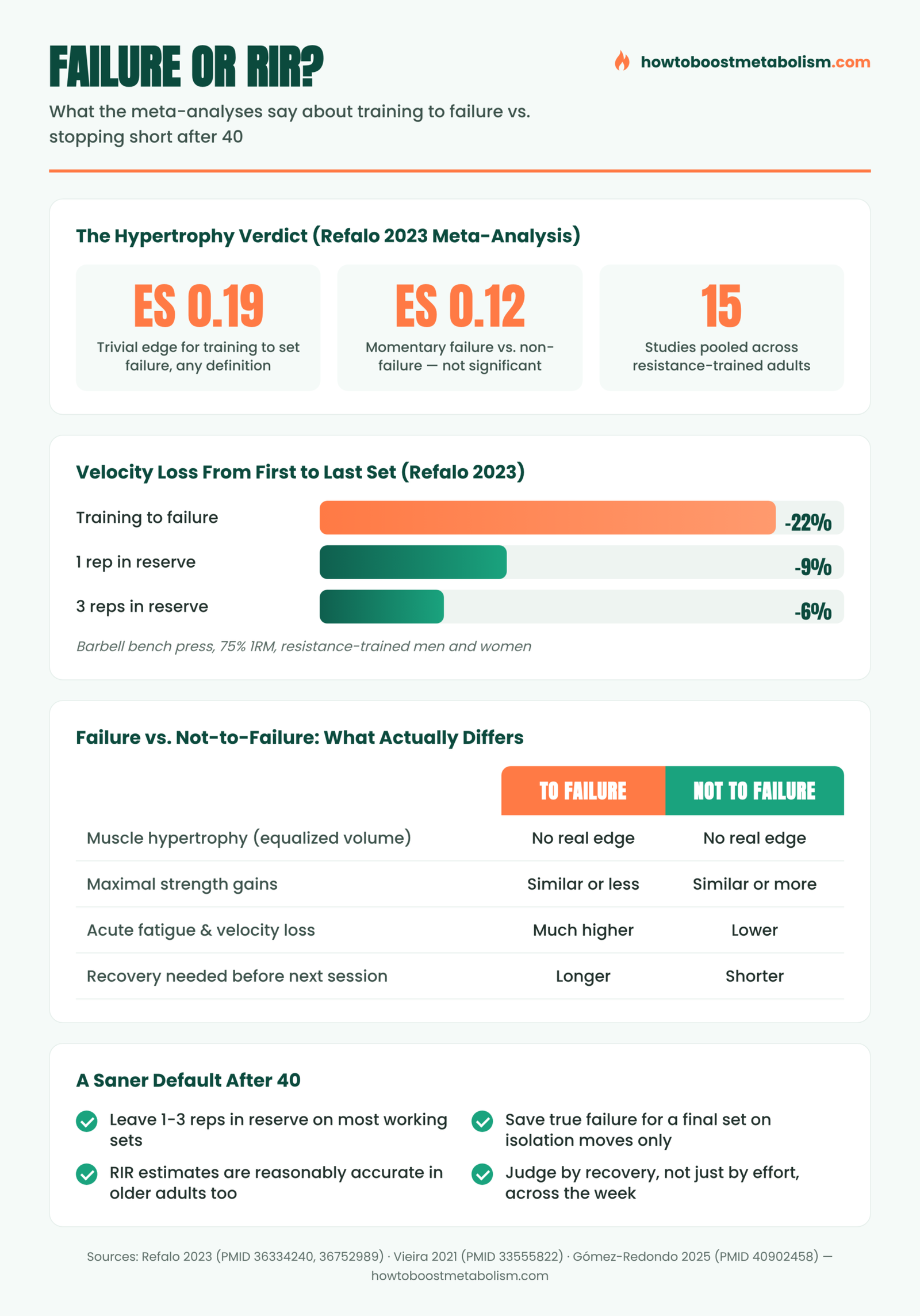
Frequently Asked Questions
Does training to failure build more muscle than stopping a few reps short?
The best current evidence says the advantage is trivial at most. A 2023 meta-analysis of 15 studies found only a small, borderline-significant edge for training to failure overall, and no significant advantage at all when looking specifically at true momentary muscular failure versus clearly non-failure training. Volume and consistent progressive overload over time matter far more than how close to failure each set goes.
Is training to failure worse for building strength?
Evidence suggests it can be. A 2021 meta-analysis found training not to failure produced equal or sometimes greater gains in maximal strength and power output compared with training to failure, especially when total training volume wasn’t matched between the two approaches.
How many reps in reserve should I leave on most sets after 40?
A reasonable default for most working sets is 1-3 reps in reserve, reserving true failure for occasional finisher sets on lower-skill, single-joint exercises. This balances the (small) stimulus benefit of harder sets against the considerably larger fatigue and recovery cost of training to true failure every set.
Can older adults accurately judge their own reps in reserve?
A 2025 study in community-dwelling adults averaging 68 years old found that self-predicted reps in reserve had reasonable validity against objectively measured proximity to failure, supporting RIR-based training as a workable strategy in this age group, not just in young competitive lifters.
How long does it take to recover from a set taken to true failure?
In one controlled trial, velocity (a marker of neuromuscular fatigue) was still measurably reduced 24 hours after training to failure, while sets stopped at 3 reps in reserve had already fully recovered by that point. By 48 hours, differences between all approaches had largely resolved.