Hip Thrust vs. Squat After 40: Which Builds Glutes Best?
This article may contain affiliate links. If you buy through them, we may earn a small commission at no extra cost to you. See our Affiliate Disclosure and Medical Disclaimer.
Walk into almost any gym and you’ll see the same argument play out in equipment choices: lifters loading up a barbell for back squats on one side, and lifters bridging under a loaded bar on a bench for hip thrusts on the other. Both exercises get credited with building a stronger, bigger backside, and fitness influencers tend to pick a side. The actual research is more specific — and more useful — than either camp’s marketing.
| Question | Short answer |
|---|---|
| Which activates the glutes more? | Hip thrust, by a wide margin, in every EMG study measuring it |
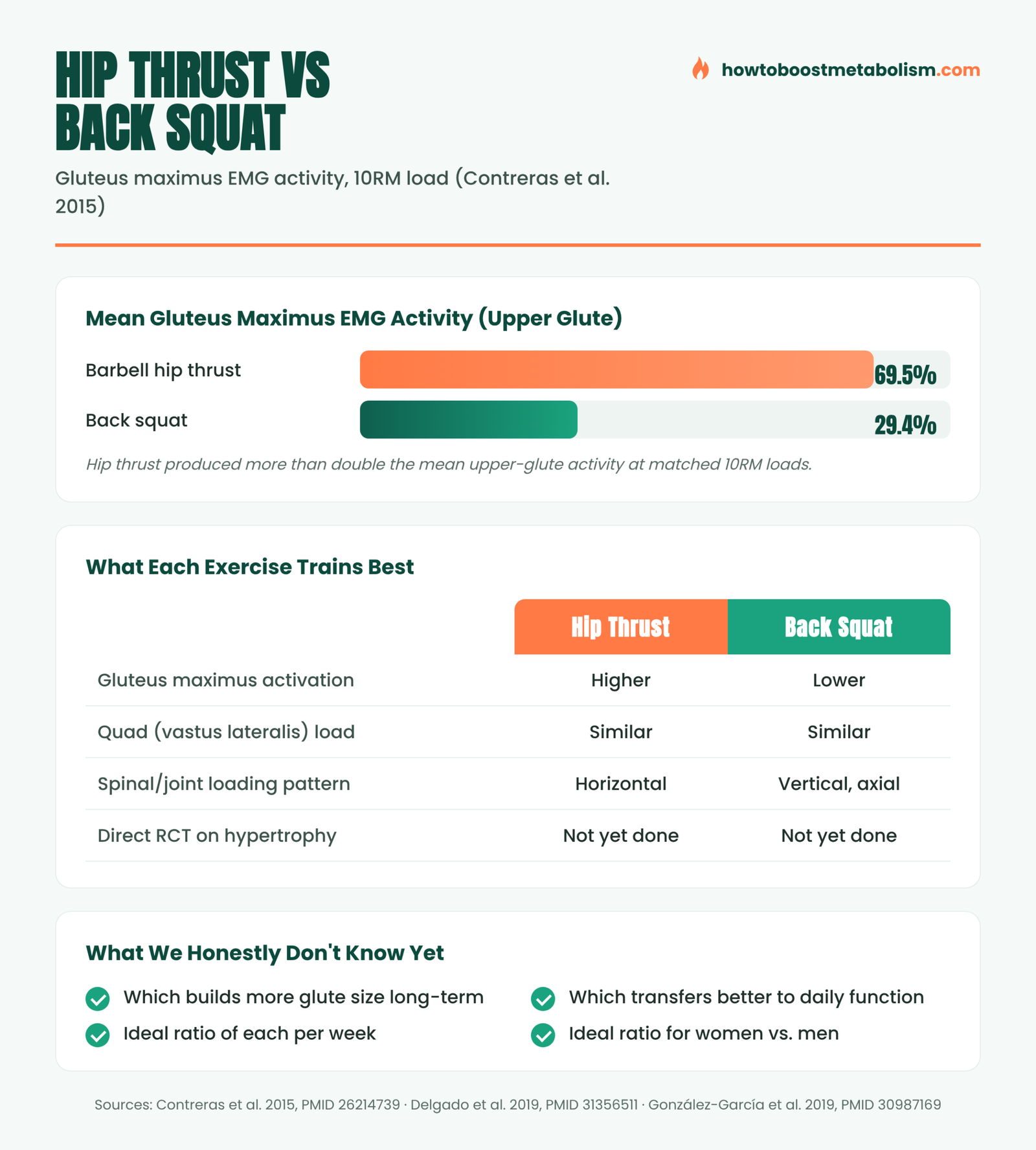
| Which loads the quads more? | Roughly tied — squat and hip thrust are similar for vastus lateralis |
| Which has a long-term hypertrophy RCT? | Neither — this specific head-to-head hasn’t been run yet |
| Which is better for athletic performance? | Depends on the sport; each transfers differently |
| Best practical answer | Use both — they’re not interchangeable, they’re complementary |
Why This Comparison Even Exists
For decades, the back squat was simply assumed to be the best glute-building exercise available, mostly because it was the biggest lift most lifters did. The barbell hip thrust, popularized more recently, forced a direct question: if you specifically isolate hip extension instead of combining it with knee extension and a spinal load, do you get more out of the glutes specifically? Several independent labs have now measured this directly with surface electromyography (EMG), which records how much electrical activity a muscle produces during a lift — a reasonable proxy for how hard a muscle is working, even though it isn’t a perfect stand-in for long-term growth.
The Core Finding: Hip Thrusts Win on Glute Activation, Clearly
The most-cited study here (PMID 26214739) had 13 trained women perform estimated 10-rep-max loads in both the back squat and the barbell hip thrust while wearing EMG sensors on the gluteus maximus, biceps femoris (a hamstring muscle), and vastus lateralis (a quad muscle). The hip thrust produced significantly higher activity in both the upper glute (mean 69.5% vs. 29.4%) and lower glute (mean 86.8% vs. 45.4%) compared to the squat, along with more than double the hamstring activation. The one muscle that showed no real difference between exercises was the vastus lateralis — both lifts worked the quads to a similar degree.
A second study (PMID 31356511) compared the back squat, Romanian deadlift, and barbell hip thrust at the same absolute load (60 kg) and at each lifter’s own 1-rep max. At 1RM, the hip thrust produced significantly higher glute activity than the squat (effect size 1.39), while the squat produced significantly higher quad activity than both the Romanian deadlift and the hip thrust. The researchers’ own framing is useful here: the squat “simultaneously activated the hip and knee extensors,” while the hip thrust more narrowly isolated hip extension — which is exactly why direct comparisons tend to favor the hip thrust for glute-specific activation. It isn’t doing something mysterious; it’s simply asking less of the knees so more of the load lands on the hips.
Free download
🔥 The Metabolism Starter Kit
3 honest guides: a 7-day reset plan, a foods cheat-sheet and 12 metabolism myths debunked. No spam — unsubscribe anytime.
The Honest Gap: No Long-Term Hypertrophy Trial Has Settled This
Here’s the part most “hip thrust vs. squat” content skips entirely. EMG activity during a single set is not the same thing as proven long-term muscle growth. A muscle lighting up more on a sensor during one lift is a reasonable hypothesis generator, not a verdict — and the researchers behind the original 2015 comparison said exactly that themselves, concluding that “longitudinal training studies are needed to determine if this enhanced activation correlates with increased strength, hypertrophy, and performance.” As of this writing, that direct, multi-week hip-thrust-versus-squat hypertrophy trial still hasn’t been published. Anyone telling you with total certainty which exercise builds a bigger glute over a year of training is going beyond what the data currently shows.
What We Do Have: A Real-World Training Comparison
The closest thing to a verdict on actual training outcomes comes from a 7-week randomized trial (PMID 30987169) in 24 adolescent female soccer players without prior lifting experience, split into a hip thrust group, a back squat group, and a non-training control. Both training groups improved compared to control, but in different ways: the hip thrust group showed larger improvements in sprint speed (10m and 20m) and agility (the T-test), while the squat group showed a bigger increase in barbell velocity specifically during squatting at heavier loads. In plain terms: each exercise improved performance in the direction you’d expect from its own demands. The hip thrust transferred better to horizontal movement (sprinting), and the squat transferred better to vertical, loaded strength.
That’s a genuinely different lesson than “one exercise wins.” It suggests the two lifts are training overlapping but distinct qualities, and that picking a single “winner” may be the wrong frame for the question entirely.
So Which Should You Actually Do After 40?
Given the trade-offs above, the practical answer for most lifters over 40 is to use both, for different reasons:
- Keep squats (or a squat variant) in your program for their simultaneous quad and hip loading, the carryover to everyday standing and climbing strength, and the vertical loading pattern that’s harder to replicate elsewhere.
- Add hip thrusts if your glutes feel like the weak link, if you have knee discomfort that limits how hard you can push squats, or if you specifically want more targeted hip-extension work without adding more knee-dominant volume.
- If you can only do one safely — say, due to a knee issue that makes squatting painful — the hip thrust is a reasonable substitute for glute and hamstring training, since it achieves comparable or higher activation of those muscles with comparatively little knee flexion demand.
- Don’t assume either one is "unsafe" after 40. Neither study above found a safety signal against either exercise in appropriately loaded, technique-sound lifters; the differences are about which muscles get emphasized, not about risk.
A Note on Technique
The hip thrust is typically performed with the upper back braced against a bench, feet planted flat, driving the hips upward until the torso and thighs form a straight line at the top — avoiding hyperextending the lower back at the peak is the most common technique error. The back squat relies more heavily on ankle, hip, and thoracic spine mobility to keep the bar path vertical; if any of those are limited, a front squat, goblet squat, or leg press can approximate the quad demand with less mobility required. Neither exercise needs to be loaded to a true 1-rep max to produce the activation differences described above — the studies cited here used estimated 10RM loads and submaximal percentages, which is a realistic training zone for most lifters over 40.
The Hamstring Piece Nobody Mentions
Most of the online debate focuses on glutes versus quads, but the 2015 EMG comparison found something else worth noting: the hip thrust produced more than double the mean biceps femoris (hamstring) activation of the back squat — 40.8% versus 14.9%. If hamstring development or hamstring injury prevention is part of your goal, that’s a meaningful point in the hip thrust’s favor on its own, independent of the glute question. The 2019 comparison against the Romanian deadlift adds useful context here too: it found the Romanian deadlift was statistically equivalent to the hip thrust for glute activation, while the back squat lagged behind both. If your program already includes Romanian deadlifts or a similar hip-hinge movement, you may already be covering some of what a hip thrust would add.
A Sample Way to Combine Both
One practical structure that respects both exercises’ strengths: squat (or a squat variant) early in a lower-body session, while you’re fresh enough to handle the balance and coordination it requires, done for 3-4 sets of 5-10 reps. Follow with hip thrusts for 2-3 sets of 8-15 reps, where fatigue matters less because the movement doesn’t demand the same balance or bracing. Over a training week, this lets the squat variation drive general lower-body strength and quad development while the hip thrust adds focused hip-extension and hamstring volume without requiring a second heavy squatting session.
Common Mistakes
- Picking one exercise and dropping the other entirely based on a single EMG study, rather than recognizing they train overlapping but different qualities.
- Assuming EMG activity equals proven hypertrophy. Higher muscle activity during a lift is a reasonable signal, not a guaranteed, measured outcome over months of training.
- Hyperextending the lower back at the top of a hip thrust to squeeze out a few more degrees of range — the goal is a neutral spine with the hips fully, not excessively, extended.
- Loading a hip thrust heavier than your core and hips can control just because the setup feels more stable than a standing squat.
What the Research Doesn’t Settle
A few open questions are worth naming honestly rather than papering over. We don’t know the ideal weekly ratio of hip thrust to squat volume for maximizing glute growth specifically. We don’t know whether the activation differences found in women (the 2015 study’s sample) apply identically to men, since most of the comparison studies used small, single-sex samples. And we don’t know how these activation differences hold up at truly heavy loads near a 1-rep max versus the submaximal loads used in most of this research. None of that undermines the core finding — hip thrusts reliably out-activate squats for the glutes — but it’s a reason to avoid treating any single number here (like "69.5% vs. 29.4%") as a precise, universal constant rather than a result from one specific sample and loading condition.
Bottom Line
Multiple independent EMG studies agree that the barbell hip thrust activates the gluteus maximus more than the back squat at comparable loads, often by a wide margin, while the two exercises load the quadriceps similarly. What the research doesn’t yet show is which one produces more glute growth after months of consistent training, because that specific head-to-head trial hasn’t been published. Until it is, the evidence-based move after 40 is to use both exercises for what they each do well, rather than treating this as a competition with a single winner.
Related Reading
This isn’t the only exercise-selection debate worth settling with real data — we covered a similar question in front squat vs. back squat after 40 and in sumo vs. conventional deadlift after 40. If your knees are the limiting factor in squatting at all, our guide to step-ups as a lower-impact lower-body builder covers a third option worth considering.
If you’d rather follow a structured program than guess at exercise selection week to week, Anabolic Fasting‘s training protocol pairs targeted strength work like this with a structured eating window. Its marketing language about building muscle and burning fat “simultaneously” is a sales pitch, not a guarantee — read it as motivation, not a promise.
Learn More →Affiliate link — we may earn a commission at no extra cost to you. Disclosure
Free download: our Metabolism Starter Kit — a protein calculator, a 7-day meal framework, and a one-page supplement checklist, with zero hype.
Get the Free Starter Kit →Related: If the hip thrust is your go-to, see how it stacks up against an even simpler floor variation in our glute bridge vs. hip thrust EMG comparison.
Frequently Asked Questions
Do hip thrusts really build glutes better than squats?
EMG studies consistently show hip thrusts produce higher gluteus maximus muscle activity than back squats at comparable loads. However, no published trial has yet directly measured whether that translates into more glute muscle growth over months of training, so "better" for long-term size is still an open question.
Should I replace squats with hip thrusts after 40?
Not necessarily. The two exercises load different things well — squats combine quad and hip work in a vertical pattern, while hip thrusts isolate hip extension. Most lifters over 40 benefit from including both rather than choosing one permanently, unless a specific injury makes one of them painful.
Are hip thrusts safe for people with lower back issues?
Hip thrusts generally place less axial load on the spine than a loaded back squat, since the bar rests across the hips rather than the shoulders. That said, hyperextending the lower back at the top of the movement is a common technique error that can aggravate existing back issues, so working with a controlled, neutral-spine range of motion matters.
What’s a good starting weight for a barbell hip thrust?
Many lifters can handle noticeably more weight on a hip thrust than they’d squat, because the movement doesn’t require balancing the load overhead or through a full squat range. Starting with just your bodyweight-plus-barbell and adding load in small increments while confirming full, controlled hip extension is a reasonable, conservative approach.
Can I do both hip thrusts and squats in the same workout?
Yes. Many programs sequence a primary squat variation earlier in a session when fatigue is lower, then add hip thrusts afterward as more targeted glute work, since the hip thrust doesn’t require as much balance or coordination under fatigue as a loaded squat does.