Front Squat vs. Back Squat After 40: What the Data Shows
This article may contain affiliate links. If you buy through them, we may earn a small commission at no extra cost to you. See our Affiliate Disclosure and Medical Disclaimer.
If you’ve ever stood in front of a barbell rack wondering whether to put the bar on your back or across your front delts, you’re not alone — and it’s a more useful question after 40 than it was at 22, when joints forgave almost anything. The good news: this isn’t a mystery. Several biomechanics labs have put lifters under force plates and EMG sensors specifically to answer it.
Here’s the honest, evidence-based breakdown of what changes between the two lifts, what stays the same, and which one makes more sense for your knees, your back, and your actual training goals after 40.
The Classic Study: Lower Knee Load, Same Muscle Recruitment
The foundational comparison here is a 2009 study in the Journal of Strength and Conditioning Research (https://pubmed.ncbi.nlm.nih.gov/19002072/), which measured tibiofemoral joint forces and muscle activity in 15 healthy, trained lifters doing both lifts. The result was clear on one point: the back squat produced significantly higher knee compressive forces and knee extensor moments than the front squat. Shear forces at the knee were small in both lifts and didn’t meaningfully differ. Just as importantly, bar position did not change overall muscle activation — the front squat was just as effective as the back squat for muscle recruitment, while putting less compressive load through the knee joint. The authors’ own conclusion was that front squats may be the better choice for people with existing knee issues like meniscus problems, or for anyone prioritizing long-term joint health.
A 2020 Study Adds a Load-Dependent Twist
A 2020 study in the Journal of Sports Science (https://pubmed.ncbi.nlm.nih.gov/32544021/) tested Division-I athletes at 40%, 60%, and 80% of their front-squat one-rep max, and found that the back squat produced greater hip extensor demand at 60% and 80%, while the front squat produced greater knee extensor demand specifically at 80%. But when the researchers modeled what would happen at each lift’s own 100% max — since people can typically lift more weight in the back squat than the front squat — the predicted knee moments converged to within about 3% of each other. In plain terms: comparing the lifts at the same absolute weight favors the front squat for knee stress, but comparing them at each lift’s own true maximum narrows that gap considerably. Context (are you comparing at equal weight, or equal relative effort?) genuinely changes the answer.
Free download
🔥 The Metabolism Starter Kit
3 honest guides: a 7-day reset plan, a foods cheat-sheet and 12 metabolism myths debunked. No spam — unsubscribe anytime.
What EMG Studies Say About Muscle Activation
A 2015 study in the Journal of Sports Science (https://pubmed.ncbi.nlm.nih.gov/25630691/) measured EMG in 12 lifters performing both squats at maximal loads, and found vastus medialis activity was significantly higher during the front squat, while semitendinosus (a hamstring muscle) activity was higher during the back squat. The back squat also produced significantly greater trunk lean. A 2016 study specifically in resistance-trained women (https://pubmed.ncbi.nlm.nih.gov/26252837/) compared parallel, full-depth, and front squats and found no statistically significant differences in gluteus maximus, biceps femoris, or vastus lateralis EMG amplitude across the three — the authors’ takeaway was that the front squat can deliver a very similar training stimulus to the back squat, despite requiring lighter absolute loads.
The Honest Summary on Muscle Growth
Put together, these findings suggest the two lifts are closer in overall training effect than their very different “feel” and loading capacity would suggest. If your main goal is simply building quad and glute size and strength, either lift can do real work — the choice comes down more to joint tolerance, mobility, and which one you can load and recover from consistently.
| Claim | What the evidence shows |
| Back squat loads the knee more at equal weight | Confirmed — higher compressive force and knee extensor moment (PMID 19002072) |
| Front squat limits are more about load, less about muscle | Supported — similar EMG activation despite lighter typical loads (PMID 26252837) |
| The knee-load gap disappears at true 1RM for each lift | Partially — predicted moments converge to ~3% apart at 100% of each lift’s own max (PMID 32544021) |
| Front squat always means less low-back stress | Depends on trunk angle and load placement, not the exercise label alone (PMID 33161870) |
| One lift is simply “better” than the other | Not supported — each has a different load/joint-stress trade-off, not a universal winner |
What Changes at the Lower Back
A 2024 study in Sports Biomechanics (https://pubmed.ncbi.nlm.nih.gov/33161870/) compared back and front squats, plus squats with a transformer bar that shifted the load more anteriorly or posteriorly. Moving the load forward — closer to a front squat position — significantly decreased trunk flexion and pelvis anterior tilt, but increased low-back extension moments. Lower-extremity loading stayed broadly similar across conditions; it was the trunk and pelvis mechanics, not the legs, that shifted most. The practical read: the front squat’s more upright posture isn’t automatically easier on the low back in every case — it trades one kind of spinal demand for another, and how that feels will vary by individual anatomy and any existing back issues.
The Front Rack Position Is the Real Limiting Factor — Not Your Legs
Ask anyone who has tried both lifts and they’ll tell you the front squat usually feels harder to simply hold onto, long before the legs give out. That lines up with the biomechanics: because the bar sits closer to your center of mass in the front squat, less torque is needed to keep your torso upright, which is exactly why knee and hip moments come out lower. But that same position asks a lot of your wrists, elbows, and upper back to keep the bar from rolling forward off your shoulders. If your wrists are stiff from years of desk work, or your thoracic spine doesn’t extend well, the front rack can feel genuinely uncomfortable well before your quads are the limiting factor — and that’s a mobility problem, not evidence the lift doesn’t suit you.
Two common fixes make a real difference: a cross-arm grip (crossing your forearms over the bar like a shelf, rather than the full Olympic-style finger grip) reduces the wrist mobility demand considerably, and a few minutes of thoracic extension and wrist mobility work before training can open the position up over a few weeks. Neither requires any special equipment, and both are worth trying before writing the front squat off as “not for my body.”
Programming Both Into a Week, Not Just Choosing One Forever
In practice, most lifters over 40 don’t need to pick a permanent favorite. A common, evidence-consistent approach is to use the back squat as the primary heavy lift once or twice a week — since it typically allows more absolute load, which matters for long-term strength and the bone-density stimulus that comes with heavier axial loading — and the front squat as a secondary, lighter, technique- and quad-focused variation later in the week, when joints and nervous system are carrying more fatigue from the rest of the training. Rotating the primary squat variation across training blocks (say, 6–8 weeks of each) is another reasonable option if one joint area needs a temporary break from its usual loading pattern without abandoning squatting altogether.
If you’re managing a specific issue — a cranky knee that flares with deep flexion under heavy axial load, or a lower back that’s sensitive to the more forward trunk lean of a heavy back squat — it’s worth treating that as data rather than a reason to avoid squatting in general. Dropping the load, switching the bar position, or temporarily training in a shorter range of motion are all smaller adjustments than cutting the entire movement pattern, and squatting in some form remains one of the most efficient ways to maintain leg strength, hip mobility, and functional capacity as you get older.
So Which One Should You Actually Do After 40?
- Existing knee sensitivity or a history of meniscus issues: the front squat’s lower compressive force and extensor moment, confirmed at equal absolute load, makes it the more conservative choice.
- Existing low-back sensitivity: try both and let your own response decide — the research shows a trade-off in spinal mechanics, not a clear universal winner.
- Priority is maximum loadable strength and bone-density stimulus: the back squat typically allows meaningfully more absolute weight, which matters for progressive overload.
- Limited wrist, elbow, or shoulder mobility: the front rack position can be uncomfortable or impossible without working on mobility first; the back squat is more forgiving here.
- Want both benefits over time: cycling between them across training blocks, or using the front squat as a technique-focused secondary lift, is a reasonable, evidence-consistent strategy.
This same “compare the real trade-offs instead of picking a winner” approach is how we looked at goblet squats vs. barbell squats and trap bar vs. barbell deadlifts, and it’s the same honest framing we used recently comparing sumo vs. conventional deadlift technique — in all of these comparisons, the real answer is usually “it depends on your joints and your goals,” not a single universally correct pick.
Switching between squat variations works best inside a program that’s actually planned for it rather than random exercise-hopping. Anabolic Fasting pairs structured strength programming with a fasting protocol aimed at building muscle while managing body fat — its “build and burn at the same time” marketing angle is a sales pitch, not a guarantee, so treat the training structure as the real value and the specific outcome claims with appropriate skepticism.
Learn More →Affiliate link — we may earn a commission at no extra cost to you. Disclosure
Free download: our Metabolism Starter Kit — a protein calculator, a 7-day meal framework, and a one-page supplement checklist, with zero hype.
Get the Free Starter Kit →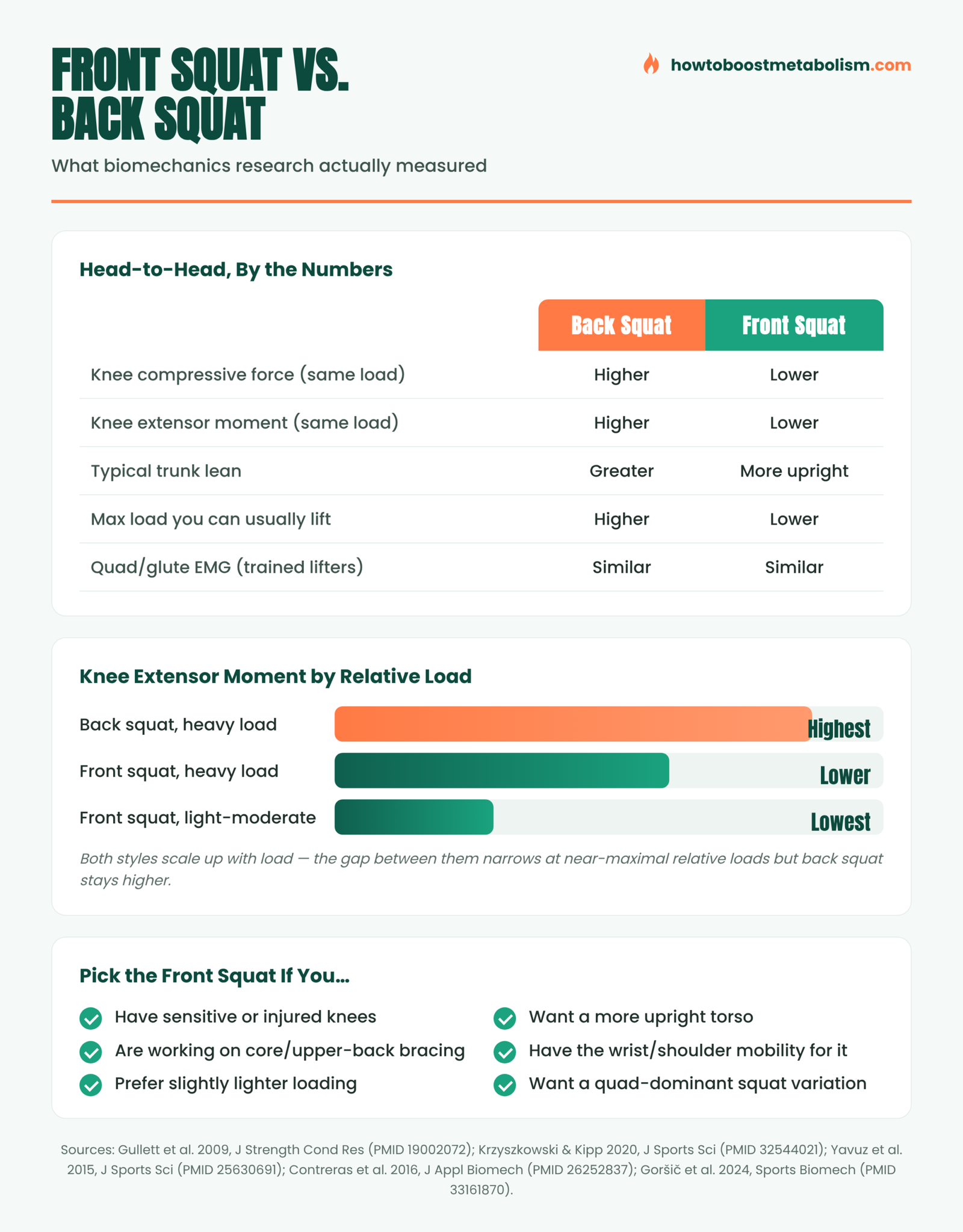
Related: If exercise-selection comparisons like this one are useful to you, we ran the same honest, EMG-backed analysis on hip thrust vs. squat for glute strength after 40.
Related: For another angle on glute and hip-extensor training, see our glute bridge vs. hip thrust breakdown of what the EMG research actually shows.
Frequently Asked Questions
Is the front squat really safer than the back squat for your knees?
The classic biomechanical comparison found that the back squat produces significantly higher compressive forces and knee extensor moments than the front squat, with shear forces staying small and similar between the two. That means the back squat places a genuinely higher mechanical load on the knee joint at a given absolute weight — useful context if you have a history of knee issues like meniscus irritation, though it doesn’t mean the back squat is unsafe for a healthy knee.
Does the front squat build the same muscle as the back squat?
Largely, yes. A study in resistance-trained women found no statistically significant differences in gluteus maximus, biceps femoris, or vastus lateralis EMG amplitude between front, full, and parallel back squats. A separate study found vastus medialis activity was actually slightly higher in the front squat. The honest summary: similar overall quad and glute recruitment, despite the front squat typically being done with lighter absolute loads.
Why can’t I load the front squat as heavy as the back squat?
Mechanically, the bar sits closer to your center of mass in the front squat, which is exactly why it produces lower knee and low-back moments at a given weight — but it also means your front rack position (wrists, elbows, upper-back strength) becomes the limiting factor well before your legs are maxed out, which is normal and not a sign anything is wrong.
Is the back squat harder on your lower back after 40?
It depends more on your trunk angle and bar placement than on the exercise’s name. Research on load placement shows that squats with a more anteriorly placed load (closer to a front squat) significantly reduce trunk flexion and increase low-back extension moments differently than a more posterior load — the trunk and pelvis adjust to manage the trade-off. In practice, people with existing low-back sensitivity often find the more upright torso position of the front squat more comfortable, but this varies by individual.
Should someone over 40 pick one and stick with it, or use both?
Using both is a defensible, evidence-consistent approach: the back squat generally allows more total load and may be the better pure strength-and-bone-density tool, while the front squat offers a lower-knee-stress, more upright alternative that’s easier on some people’s lower backs. Many lifters over 40 rotate them across a training block or use the front squat as a lighter, technique-focused variation and the back squat as the primary heavy lift.