Static Stretching Before Lifting: Does It Hurt You?
This article may contain affiliate links. If you buy through them, we may earn a small commission at no extra cost to you. See our Affiliate Disclosure and Medical Disclaimer.
Somewhere in the last two decades, the gym consensus flipped: static stretching before a workout went from “obviously good for you” to “will tank your strength.” If you’re past 40 and dealing with a stiff hip or a cranky shoulder, that leaves you stuck between two fears — skip the stretch and feel restricted, or stretch and supposedly sabotage your working sets. The actual research is more specific, and considerably less alarming, than the gym-floor version of this story, and it comes down to a question almost nobody asks out loud: for how long, exactly, are you holding that stretch?
At a Glance
| Scenario | What the research shows |
|---|---|
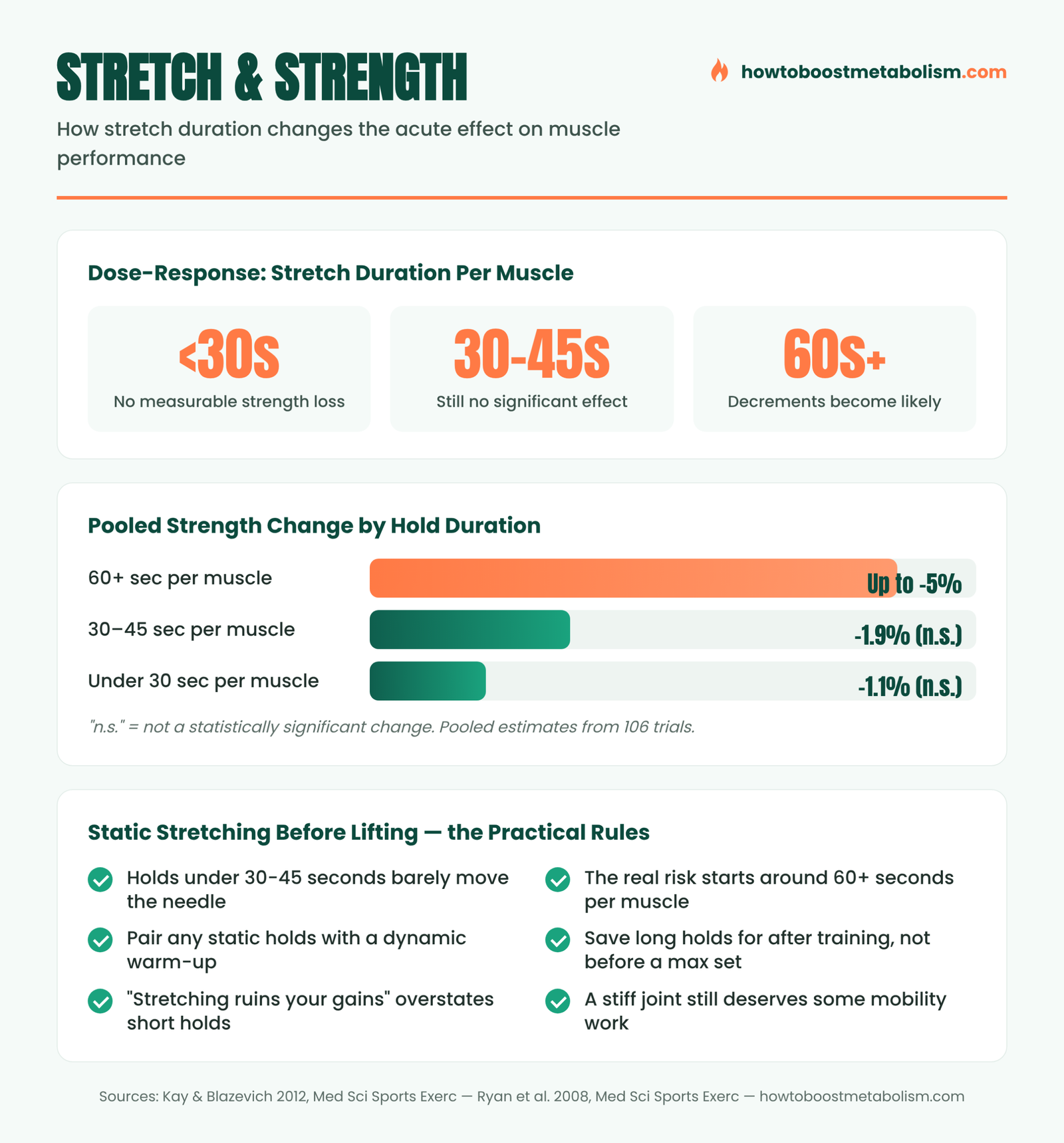
| Stretch held under 30 seconds per muscle | No measurable effect on maximal strength (pooled estimate: -1.1%) |
| Stretch held 30–45 seconds per muscle | Still no statistically significant effect (pooled estimate: -1.9%) |
| Stretch held 60 seconds or more per muscle | A real decrement becomes likely — effect grows with duration |
| Practical durations (2–8 minutes total, split across reps) | Did not reduce isometric peak torque vs. a resting control group |
| Static stretching inside a full warm-up (dynamic work after) | Effects become trivial regardless of static-stretch duration |
What “Static Stretching” Actually Means Here
Static stretching means moving a joint to the edge of its range and holding that position, without bouncing or active muscle contraction — think a seated hamstring stretch held for a count, or leaning into a doorway shoulder stretch. That’s distinct from dynamic stretching (controlled, moving stretches like leg swings or walking lunges) and from a general aerobic warm-up (a few minutes of easy cardio to raise tissue temperature). The research on “stretching before lifting hurts performance” is almost entirely about the static, held-position kind — and even there, the effect depends heavily on how long you hold it.
Free download
🔥 The Metabolism Starter Kit
3 honest guides: a 7-day reset plan, a foods cheat-sheet and 12 metabolism myths debunked. No spam — unsubscribe anytime.
What the Research Actually Shows: It’s a Dose-Response Effect
The most comprehensive systematic review on this question combed through 4,559 candidate studies and included 106 that met rigorous criteria. The pattern it found was sigmoidal, not all-or-nothing: short-duration static stretches under 30 seconds had no detrimental effect on maximal muscle performance (pooled estimate of just -1.1%), and stretches in the 30–45 second range still showed no significant effect (-1.9%). A significant reduction became likely only once stretches reached 60 seconds or longer per muscle, with the magnitude growing from there (Kay & Blazevich, 2012, Med Sci Sports Exerc). That dose-response relationship held regardless of which performance task, contraction type, or muscle group was being tested.
A separate, frequently cited dose-response study on the calf muscles tested stretching for 2, 4, or 8 minutes total (broken into repeated 30-second holds) against a no-stretch control group that simply rested. Isometric peak torque dropped slightly immediately after every condition — including the resting control (a 4% drop, most likely from the repeated maximal test contractions themselves, not the stretching) — and the stretching groups weren’t meaningfully worse: 2% after 2 minutes, 4% after 4 minutes, 6% after 8 minutes, with all values returning to baseline within 10 minutes. Range of motion, meanwhile, improved measurably after every stretching duration (Ryan et al., 2008, Med Sci Sports Exerc). In other words: even several minutes of practical, broken-up static stretching didn’t produce a strength deficit clearly distinguishable from simply testing strength twice.
Why the “Stretching Kills Your Gains” Story Spread Anyway
The studies that found the largest, most dramatic strength losses from stretching tend to share a few features: very long hold times (well past 60 seconds, sometimes several minutes per muscle in a single continuous hold), little task-specificity between the stretch and the test, and — critically — testing performed immediately after stretching with no proper warm-up before or after. A mechanistic review looking specifically at why stretch-induced deficits happen concluded that when static stretching is performed within a complete warm-up — some light aerobic activity beforehand, and task-specific dynamic movement afterward — the effects on subsequent performance become trivial, with some evidence of improved force output at longer muscle lengths (Behm, Kay, Trajano & Blazevich, 2021, Eur J Appl Physiol). The headline-grabbing version of the research strips out that context; the practical reality is closer to “don’t replace your warm-up with ten minutes of static holds and then max out cold.”
The Proposed Mechanisms Behind Short-Term Strength Dips
When a stretch-induced dip in force does show up, researchers point to two broad categories of cause. The first is neural: prolonged stretching appears to reduce voluntary muscle activation and alter the excitability of motor neurons, meaning the nervous system briefly recruits the muscle somewhat less effectively. The second is mechanical: holding a muscle at a longer length can shift the force-length relationship, change how sensitive the muscle fibers are to calcium, and alter the stiffness of the tissue surrounding the muscle (the parallel elastic component) (Behm, Kay, Trajano & Blazevich, 2021). There’s also a plausible psychological piece — a sense of looseness or fatigue after stretching, or simply expecting to feel weaker, that the same review flags as a possible nocebo effect layered on top of the physical mechanisms. None of these mechanisms are fully pinned down yet, which is part of why the research community still debates exactly how much they matter at practical, everyday stretch durations.
Does This Change As You Get Older? A Fair Evidence Gap
Most of the foundational research on static stretching and acute strength loss — including both studies cited above — was conducted in younger or mixed-age recreational and athletic populations, not specifically in adults over 40 or 50. Tendons and connective tissue do tend to stiffen somewhat with age, and joint range of motion often narrows, which is part of why a short static hold can genuinely feel more necessary before training as you get older. But that’s a separate question from whether stretching itself behaves differently in an older muscle-tendon unit, and the dose-response literature doesn’t clearly answer it. The honest position is that the general duration-based pattern (short holds are low-risk, long holds carry more risk) is the best evidence available for lifters of any age, while age-specific confirmation of the exact cutoffs is still a gap in the research.
An Honest Nuance: This Isn’t a Blanket “Stretching Is Always Fine”
None of this means long static holds are risk-free in every context. The populations studied in this literature are overwhelmingly healthy, recreationally active, or athletic adults performing submaximal to near-maximal efforts in controlled lab settings — not someone attempting a true 1-rep max. If you compete in powerlifting, Olympic lifting, or any sport where a single maximal attempt is the entire point, erring toward shorter static holds (or skipping them in favor of dynamic work) right before that specific attempt remains a reasonable, conservative choice, even though the broader evidence suggests the risk at practical durations is small.
A Separate Question: Does Stretching Actually Prevent Injury?
Performance and injury prevention are two different claims, and it’s worth not conflating them. The systematic reviews above are about force and power output, not injury rates — and the broader exercise science literature on whether pre-exercise static stretching meaningfully reduces injury risk is considerably weaker and more mixed than the performance data. Range of motion genuinely does improve after stretching, which can matter for lifts that require you to move well through a deep position (like a full squat), but “more range of motion” and “fewer injuries” aren’t automatically the same outcome. If your goal is injury prevention specifically, a general warm-up that raises tissue temperature and rehearses the actual movement pattern you’re about to load has a more direct, better-supported rationale than static stretching alone.
A Practical Template for Lifters Over 40
| Situation | Suggested approach |
|---|---|
| Default warm-up | 5–10 min light aerobic activity + dynamic, task-specific movement for the joints you’ll train |
| A genuinely stiff or restricted joint pre-session | A short static hold (under 30–45 sec) is unlikely to meaningfully affect the set that follows |
| Wanting to improve long-term flexibility or range of motion | Longer static holds (60 sec+) work well — just place them after training or on a separate mobility day |
| About to attempt a true 1-rep max or competition lift | Favor dynamic warm-up over long static holds immediately beforehand |
| Chronic tightness limiting depth or range in a lift | Address it consistently over weeks (mobility work, loaded stretching) rather than hoping a single pre-set stretch fixes it |
Common Mistakes People Make With Pre-Workout Stretching
- Holding a single stretch for two or more minutes right before a heavy top set, then blaming the stretch (rather than the missing warm-up) for a flat lift.
- Avoiding all stretching out of fear, even when a joint genuinely needs some mobility work to move safely through a lift’s range.
- Treating a quick, practical static hold the same as the long, isolated, no-warm-up protocols that produced the biggest effects in research.
- Using static stretching as the entire warm-up instead of pairing it with dynamic, task-specific movement.
- Giving up on improving a chronically tight area because of a vague fear that any stretching anywhere, anytime, will hurt performance.
If your real issue is chronic stiffness rather than a single pre-set stretch, a structured program built for lifters over 40 — like Old School New Body — builds mobility and joint preparation into the plan itself instead of leaving warm-up as an afterthought. Treat its marketing claims as program positioning, not a guarantee; the independent research above is what should guide your actual stretching decisions.
See the Program →Affiliate link — we may earn a commission at no extra cost to you. Disclosure
Free download: our Metabolism Starter Kit — a protein calculator, a 7-day meal framework, and a one-page supplement checklist, with zero hype.
Get the Free Starter Kit →Related Reading
For more on warming up and recovering well around your lifts, see our guides to foam rolling after 40, what muscle soreness (DOMS) actually means, and velocity-based training for lifters after 40. None of these replace a few minutes of deliberate warm-up before your working sets, but together they cover most of what actually moves the needle on feeling — and performing — better in a session.
Frequently Asked Questions
Will stretching before lifting make me weaker?
Only at longer durations. The dose-response research shows stretches under roughly 30-45 seconds per muscle produce no statistically significant strength loss, while holds of 60 seconds or more are the point where a real decrement becomes likely. A quick, practical stretch is not the problem the gym-lore version of this claim makes it out to be.
How long can I hold a stretch before it hurts my set?
The clearest research-backed cutoff is around 60 seconds per muscle. Below that, pooled data shows no significant effect on maximal strength; above it, the likelihood and size of any decrement increases with duration.
Is it better to skip stretching entirely before lifting?
Not necessarily. A dedicated dose-response study found that even several minutes of practical, broken-up stretching improved range of motion without producing a meaningfully bigger strength drop than simply warming up and testing strength without stretching. If a joint needs the mobility, a short static hold is a reasonable tool.
Does stretching before a 1-rep max attempt matter more?
The research base here is mostly submaximal-to-near-maximal effort in recreational and athletic populations, not true 1RM attempts. For a single maximal lift, favoring a dynamic warm-up over long static holds immediately beforehand remains the more conservative, cautious approach.
What’s the actual best warm-up before strength training after 40?
A short period of light aerobic activity followed by dynamic, joint-specific movement that mimics the lift you’re about to perform. Static stretching can be layered in for a genuinely restricted joint, but shouldn’t replace that dynamic, task-specific preparation.