Do You Need a Lifting Belt After 40? The Research
This article may contain affiliate links. If you buy through them, we may earn a small commission at no extra cost to you. See our Affiliate Disclosure and Medical Disclaimer.
Walk the free-weight section of any gym and you’ll see the ritual: someone cinches on a thick leather belt, takes a few deep breaths, and pulls a weight off the floor that looks like it shouldn’t move. The belt has become shorthand for “serious lifter,” and for people over 40 wondering whether they should get one before their next heavy session, the honest answer requires separating three different questions that get blurred together: does it protect your spine, does it change your blood pressure risk, and does it actually make you stronger or safer in a way you’d notice.
This is a straight look at the biomechanics and cardiovascular research on weightlifting belts — not a listicle of “best belts of 2026,” but an honest answer to whether the gear matters as much as gym culture suggests, particularly for someone whose spine and cardiovascular system aren’t operating at 25-year-old baseline anymore.
At a Glance
| Claim | Verdict |
|---|---|
| Increases intra-abdominal pressure (IAP) | Yes — consistently shown across multiple studies |
| Reduces lower-back (erector spinae) muscle activity | No clear evidence — one classic study found no reduction |
| Proven to increase spine load tolerance | Not demonstrated — reviewers found no solid evidence for this |
| Improves squat performance (reps, speed) | Yes — a 2026 study found a measurable benefit |
| Improves objectively measured postural stability | No — same study found this was only perceived, not measured |
| Changes blood pressure response to a heavy lift | The lift and breath-holding technique drive this, not the belt |
What a Belt Actually Does: Pressure, Not Magic
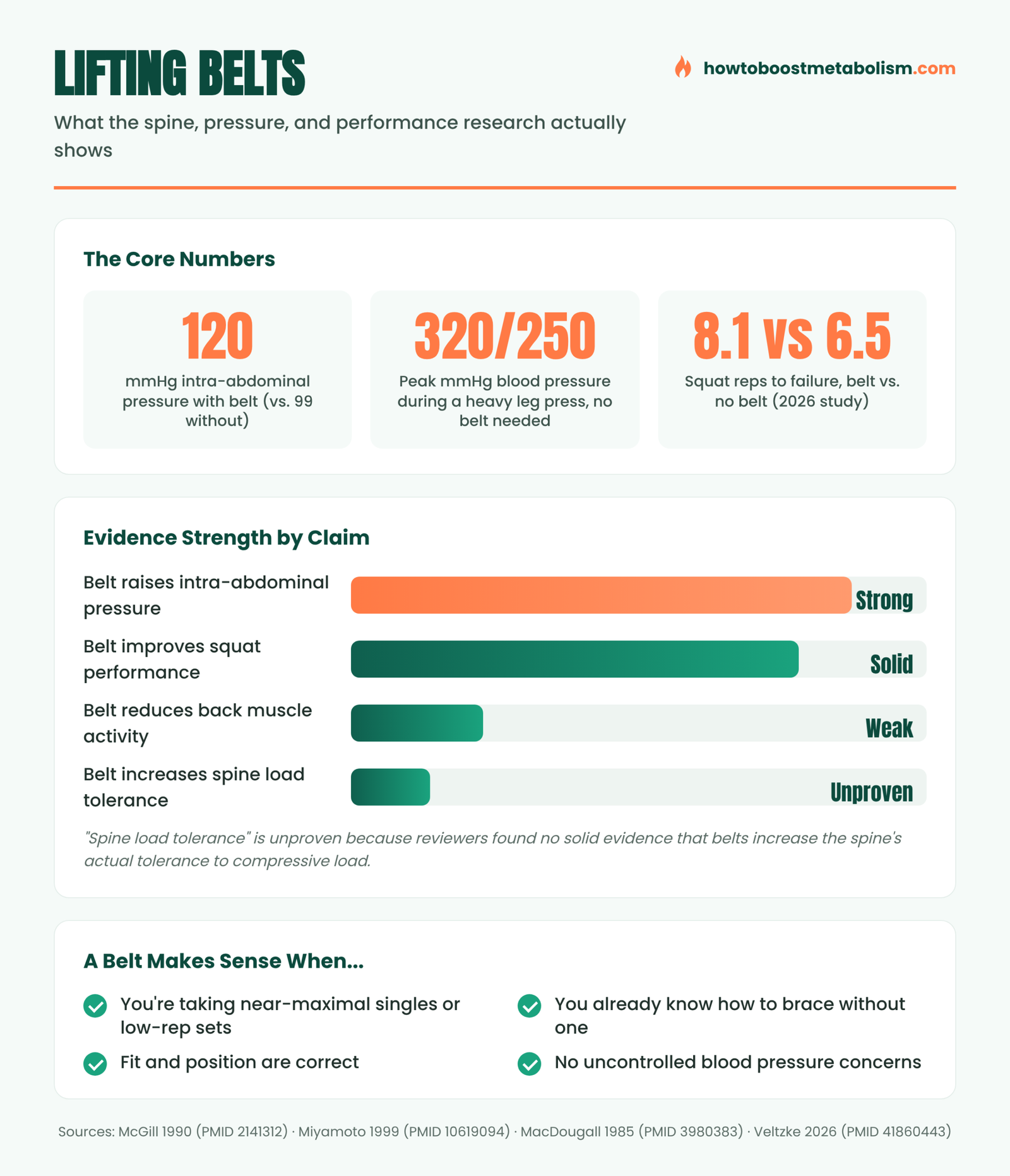
The physiological case for a lifting belt rests on intra-abdominal pressure (IAP) — when you brace your core against a belt, you create a more rigid cylinder of pressure around your spine, in theory redistributing some of the compressive load away from the vertebrae. McGill, Norman & Sharratt (1990, Ergonomics) directly measured this: six subjects lifting 72.7-90.9 kg loads showed IAP rise from a mean of 99 mmHg without a belt to 120 mmHg with one — a real, measurable, statistically significant increase. But the same study found something that complicates the simple “belt = back protection” story: erector spinae (lower back) muscle activity tended to be lower only when the breath was held, not specifically because of the belt, and wearing the belt didn’t meaningfully add to that reduction. In other words, the belt boosted IAP convincingly, but that didn’t translate cleanly into less work for the back muscles the belt is supposedly protecting.
A follow-up study using different methodology (Miyamoto et al., 1999, Clin Biomech) measured both intra-abdominal and intra-muscular pressure in the erector spinae directly during belted and unbelted lifts, and the authors were blunt in their conclusion: performance can increase with belt use, but “at present, there is no reason to believe that spine tolerance to loads increases with belts.” That’s a meaningfully more cautious statement than most gym advice implies — a belt may help you lift more, without clear evidence it makes your spine itself more resilient to that larger load.
The 2026 study: real performance gain, but check your assumption about why
The most recent direct test (Veltzke et al., 2026, J Strength Cond Res) had experienced and inexperienced men and women perform sets of squats to exhaustion at their beltless 6-rep-max, both with and without a belt, while standing on force plates that objectively measured postural sway. The belt group completed more repetitions (8.1 vs. 6.5) and moved through the concentric phase faster — a real, useful performance benefit regardless of sex or prior belt experience. But here’s the honest twist: wearing the belt significantly increased how stable people felt (self-reported score), without producing a matching improvement in objectively measured postural sway. The authors’ own conclusion was explicit — the performance improvement “cannot be attributed to an increase in postural stability.” Something about the belt is helping output, but it’s not simply making you more physically stable in a way instruments can detect; it may be partly psychological confidence, partly the IAP effect on bracing and effort tolerance.
Free download
🔥 The Metabolism Starter Kit
3 honest guides: a 7-day reset plan, a foods cheat-sheet and 12 metabolism myths debunked. No spam — unsubscribe anytime.
The Blood Pressure Question: It’s the Lift, Not the Leather
The scariest numbers in this topic come from classic cardiovascular research, not belt studies directly. MacDougall et al. (1985, J Appl Physiol) directly catheterized the brachial artery of five experienced bodybuilders during heavy lifts to failure. During double-leg presses at near-maximal effort, mean peak pressures hit 320/250 mmHg, with one subject exceeding 480/350 mmHg — pressures that would be a hypertensive emergency in a clinical setting if sustained. A follow-up study (MacDougall et al., 1992, J Appl Physiol) found this pressure spike scaled with relative intensity and was strongly linked to the Valsalva maneuver (holding your breath against a closed airway to brace), not muscle size or absolute strength. Belts are typically worn exactly for the kind of near-maximal, Valsalva-heavy lifting where these spikes occur — so belt use correlates with cardiovascular risk mainly because it’s a marker for lifting style and intensity, not because the belt itself raises blood pressure through some separate mechanism.
This distinction matters practically: the risk conversation for someone over 40 with blood pressure concerns isn’t really “should I wear a belt,” it’s “should I be taking near-maximal singles to failure with a held breath at all” — a question worth a direct conversation with a physician, independent of any gear choice.
Free download: our Metabolism Starter Kit — a protein calculator, a 7-day meal framework, and a one-page supplement checklist, with zero hype.
Get the Free Starter Kit →A Newer Angle: Measuring Bracing Directly
A 2026 pilot study (Harris et al., J Strength Cond Res) introduced a strain-gauge belt that measures “abdominal hoop stress” (AHS) — a direct, field-usable readout of how hard someone is actually bracing during a squat or deadlift. In 25 collegiate powerlifters, AHS correlated strongly with weight lifted and was significantly lower in lifters with a history of low back pain — suggesting bracing quality, not just belt ownership, is the more meaningful variable, and that a belt alone doesn’t guarantee good bracing technique. This is early, pilot-stage research, but it points toward where this field is heading: treating the belt as a tool that supports a skill (bracing), not a substitute for learning that skill in the first place.
So: Do You Actually Need One After 40?
- If you’re new to structured strength training or returning after a long break, learn to brace and control intra-abdominal pressure without a belt first — a belt doesn’t teach technique, it supports technique you already have.
- If you’re progressing into genuinely heavy, near-maximal lifts (low-rep squats, deadlifts, overhead presses), a belt has real evidence for improving performance output, even if the “spine protection” story is softer than advertised.
- If you have any cardiovascular concern, the more important conversation is about lifting intensity and breath-holding technique, not belt brand.
- If your goal is general strength and muscle maintenance after 40 rather than competitive maximal lifting, a well-built, moderate-intensity program often doesn’t require near-maximal singles at all — which is a big part of why gentler, structured programs for beginners and returning lifters over 40 tend to de-emphasize belt-dependent training in the early phases.
That last point is worth sitting with: a lot of the belt conversation assumes you’re already working up to heavy singles, but most of the actual evidence for muscle growth and strength after 40 — including the barbell vs. dumbbell comparison we covered separately — comes from moderate, controlled-intensity training that most people never need a belt for in the first place.
Programs built specifically for beginners and returning lifters over 40 tend to use submaximal, controlled loads rather than near-maximal singles — which is exactly the training style where belt dependence (and the blood-pressure spikes discussed above) matters least. Old School New Body‘s F4X method is one such program, built around moderate loads appropriate for someone starting or restarting strength training in their 40s or beyond. (Note: some of the program’s marketing claims about age-related muscle loss rates aren’t independently verified — judge the training method on its structure, not the sales copy.)
Check Availability →Affiliate link — we may earn a commission at no extra cost to you. Disclosure
Practical Belt Use: What the Research Supports
- Use it for its proven purpose — near-maximal effort sets, not as a default for every warm-up set or moderate-intensity training day.
- Don’t mistake belt use for a license to skip bracing practice — the 2026 abdominal hoop stress pilot data suggests actual bracing quality, not belt ownership, tracks more closely with low back pain history.
- Fit matters more than brand — a belt that’s too narrow, too flexible, or poorly positioned won’t generate the IAP increase the research is actually based on.
- Don’t use belt use as a reason to ignore blood pressure symptoms (dizziness, visual spots, chest tightness) during heavy lifts — those warrant stopping and medical follow-up regardless of gear.
If grip and core bracing — not belt shopping — is the actual limiting factor in your lifts, our guide to grip strength as a longevity marker and our breakdown of isometric training for joint health after 40 (which covers Valsalva-related bracing in more depth) are more directly useful next reads than any equipment review.
For lifters who prefer to build strength and intra-abdominal pressure control without barbell-style near-maximal loading at all, our comparison of resistance bands vs. free weights covers a lower-risk alternative path to the same strength outcomes.
Related: Looking at other squat accessories? Our companion guide on weightlifting shoes after 40: do they actually help covers the footwear side of the equation.
Frequently Asked Questions
Does a lifting belt actually protect your lower back?
The research is more nuanced than most gym folklore suggests. A belt reliably increases intra-abdominal pressure (IAP), which can create a stiffer, more supported torso — but one classic study found erector spinae (lower back) muscle activity didn’t decrease when wearing a belt, and a separate analysis concluded there’s no solid evidence that spine tolerance to compressive loads actually increases with a belt. The honest summary: a belt changes how your trunk braces, but “protects your spine” overstates what’s been directly demonstrated.
Does a weightlifting belt increase blood pressure?
Not specifically — but what a belt is usually used for (very heavy, near-maximal lifts with a Valsalva maneuver) absolutely does. Classic research directly measuring arterial pressure during heavy resistance exercise recorded mean peak values around 320/250 mmHg during heavy leg presses, with one subject exceeding 480/350 mmHg. That’s the exercise and breath-holding technique driving the spike, not the belt itself, but belt use is a marker for exactly the intensity of effort where this matters most.
Does wearing a belt actually improve performance?
A 2026 study found belt use increased squat repetitions to failure and movement speed in both men and women, regardless of experience — a genuine, measurable performance benefit. Interestingly, the same study found the belt increased perceived stability without a matching increase in objectively measured postural stability, suggesting part of the benefit may be psychological confidence as much as a direct biomechanical effect.
Should beginners over 40 use a lifting belt?
Most strength coaches recommend learning to brace and control intra-abdominal pressure without a belt first, then introducing one for near-maximal work once technique is solid — a belt can’t fix a lifter who doesn’t already know how to create tension. For someone over 40 starting or restarting a structured program with moderate, progressively increasing loads, a belt usually isn’t necessary in the early months at all.
Is a lifting belt safe if I have high blood pressure?
This is a conversation for your doctor, not a blog post, because the relevant risk is the heavy-lift-plus-Valsalva combination a belt is typically used alongside, not the belt fabric itself. People with uncontrolled hypertension or cardiovascular disease are generally advised to avoid training techniques that spike blood pressure as dramatically as a near-maximal weight lifted with breath-holding does, belt or no belt.