Best Matcha Powder 2026: Ranked by Evidence and Quality
This article may contain affiliate links. If you buy through them, we may earn a small commission at no extra cost to you. See our Affiliate Disclosure and Medical Disclaimer.
Matcha is everywhere right now — lattes, smoothies, protein bowls, TikTok “matcha girl” routines — and most of the marketing around it treats it as some kind of metabolism superfood. The honest version is more interesting and more useful: matcha genuinely has real, measured effects on fat oxidation during exercise in small controlled studies, but those effects are modest, specific, and easy to overstate if you’re shopping based on a brand’s homepage rather than the actual research. This guide ranks what to actually buy, based on that research plus sourcing, grade, and price — not vibes.
What the research on matcha and metabolism actually says
Matcha’s metabolic compounds are the same ones found in all green tea: catechins, especially epigallocatechin gallate (EGCG), plus caffeine. A well-known analysis of combined catechin-and-caffeine intake found it increased 24-hour energy expenditure by about 4.7% and fat oxidation by around 16% across pooled data from multiple short-term feeding studies (Hursel et al., 2011, Obesity Reviews, PMID 21366839). A separate Cochrane-style systematic review of green tea preparations for weight loss found the overall effect on body weight across available trials was small and not consistently significant (Jurgens et al., 2012, PMID 23235664).
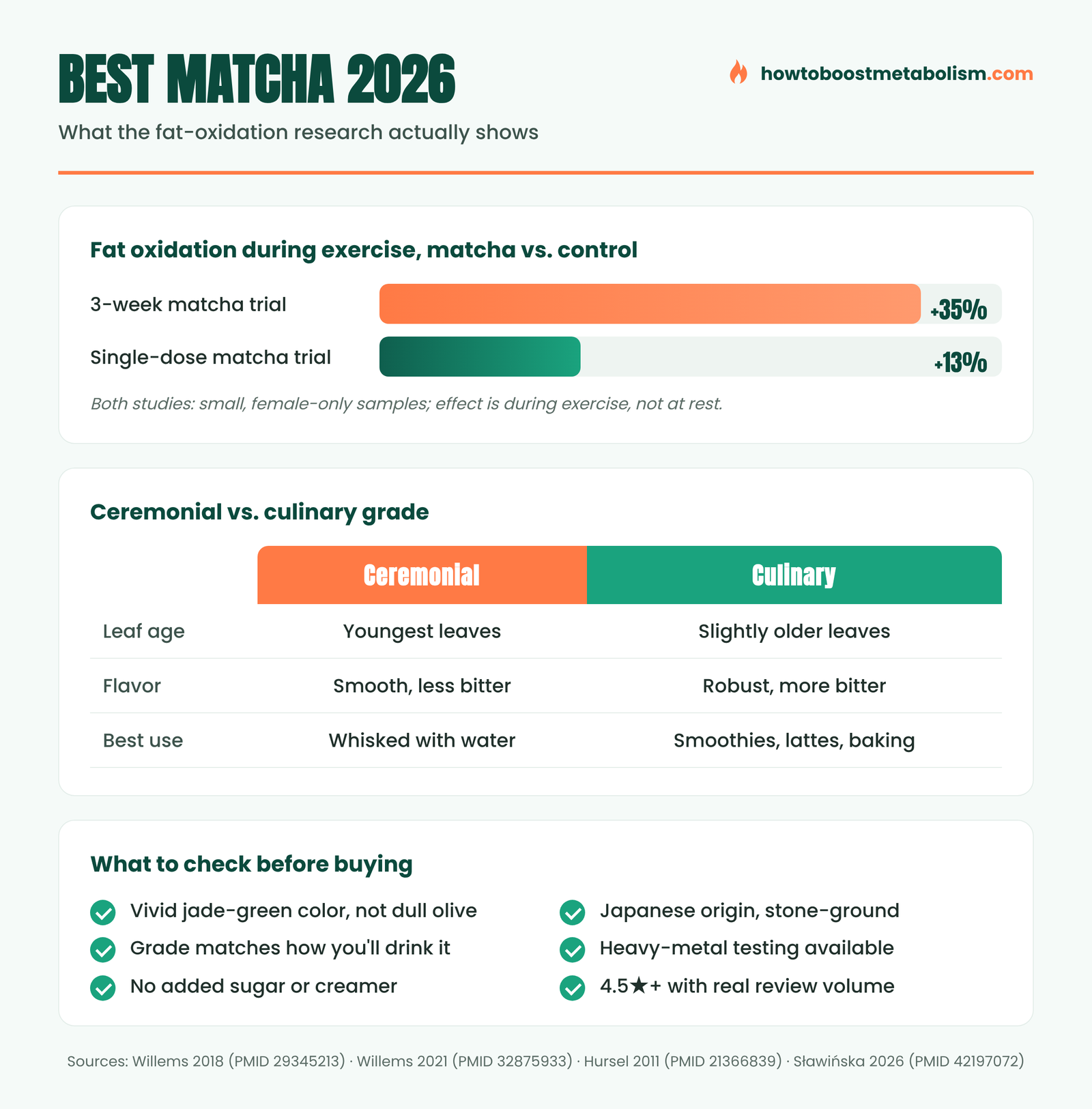
Matcha specifically — rather than brewed green tea — has its own small evidence base. In one crossover study, women who drank a matcha beverage before a 30-minute brisk walk had a measurably lower respiratory exchange ratio and higher fat oxidation (0.35 vs. 0.31 g/min with a control drink) than on the control condition, though the authors were careful to note the effect “should not be overstated” as a weight-loss tool on its own (Willems, Şahin & Cook, 2018, IJSNEM, PMID 29345213). A follow-up trial had women take matcha capsules daily for three weeks and found fat oxidation during a moderate-intensity treadmill walk rose by about 35% compared with placebo (0.26 vs. 0.21 g/min), while total energy expenditure during the walk stayed about the same — meaning the body shifted which fuel it burned, without necessarily burning more calories overall (Willems, Fry, Belding & Kaviani, 2021, Journal of Dietary Supplements, PMID 32875933). A broader 2026 review of matcha’s bioactive compounds summarizes this same pattern — real, catechin-driven metabolic effects, generally modest in size — alongside matcha’s better-established benefits for liver fat and lipid markers (Sławińska & Raczkowska, 2026, Nutrients, PMID 42197072), and a separate 2025 review found consistent benefits for markers of fatty liver disease across multiple small trials and animal studies (PMID 40806117).
Put together: matcha before or during exercise appears to shift the body toward burning a somewhat higher share of fat for fuel in that window. It is not a stimulant that melts fat while you sit at a desk, and it will not replace a calorie deficit — but as a pre-workout habit with a reasonable evidence trail (and real benefits for liver and lipid markers independent of weight), it’s one of the more defensible “metabolism drinks” on the market, which is more than can be said for most of what’s sold under that label.
What actually separates a good matcha powder from a bad one
- Color: vivid, almost jade green — dull olive or brownish powder usually means older leaf, oxidation, or poor storage
- Origin and grinding: traditionally stone-ground Japanese matcha (Uji, Nishio, or similar regions) tends to have the finest, smoothest texture; mass-produced matcha can taste gritty or harsh
- Grade matched to use: ceremonial grade for drinking with just water; culinary grade for smoothies, lattes, and baking where it will be mixed with other strong flavors
- Third-party testing for heavy metals, since tea plants can accumulate lead from soil — reputable brands publish this testing or make it available on request
- No added sugar or creamer powder hiding in a “matcha latte mix” sold as if it were plain matcha
Free download
🔥 The Metabolism Starter Kit
3 honest guides: a 7-day reset plan, a foods cheat-sheet and 12 metabolism myths debunked. No spam — unsubscribe anytime.
Two matcha powders worth buying
Best for daily ceremonial-style drinking
A well-regarded, consistently vivid-green organic matcha intended for whisking with water rather than mixing into other ingredients. It carries a 4.5-star rating across more than 2,600 reviews, which for a product people drink daily and would quickly complain about if the flavor or color were inconsistent, is a meaningful signal of batch-to-batch quality.
Best budget option for smoothies and lattes
A smaller, more affordable organic Japanese matcha that’s a sensible starting point if you’re not sure you’ll like matcha enough to commit to a larger tin, or if you mainly plan to blend it into a smoothie or oat-milk latte where a slightly more robust, less delicate flavor profile won’t be noticeable.
| Product | Grade | Size | Best for |
| Tao of Tea Organic Matcha | Ceremonial-style | 3 oz (85 g) | Daily drinking with water, pre-workout |
| Jade Leaf Organic Matcha | Culinary | 1.06 oz (30 g) | Smoothies, lattes, trying matcha for the first time |
How to actually use matcha for the fat-oxidation effect
Both of the studies that found a measurable effect used matcha before or during exercise, not as a sip-it-whenever drink. A reasonable, evidence-aligned routine: whisk about 1 gram (roughly half a teaspoon) of matcha into hot water 30–60 minutes before a workout, or build it into a daily 1–3-week habit the way the three-week trial did. Drinking matcha with no activity at all isn’t wrong, but it’s drinking it for the taste and the liver/lipid benefits in the newer reviews above — not for the specific fat-oxidation effect this article is ranking products against.
Free download: our Metabolism Starter Kit — a protein calculator, a 7-day meal framework, and a one-page supplement checklist, with zero hype.
Get the Free Starter Kit →If you’re comparing matcha against other teas commonly marketed for metabolism, see our roundup of the 5 best teas to boost your metabolism, or our deeper look at whether green tea itself actually boosts metabolism. For a full, evidence-ranked view of everything worth considering, see our best metabolism supplements guide for 2026.
Frequently Asked Questions
Does matcha actually boost metabolism more than regular green tea?
Matcha and brewed green tea contain the same core compounds — catechins like EGCG and caffeine — so the metabolic effect comes from the dose of those compounds, not from matcha being inherently special. Because matcha is whole powdered leaf rather than steeped and discarded leaf, a typical serving can deliver a meaningfully higher catechin dose per cup than weak brewed tea, which is the real reason matcha shows up in fat-oxidation studies more than loose-leaf green tea does.
What does the research actually show matcha does for fat burning?
Two small controlled studies in women found that matcha increased fat oxidation during exercise — in one, fat oxidation rose about 13% during a 30-minute brisk walk; in a separate three-week trial, fat oxidation during moderate exercise rose by roughly 35% compared with placebo, with no change in total energy expenditure. Both studies are honest about scope: this is a shift in which fuel you burn during a workout, not a proven calorie-burning effect from drinking matcha while sitting still.
What’s the difference between ceremonial-grade and culinary-grade matcha?
Ceremonial grade is made from the youngest, shade-grown leaves, stone-ground finer, and meant to be whisked with just water for a smooth, lower-bitterness drink. Culinary grade is made from slightly older leaves, has a more robust, sometimes bitter flavor, and is intended to be mixed into smoothies, lattes, or baking where other ingredients balance the taste. For metabolism purposes the catechin and caffeine content doesn’t differ enough between grades to matter — grade is mostly about taste and texture, not effect.
Is matcha safe to drink every day, and how much caffeine does it have?
A typical teaspoon (about 1 gram) of matcha contains roughly 35–70 mg of caffeine, somewhat less than an 8-oz cup of drip coffee (around 95 mg) but more than most brewed green tea. For most healthy adults, 1–2 servings a day is a reasonable amount; people who are pregnant, caffeine-sensitive, or on medications that interact with caffeine should check with a doctor, and matcha is not a substitute for any prescribed treatment.
Can matcha cause any side effects or interact with medications?
Like any caffeine- and catechin-containing product, matcha can cause jitteriness, insomnia, or stomach upset in sensitive people, especially at higher doses or on an empty stomach. There are rare reports linking very high-dose concentrated green tea catechin extracts (not typical dietary matcha) to liver issues, which is why dietary, food-grade matcha in normal culinary amounts is considered a different risk category than high-dose supplement extracts. If you take thyroid medication, iron supplements, or certain other drugs, space them apart from matcha, since tea catechins can affect absorption.
This article is for general information and is not a substitute for medical advice. See our Medical Disclaimer.