Low Ferritin and Exercise Performance After 40
This article may contain affiliate links. If you buy through them, we may earn a small commission at no extra cost to you. See our Affiliate Disclosure and Medical Disclaimer.
If you’re over 40 and your workouts suddenly feel harder than they should — flatter energy, slower recovery, a stubborn plateau that showed up out of nowhere — the usual suspects get blamed first: not enough sleep, too much stress, “just getting older.” One cause that rarely comes up, because it doesn’t show up on a standard checkup unless someone specifically looks for it, is low iron stores without full-blown anemia. It’s common, it’s easy to test for, and the research on whether fixing it actually helps performance is more interesting — and more conditional — than most supplement marketing lets on.
What “Low Ferritin Without Anemia” Actually Means
A standard complete blood count checks hemoglobin — the oxygen-carrying protein in red blood cells. If hemoglobin is low, that’s anemia, and it’s usually caught. But hemoglobin is the last thing to drop. Iron stores are drawn down well before anemia sets in, and that earlier stage — called iron depletion or iron deficiency without anemia — is measured with a different blood marker: serum ferritin, which reflects how much iron is stored in your tissues.
Related: Does Zinc Deficiency Slow Your Metabolism?
Most labs flag ferritin as “low” only below roughly 15 micrograms per liter, but several research groups studying exercise performance use a higher cutoff — often under 20–50 µg/L — to define functional iron depletion, because measurable effects on muscle and endurance tend to show up well before the lab’s own “deficient” threshold. That gap is exactly why this can slip past a normal checkup: your hemoglobin looks fine, your ferritin is technically “in range” by the lab’s low bar, and nobody digs further.
The Research: Can Iron Repletion Actually Improve Performance?
This isn’t a fringe idea. It’s been studied directly, in controlled trials, specifically in women — because iron depletion without anemia is far more common in women than men, largely due to menstrual blood loss.
Rowers Lose Seconds Without Losing Blood
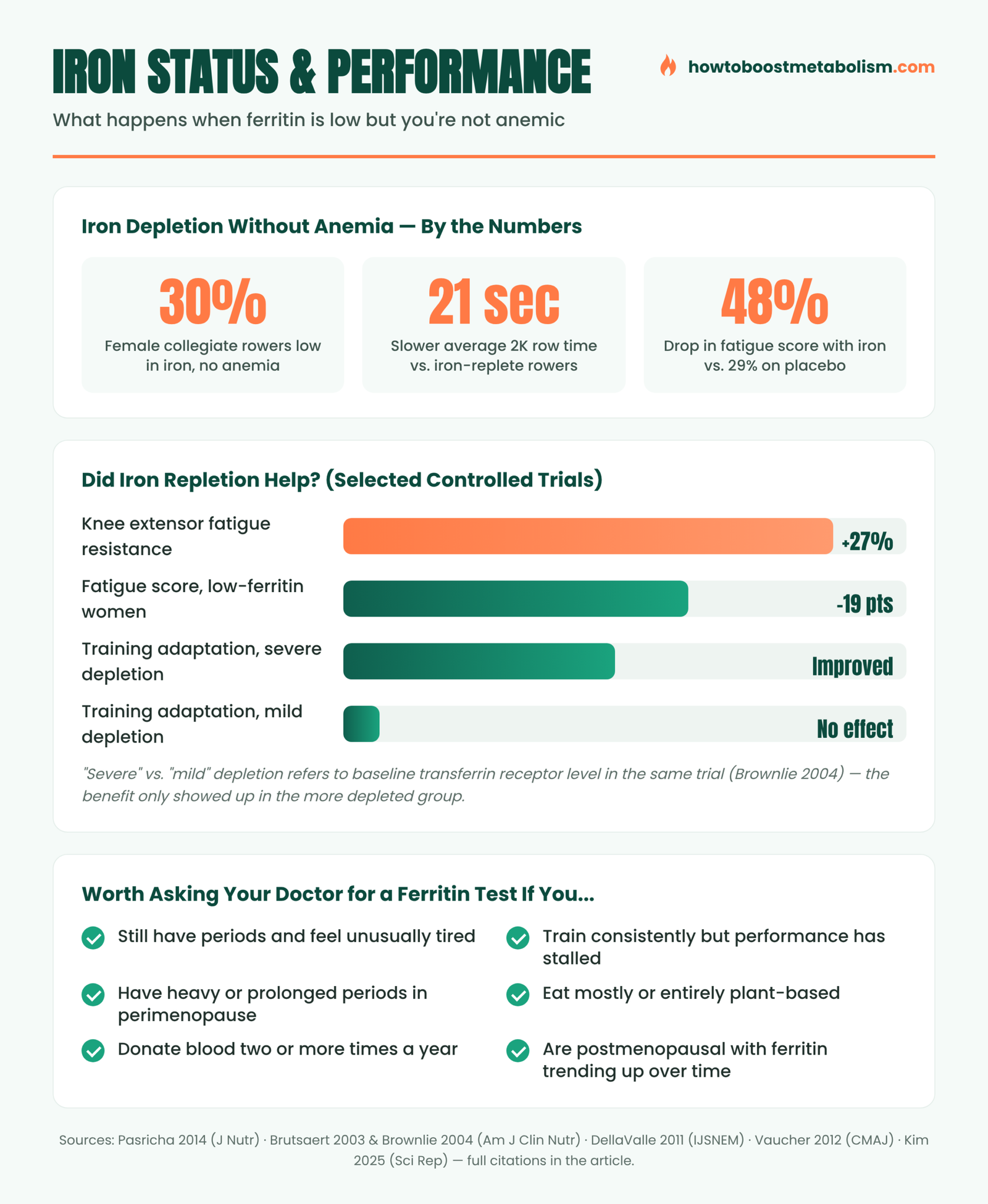
A study of 165 female collegiate rowers (DellaValle & Haas, 2011, International Journal of Sport Nutrition and Exercise Metabolism) screened everyone’s iron status at the start of a training season. About 30% of the non-anemic rowers turned out to be iron-depleted (serum ferritin under 20 µg/L). Their self-reported best 2,000-meter race times were roughly 21 seconds slower than teammates with normal iron status — a meaningful gap in a sport measured in fractions of a second. Hemoglobin told the coaches nothing useful here; ferritin did.
A Controlled Trial, Inside the Muscle Itself
Correlation isn’t proof, so the more convincing evidence comes from randomized trials. In one (Brutsaert et al., 2003, American Journal of Clinical Nutrition), iron-depleted, non-anemic women were randomly assigned to iron supplementation or placebo, then tested on a repeated knee-extensor fatigue protocol before and after treatment. The iron group’s muscle contraction force held up noticeably better under repeated fatigue — about 15% higher at six minutes into the protocol and roughly 27% higher by the end — compared with no meaningful change in the placebo group. This was a local-muscle effect, not just “feeling less tired,” and the researchers couldn’t fully explain it through the measured iron markers alone, which is an honest detail worth including rather than glossing over: the mechanism isn’t completely settled, even though the effect showed up.
Training Harder Doesn’t Always Help If You’re Depleted — But the Benefit Isn’t Universal
A separate trial (Brownlie et al., 2004, American Journal of Clinical Nutrition) put 41 previously untrained, iron-depleted women through a supervised cycling program, half on iron supplements and half on placebo. Here’s the honest part: iron only improved endurance-capacity gains in women who started out more severely depleted (a higher baseline transferrin receptor level). Women with milder depletion saw no significant difference between iron and placebo. In other words, this isn’t a universal performance hack — it mattered most for the people who were genuinely running low.
Fatigue in Everyday Life, Not Just Athletes
Most of this research is framed around athletes, but a large primary-care trial (Vaucher et al., 2012, CMAJ) tested 198 women aged 18–53 with unexplained fatigue and ferritin under 50 µg/L — a group that looks a lot like “tired, busy, nothing obviously wrong on paper.” After 12 weeks, fatigue scores dropped 47.7% in the iron group versus 28.8% on placebo — a real difference, though notably the placebo group also improved substantially, a reminder that some of what feels like “the iron fixed it” is also just time, attention, and expectation. Quality of life, depression, and anxiety scores didn’t differ between groups. The authors’ own conclusion was measured, not triumphant: iron supplementation “should be considered” for women with unexplained fatigue and ferritin under 50 µg/L — not prescribed blindly to everyone who feels tired.
Free download
🔥 The Metabolism Starter Kit
3 honest guides: a 7-day reset plan, a foods cheat-sheet and 12 metabolism myths debunked. No spam — unsubscribe anytime.
What the Broader Evidence Says
Zooming out from individual trials, a systematic review and meta-analysis (Pasricha et al., 2014, The Journal of Nutrition) pooled the available randomized trials in women of reproductive age and concluded that iron supplementation does benefit physical performance measures overall — but the authors also flagged meaningful variation between studies in dose, duration, and how “performance” was even measured. This is a genuinely useful nutrient intervention for a specific, identifiable subgroup — not a universal energy fix, and not evidence that more iron is better once you’re actually replete.
The Twist Almost Nobody Mentions: What Changes After Menopause
Nearly all of the research above was done in premenopausal or perimenopausal women, where monthly blood loss is the main reason iron depletion happens in the first place. After menopause, that source of iron loss disappears — and the story changes in a way that matters for anyone past 40 reading generic “take an iron supplement” advice aimed at a younger audience.
A 2025 cohort study (Kim et al., 2025, Scientific Reports) tracked ferritin through the menopausal transition and found it rises — sometimes sharply — as periods stop, and that this rise is linked to markers of worsening metabolic health, not improving energy. Related work comparing men and postmenopausal women (indexed under iron, inflammation, and atherosclerosis research) has pointed the same direction: once menstrual iron loss ends, rising ferritin tends to track with inflammation and cardiometabolic risk rather than vitality.
The honest, practical takeaway: the “am I iron deficient” question and the “should I supplement” question have different answers depending on where you are in the menopause transition. Still menstruating, especially with heavy or prolonged periods? Depletion is the realistic risk. Several years postmenopausal? Rising ferritin without a clear reason is worth mentioning to a doctor too — in the opposite direction, as a metabolic flag rather than a deficiency.
Who’s Actually at Risk After 40
- Perimenopausal women with heavy, prolonged, or more frequent periods — a common and under-discussed feature of the transition
- Anyone eating a mostly or entirely plant-based diet, since non-heme (plant) iron is absorbed far less efficiently than iron from animal sources
- Regular blood donors, especially those donating two or more times a year
- Endurance athletes and anyone training hard most days of the week — foot-strike hemolysis, gut blood loss, and sweat losses all add up
- Anyone with undiagnosed gastrointestinal issues causing chronic low-grade blood loss (this always deserves medical attention, not just a supplement)
Fatigue Has Other Causes Too — Don’t Stop at Ferritin
Low iron is one explanable, testable cause of the “my training feels harder than it used to” complaint after 40 — but it’s not the only one, and it’s worth saying plainly that fixing ferritin won’t help if the real driver is something else entirely. Thyroid dysfunction, poor sleep quality, vitamin D or B12 deficiency, under-fueling relative to training load, and the broader hormonal shifts of perimenopause can all produce an almost identical picture: flat energy, slower recovery, a performance plateau that seems to come out of nowhere. A ferritin test is cheap, easy to add to routine bloodwork, and worth doing — but if it comes back normal, the honest next step is to keep looking rather than assume “it’s probably iron anyway” and supplement regardless.
Should You Just Start Taking an Iron Supplement?
No — and this is the one place where caution matters more than optimism. Iron is not like vitamin C, where excess is harmlessly excreted. The body has limited ways to get rid of extra iron, and chronic over-supplementation can contribute to oxidative stress and, in people with undiagnosed hemochromatosis (a genetic iron-overload condition), real organ damage. Taking iron you don’t need is not a neutral, “can’t hurt” move.
The responsible sequence is: get a ferritin test (and ideally a full iron panel) before supplementing, work with your doctor to confirm depletion rather than guessing from symptoms alone, and investigate the cause of the deficiency if one isn’t obvious — because “just take iron” without finding the leak is treating a symptom, not the problem.
| Iron Status | What It Looks Like | What the Evidence Supports |
|---|---|---|
| Normal ferritin, normal hemoglobin | No anemia, iron stores adequate | No benefit shown from extra iron |
| Low ferritin, normal hemoglobin | “Iron depleted without anemia” — the focus of this article | Supplementation may improve fatigue and exercise capacity in confirmed cases |
| Low ferritin, low hemoglobin | True iron-deficiency anemia | Medical treatment indicated — see a doctor, not a supplement aisle |
| Rising ferritin after menopause | No menstrual loss, ferritin climbing | Flag for metabolic/inflammatory risk, not a deficiency signal |
A Practical Testing-and-Action Plan
- Ask for serum ferritin alongside your regular bloodwork, not just a basic CBC — hemoglobin alone will miss depletion
- If ferritin comes back low and you’re still menstruating, talk to your doctor about whether heavy or prolonged periods are part of the picture
- If you eat plant-based, pair iron-rich plant foods (lentils, tofu, spinach, fortified cereals) with vitamin C at the same meal to boost absorption
- Don’t self-prescribe high-dose iron for more than a few weeks without a repeat blood test — more isn’t automatically better
- If you’re postmenopausal and ferritin is climbing, ask what else that bloodwork shows (fasting glucose, A1c, lipids) rather than assuming it’s a wellness win
Free download: our Metabolism Starter Kit — a protein calculator, a 7-day meal framework, and a one-page supplement checklist, with zero hype.
Get the Free Starter Kit →Iron status is one piece of a bigger picture that includes vitamin D, zinc and magnesium for recovery, and the broader hormonal shifts covered in our guide to boosting metabolism during perimenopause. If bone health is also on your radar during this transition, our piece on strength training for menopause and bone density covers the training side of the same hormonal window.
Fixing low ferritin restores your capacity to train hard — it doesn’t supply the training. For women over 40 coming back after fatigue or a long break, Old School New Body (co-written by Becky Holman) is a moderate, approachable strength program that scales up as energy returns. One honest caveat: ignore the age-related statistics on its sales page — they aren’t sourced — and judge the program by its structure, not the copy.
A strength program to grow into as your iron status improves:
Check Availability →Affiliate link — we may earn a commission at no extra cost to you. Disclosure
Frequently Asked Questions
What’s the difference between iron deficiency and iron-deficiency anemia?
Iron deficiency (or depletion) without anemia means your iron stores — measured by serum ferritin — are low, but your hemoglobin and red blood cells are still in the normal range. Anemia is a later stage, where hemoglobin itself has dropped. Depletion can affect energy and exercise capacity well before anemia shows up on a standard blood count.
What ferritin level is considered too low for exercise performance?
Clinical labs often flag “deficient” only below about 15 µg/L, but several of the exercise-performance studies cited here used thresholds closer to 20–50 µg/L to define functional depletion, since effects on endurance and fatigue tended to appear before the lab’s stricter cutoff. Ask your doctor to interpret your specific number rather than relying on a single universal line.
Can low iron cause fatigue even with a totally normal hemoglobin?
Yes, according to the trials above — fatigue and reduced muscular endurance showed up in women with low ferritin but normal hemoglobin, and in several cases improved with iron repletion. This is exactly why ferritin needs to be checked separately from a standard complete blood count.
Is it safe to take an iron supplement without testing first?
It’s not recommended. Iron accumulates in the body if you don’t need it, and unnecessary long-term supplementation can contribute to oxidative stress or, in people with an underlying iron-overload condition, more serious harm. Get a ferritin test first and supplement under medical guidance if it’s actually low.
Does iron deficiency risk go away after menopause?
The main driver of iron depletion in women — menstrual blood loss — goes away after menopause, and ferritin commonly rises during and after the transition. Research links that postmenopausal rise in ferritin to metabolic and inflammatory risk markers rather than to improved energy, so a high and climbing ferritin after menopause is worth discussing with a doctor in its own right, separate from the deficiency question covered in this article.