Loaded Carries After 40: What Farmer’s Walks Really Train
This article may contain affiliate links. If you buy through them, we may earn a small commission at no extra cost to you. See our Affiliate Disclosure and Medical Disclaimer.
Walk into most gyms and you won’t see loaded carries programmed much — no machine does them, and they don’t photograph as well as a heavy deadlift. But pick up two heavy dumbbells and walk 40 feet, and you’ll feel immediately why strength coaches keep bringing them back: your grip, your trunk, and your hips are all working at once, for an uncomfortably long time. Here’s what the actual biomechanics and EMG research says these movements do, and what it doesn’t settle yet.
What Counts as a “Loaded Carry”
The category covers a handful of related variations, each loading the body a little differently, according to a 2024 EMG study that directly compared them (Ellestad et al., International Journal of Exercise Science):
- Farmer’s carry (FC) — walking while holding a weight in each hand, loaded symmetrically.
- Suitcase carry (SC) — walking with a single weight in one hand, loading one side only.
- Farmer’s hold / suitcase hold — the same positions, held stationary instead of walking.
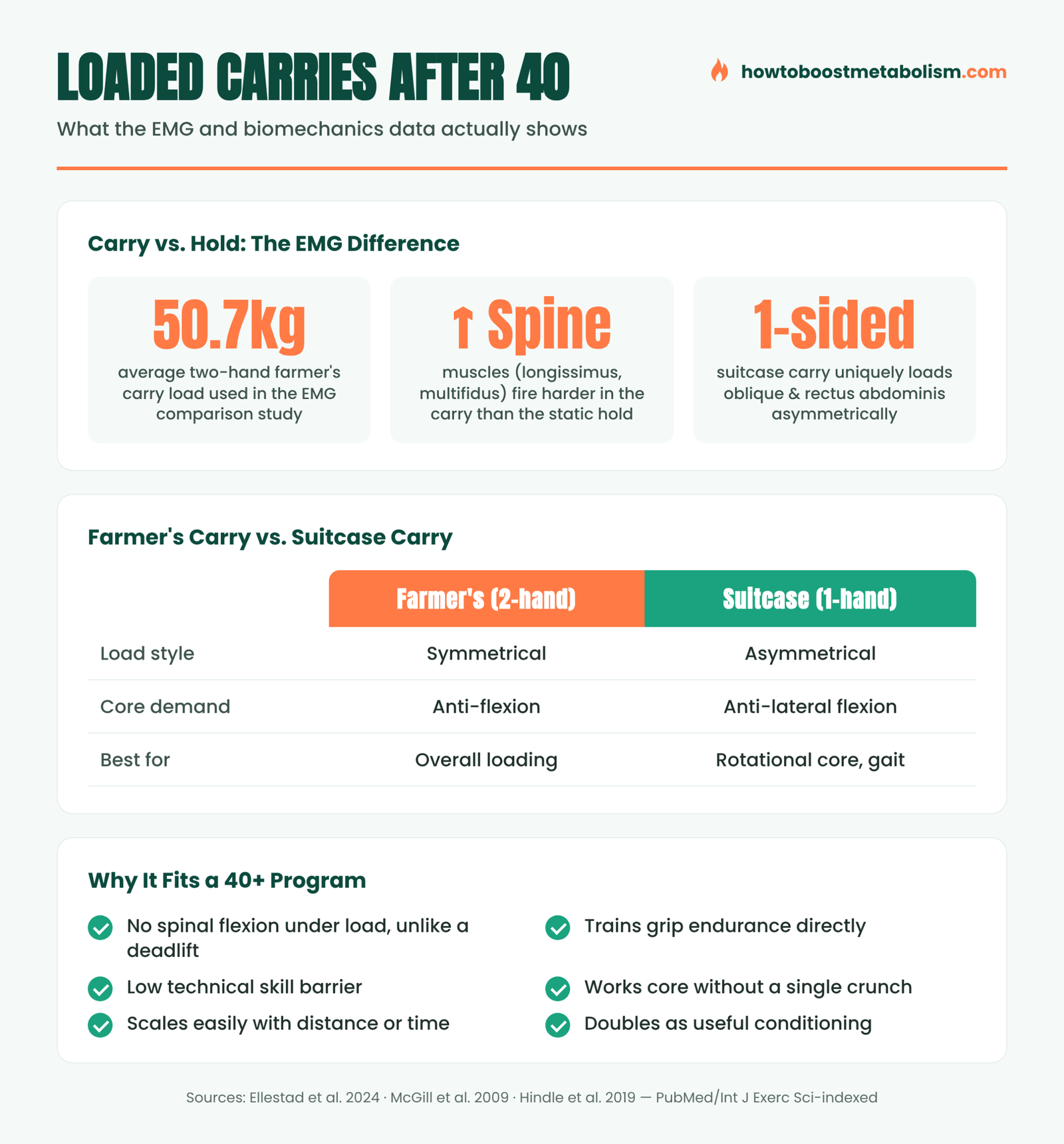
The researchers measured surface EMG of the rectus abdominis, external oblique, longissimus (a spinal erector), and multifidus (a deep spinal stabilizer) across all four variations using an average two-hand load of about 50.7 kg for the farmer’s variations. Two findings stand out. First, the farmer’s carry produced higher muscle activation than the farmer’s hold in the longissimus, multifidus, rectus abdominis, and external oblique — walking with the load, not just standing with it, is what drives more of the trunk work. Second, the suitcase carry produced greater activation on the loaded side than the suitcase hold in the spinal erectors, with the rectus abdominis and external oblique working harder on the side opposite the load — exactly what you’d expect from a movement that’s trying to tip your spine sideways while you resist it.
Why the Spine Treats This Differently Than a Deadlift
A widely cited biomechanics study of strongman-style events (McGill, McDermott & Fenwick, 2009, Journal of Strength and Conditioning Research) modeled trunk EMG and lumbar spine motion, load, and stiffness across the farmer’s walk, yoke walk, Atlas stone lift, suitcase carry, keg walk, tire flip, and log lift. The farmer’s walk in particular stood out for producing high trunk and hip demand without requiring the spine to move through a large range of motion under load — unlike, say, an Atlas stone lift, where the researchers noted the awkward shape of the stone made it difficult to avoid loading a less protected spine position. In the farmer’s walk, the torso is braced in a fixed, neutral-ish posture while walking does the work, which is a meaningfully different demand profile than a barbell lift where the spine has to move through a hinge pattern under load.
A broader systematic review of strongman exercise biomechanics (Hindle et al., 2019, Sports Medicine – Open) reached a similar conclusion at a higher level: these loaded-carriage movements train whole-body stiffness and the ability to resist unwanted motion under load — a skill that doesn’t get trained directly by most isolated machine work, and one the reviewers flagged as transferable to general strength and conditioning and rehabilitation settings, not just strongman competition.
Free download
🔥 The Metabolism Starter Kit
3 honest guides: a 7-day reset plan, a foods cheat-sheet and 12 metabolism myths debunked. No spam — unsubscribe anytime.
Does It Actually Burn More Calories? Here’s the Honest Answer
This is where we have to be upfront about a gap in the evidence: there isn’t a large body of direct metabolic-cost (VO2 / calories-per-minute) research specifically on hand-carried farmer’s walks. What does exist is a well-developed literature on loaded walking more broadly — for instance, a 2024 study modeling the metabolic cost of walking with weighted vests (Looney et al., Medicine & Science in Sports & Exercise) found that metabolic rate rises in a predictable, load-dependent way as carried weight increases, consistent with decades of military load-carriage research. It’s reasonable to expect a similar direction of effect from carrying weight in the hands — more load, more metabolic demand, especially since grip fatigue forces you to walk slower and brace harder than an unloaded walk. But we won’t claim a specific “X calories burned per set” number for hand-held carries, because that number hasn’t been directly measured in the published research we could verify. Treat loaded carries as a strength-and-conditioning tool with a plausible but unquantified metabolic bonus, not as a calorie-burning hack with a hard number attached.
At a Glance: Picking a Variation
| Variation | Primary demand | Coaching cue |
|---|---|---|
| Farmer’s carry (2-hand) | Overall trunk + grip + hip loading | Grip strength, keep torso tall |
| Suitcase carry (1-hand) | Anti-lateral-flexion core, gait-like demand | Resist leaning toward the load |
| Farmer’s hold (static) | Grip endurance with less trunk EMG | Good low-impact entry point |
| Front-loaded carry | More upper-back and anti-extension demand | Useful variation, not a default |
Why This Fits Especially Well After 40
A few practical reasons loaded carries show up often in 40+ strength programming, beyond the EMG data above:
- Grip strength is a tracked longevity marker — see our deep dive on why grip strength correlates with health outcomes — and carries train grip directly, under real load, with no extra equipment.
- Low technical skill barrier. Unlike a deadlift or Olympic lift variation, “pick it up and walk” has very little technique to coach wrong, which matters if you’re training without close supervision.
- Pairs naturally with unilateral work — see our guide to single-leg and single-arm training after 40 — since the suitcase carry is itself a unilateral, anti-rotation exercise.
- Scales without changing the exercise. You can make it harder with more weight, more distance, or more time under tension, without needing a new skill or a heavier one-rep max.
How to Actually Program Loaded Carries
- Start with time, not distance: 20-30 seconds per set for a farmer’s carry, 15-20 seconds per side for a suitcase carry.
- Pick a load you can hold with good posture for the full set — if your shoulders round forward or you start leaning hard to one side, the load is too heavy for that variation.
- 2-4 sets, 2-3 times per week is enough to build real grip and trunk endurance without turning into a separate workout.
- Progress distance or time before adding load once form is solid — carries reward longer sets more than they reward near-maximal loads.
- Use suitcase carries to address side-to-side imbalance if you already know you have one — see our simple at-home strength imbalance self-tests if you’re not sure.
Common Mistakes
- Letting the shoulders shrug up toward the ears instead of staying packed down and back.
- Walking too fast and turning it into a shuffle instead of a controlled, braced walk.
- Using straps immediately instead of letting grip be part of the training stimulus, at least some of the time.
- Treating it as a finisher only, rather than programming it with the same intent as any other strength movement.
- Holding your breath for the entire set instead of breathing in a controlled, braced pattern — a long set with no breathing is harder to sustain and doesn’t add any training benefit.
- Comparing your carry weight to someone else’s Instagram clip — grip strength varies enormously between individuals, and the right load is whatever challenges your own posture and grip for the target duration.
Loaded Carries vs. Rucking: Not the Same Tool
It’s easy to lump loaded carries in with weighted-vest walking or rucking, since both involve walking under load. The demand is different, though. A weighted vest or backpack distributes load close to your center of mass and lets your arms move freely, which is why rucking sessions can stretch to 30-60 minutes. A farmer’s or suitcase carry puts the load in your hands, well away from your spine’s natural axis, which is exactly why it fatigues the grip and trunk so much faster — most sets end in well under a minute, not because the “workout” is shorter, but because the specific demand on the hands and trunk is so much higher per minute. Think of rucking as a conditioning and bone-loading tool you can sustain for a long time, and loaded carries as a short, intense strength-and-grip tool you layer in for a few sets at a time. They complement each other rather than compete.
A Sample Way to Add Carries to an Existing Workout
You don’t need a dedicated “carry day.” The simplest approach is to use carries as a finisher after your main lifts, when grip fatigue won’t compromise a heavier barbell movement that still needs a secure grip:
| Order | Movement | Typical dose |
|---|---|---|
| 1 | Main strength work (squat, press, row, etc.) | As programmed |
| 2 | Farmer’s carry | 3 sets × 30 seconds, moderate-heavy load |
| 3 | Suitcase carry, each side | 2 sets × 20 seconds per side |
| 4 | Easy walk or mobility cooldown | 5 minutes |
On a day with no other heavy pulling or deadlifting, you can also run carries as their own short session — several rounds of farmer’s carry, suitcase carry, and a static hold, with a short walk back as the rest period. It’s an easy way to get real conditioning without a single traditional “cardio” exercise.
Loaded carries work best inside a program that also covers squatting, hinging, and pressing patterns — not as a standalone fix. Old School New Body’s F4X approach is one structured option built specifically for lifters over 40 who want a simple framework rather than building a program from scratch. One honest caveat: some of the landing-page statistics about age-related muscle loss aren’t independently sourced, so judge the program on its structure, not its marketing claims.
See the Program →Affiliate link — we may earn a commission at no extra cost to you. Disclosure
Free download: our Metabolism Starter Kit — a protein calculator, a 7-day meal framework, and a one-page supplement checklist, with zero hype.
Get the Free Starter Kit →Related: Grip training shows up in more than just carries. We also examined what dead hangs actually do for grip and tendon health after 40.
Frequently Asked Questions
What’s the difference between a farmer’s carry and a suitcase carry?
A farmer’s carry loads both hands evenly, mainly challenging the trunk to resist forward/backward collapse. A suitcase carry loads one hand only, forcing the trunk to resist leaning sideways toward the weight — EMG data shows it activates the spinal erectors and obliques on the loaded side differently than a two-hand carry.
Do loaded carries actually burn a lot of calories?
Probably more than standing still, and research on loaded walking in general shows metabolic cost rises with carried weight. But there isn’t well-established direct research measuring calories burned specifically during hand-held farmer’s walks, so treat any specific number you see online with caution.
Are loaded carries safe for a bad lower back?
They can be a lower-risk alternative to loaded hinging movements for some people, since the spine stays in a relatively fixed position rather than moving through a large range under load. That said, anyone with an active back injury should get individual guidance before loading the trunk in any way.
How heavy should a farmer’s carry be?
Heavy enough that grip and posture are both challenged by the end of a 20-30 second set, but not so heavy that your shoulders round forward or you have to lean to stay upright. Load is less important than being able to hold the position for the full set.
Can loaded carries replace deadlifts or squats?
No — they train grip and trunk bracing extremely well, but they don’t load the lower body through a full range of motion the way a squat or deadlift does. They’re a strong addition to a program, not a replacement for your main compound lifts.
How is a loaded carry different from rucking?
Rucking distributes weight close to your center of mass (a vest or backpack) and is built for longer, sustained sessions. A loaded carry puts weight in your hands, which fatigues grip and trunk stability much faster, so sets are typically short and intense rather than long and steady. Both are useful; they just train different qualities.
This article is for educational purposes and is not medical advice. See our Medical Disclaimer and consult a professional before starting a new loading pattern if you have an existing back, shoulder, or grip-related injury.