Best Rep Range for Muscle vs. Fat Loss (2026)
This article may contain affiliate links. If you buy through them, we may earn a small commission at no extra cost to you. See our Affiliate Disclosure and Medical Disclaimer.
If you’ve spent any time in a gym or a fitness forum, you’ve heard the rules: “3-5 reps builds strength, 8-12 builds muscle, 15-20 burns fat.” It’s tidy, it’s quotable, and it’s largely a myth. The actual research on loading and rep ranges tells a more useful — and more forgiving — story, and it matters whether your goal is building muscle after 40, protecting muscle while losing fat, or just not wasting time under the bar.
This isn’t an anti-science hot take. It’s what a 2017 systematic review and meta-analysis in the Journal of Strength and Conditioning Research, and a 2024 dose-response analysis in Sports Medicine, actually found when they pooled dozens of training studies instead of one gym’s house opinion.
The Study That Changed the Rep-Range Conversation
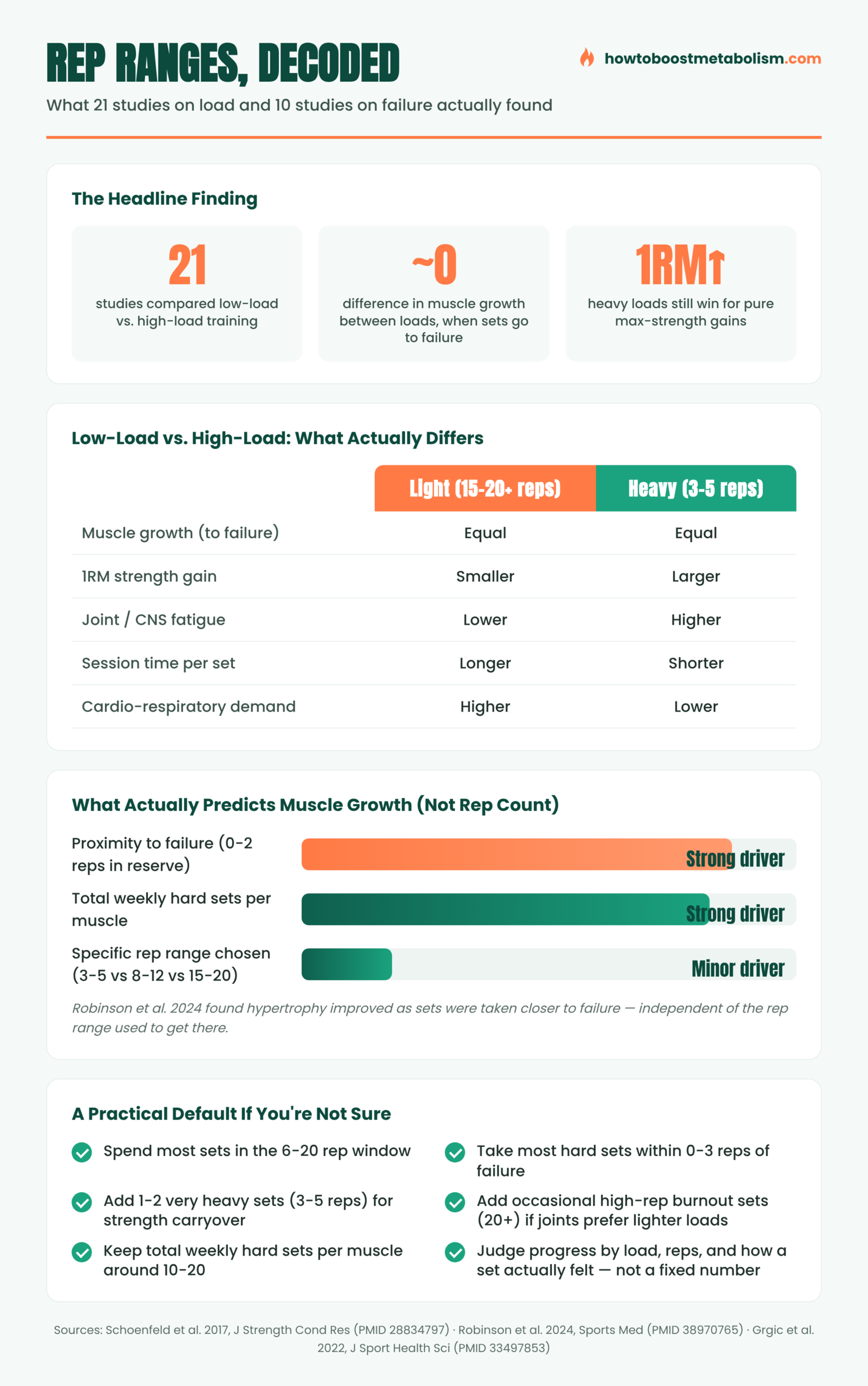
Schoenfeld, Grgic, Ogborn, and Krieger pooled 21 studies comparing low-load training (≤60% of 1-rep max, roughly 15 or more reps per set) against high-load training (over 60% of 1RM, roughly 12 reps or fewer), with every set taken to momentary muscular failure (Schoenfeld et al., 2017, J Strength Cond Res). The result surprised a lot of long-held gym wisdom: changes in muscle hypertrophy were statistically similar between the two loading ranges. Heavier loads did produce significantly larger gains in 1-rep-max strength — if your goal is a bigger max lift, load still matters. But for building muscle tissue itself, a broad spectrum of rep ranges got people to roughly the same place.
That single finding undercuts the entire “8-12 is the hypertrophy range” framing. It’s not that 8-12 reps is wrong — it’s a perfectly good range — it’s that 4 reps and 20 reps can build comparable muscle, provided the sets are taken hard enough and the total training volume is similar.
So What Actually Drives Muscle Growth, If Not the Rep Count?
A 2024 meta-regression in Sports Medicine dug into exactly this question by quantifying how close to failure a set was taken — measured in estimated “reps in reserve” (RIR) — across dozens of training studies (Robinson, Pelland, Remmert, Refalo, Jukic, Steele & Zourdos, 2024, Sports Medicine). The pattern that emerged: proximity to failure meaningfully predicted muscle growth — sets taken closer to failure produced more hypertrophy — while strength gains were similar across a wide range of RIR. In other words, how close you push a set to failure matters more for size than the specific number of reps in that set.
A related 2022 systematic review reached a complementary conclusion: training to repetition failure versus stopping a couple of reps short produced similar strength and hypertrophy outcomes in most comparisons, provided total training volume was accounted for (Grgic, Schoenfeld & Orazem, 2022, J Sport Health Sci). Pushed together, the evidence points at two variables that matter far more than “which rep range”: how close to failure you train, and how much total hard work (sets × intensity, summed across the week) you accumulate per muscle group.
| Rep range | What it mainly builds | Best used for |
|---|---|---|
| Very heavy (1-5 reps) | Primarily 1RM strength; builds muscle too, if volume is adequate | Peaking, strength-focused blocks |
| Moderate (6-12 reps) | Muscle + some strength; the most time-efficient middle ground | General hypertrophy, most lifters |
| Light (13-20+ reps) | Builds muscle equally well to failure; easier on joints, more cardio-like fatigue | Joint-friendly days, metabolic finishers |
Free download
🔥 The Metabolism Starter Kit
3 honest guides: a 7-day reset plan, a foods cheat-sheet and 12 metabolism myths debunked. No spam — unsubscribe anytime.
Does This Change for Fat Loss Instead of Muscle Growth?
Here’s where the old “high reps for fat loss” rule falls apart on its own terms: no rep range burns fat directly. Fat loss is driven by a sustained calorie deficit, not by how many reps are in a set. What rep range actually changes during a fat-loss phase is secondary — but real:
Heavier, lower-rep training (roughly 4-10 reps) tends to preserve more strength and muscle mass while you’re eating less, because it keeps the mechanical tension high enough to justify keeping the muscle around. Lighter, higher-rep training burns more calories per set and adds more to your weekly step-equivalent fatigue, but on its own it doesn’t out-muscle a calorie surplus or make up for a calorie deficit that’s too aggressive to sustain. For most people cutting calories, a mix — mostly 6-15 reps, with a few genuinely heavy sets kept in — protects muscle better than chasing a high-rep burn for its own sake.
Why the Old “3-5 / 8-12 / 15-20” Rule Stuck Around So Long
The three-tier rule wasn’t invented from nothing — it comes from real physiology, just applied too rigidly. Heavier loads do recruit more motor units and produce higher peak mechanical tension per rep, which is one of the signals that drives muscle growth. Lighter, higher-rep sets produce more metabolic stress — the burning, pump-inducing fatigue from accumulated metabolites — which is a second, separate growth signal. The rule’s mistake was treating these as mutually exclusive instead of overlapping: a 12-rep set taken close to failure produces plenty of both mechanical tension and metabolic stress, which is exactly why it doesn’t underperform a 5-rep set or a 20-rep set by much, if at all, once total volume is matched.
It also stuck around because early strength research — much of it done on powerlifters training for a 1-rep max — showed that heavy, low-rep work was clearly superior for building maximal strength. That part of the rule is still true. The error was generalizing a strength-training finding to a muscle-growth question, where the two goals respond to training variables differently.
Matching Rep Range to the Exercise, Not Just the Goal
In practice, the exercise itself often makes the decision for you. Big, technically demanding barbell lifts — heavy squats, deadlifts, overhead presses — tend to break down in form well before true muscular failure at very low reps, which is one reason experienced lifters often keep those in the 3-8 rep range and save higher-rep, higher-failure-tolerance work for machines, cables, and isolation exercises where a technical breakdown is lower-risk. Leg extensions, lateral raises, cable rows, and most machine work tolerate being pushed closer to true failure at higher reps (12-25) without the same injury trade-off a heavy barbell lift carries at the same proximity to failure.
This is also where rep range interacts with age and joint history more than with the muscle-building math itself. A heavy, low-rep front squat and a lighter, higher-rep leg press can produce comparable quad growth — but one puts far more compressive load through the knees and spine per working set. Choosing the joint-friendlier option isn’t settling for a worse rep range; based on the evidence above, it’s very often an equally effective one.
Common Mistakes With Rep Range
| Mistake | Better approach |
|---|---|
| Chasing a specific “ideal” number instead of effort | Pick a range, then push each set genuinely close to failure — the range matters less than how hard the set actually was |
| Never training above 15 reps or never below 8 | Rotate ranges across a block; each extreme has a joint-stress and time-efficiency trade-off worth using occasionally |
| Reducing weight every week to “hit” a rep target | Let reps fluctuate slightly; prioritize adding small amounts of weight or total volume over strict rep adherence |
| Treating fat loss as a rep-range problem | Fix the calorie deficit first; rep range only changes muscle retention and session fatigue during a cut |
Why This Matters More After 40
If you’re over 40, the stakes around rep range shift slightly: joints often tolerate very heavy, very low-rep work less comfortably, and recovery from true failure training takes a bit longer. The research above is good news here — because muscle growth doesn’t require grinding out 3-rep maxes, you can lean on the 8-20 rep range, train close to (not always at) failure, and still build and keep real muscle. That’s lower joint stress for a very similar hypertrophy outcome.
A Practical Framework (Not a Rule)
Instead of memorizing “use X reps for Y goal,” a more durable approach: pick a rep range you can control with good form, that lets you get within a few reps of genuine effort, and that you can recover from before the next session. Rotate ranges across a training block instead of locking into one number forever — it’s easier on specific joints and keeps training interesting, without changing the muscle-building math much.
| Rep range | What it feels like in practice | Good fit if… |
|---|---|---|
| 3-5 | Heavy, strength-forward; fewer total reps per set | Shoulders/elbows feeling beat up, chasing a strength number |
| 6-12 | The practical default for most muscle-building goals | No specific joint issue; want efficient sessions |
| 13-20+ | Lighter loads, more total reps, lower per-rep joint stress | Joint-sensitive days, higher-rep accessory work |
One honest caveat: these studies mostly measure muscle size and 1RM strength in controlled lab settings over 6-12 weeks. Real-world adherence — whether you’ll actually keep showing up — matters more than which range is marginally “optimal” on paper. The rep range you’ll stick with consistently beats the one a meta-analysis mildly favors.
Pairing Rep Range With a Structured Program
If building visible muscle while keeping body fat in check is the actual goal — not just the rep range on a single exercise — the bigger lever is a complete program that coordinates training volume, nutrition, and recovery over weeks, not a single set scheme. Progressive overload after 40 and planned deload weeks both matter more to long-term results than which exact rep count you use on a Tuesday.
Programs built to combine structured training with a fat-loss-friendly eating approach are marketed as helping you build muscle and lose fat in the same block. That framing is the vendor’s marketing claim, not an independent guarantee — but the underlying idea (train with real effort, control calories, recover deliberately) lines up with what the research above actually supports.
Check the Program →Affiliate link — we may earn a commission at no extra cost to you. Disclosure
Free download: our Metabolism Starter Kit — a protein calculator, a 7-day meal framework, and a one-page supplement checklist, with zero hype.
Get the Free Starter Kit →At a Glance
| Question | Short answer |
|---|---|
| Does rep range alone determine muscle growth? | No — proximity to failure and total weekly volume matter more (PMID 28834797, 38970765) |
| Is 8-12 reps the “best” range? | It’s a good, efficient range — not uniquely superior to 4-7 or 13-20 for hypertrophy |
| Does a specific rep range burn fat? | No — fat loss depends on a sustained calorie deficit, not rep count |
| What should lifters over 40 prioritize? | A rep range their joints tolerate, trained close to (not always at) failure, applied consistently |
Related: Rep range is only half the volume equation — see how it fits into the bigger picture of weekly set volume, and the MEV/MAV/MRV framework.
Related: Once you’ve settled on a rep range, how you structure the set itself is the next question — our guide to cluster sets vs. traditional sets covers what the newest research shows.
Frequently Asked Questions
Is 8-12 reps really the best rep range for building muscle?
It’s a solid, time-efficient range, but a 2017 meta-analysis of 21 studies found muscle growth was statistically similar between low-load (15+ reps) and high-load (≤12 reps) training when sets were taken to failure. 8-12 isn’t uniquely superior — it’s one good option among several.
What rep range builds the most muscle after age 40?
Research doesn’t point to a single “best” range for any age group. A range in roughly 6-20 reps that’s joint-tolerable and trained close to failure, applied consistently across weeks, tends to work as well as anything more rigid — with less joint stress than near-maximal 1-3 rep work.
Do high reps burn more fat than low reps?
Not directly. Fat loss comes from a sustained calorie deficit, not from a specific rep count. Higher-rep sets do burn slightly more calories per set and add more metabolic fatigue, but they don’t substitute for calorie control, and heavier lower-rep work tends to protect muscle better during a cut.
Should I train every set to complete failure?
Not necessarily. A 2022 review found failure and near-failure training produced similar outcomes when volume was matched, and the 2024 dose-response analysis found strength gains were similar across a wide range of effort levels — only hypertrophy showed a modest edge for sets taken closer to failure. Most lifters do well leaving 0-3 reps in reserve on most sets.
Can I mix rep ranges in the same training week?
Yes — and it’s a reasonable strategy. Rotating between heavier (3-6 reps), moderate (8-12), and lighter (15-20+) work across a week or training block spreads joint stress out while keeping total volume and effort level high, without sacrificing muscle-building results.