Can Strength Training Help With Migraines?
This article may contain affiliate links. If you buy through them, we may earn a small commission at no extra cost to you. See our Affiliate Disclosure and Medical Disclaimer.
If you live with migraines, you’ve probably been warned about exercise from both directions — told it will help prevent attacks, and separately warned that overexertion is a classic trigger. Both warnings are grounded in real evidence, which makes the honest answer more complicated than either claim alone. Here’s what the actual randomized trials on strength training and migraine frequency show, including where the evidence is thin and where exercise itself can backfire.
The Old Idea: Exercise and Migraines Don’t Mix
Exertional headache is a real, recognized phenomenon — sudden, intense physical effort can trigger a headache or even a migraine attack in susceptible people, and it’s one reason some clinicians have historically been cautious about recommending vigorous training to migraine patients. But ‘exercise can sometimes trigger an attack’ and ‘structured exercise, done sensibly over months, reduces how often attacks happen’ are not contradictory statements. Most of the research below is about the second claim, using controlled training programs rather than sudden, unaccustomed effort.
The First Real Head-to-Head Trial: Exercise vs. Relaxation vs. a Migraine Drug
The most important early study here is a Swedish randomized trial (Varkey et al., 2011, Cephalalgia) that did something unusually rigorous: it compared exercise directly against both a relaxation program and daily topiramate, a medication actually prescribed for migraine prevention. Ninety-one adults with migraine were randomized to 40 minutes of exercise three times a week, a recorded relaxation program, or topiramate titrated up to the highest dose they could tolerate, for three months.
The result was a genuine three-way tie. Exercise reduced migraine attacks by an average of 0.93 per month, relaxation by 0.83, and topiramate by 0.97 — with no statistically significant difference between any of the groups (p=0.95). The honest headline isn’t that exercise is a miracle cure; it’s that a non-drug intervention performed statistically indistinguishably from an actual migraine medication, in people who hadn’t necessarily failed other treatments. For anyone who can’t tolerate migraine medication or prefers not to take one daily, that’s a meaningful finding on its own.
Free download
🔥 The Metabolism Starter Kit
3 honest guides: a 7-day reset plan, a foods cheat-sheet and 12 metabolism myths debunked. No spam — unsubscribe anytime.
The Meta-Analysis: A Real, But Modest, Effect
A 2019 systematic review and meta-analysis (Lemmens et al., The Journal of Headache and Pain) pooled six qualifying studies on aerobic exercise and migraine. It found a statistically significant reduction in migraine days after aerobic exercise training — but the pooled effect size was small: an average reduction of 0.6 ± 0.3 migraine days per month. The review rated this as moderate-quality evidence and was explicit that effect sizes were small partly because studies used wildly different exercise protocols and outcome measures, making it hard to pin down an optimal ‘dose.’ This is the kind of caveat that’s easy to skip past in a marketing headline and the first thing worth knowing before expecting dramatic results.
Does Adding Resistance Training Help More Than Cardio Alone?
Almost all of the older research on exercise and migraine focuses on aerobic training specifically, not strength training. A 2025 pilot randomized controlled trial (Headache) is one of the first to test this directly. Twenty-four participants with migraine were split into three groups: aerobic exercise alone, combined aerobic plus resistance training (five exercises targeting the neck, upper back, and shoulders), or a no-exercise control, each for 12 weeks after a one-month baseline headache diary.
Both the aerobic-only and combined groups significantly reduced monthly migraine days compared with baseline (p<0.001 for both), while the control group showed no meaningful change. The detail that matters for this article: migraine frequency dropped significantly more in the combined aerobic-plus-resistance group than in the aerobic-only group (p=0.027). Anxiety scores also improved more in the combined group. The obvious caveat is the sample size — 24 total participants split across three arms is a pilot study, not a definitive trial, and it needs replication in a larger cohort before anyone should treat the specific resistance component as proven superior to cardio alone. But it's the first controlled signal that adding targeted strength work on top of aerobic exercise may do more than aerobic exercise by itself, rather than less.
| Comparison | Result | Source |
|---|---|---|
| Exercise alone vs. relaxation/medication | No significant difference (tie) | Varkey et al., 2011 |
| Aerobic training vs. no exercise | -0.6 days/month (modest, significant) | Lemmens et al., 2019 meta-analysis |
| Combined aerobic + resistance vs. aerobic alone | Greater reduction (p=0.027) | 2025 pilot RCT, n=24 |
Why Might Lifting Specifically Help?
No trial above has isolated the biological mechanism, so treat this section as plausible reasoning rather than proven cause and effect. Chronic tension in the neck, upper back, and shoulders is a well-documented migraine trigger and comorbidity for many patients, and targeted strengthening of those exact muscles — the approach used in the 2025 pilot trial — is a logical way to address that specific contributor. Resistance training also improves sleep quality and stress-hormone regulation in multiple unrelated trials, and both poor sleep and stress are among the most commonly reported migraine triggers. None of this proves the mechanism; it just gives the pilot trial’s result a plausible explanation rather than making it look like a statistical fluke.
There’s also a secondary, less direct pathway worth mentioning: anxiety and migraine frequently occur together, and exercise — resistance training included — has a reasonably strong independent evidence base for reducing anxiety symptoms. In the 2025 pilot trial specifically, anxiety scores improved more in the combined aerobic-plus-resistance group than in the aerobic-only group, which tracked alongside (but doesn’t prove it caused) the larger reduction in migraine days. Depression scores, notably, did not improve significantly in either exercise group in that trial — a reminder not to overstate the mental-health benefits based on one small study.
Chronic vs. Episodic Migraine: Does the Evidence Differ?
Most of the trials above enrolled people with episodic migraine — generally fewer than 15 headache days a month — rather than chronic migraine, which is defined as 15 or more headache days a month for at least three months. That distinction matters because chronic migraine is a harder condition to treat by almost any method, pharmaceutical or otherwise, and the exercise literature specific to chronic migraine is thinner and more mixed. If you have chronic migraine, the honest expectation is that exercise is a reasonable adjunct worth discussing with a headache specialist as part of a broader treatment plan, not a method with the same level of direct evidence as in episodic migraine. People with medication-overuse headache — a complication of taking acute migraine medication too frequently — are a separate case entirely, and need that issue addressed with a physician before exercise or anything else can be judged fairly.
The Other Side: When Exercise Itself Is the Trigger
A fair article on this topic has to take the warning as seriously as the benefit. Primary exertional headache and exercise-triggered migraine are real enough that abrupt, high-intensity effort — especially in heat, with dehydration, or on an empty stomach — can provoke the exact attack you’re trying to prevent. The practical resolution isn’t to avoid training; it’s to avoid the specific conditions that tend to provoke attacks: sudden maximal efforts, training in a dehydrated or fasted state, and skipping the warm-up. Every trial discussed above used graded, moderate programs building up over weeks, not a single all-out session, and that distinction is probably doing real work.
One specific technique is worth flagging by name: the Valsalva maneuver, where you hold your breath and strain against a closed airway during a heavy lift. It briefly spikes blood pressure and intracranial pressure, which is a plausible — though not formally tested in these trials — way for heavy, breath-holding lifts to provoke a headache in someone prone to them. None of the migraine trials above used heavy maximal lifting; they used light-to-moderate resistance exercises for the neck, upper back, and shoulders. If you want to add heavier compound lifting later, breathing normally through each rep rather than holding your breath is a reasonable precaution, not just for migraine but for blood pressure generally.
What a Realistic 12-Week Program Actually Looks Like
The 2025 pilot trial’s combined group is the most directly relevant template available, so it’s worth describing in more detail than ‘light resistance training.’ Participants performed the same aerobic exercise as the aerobic-only group, three days a week, and added five resistance exercises targeting the neck, upper back, and shoulder muscles on those same training days, for 12 weeks.
- Aerobic base: moderate-intensity cardio (walking, cycling, or similar), 3 sessions per week.
- Add 5 light resistance exercises for the neck, upper back, and shoulders — think scapular retractions, light shoulder external rotation, and gentle isometric neck holds rather than heavy pressing movements.
- Keep intensity moderate throughout; the benefit in this research came from consistency over 12 weeks, not from pushing to failure.
- Track migraine days in a diary from week one, since the pilot trial’s one-month baseline period is what let researchers detect a real change rather than normal month-to-month variation.
This is a conservative, specific starting point drawn directly from the only controlled trial testing resistance training for migraine so far — not a generic ‘lift weights’ recommendation. As larger trials are published, the optimal exercise selection may well turn out to look different.
A Cautious, Gradual Way to Start
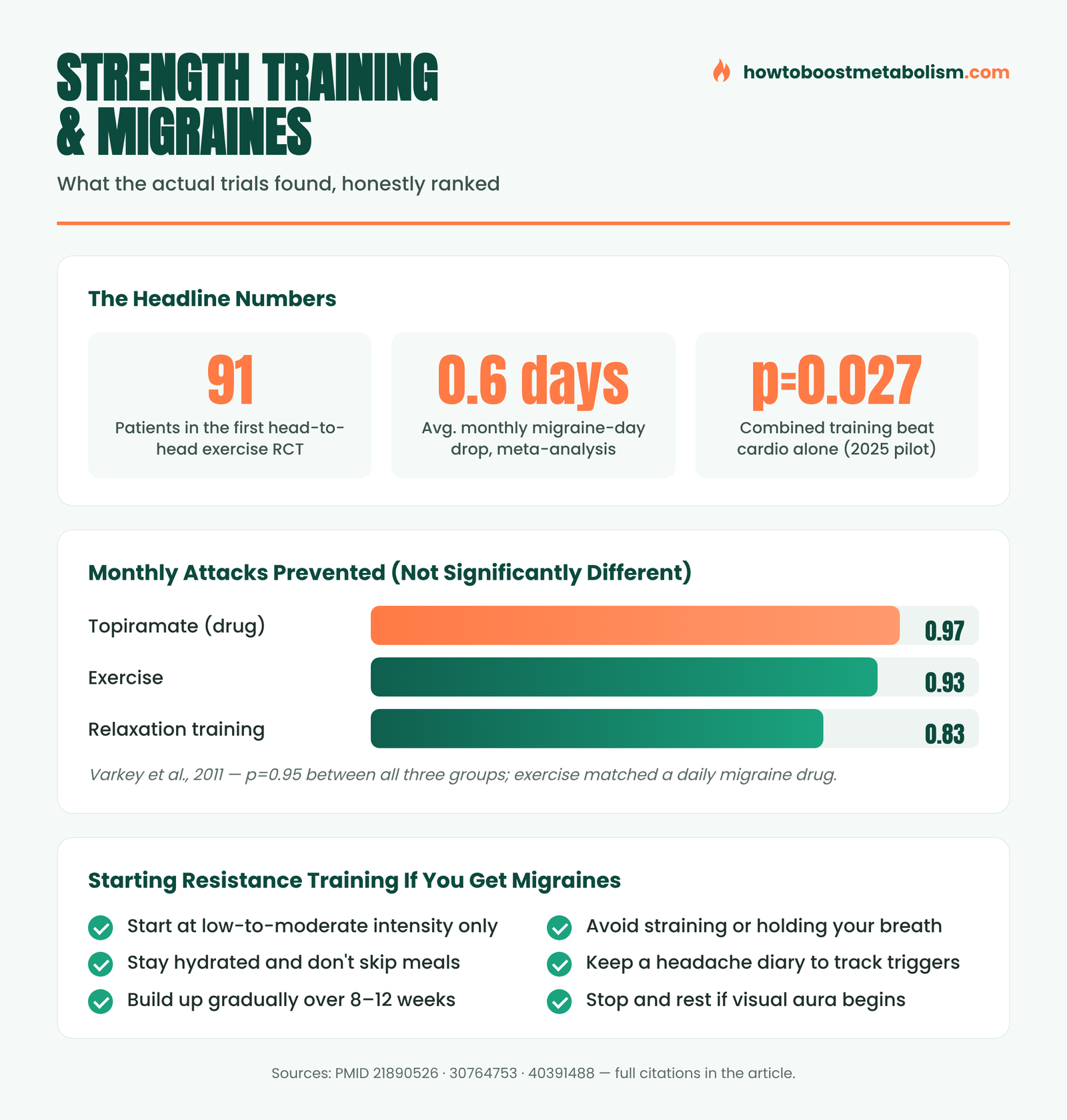
- Begin with low-to-moderate intensity sessions, 2–3 times per week, rather than maximal effort.
- Include light strengthening for the neck, upper back, and shoulders, mirroring the 2025 pilot protocol.
- Eat something beforehand and stay hydrated — skipping meals and dehydration are two of the most common exercise-related migraine triggers.
- Warm up properly rather than jumping straight into heavy loads.
- Keep a simple headache diary alongside your training log so you can see whether frequency is trending down over 8–12 weeks, and whether any particular session type seems to provoke an attack.
Who Should Talk to a Doctor First
Anyone with migraine with aura, a history of exercise-triggered attacks, or any new or unusual headache pattern should check in with a physician before starting a new training program — both to rule out other causes and to get individualized guidance on intensity. This research is a reason to consider exercise as one legitimate option among several, not a reason to self-prescribe intense training in place of medical care, especially if you’re currently on a preventive medication that’s working.
It’s also worth a conversation with your doctor if you’re over 40 and starting a new exercise habit after a long sedentary stretch, independent of the migraine question — standard pre-exercise screening for cardiovascular risk factors applies here just as it would for anyone else beginning a new training program at this age.
If you’re building a broader, affordable strength routine for the long haul rather than just this one specific goal, Old School New Body lays out a structured program designed for adults starting or restarting training later in life. One honest note: some of the marketing claims on its sales page about aging and muscle loss are not independently sourced, so treat those specific numbers as promotional rather than peer-reviewed — the training structure itself is the useful part.
See the Program →Affiliate link — we may earn a commission at no extra cost to you. Disclosure
Free download: our Metabolism Starter Kit — a protein calculator, a 7-day meal framework, and a one-page supplement checklist, with zero hype.
Get the Free Starter Kit →Frequently Asked Questions
Can exercise trigger a migraine instead of preventing one?
Yes, in susceptible people, especially with sudden maximal effort, dehydration, or training on an empty stomach — this is sometimes called exertional or exercise-triggered headache. Every trial showing a preventive benefit used gradual, moderate programs built up over weeks, not single intense sessions.
Is strength training as effective as migraine medication?
A 2011 randomized trial found that exercise (a mix of aerobic effort) reduced migraine attacks about as much as daily topiramate, with no statistically significant difference between the two. That trial didn’t isolate strength training specifically, so treat this as evidence for structured exercise broadly, not resistance training alone.
Should you lift weights during an active migraine attack?
No trial discussed here tested training during an active attack, and most clinical guidance recommends rest, a dark quiet room, and your usual acute treatment during an attack itself. The preventive benefit comes from consistent training between attacks, not training through one.
What type of strength training is best studied for migraine?
The most relevant trial used light resistance exercises targeting the neck, upper back, and shoulders alongside aerobic training, three days a week for 12 weeks. That’s the specific protocol with the strongest direct evidence so far, though the trial was small.
How long before strength training reduces migraine frequency?
In the trials above, meaningful reductions in monthly migraine days were measured at 12 weeks, not days or a couple of weeks in. Give a new program a full three months before judging whether it’s helping your specific migraine pattern.
Related reading: resistance training and brain health, sleep debt and muscle recovery, and strength training and inflammation markers.
This article is for educational purposes and is not a substitute for individualized medical advice, especially if you have migraine with aura or a complex headache history. See our full Medical Disclaimer.