Does Strength Training Improve Brain Health After 40?
This article may contain affiliate links. If you buy through them, we may earn a small commission at no extra cost to you. See our Affiliate Disclosure and Medical Disclaimer.
A lot of fitness content treats “lifting weights sharpens your brain” as settled science. It isn’t — not in the simple, universal way it’s usually presented. Some well-designed randomized trials found real, measurable cognitive benefits from resistance training. At least one equally well-designed trial found none. Both are worth knowing about if you’re 40+ and deciding where to put your limited exercise time.
This article walks through what the actual randomized controlled trials found — the encouraging ones and the disappointing one — and what that honestly means for how you should think about strength training as part of protecting your brain as you age.
The Study Most Headlines Are Built On
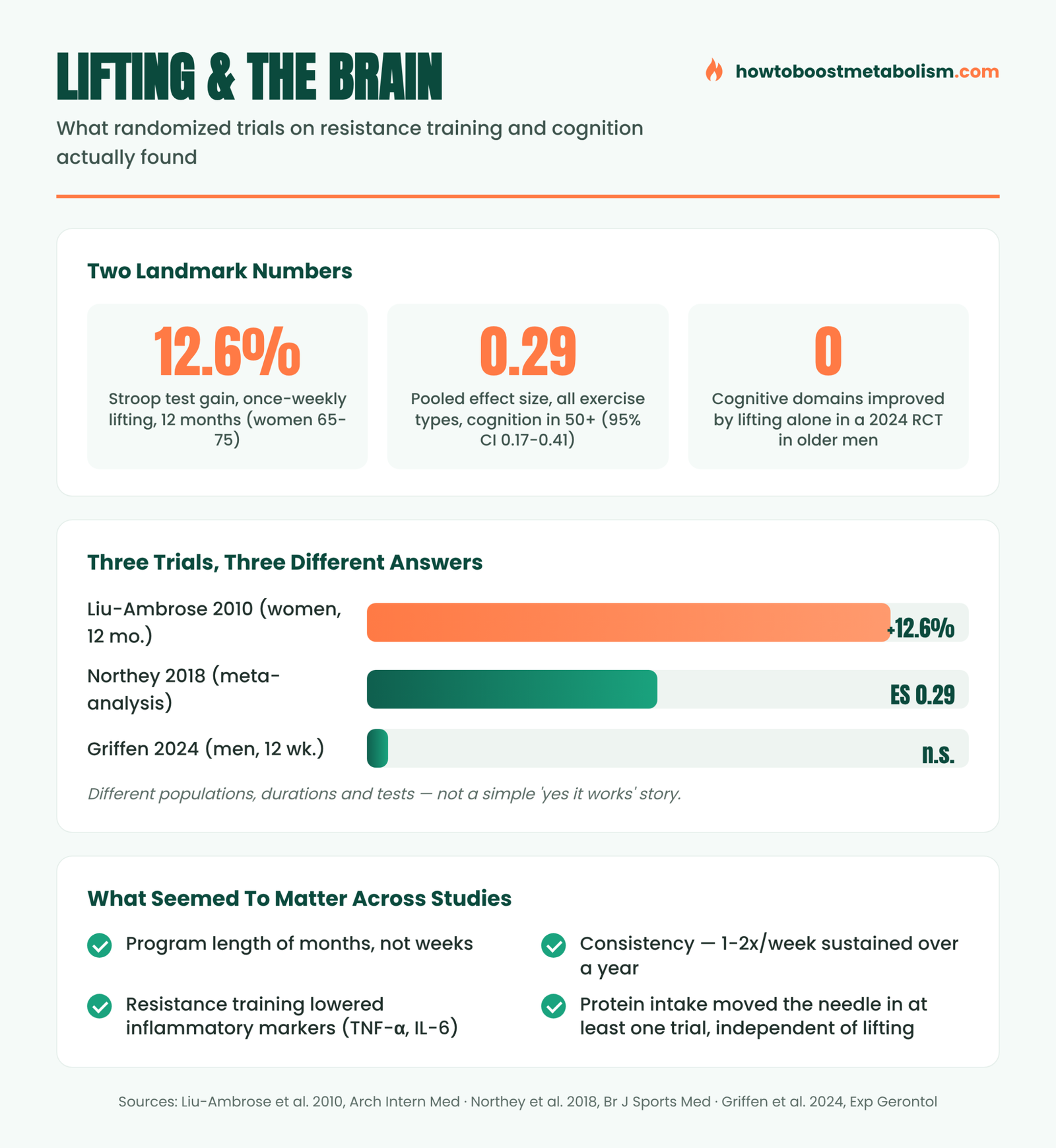
The trial most often cited is a 2010 randomized controlled trial published in the Archives of Internal Medicine (PMID 20101012). Researchers at the University of British Columbia randomized 155 community-dwelling women aged 65 to 75 to once-weekly resistance training, twice-weekly resistance training, or a twice-weekly balance-and-tone control program, for a full 12 months.
The primary outcome was the Stroop test, which measures selective attention and the ability to resolve conflicting information — a core “executive function” skill that tends to decline with age. Both resistance training groups significantly outperformed the control group (p ≤ .03). Task performance improved by 12.6% in the once-weekly group and 10.9% in the twice-weekly group, while it declined by 0.5% in the balance-and-tone control group. The improvement in selective attention was also significantly associated with increased gait speed — a detail that matters because gait speed itself is an independent predictor of healthy brain aging.
Two things about this trial are easy to miss if you only read the headline. First, it ran for a full year, not a few weeks. Second, once-weekly training did about as well as twice-weekly — more wasn’t obviously better here, which is a useful data point if your realistic training frequency is one honest session a week rather than an idealized four.
Zooming Out: What a Larger Meta-Analysis Found
A single trial, however well designed, is one data point. A 2018 systematic review and meta-analysis in the British Journal of Sports Medicine (PMID 28438770) pooled 36 studies and 333 effect sizes across adults over 50, covering aerobic exercise, resistance training, multicomponent training, and tai chi. The pooled effect across all exercise types was statistically significant: an effect size of 0.29 (95% CI 0.17–0.41, p < 0.01), and this held regardless of the specific cognitive domain tested or whether participants already had cognitive impairment.
The authors also identified a practical detail: sessions of 45–60 minutes at least moderate intensity were associated with the clearest benefits. Resistance training was one of several modalities that showed a significant point estimate on its own — it wasn’t the single best option, but it wasn’t an also-ran either.
Free download
🔥 The Metabolism Starter Kit
3 honest guides: a 7-day reset plan, a foods cheat-sheet and 12 metabolism myths debunked. No spam — unsubscribe anytime.
The Honest Catch: A 2024 Trial Found Nothing From Lifting Alone
Here’s where this gets genuinely interesting instead of a tidy success story. A 2024 secondary analysis of a randomized, double-blind, placebo-controlled trial in Experimental Gerontology (PMID 38844183) tested resistance exercise and whey protein supplementation, separately and combined, in 36 older men over 12 weeks.
Whey protein supplementation alone improved executive function scores more than the control (placebo) group (+0.31 vs. +0.06, p = 0.03), with a trend toward improved overall cognitive function. Resistance exercise alone did not improve any cognitive domain measured (p ≥ 0.07), and adding it to protein supplementation didn’t produce an extra benefit either. That’s a direct contradiction of the simple “lifting weights sharpens your mind” framing.
It wasn’t a totally null result for exercise, though. Resistance training did significantly lower two markers of systemic inflammation — tumor necrosis factor-alpha (p = 0.02) and interleukin-6 (p = 0.048) — compared with the no-exercise group. The catch is that these biomarker changes didn’t correlate with the cognitive test changes, so the honest conclusion is that resistance training reduced inflammation in this trial without a detectable cognitive payoff over 12 weeks.
Why Three Good Studies Gave Three Different Answers
This isn’t a case of “good study vs. bad study.” The disagreement is explainable by real differences in design, and understanding why matters more than picking a side:
| Study | Population | Duration | Result |
|---|---|---|---|
| Liu-Ambrose 2010 | 155 women, 65–75 | 12 months | Stroop test ↑12.6% / ↑10.9%, significant |
| Northey 2018 (meta-analysis) | 36 studies, adults 50+ | varies by study | Pooled effect size 0.29, significant |
| Griffen 2024 | 36 men, 67 ± 4 years | 12 weeks | No cognitive domain improved from RE alone |
The biggest single variable is likely duration. The trial that found a clear cognitive benefit ran for a full year; the trial that found none ran for 12 weeks. If resistance training’s effect on the brain works through slow pathways — chronic reductions in inflammation, gradual changes in cerebrovascular health, cumulative effects on sleep and mood — three months may simply be too short a window to detect it on a cognitive test, even if the underlying biology is quietly shifting in a good direction.
Population differences matter too: older women versus older men, and different baseline health and cognitive status, can change how much room there is to measurably improve. And the tests themselves weren’t identical — the Stroop test specifically measures selective attention and conflict resolution, while the 2024 trial used a broader neuropsychological battery (CANTAB) covering multiple domains at once.
What Might Be Happening Biologically (With the Right Amount of Caution)
A few plausible mechanisms come up repeatedly in this research, and it’s worth being clear that “plausible mechanism” is not the same as “proven cause.” Resistance training acutely and chronically affects levels of brain-derived neurotrophic factor (BDNF) and insulin-like growth factor 1 (IGF-1), both implicated in neuroplasticity in animal models. It measurably lowers systemic inflammatory markers like IL-6 and TNF-alpha, as shown directly in the 2024 trial above — chronic low-grade inflammation is independently linked to cognitive decline. And it improves cardiovascular fitness and gait speed, both of which correlate with brain health in observational research.
None of these pathways has been definitively shown to be the cause of the cognitive improvements seen in trials like Liu-Ambrose 2010. They’re reasonable candidates, not settled explanations — which is exactly why a 12-week trial that lowered inflammation still didn’t move the needle on cognitive tests. The pathway may exist and still need more time to produce a measurable result.
Does It Matter More If You’re at Higher Risk?
None of the three trials above specifically targeted people with a family history of dementia or existing mild cognitive impairment as their primary population — the 2010 trial recruited healthy community-dwelling women, and the 2024 trial recruited healthy older men. Other, smaller trials (not detailed here) have tested resistance training specifically in people already diagnosed with mild cognitive impairment, with more mixed results than the general-population studies. The honest summary is that the strongest, best-replicated evidence for a cognitive benefit exists in generally healthy older adults training consistently for the long term — not as a treatment once cognitive decline has already started. If you have a personal or family history that concerns you, that’s a conversation for a physician, not a reason to expect a specific exercise program to reverse existing decline.
It’s also worth being honest about what these studies can’t tell you: none of them followed participants long enough to measure whether resistance training changes the actual incidence of dementia decades later. What they measured was performance on specific cognitive tests over months to a year — a reasonable proxy, but not the same claim as “prevents dementia.” Be skeptical of any source, including this one, that blurs that distinction.
A Practical, Honest Takeaway for Your Training Week
Based on what these trials actually show, the reasonable position is: resistance training is a plausible, low-risk contributor to long-term brain health, with its clearest support coming from programs sustained for a year or more, not a few months. It is not a guaranteed, fast cognitive fix, and a 12-week program shouldn’t be expected to produce a measurable memory boost on its own.
What stacks the odds in your favor, based on what moved the needle across these studies: training consistently once or twice a week for the long haul rather than cycling on and off; treating protein intake as a separate, independently useful lever rather than assuming lifting alone covers it (see our breakdown of complete vs. incomplete protein after 40); and not expecting a short block of training to show up on a cognitive test even if it’s quietly doing useful work on inflammation in the background.
If you’re building a resistance training habit for your brain as much as your muscles, pairing it with an eating pattern that’s actually been studied for cognitive aging matters. The Mediterranean Diet is one of the few dietary patterns with real research behind it for brain health (the MIND diet, which much of the current research draws on, is a Mediterranean–DASH hybrid) — it’s not a resistance-training program, but it’s a reasonable food-side complement to the exercise habit this article is about. Heads up: the structure includes a recurring subscription charge after the initial plan — check the pricing page before you buy.
Learn More →Affiliate link — we may earn a commission at no extra cost to you. Disclosure
Fatigue, B12, and the Bigger Picture
Brain health after 40 doesn’t live in a vacuum — it overlaps heavily with the same levers that affect energy and recovery generally. If brain fog and fatigue are a bigger complaint for you than memory specifically, it’s worth ruling out a B12 issue first; we cover that in vitamin B12, metabolism and fatigue after 40. Creatine is the other supplement with a growing, separate evidence base specifically for brain function — not the same mechanism as resistance training itself, but often used alongside it; see creatine and brain/cognitive function after 40. And if you’re interested in the aging-biology angle more broadly, our look at spermidine and metabolic aging covers a related but distinct mechanism (autophagy) that’s been getting attention in longevity research.
Related Reading
Creatine and Brain/Cognitive Function After 40 · Vitamin B12, Metabolism and Fatigue After 40 · Sleep Debt and Muscle Protein Synthesis After 40
Free download: our Metabolism Starter Kit — a protein calculator, a 7-day meal framework, and a one-page supplement checklist, with zero hype.
Get the Free Starter Kit →Frequently Asked Questions
Does lifting weights definitely improve memory after 40?
No single trial proves that for everyone. A 12-month randomized trial in women 65-75 found significant improvements in attention and executive function; a 12-week randomized trial in men found no cognitive improvement from resistance training alone. Duration and population both appear to matter.
How long do I need to train before I’d expect to see a brain benefit?
The clearest positive evidence comes from a program lasting a full year, not a few weeks. A 12-week program in one trial lowered inflammation markers but didn’t produce a measurable cognitive change, so patience with a consistent long-term habit looks more important than any specific weekly volume.
Is cardio better than lifting for brain health?
The 2018 meta-analysis found significant benefits across aerobic exercise, resistance training, multicomponent training, and tai chi — resistance training wasn’t inferior to cardio in that pooled analysis, but no single modality was clearly the best for every study included.
Does resistance training help even if it doesn’t improve memory test scores?
Possibly, through pathways a short study wouldn’t capture. The 2024 trial found resistance training significantly reduced inflammatory markers (TNF-alpha, IL-6) even though cognitive test scores didn’t change over 12 weeks — chronic inflammation is independently linked to cognitive decline over years, not weeks.
Should I prioritize protein or resistance training for brain health?
Treat them as separate levers, not substitutes. In the 2024 trial, whey protein supplementation alone improved executive function scores while resistance training alone did not, and combining them didn’t add extra benefit — so neither should be assumed to cover for the other.
This article is for general educational purposes and is not medical advice. Cognitive decline and dementia risk involve many factors beyond exercise; talk to a physician about concerns regarding your own memory or cognitive health. See our Medical Disclaimer.