Strength Training and Sleep Apnea After 40: What Helps
This article may contain affiliate links. If you buy through them, we may earn a small commission at no extra cost to you. See our Affiliate Disclosure and Medical Disclaimer.
Obstructive sleep apnea (OSA) becomes dramatically more common with age and with weight gain around the midsection — exactly the territory a lot of 40+ readers of this site are already working on for other reasons. What’s less widely known is that resistance training specifically, not just “exercise in general” or cardio, has now been tested in randomized controlled trials as a direct intervention for OSA severity. The most recent of these trials was published in 2026. Here’s what it, and the two trials before it, actually measured.
Most of what gets written about exercise and sleep apnea online focuses on weight loss in general terms — “lose weight, your apnea improves” — without getting specific about which type of exercise was actually tested, or by how much. That generic framing is roughly true, but it skips past a more useful, more recent, and more specific question: does resistance training on its own, independent of a broader weight-loss diet, move the needle on a clinically measured apnea-hypopnea index? As of 2026, there’s now a direct answer, not just an inference.
The 2026 Trial: An 8-Week Resistance Training Program
The newest and most direct evidence comes from a 2026 randomized controlled trial in Sleep Medicine (PMID 41806678). Researchers enrolled 25 adults with moderate to severe OSA (average age 55.4 ± 8.3 years, average BMI 36.3 ± 7.3, average baseline apnea-hypopnea index of 50.5 events per hour — a severe starting point) and randomized them to either an 8-week resistance training program (three sessions a week) or a stretching control group.
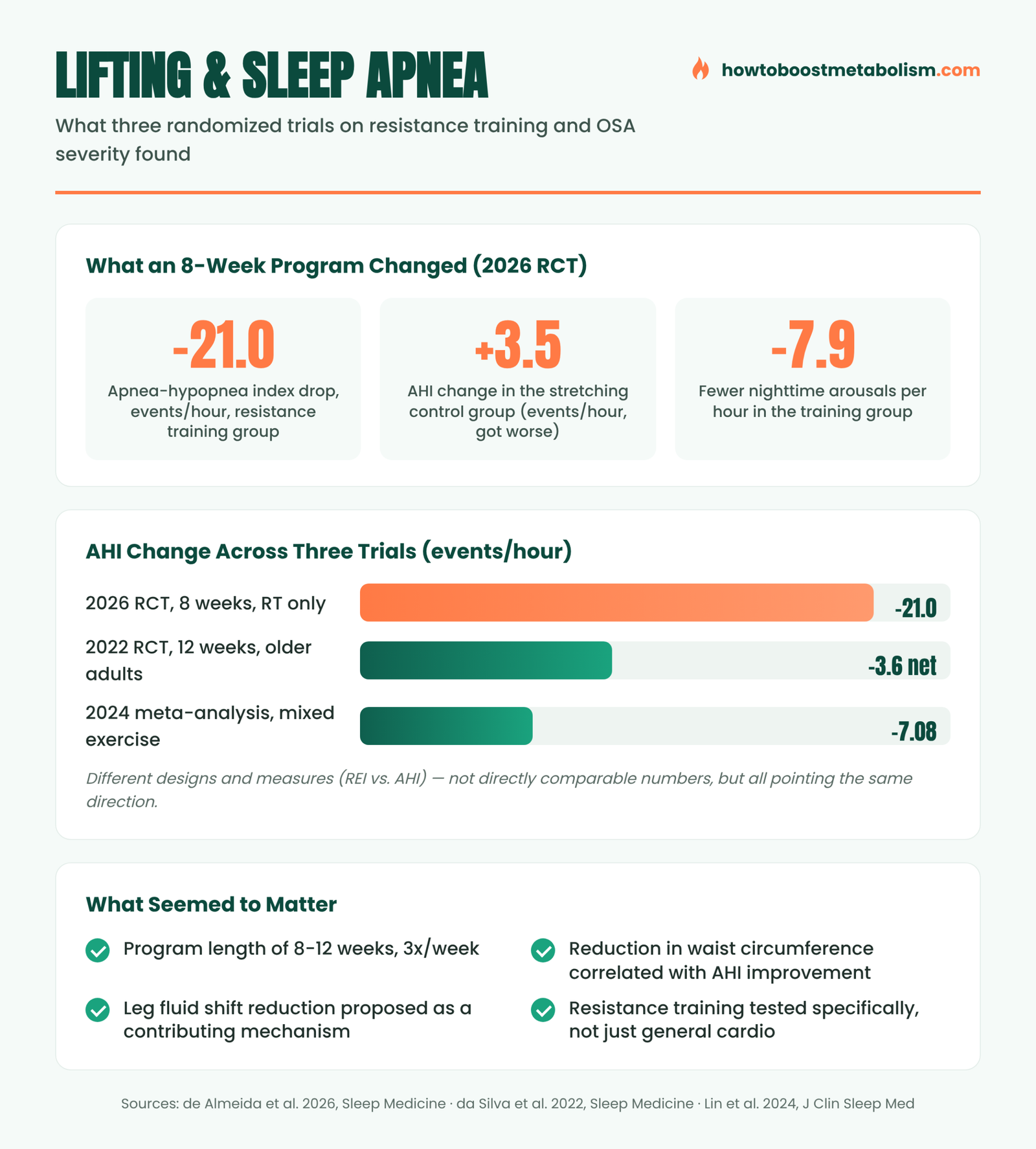
Measured by overnight polysomnography — the gold-standard sleep study, not a consumer wearable — the resistance training group’s AHI dropped by an average of 21.0 events per hour, while the stretching control group’s AHI actually increased by 3.5 events per hour over the same period (group × time interaction p = 0.015). The training group also had significantly fewer nighttime micro-arousals (−7.9 vs. +7.4, p = 0.028) — a secondary but clinically meaningful measure, since arousals fragment sleep even when they’re too brief for a person to consciously remember.
The researchers also found a specific correlation worth noting: within the training group, the amount someone’s waist circumference shrank was directly correlated with how much their AHI improved (r = 0.643, p = 0.018). That’s a clue about mechanism, not just an outcome — it suggests midsection fat loss, not muscle gain itself, was doing a meaningful share of the work.
An Earlier Trial in Older Adults Found a Smaller but Real Effect
A 2022 randomized, masked, controlled trial in the same journal (PMID 35561473) tested a longer, 12-week resistance training program specifically in adults aged 65 to 80 with moderate-to-severe OSA (baseline respiratory event index around 29-30 events/hour). This trial had a specific hypothesis going in: that resistance training changes leg fluid retention, and that overnight fluid shifting from the legs to the neck — a known contributor to airway narrowing during sleep — might be part of why training helps.
The training group’s respiratory event index improved by 3.6 events per hour on average, while the control group (given healthy lifestyle advice only) got worse by 6.7 events per hour — a statistically significant difference that held up even after statistically adjusting for changes in BMI and body water content. The authors’ own conclusion was appropriately modest: body water changes were “slight but cannot be dismissed” as a contributing mechanism, alongside whatever else resistance training was doing.
Free download
🔥 The Metabolism Starter Kit
3 honest guides: a 7-day reset plan, a foods cheat-sheet and 12 metabolism myths debunked. No spam — unsubscribe anytime.
What a Broader Meta-Analysis Adds
Zooming out from individual trials, a 2024 systematic review and meta-analysis in the Journal of Clinical Sleep Medicine (PMID 39150699) pooled 12 studies and 526 patients testing aerobic exercise and/or resistance training against control conditions for OSA. Across all exercise types combined, AHI dropped by an average of 7.08 events per hour (95% CI −9.98 to −4.17, p < .00001), daytime sleepiness scores improved significantly, BMI dropped modestly, and cardiovascular fitness (VO2peak) improved.
This meta-analysis didn’t isolate resistance training’s effect from aerobic exercise’s effect as cleanly as the two trials above — it pooled both types of training together to answer a broader question (“does exercise help OSA at all”). Its value here is as a sanity check: the two resistance-training-specific trials above aren’t outliers reporting an effect that contradicts the wider literature. They’re consistent with, and arguably stronger than, the pooled effect across all exercise types.
| Study | Population | Protocol | Result (events/hour) |
|---|---|---|---|
| de Almeida 2026 | 25 adults, avg. age 55 | 8 wks, RT only | AHI: −21.0 vs. +3.5 (control) |
| da Silva 2022 | 23 adults, 65–80 yrs | 12 wks, RT only | REI: −3.6 vs. +6.7 (control) |
| Lin 2024 (meta-analysis) | 526 patients, 12 studies | varies, mixed exercise | AHI: −7.08 (pooled, all exercise types) |
Why Would Lifting Weights Affect Breathing During Sleep?
OSA happens when soft tissue around the upper airway collapses or narrows repeatedly during sleep, interrupting airflow. Several plausible, partially-overlapping mechanisms come up across this research. Reducing visceral and neck-area fat through body composition change can reduce mechanical narrowing of the airway — this is the most intuitive pathway, and it’s the one directly supported by the waist-circumference correlation in the 2026 trial. Reducing fluid retention in the legs may reduce the amount of fluid that redistributes to the neck and upper airway overnight when lying down — the specific hypothesis the 2022 trial was built to test. And broader improvements in cardiovascular and metabolic fitness, picked up across the pooled 2024 meta-analysis, may improve respiratory muscle function and reduce systemic inflammation that contributes to airway tissue swelling.
None of these trials isolated a single definitive mechanism — the honest state of the evidence is “resistance training measurably reduces OSA severity in several controlled trials, and multiple plausible explanations exist, without one being definitively proven as the cause.”
How This Fits With Sleep and Recovery More Broadly
This research sits on top of a two-way relationship that’s worth being clear about: poor sleep makes training recovery worse, and training may improve sleep quality and now, specifically, OSA severity. If you’re dealing with both a suspected sleep issue and the downstream effects on training — more soreness, slower strength gains, feeling constantly run-down — it’s worth reading our breakdown of sleep debt and muscle protein synthesis after 40 alongside this one, since they describe two sides of the same relationship. Magnesium and zinc are also commonly discussed in the context of sleep quality specifically; we cover the actual evidence (and its limits) in zinc, magnesium, and sleep recovery timing.
One mechanism behind resistance training’s effect on sleep apnea in these trials was a drop in waist circumference and overall body composition change, not muscle growth alone. Anabolic Fasting is built around combining a structured eating window with resistance training specifically to support fat loss while preserving muscle — which is the general direction several of these trials point toward, even though it wasn’t the specific protocol tested in the sleep apnea research itself. Treat the marketing framing of “build muscle and burn fat simultaneously” as the company’s own claim, not a guarantee.
Learn More →Affiliate link — we may earn a commission at no extra cost to you. Disclosure
What This Doesn’t Mean
None of this means resistance training is a replacement for a CPAP machine or other prescribed OSA treatment if you’ve been diagnosed with moderate-to-severe apnea. The 2026 trial’s participants still had a residual AHI after training that, for most of them, would likely still meet criteria for at least mild OSA — a 21-point drop from a baseline of 50.5 is a large relative improvement, not a cure. These trials are evidence that resistance training is a legitimate adjunct intervention worth discussing with a sleep physician, not a reason to stop or delay prescribed treatment.
It’s also worth noting all three sources above studied relatively short programs (8-12 weeks) in small-to-moderate sample sizes (23-526 participants). That’s a real evidence base, not a fluke, but it’s not yet the scale of evidence behind, say, CPAP therapy itself. For general metabolic context on why midsection fat specifically tends to be the stubborn kind, see our piece on visceral fat, which covers the same tissue implicated in the waist-circumference correlation above.
A Note on Safety If You Have Diagnosed OSA
Obstructive sleep apnea is associated with higher rates of hypertension and cardiovascular disease, and heavy resistance training produces acute spikes in blood pressure during a lift — a legitimate reason to get medical clearance before starting, not a reason to avoid resistance training altogether. None of the three trials above reported serious adverse cardiovascular events from the training protocols used, which were standard full-body programs rather than anything involving maximal single-rep lifts or breath-holding under heavy load. If you also have diagnosed hypertension, our separate breakdown of strength training and blood pressure after 40 covers the acute-spike-versus-chronic-adaptation distinction in more detail, which applies whether or not OSA is part of the picture.
Severe, untreated OSA itself can cause significant daytime fatigue, which is its own safety consideration during training — fatigue affects coordination and judgment under a loaded barbell. If you’re falling asleep unintentionally during the day or struggling to stay alert during a workout, that’s worth raising with a physician before adding a new training stimulus, independent of what these trials found about long-term benefit.
A Practical Starting Point
If you suspect you have OSA — loud snoring, witnessed pauses in breathing, waking unrefreshed, daytime sleepiness — get evaluated by a sleep physician first; a home or in-lab sleep study is how AHI is actually measured, not a guess. If you’re already diagnosed and cleared for exercise, the protocols tested above were straightforward: full-body resistance training, 3 sessions a week, 8-12 weeks, nothing exotic. The evidence suggests this is worth doing as a genuine health intervention, not just a body-composition goal on the side.
Free download: our Metabolism Starter Kit — a protein calculator, a 7-day meal framework, and a one-page supplement checklist, with zero hype.
Get the Free Starter Kit →Frequently Asked Questions
Can strength training actually reduce sleep apnea severity?
Yes, according to multiple randomized controlled trials. The most recent, a 2026 trial, found an 8-week resistance training program reduced the apnea-hypopnea index by 21.0 events per hour on average, while a stretching control group got slightly worse over the same period.
Does this mean I can stop using my CPAP machine?
No. These trials show resistance training as a meaningful adjunct that reduces OSA severity, not a replacement for prescribed treatment. Participants in the 2026 trial still had residual apnea after training. Talk to your sleep physician before changing any prescribed treatment.
How is resistance training supposed to help with a breathing problem during sleep?
Several mechanisms are proposed: reduced neck and midsection fat easing airway narrowing, reduced overnight fluid shift from the legs to the airway, and general improvements in cardiovascular and metabolic health. No single trial has proven exactly which mechanism matters most.
How long does it take to see a change in sleep apnea severity from training?
The trials that measured a significant benefit ran for 8 to 12 weeks, with training 3 times a week. That’s the timeframe the actual evidence covers — there’s no data here on whether a shorter program would work as well.
Is cardio or resistance training better for sleep apnea?
The evidence doesn’t clearly favor one over the other. A 2024 meta-analysis pooling both aerobic and resistance training found a significant pooled benefit across exercise types; the resistance-training-specific trials found effects at least as large individually, but weren’t designed to directly out-compete cardio.
This article is for general educational purposes and is not medical advice. Obstructive sleep apnea is a medical diagnosis that requires evaluation by a physician or sleep specialist; do not use this article to self-diagnose or to replace prescribed treatment. See our Medical Disclaimer.