Nordic Hamstring Curls After 40: Do They Prevent Injury?
This article may contain affiliate links. If you buy through them, we may earn a small commission at no extra cost to you. See our Affiliate Disclosure and Medical Disclaimer.
The Nordic hamstring curl gets described, fairly often, as the single most evidence-backed exercise in all of sports medicine for preventing a specific injury. That reputation is mostly earned — but it’s also gotten simpler in the retelling than the actual research supports, and the research itself is split between a famous “halves your risk” headline and a more recent, methodologically stricter paper that calls the whole thing inconclusive. Both papers are real, both are worth knowing, and if you’re 40+ and deciding whether to add this exercise to your week, the nuance actually matters.
What a Nordic Hamstring Curl Actually Is
You kneel with your ankles anchored (a partner holding them, a Nordic curl bench, or a landmine/band setup), then lower your torso toward the floor as slowly as you can control, catching yourself with your hands at the bottom and pushing back up. The lowering phase is the point: it loads the hamstrings eccentrically — lengthening under tension — which is specifically the type of contraction most associated with hamstring strain injuries during sprinting.
The Headline Study: An 8,459-Athlete Meta-Analysis
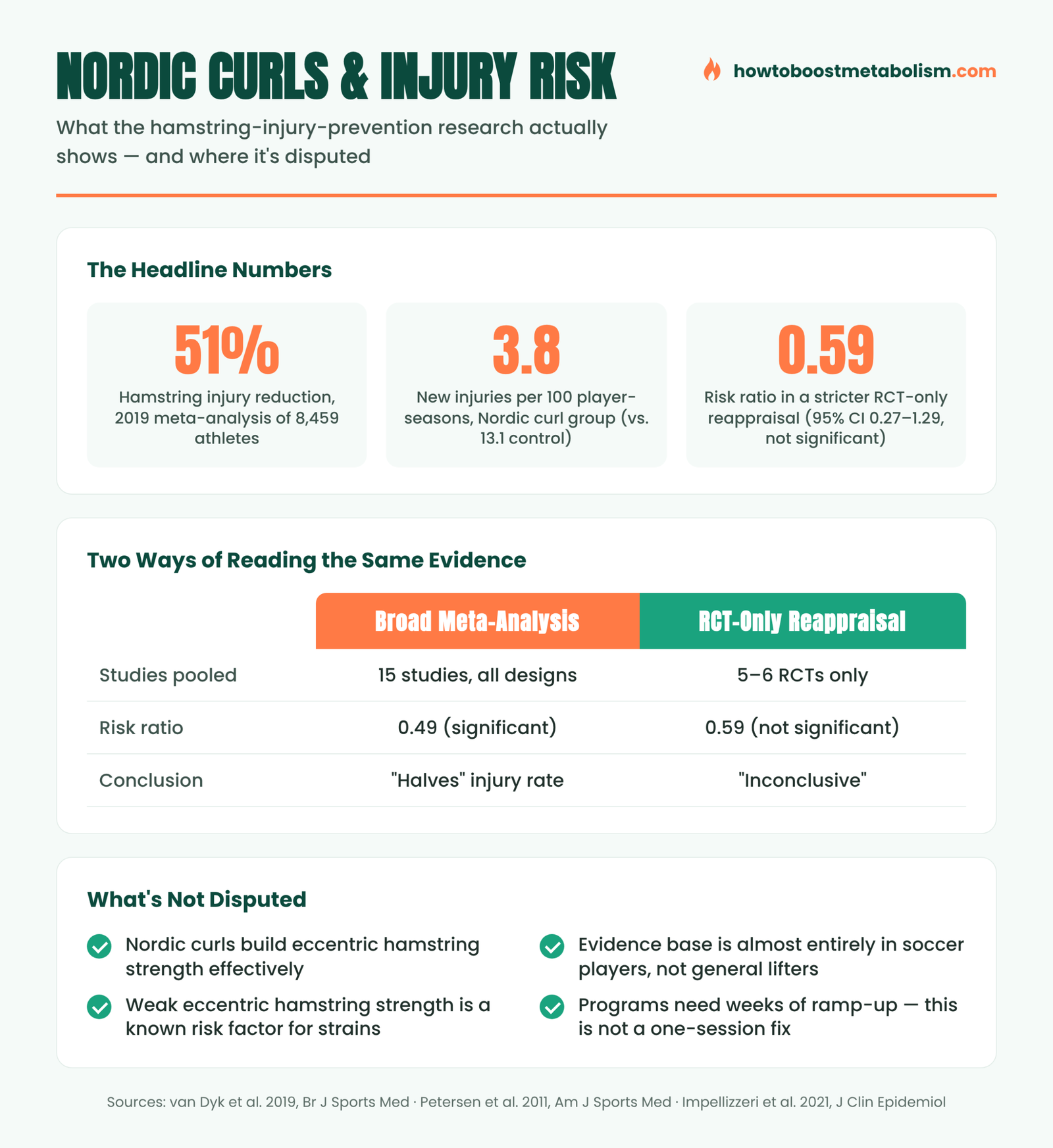
The most-cited paper is a 2019 systematic review and meta-analysis in the British Journal of Sports Medicine (PMID 30808663), pooling 15 studies and 8,459 athletes across multiple sports. The headline finding: including the Nordic hamstring exercise in an injury prevention program reduced the overall injury risk ratio to 0.49 (95% CI 0.32–0.74, p = 0.0008) — in plain terms, roughly half the hamstring injuries compared with programs that didn’t include it. Pooling just the eight randomized controlled trials gave a similar risk ratio of 0.52, and removing high-risk-of-bias studies nudged it to 0.55 — all still clearly favoring the exercise.
The authors’ blunt conclusion: programs that include the Nordic hamstring exercise reduce hamstring injuries by up to 51%, essentially halving the rate across multiple sports and athlete populations.
Free download
🔥 The Metabolism Starter Kit
3 honest guides: a 7-day reset plan, a foods cheat-sheet and 12 metabolism myths debunked. No spam — unsubscribe anytime.
The Single Best Individual Trial
The strongest individual study behind that pooled result is a 2011 cluster-randomized controlled trial in the American Journal of Sports Medicine (PMID 21825112). Fifty Danish soccer teams (942 players) were randomized to a 10-week progressive eccentric Nordic curl program followed by a weekly maintenance program, or to their usual training with no additional hamstring work, and followed for a full season.
The intervention group had 15 acute hamstring injuries; the control group had 52. Per 100 player-seasons, that’s 3.8 injuries in the training group versus 13.1 in the control group (adjusted rate ratio 0.293, 95% CI 0.150–0.572, p < .001). The effect was even larger for preventing repeat injuries specifically — 7.1 vs. 45.8 per 100 player-seasons (RR 0.137) — which matters because a prior hamstring strain is one of the strongest known predictors of a future one.
The Honest Catch: A 2021 Reappraisal Called It Inconclusive
Here’s where the simple story breaks down. A 2021 paper in the Journal of Clinical Epidemiology (PMID 34520846) deliberately revisited the meta-analysis above, arguing that pooling studies of very different designs and risk-of-bias levels can inflate how confident the conclusion sounds. When the authors restricted the analysis to only the randomized controlled trials — five in the original dataset, six after an update — the risk ratio came out to 0.59 (95% CI 0.27–1.29), with a prediction interval wide enough (0.10–3.29) that the effect could plausibly range from a strong benefit to a mild increase in risk.
Their conclusion, stated directly in the paper’s title: the Nordic hamstring exercise’s injury-preventive effect, using methodology they consider more appropriate, is inconclusive — not disproven, but not the slam-dunk the 51% headline implies either. This is a legitimate methodological critique from epidemiologists, not a fringe contrarian take, and it’s the kind of nuance that rarely survives the trip into a listicle.
Reconciling the Two Papers
Both papers can be correct about what they measured. The 2019 meta-analysis pooled a wider set of study designs and found a strong, statistically significant effect. The 2021 reappraisal restricted the pool to a smaller set of pure RCTs and found a weaker, not-statistically-significant effect with wide uncertainty. Smaller study pools naturally produce wider confidence intervals — that’s partly a sample-size story, not necessarily proof the effect isn’t real. But it’s also a legitimate reminder that “this halves your risk” is a stronger claim than the strictest available evidence can fully support.
| Question | Finding | Caveat |
|---|---|---|
| Population studied | Soccer players, mixed sports | Not general 40+ recreational lifters |
| Strongest single RCT | 3.8 vs. 13.1 injuries per 100 player-seasons | Large, but one trial |
| Stricter RCT-only pool | RR 0.59, not statistically significant | Real uncertainty remains |
| What’s well established | Nordic curls build eccentric hamstring strength | The mechanism is solid |
The Part Almost Nobody Mentions: This Is Athlete Research
Every trial behind both the optimistic and skeptical conclusions above was conducted in competitive or semi-competitive soccer players — people doing repeated high-speed sprinting, which is the dominant mechanism for hamstring strains in that population. If your “hamstring risk” looks more like deadlifts, Romanian deadlifts, or the occasional weekend sprint at a kid’s soccer game than 90 minutes of competitive match play, the evidence doesn’t transfer automatically. The underlying logic — stronger eccentric hamstrings should mean more resilient hamstrings — is reasonable to extend to general strength training, but it hasn’t been directly tested in that population the way it has in athletes.
This matters for a 40+ lifter specifically because eccentric strength and connective tissue resilience both tend to decline with age, which is exactly the population where a cheap, low-equipment exercise that targets eccentric hamstring strength looks most appealing — even without a direct trial proving it prevents strains during, say, a heavy Romanian deadlift session. For more on how eccentric loading affects connective tissue specifically, see our piece on single-leg work like the Bulgarian split squat, which shares some of the same unilateral loading logic.
How to Actually Program Nordic Curls
Across both the supportive and skeptical trials, one thing is consistent: nobody just threw athletes into a maximal set of Nordic curls and called it done. The 2011 trial used a 10-week progressive ramp-up before moving to a weekly maintenance dose. Trying to do bodyweight-eccentric-only Nordic curls at full range from day one is a reliable way to make yourself extremely sore, not a reliable way to build strength safely. A sensible starting point is partial-range curls, or curls assisted by a resistance band, for 2–3 sets of 3–5 controlled reps, adding range and volume gradually over several weeks — the same deload-and-progress logic we cover in loaded carries and farmer’s walks after 40, another posterior-chain-heavy exercise that rewards patience over ambition.
Nordic curls are a free, equipment-light way to build eccentric hamstring strength, but they’re one piece of a bigger picture — balanced posterior-chain training, sensible progression, and not skipping the boring exercises for the exciting ones. Old School New Body is built specifically around safe, structured strength programming for people over 40 returning to or restarting training, which is the exact population most likely to pull a hamstring from doing too much, too fast.
Learn More →Affiliate link — we may earn a commission at no extra cost to you. Disclosure
What If a Full Nordic Curl Is Too Much Right Now?
A full-range Nordic curl, done with no assistance, is a genuinely hard exercise — many people, especially coming back to training after 40, can’t control the lowering phase through the full range without collapsing partway down. That’s not a reason to skip the exercise category; it’s a reason to scale it. Common, sensible regressions include holding a resistance band in front of you (anchored to something stable) to assist the hardest part of the descent, limiting the range to the top 30-40 degrees where the lever arm is shortest, or using a slow eccentric-only partner-assisted version where someone gently pushes your torso back up once you’ve controlled the lowering as far as you can manage.
The point of all of these regressions is the same: you want to spend time under tension in the eccentric phase, under control, without a hard stop or a collapse. A rep that ends in a faceplant because you ran out of strength isn’t building usable eccentric capacity — it’s just practicing falling. Two to three sessions a week of a few controlled reps, building range and difficulty over four to six weeks, is a far more realistic path to the strength the research is actually measuring than attempting the hardest version of the exercise on day one.
Who Should Be Cautious or Skip This Exercise
Anyone with an acute, unhealed hamstring strain should not be doing eccentric Nordic curls — this exercise is studied as a prevention tool for healthy or previously-injured-but-healed athletes, not as a treatment for a current tear, and loading an acute injury this way can make it worse. People with significant knee pain may also find the kneeling anchor position uncomfortable and should try a padded surface or an alternative anchor setup, or substitute a different eccentric hamstring exercise like a slow single-leg Romanian deadlift. As with any new exercise that produces unfamiliar muscle soreness, expect noticeably more delayed-onset soreness than usual in your first few sessions — that’s expected and not itself a sign you’ve done something wrong, though it’s worth easing in rather than chasing volume in week one.
Where This Fits Into a Broader Posterior Chain Plan
Nordic curls are a targeted accessory exercise, not a replacement for compound posterior-chain movements like deadlifts, hip thrusts, or step-ups. If your current program is light on single-leg or unilateral work generally, our guide to the step-up exercise covers a complementary movement that trains similar stabilizer demands without the eccentric-overload learning curve Nordic curls require up front.
Related Reading
Loaded Carries and Farmer’s Walks After 40 · Bulgarian Split Squat Guide · Step-Up Exercise Guide
Free download: our Metabolism Starter Kit — a protein calculator, a 7-day meal framework, and a one-page supplement checklist, with zero hype.
Get the Free Starter Kit →Related: Posterior-chain work pairs well with direct hip-extensor training — our glute bridge vs. hip thrust comparison covers which one activates the glutes more.
Frequently Asked Questions
Do Nordic hamstring curls really cut hamstring injury risk in half?
A 2019 meta-analysis of 8,459 athletes found a risk ratio of 0.49, often summarized as ‘roughly half.’ A 2021 reappraisal restricted to randomized controlled trials only found a weaker, not statistically significant risk ratio of 0.59. Both are legitimate readings; the true effect size is less certain than the ‘51%’ headline implies.
Does this research apply to general lifters, not just soccer players?
Not directly — every trial behind these numbers was conducted in competitive or semi-competitive soccer players, where repeated sprinting is the main injury mechanism. The logic (stronger eccentric hamstrings likely means more resilient hamstrings) is reasonable to extend to lifting, but it hasn’t been directly tested in a general strength-training population.
How do I start Nordic curls without hurting myself?
The supportive trials used a multi-week progressive ramp-up, not a maximal first session. Start with partial range of motion or band-assisted curls for 2-3 sets of 3-5 controlled reps, and add range and volume gradually over several weeks rather than chasing full bodyweight range immediately.
What’s the biggest risk factor for hamstring strains besides weak eccentric strength?
A prior hamstring strain is one of the strongest known predictors of a future one — in the 2011 Danish trial, the Nordic curl program’s biggest relative benefit was specifically in preventing repeat injuries (rate ratio 0.137), even larger than its effect on first-time injuries.
Should I do Nordic curls instead of deadlifts and hip thrusts?
No — Nordic curls are a targeted accessory movement for eccentric hamstring strength, not a substitute for compound posterior-chain exercises. They’re meant to complement a program that already includes hinge and hip-extension work, not replace it.
This article is for general educational purposes and is not medical advice. If you have an existing hamstring injury or chronic pain, consult a physical therapist or physician before starting an eccentric loading program. See our Medical Disclaimer.