Why Lifting Weights Can Raise Your Liver Enzymes After 40
This article may contain affiliate links. If you buy through them, we may earn a small commission at no extra cost to you. See our Affiliate Disclosure and Medical Disclaimer.
If you train hard and ever happen to get a routine blood panel — before a procedure, for a new medication, or just an annual physical — there’s a specific, slightly alarming thing that can happen: your liver enzymes come back “high.” Not wildly dangerous, but outside the lab’s reference range, with no warning that it might be the gym’s fault, not your liver’s.
This isn’t a rare fluke. It’s documented closely enough that gastroenterology and hepatology journals have published case reports specifically to warn other doctors about it. Here’s what the evidence actually shows, what it doesn’t show, and how to read your own numbers without panicking — or dismissing something that genuinely needs a doctor’s look.
What a “Liver Panel” Actually Measures
A standard liver function test usually reports alanine aminotransferase (ALT), aspartate aminotransferase (AST), alkaline phosphatase, bilirubin, total protein, and albumin. ALT is fairly liver-specific. AST is not: it’s also abundant in skeletal muscle, heart muscle, red blood cells, and kidney tissue. That single fact is the root of the whole issue. When AST rises, a lab report can’t tell you on its own whether the signal is coming from your liver or from muscle fibers that took a beating in Tuesday’s leg session.
The Case Reports That Started This Conversation
Case 1: An Asymptomatic Lifter, Flagged, Then Cleared
In a 2021 report in Case Reports in Hepatology (https://pubmed.ncbi.nlm.nih.gov/33777462/), physicians described a healthy man doing vigorous exercise who presented with markedly elevated transaminases on routine testing. He had no symptoms. Further evaluation came back essentially normal, and when his enzymes were re-checked three weeks and then a month after cutting back on the intense training, they had returned to the normal range. The authors’ conclusion was blunt: muscle-damage-induced transaminitis should be on the differential list before anyone starts assuming liver disease in an asymptomatic, otherwise healthy person who trains hard.
Case 2: Two Men, Tested for Something Else Entirely
A more striking pair of cases appeared in 2026 in Case Reports in Gastrointestinal Medicine (https://pubmed.ncbi.nlm.nih.gov/42910154/). Both patients were young, active men undergoing routine liver screening for unrelated reasons — one before starting tuberculosis treatment, one during hepatitis B monitoring. Both showed AST elevated out of proportion to ALT, which can look like acute liver injury on paper. In both cases, a targeted history revealed heavy resistance training before the blood draw, and a creatine kinase (CK) test confirmed the real source: muscle, not liver. Once that was established, their tuberculosis treatment and hepatitis B surveillance continued without unnecessary changes. The authors specifically flagged this as an under-recognized trap in pretreatment liver screening — the kind of mix-up that can delay necessary medication or trigger invasive, unnecessary liver workups.
Free download
🔥 The Metabolism Starter Kit
3 honest guides: a 7-day reset plan, a foods cheat-sheet and 12 metabolism myths debunked. No spam — unsubscribe anytime.
What Controlled Studies Show, Not Just Case Reports
Case reports describe real events, but they can’t tell you how common this is or exactly which exercise conditions trigger it. For that, controlled studies help — and they add an honest wrinkle: it isn’t automatic.
A 2014 study in the Scandinavian Journal of Clinical and Laboratory Investigation (https://pubmed.ncbi.nlm.nih.gov/24484196/) compared trained and sedentary men at rest and after a maximal exercise test. Trained men had significantly higher baseline CK, CK-MB, ALT, and LDH than sedentary men even before exercising that day — a sign of the ongoing, low-grade muscle turnover that comes with a consistent training habit. A single maximal exercise bout then transiently raised a cardiac marker (NT-proBNP) further, though not a specific troponin, suggesting the cardiac signal was mild and benign rather than evidence of heart damage.
But a 2014 study in Exercise Immunology Review (https://pubmed.ncbi.nlm.nih.gov/24974720/) is the honest counterweight. Nine healthy young men did a demanding eccentric calf-raise protocol — enough to cause real, measurable muscle soreness and reduced range of motion for days. CK and aldolase rose sharply and stayed elevated out to 96 hours. AST and ALT, however, did not change significantly by 96 hours. In other words: muscle damage reliably moves CK, but it doesn’t automatically drag AST and ALT along with it every time — the size of the muscle-damage event and which muscle groups are involved both seem to matter.
| Claim | What the evidence shows |
| Hard resistance training can elevate AST | Yes — documented in case reports and consistent with higher baseline CK/ALT in trained individuals |
| It always elevates ALT too | Not necessarily — a demanding eccentric protocol raised CK/aldolase without a significant AST/ALT change at 96h in one trial |
| It can look like acute liver injury on paper | Yes — two 2026 cases showed AST disproportionately above ALT, mimicking hepatocellular injury |
| CK testing resolves the confusion | Yes — in both 2026 cases, CK confirmed a muscular source and prevented unnecessary liver workups |
| It’s dangerous and needs treatment | No — in all published cases, levels normalized within weeks of reduced training, with no liver pathology found |
Which Kinds of Training Are Most Likely to Trigger This
Not all workouts are equally likely to move AST and ALT. The pattern across both the case reports and the controlled studies points at a few recurring ingredients: a large amount of eccentric loading (the lowering phase of a squat or deadlift, slow negatives, downhill running), unfamiliar exercises your body hasn’t adapted to yet, unusually high volume compared with your recent training history, and multi-joint, large-muscle-group work such as heavy squats, deadlifts, and leg presses rather than small isolation movements. Both men in the 2026 case report had specifically done heavy resistance training, not a light maintenance session. A first serious leg day after a long layoff, a new program with a lot of eccentric work, or a personal-record attempt are the scenarios most likely to show up on a blood panel a day or two later — a single easy walk or a light recovery session is very unlikely to move these markers at all.
This also explains why the two controlled studies above look like they disagree, when they actually don’t. The maximal-exercise-test study still involved trained men pushing to exhaustion; the eccentric calf-raise study, while demanding for the calf muscles specifically, was a smaller, more localized stimulus. Size and type of the muscle-damage event appear to matter more than simply “did you lift weights today.”
AST vs. ALT vs. CK: A Practical Way to Read Your Own Bloodwork
- AST up, ALT roughly normal, CK clearly elevated: points toward muscle, especially if you trained hard in the 24–72 hours before the draw.
- ALT up more than AST, CK normal: points away from exercise and toward the liver specifically — worth following up.
- GGT and bilirubin normal: reassuring, since neither is affected by muscle damage the way AST/ALT can be.
- Levels re-checked after 2–4 weeks of lighter training: if they’ve normalized, that supports an exercise explanation; if not, it doesn’t.
None of this is a substitute for a doctor interpreting your actual labs in the context of your symptoms, alcohol intake, medications, and history. It’s a map for understanding what questions are worth asking — including the very practical one: “did I lift anything heavy this week?”
What This Means If You’re Training Seriously After 40
This connects to a pattern that shows up again and again once you start paying attention to lab work and lifting: the body’s injury- and recovery-signaling systems don’t neatly separate “muscle” from “organ.” We’ve covered the same theme from the kidney side in our piece on how muscle mass and creatine supplementation can distort creatinine-based kidney estimates, and more broadly in our look at what the long-term safety data on creatine actually says about kidneys and liver. If you’re also tracking inflammation markers, our article on what resistance training does and doesn’t do to CRP and TNF-alpha covers a related piece of the “what does my bloodwork actually mean” puzzle.
The practical takeaway for lifters over 40, who often get more routine bloodwork than younger adults simply because preventive screening ramps up with age: mention your training schedule to whoever orders your labs, especially if you’ve recently started a new program, added a lot of eccentric work (slow negatives, downhill running, novel exercises), or had a notably harder week than usual. It’s a five-second sentence that can save weeks of unnecessary follow-up testing.
Who Should Still Take an Abnormal Result Seriously
Exercise-induced transaminase elevation is a reasonable hypothesis, not a free pass to ignore lab results. Take any of the following seriously and get it checked rather than assuming it’s the gym: AST/ALT that stay elevated weeks after a deload or reduced training load; ALT rising more than AST; jaundice, dark urine, pale stools, right-upper-abdominal pain, or unusual fatigue; a history of heavy alcohol use, hepatitis risk factors, or liver-toxic medications; or any elevation found during a workup for an unrelated, serious condition, where the stakes of a wrong assumption are high. In those cases, this article is a reason to ask your doctor a sharper question — not a reason to skip the visit.
It’s also worth saying plainly what this article is not: it is not a reason to self-diagnose away a real abnormal result, and it’s not evidence that strength training is somehow bad for your liver. Quite the opposite — resistance training is consistently linked to better, not worse, markers of metabolic and liver health over the long run, including in people with fatty liver disease. The point here is narrower and more practical: a single blood draw taken too close to a hard session can create a false alarm, and knowing that this is a recognized, published phenomenon — not something you’re imagining — makes it much easier to ask the right follow-up question instead of either panicking or shrugging it off.
Recovering well between hard sessions — sleep, structured deloads, and realistic programming — is one of the simplest ways to keep muscle-damage markers from spiking unnecessarily often. Old School New Body builds its F4X method around exactly this kind of sustainable, joint- and recovery-conscious strength training for adults over 40. (Note: the program’s marketing claims aren’t independently verified by clinical research — treat them as marketing, not peer-reviewed fact.)
Learn More →Affiliate link — we may earn a commission at no extra cost to you. Disclosure
Free download: our Metabolism Starter Kit — a protein calculator, a 7-day meal framework, and a one-page supplement checklist, with zero hype.
Get the Free Starter Kit →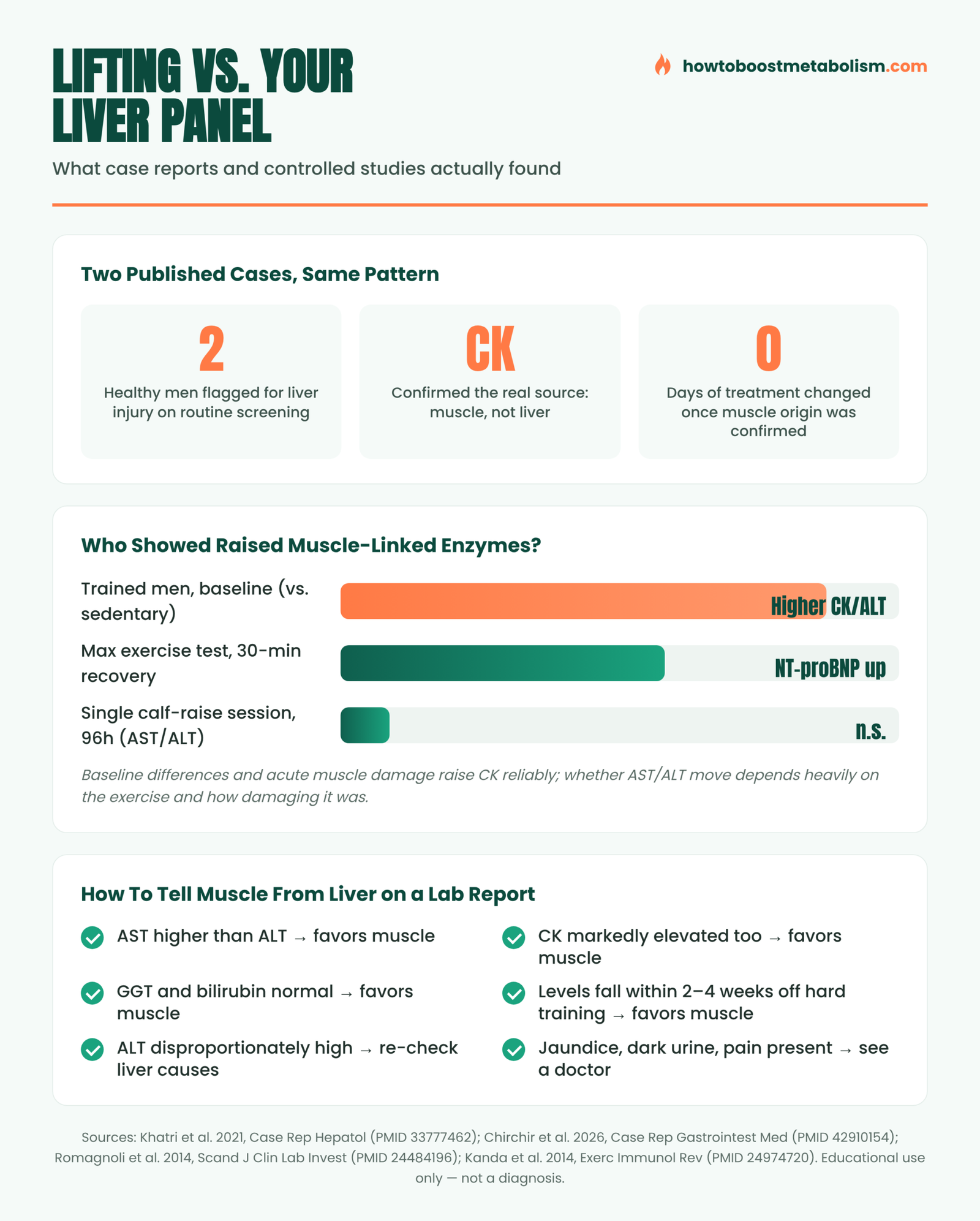
Frequently Asked Questions
Can strength training really make your liver enzyme test look abnormal?
Yes. AST (aspartate aminotransferase) and, to a lesser degree, ALT (alanine aminotransferase) are not exclusive to the liver — both are also released from damaged skeletal muscle. A hard resistance training session, especially one with a lot of eccentric loading or unfamiliar volume, can push AST and sometimes ALT above the standard reference range for a few days, with no liver problem involved at all.
How do doctors tell the difference between a muscle source and a real liver problem?
The single most useful extra test is creatine kinase (CK). CK leaks from muscle but not from liver cells, so when AST is up and CK is markedly elevated alongside it — especially with AST higher than ALT — a muscular origin is far more likely than liver injury. Gamma-glutamyl transferase (GGT) and bilirubin, which are not affected by muscle damage, are also useful: if they’re normal while AST/ALT are high, that again points away from the liver.
How long does exercise-related AST/ALT elevation last?
In the published case reports, levels returned to the normal range within roughly two to four weeks after stopping or significantly reducing the triggering training, which fits the general time course of muscle-damage marker clearance. If your levels don’t trend back down after a period of lighter training, that’s a reason to keep investigating rather than assume it’s exercise.
Does this mean I should stop lifting heavy before a blood test?
If you have a liver panel scheduled for an unrelated reason — a medication check, a routine physical, screening before a procedure — it’s reasonable to avoid a maximal or unusually hard session, and any new or eccentric-heavy routine, for roughly 48 to 72 hours beforehand. You don’t need to stop training altogether; you just don’t want your bloodwork caught at the peak of a normal, temporary muscle-damage response.
Is a disproportionate AST elevation always harmless?
No — and that’s the honest caveat. Exercise-induced transaminase elevation is common and usually benign, but it is a diagnosis made by ruling other things out (alcohol use, medications, viral hepatitis, fatty liver disease, bile duct issues), not something you should assume on your own. If AST/ALT stay elevated after a few weeks away from hard training, or you have other symptoms like jaundice, dark urine, abdominal pain, or unusual fatigue, that needs a doctor’s evaluation, not a workout log.