Machines vs Free Weights for Muscle After 40
This article may contain affiliate links. If you buy through them, we may earn a small commission at no extra cost to you. See our Affiliate Disclosure and Medical Disclaimer.
Walk into almost any gym and you’ll find a quiet tribal divide: the free-weight side with its barbells and dumbbells, and the machine section with its pin-loaded stacks and guided paths. Ask ten lifters which one “actually builds muscle” and you’ll get ten confident, often contradictory answers. The actual research on this question is less dramatic than the gym-floor debate — but it does have a clear, useful answer.
What a Real Meta-Analysis Found
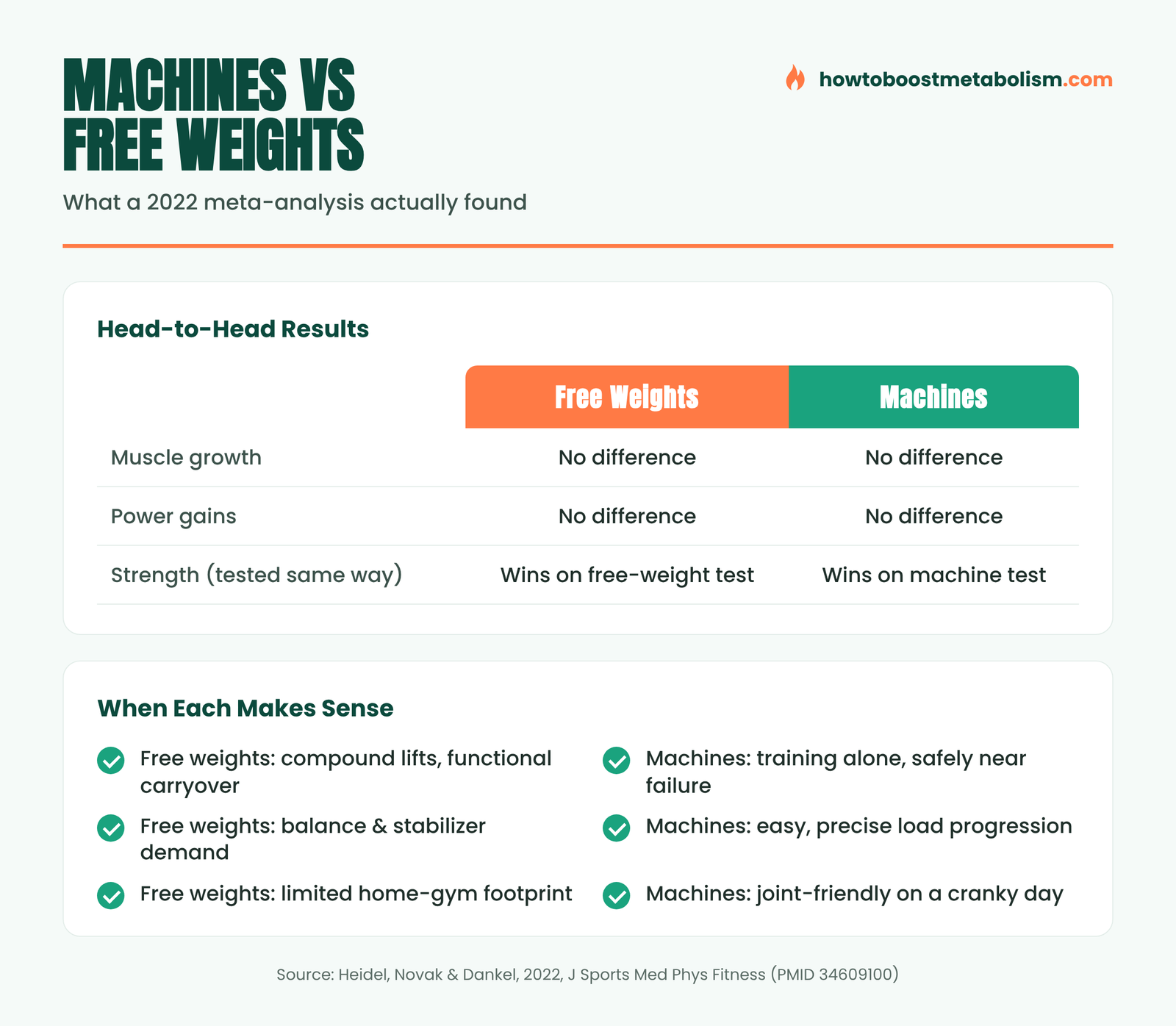
In 2022, researchers at Rowan University pooled the available controlled trials comparing free-weight training against machine-based training, using a three-level random-effects model to combine studies measuring muscle size, strength, and power (Heidel, Novak & Dankel, 2022, J Sports Med Phys Fitness). The results were strikingly undramatic on the question most lifters actually care about: there was essentially no difference in muscle hypertrophy between the two training modes (effect size -0.01, 95% CI -0.525 to 0.545) and no difference in power gains either (effect size -0.049, 95% CI -0.557 to 0.460).
The one place a real difference shows up: specificity
Where the review did find a consistent, statistically meaningful pattern was strength — but only when you look at how strength was tested. When strength was measured using a free-weight lift, the group that had trained with free weights came out ahead (effect size 0.655, 95% CI 0.269 to 1.041). Flip it around: when strength was measured on a machine, the machine-trained group came out ahead (effect size -0.784, 95% CI -1.223 to -0.344). When the test used a neutral device that favored neither training style, the two groups performed similarly (effect size 0.128, 95% CI -0.303 to 0.559).
That’s the whole story in one sentence: you get strong at what you practice. It’s not that one modality produces a mysteriously superior nervous-system adaptation — it’s that a barbell squat and a leg-press machine are testing overlapping but distinct skills, and training transfers most cleanly to the test that matches the training.
| Outcome | What the research found | Source |
|---|---|---|
| Muscle size (hypertrophy) | No meaningful difference | Heidel et al. 2022 meta-analysis |
| Power output | No meaningful difference | Heidel et al. 2022 meta-analysis |
| Strength, tested free-weight | Free-weight training wins | Heidel et al. 2022 meta-analysis |
| Strength, tested on machine | Machine training wins | Heidel et al. 2022 meta-analysis |
| Acute cardiovascular stress | Similar between modes | Parks et al. 2020, Eur J Sport Sci |
Why This Surprises So Many Lifters
Free weights get credited with building “real” strength partly because compound barbell lifts — squats, deadlifts, bench press — require stabilizer muscles and balance that a guided machine path removes from the equation. That’s true, and it matters for carrying groceries, catching yourself on a curb, or the kind of functional strength discussed in our guide to full-body vs. split training after 40. But “requires more stabilization” and “builds more muscle” are two different claims, and the pooled evidence only supports the first one.
Machines, meanwhile, get dismissed as somehow less effective partly because they’re easier — you don’t need a spotter, the path is fixed, and you can push closer to genuine muscular failure on an isolation exercise without the balance demands that would otherwise force you to stop early. That ease is a real advantage for certain goals, not a disqualifying flaw.
Free download
🔥 The Metabolism Starter Kit
3 honest guides: a 7-day reset plan, a foods cheat-sheet and 12 metabolism myths debunked. No spam — unsubscribe anytime.
Where This Actually Matters If You’re Training After 40
After 40, the practical considerations usually outweigh the marginal theoretical differences the research didn’t find anyway. A few worth weighing honestly:
- Joint-friendliness on bad days. A guided machine path can let you keep training a muscle group around a cranky shoulder or knee that would make the equivalent free-weight movement painful or risky that week.
- Training alone. Pushing a leg press or chest press machine close to failure without a spotter is considerably safer than doing the same with a loaded barbell.
- Carryover to daily life. Getting up off the floor, catching a grandchild, or carrying an awkward box all resemble free-weight movement patterns and the kind of barbell vs. dumbbell work more than they resemble a seated leg extension.
- Progressive overload tracking. Machines make small, precise load increases easy (a 5-lb pin change), which supports the kind of steady progressive overload that drives long-term gains without guessing at plate math.
- Home gym reality. Most home setups lean free-weight by necessity — a rack, a bench, and a set of adjustable dumbbells cost and store far more reasonably than a commercial machine stack, a point we get into in our home gym essentials guide.
A Sensible Way to Combine Both
- Build the session around 1-2 compound free-weight lifts (squat, hinge, press, row pattern) while you’re fresh and form matters most.
- Use machines for accessory and isolation work later in the session, when fatigue makes free-weight balance and setup more of a liability than a benefit.
- On days when a joint is cranky or you’re training without anyone around to spot you, lean harder on machines for that session rather than skipping the muscle group entirely.
- Track load and reps on both equally — the review’s biggest lesson is that consistent, progressive effort matters more than which equipment delivered it.
What the Research Doesn’t Settle
It’s worth being honest about the limits of this evidence too. The 2022 meta-analysis pooled studies across a range of ages, training backgrounds, and program lengths, and most of the underlying trials were relatively short — weeks to a few months, not the years of training most people over 40 are actually planning for. It also didn’t specifically isolate injury rates between the two modes, so “no difference in hypertrophy” shouldn’t be read as “no difference in anything that matters.” A barbell squat done with poor form under heavy load carries different risks than a leg-press machine done with poor form, even if both can eventually build comparable muscle.
The acute cardiovascular data adds a small additional piece: a 2020 study in resistance-trained adults found that both free-weight and machine-based resistance exercise produced similar, temporary increases in aortic stiffness and pulse-wave reflection right after a session, with reduced myocardial perfusion efficiency during that recovery window (Parks et al., 2020, Eur J Sport Sci). That’s a normal, transient response to resistance exercise in general — not a red flag unique to either modality — but it’s one more reason anyone with known cardiovascular issues should get individualized guidance on resistance training intensity rather than assuming either equipment choice is automatically the “safer” one.
A Sample Week That Uses Both Deliberately
Rather than treating this as an either-or decision, here’s what a typical three-day week might look like for someone over 40 who wants the benefits of both modalities without overthinking every session:
| Session | Free-weight emphasis (early, fresh) | Machine emphasis (later, fatigued) |
|---|---|---|
| Day 1 — Lower body | Barbell or dumbbell squat pattern, hip hinge | Leg press, leg curl, calf raise machine |
| Day 2 — Upper body | Dumbbell bench or overhead press, row | Cable row, lat pulldown, machine shoulder press |
| Day 3 — Full body / weak points | Loaded carry, unilateral lunge pattern | Chest press machine, leg extension, core machine work |
This isn’t the only valid split — someone training four or five days a week, or working around a specific injury, would reasonably structure things differently. The underlying principle stays the same regardless of the split: free weights get priority early in a session for the compound, balance-demanding patterns, and machines pick up the isolation and “push closer to failure safely” work once central fatigue makes free-weight form harder to maintain.
It’s also worth remembering that this comparison is specifically about building muscle, strength, and power — not about every fitness outcome that matters after 40. Bone density, for instance, responds most reliably to load that’s applied through the skeleton in a weight-bearing, often free-weight or bodyweight pattern, which is part of why our coverage of trap bar vs. barbell deadlifts treats that movement as a priority rather than an optional extra. Equipment choice for muscle growth and equipment choice for other training goals don’t always point in the same direction, and it’s worth being clear with yourself about which goal you’re actually optimizing for in a given session.
A Note on Training Age and Technique
One honest nuance the pooled data can’t fully capture: someone who has spent years refining barbell technique will naturally express more strength and muscle recruitment on a free-weight test, and the reverse is true for someone with years of machine-only training. This is really just the specificity finding playing out over a longer timeline — your body gets efficient at the movement patterns it repeats most, which is also why switching modalities after a long layoff on one of them often feels surprisingly hard at first, even if your muscles haven’t actually shrunk.
None of this is an argument that equipment choice doesn’t matter at all — it’s an argument that it matters less than most gym-floor debates suggest, and far less than simply training consistently with progressively heavier loads, in either modality, for months at a time.
If your real obstacle is less “machines vs. free weights” and more “I don’t have consistent access to either,” Old School New Body is built around minimal equipment and a structured progression specifically designed for the 40-and-up body — useful if a full machine stack simply isn’t in the picture right now. (Note: ignore the dramatic aging statistics on the sales page — they aren’t independently sourced. Judge it on the actual program structure.)
See the Program →Affiliate link — we may earn a commission at no extra cost to you. Disclosure
Free download: our Metabolism Starter Kit — a protein calculator, a 7-day meal framework, and a one-page supplement checklist, with zero hype.
Get the Free Starter Kit →Related: Specifically comparing two of the most common back-building exercises, we broke down what EMG research says about cable row vs. free-weight row and which is the smarter choice for a sensitive lower back.
Frequently Asked Questions
Do free weights really build more muscle than machines?
Not according to the best available evidence. A 2022 systematic review and meta-analysis pooling the available trials found no significant difference in muscle hypertrophy between free-weight and machine-based training programs. The old gym-floor belief that free weights are automatically superior for building size isn’t what the pooled data shows.
So is there any real difference between machines and free weights?
Yes — in how strength transfers, not in muscle growth. The same 2022 meta-analysis found a “specificity” effect: people who trained with free weights got stronger specifically on free-weight tests, and people who trained on machines got stronger specifically on machine-based tests. When strength was tested on a neutral device that matched neither training mode exactly, the two approaches produced similar gains. In plain terms, you get better at what you practice.
I’m over 40 and new to lifting — should I start with machines or free weights?
Either can work for building muscle, so this is really a question of comfort, access, and goals rather than one being objectively superior. Machines constrain the movement path, which many people find easier to learn and load confidently without a spotter or coach present. Free weights demand more balance and coordination but carry over more directly to real-world tasks like carrying groceries or getting up off the floor, and to compound lifts you may want to progress toward later.
Do machines or free weights put more stress on the heart and blood vessels?
A smaller 2020 study measuring vascular responses in resistance-trained adults found that acute free-weight and machine-based resistance exercise produced similar increases in aortic stiffness and pulse-wave measures immediately after the session, with no meaningful difference between the two modalities. Neither mode appears to be the “gentler” option on the cardiovascular system in the short term.
What’s the actual best approach after 40 — pick one or use both?
Using both is a reasonable, well-supported approach, and it’s what most structured strength programs for this age group end up recommending anyway: machines for safely pushing close to failure on isolation work or when training without a partner, free weights for the compound, balance-demanding movements that carry over to daily function. Neither modality needs to be abandoned in favor of the other, and switching between them later won’t cost you real muscle — you may just test a little weaker on whichever one you haven’t practiced recently, which is the specificity effect above showing up in real time, not lost fitness.