Caffeine Before Strength Training After 40: The Real Limits
This article may contain affiliate links. If you buy through them, we may earn a small commission at no extra cost to you. See our Affiliate Disclosure and Medical Disclaimer.
Coffee before a workout is one of the oldest, cheapest performance habits in the gym, and unlike most things sold as “pre-workout,” it genuinely has a large body of research behind it. The honest version of that research, though, is more modest than the marketing around pre-workout supplements suggests: caffeine gives a small, real boost to strength and power output, a small bump in fat oxidation markers, and a sleep cost that gets more expensive to ignore as you get older. None of that makes it useless — it makes it a genuinely useful tool with real limits, which is a more honest pitch than most of what’s on a supplement-store shelf.
At a Glance
| Claim | What the Evidence Actually Shows |
|---|---|
| Improves muscular strength | Small but real effect, even at low doses (1-2 mg/kg) |
| Improves muscular endurance and power | Small-to-moderate real effect across pooled meta-analyses |
| Increases fat burning | Small-to-moderate increase in fat oxidation markers, more consistent in blood biomarkers than in whole-body gas exchange |
| “Melts” stubborn fat or drives meaningful weight loss alone | Not supported — effect size is small and caffeine alone isn’t a fat-loss strategy |
| Safe at any dose, any time of day | Not supported — evening caffeine measurably disrupts sleep in athletes |
| Works the same at every age | Understudied specifically in older lifters; most trials are in younger adults |
What the Research Actually Shows
The most useful starting point is a 2020 umbrella review in the British Journal of Sports Medicine by Grgic and colleagues, which pooled 21 separate published meta-analyses covering caffeine’s effects on exercise performance. Across this large body of evidence, caffeine showed ergogenic (performance-enhancing) effects for aerobic endurance, muscular strength, muscular endurance, power, jumping performance, and exercise speed. The review’s own honesty check is worth repeating: the quality of evidence was generally rated moderate, with some low-to-very-low quality evidence mixed in, and most of the individual studies feeding into these meta-analyses were conducted in young men. That’s a real gap for anyone training in their 40s, 50s, or beyond — the direction of the effect is well established, but the exact magnitude in an older, more diverse lifting population is less certain.
A separate 2022 meta-analysis in Nutrition by Grgic specifically examined the minimum effective, or “ergogenic,” dose of caffeine for resistance exercise, pooling 12 studies using doses between 0.9 and 2 mg/kg of body weight — noticeably lower than the 3-6 mg/kg doses used in a lot of pre-workout products and older research. Even at this low-dose range, caffeine produced a measurable ergogenic effect on muscular strength (effect size 0.17), muscular endurance (0.21), and especially mean lifting velocity (0.56). For a roughly 80 kg (175 lb) lifter, 1-2 mg/kg works out to about 80-160 mg of caffeine — one to two regular cups of coffee — which is a meaningfully smaller, cheaper, and lower-risk dose than many commercial pre-workout formulas that pack 300+ mg into a single scoop.
Free download
🔥 The Metabolism Starter Kit
3 honest guides: a 7-day reset plan, a foods cheat-sheet and 12 metabolism myths debunked. No spam — unsubscribe anytime.
The Fat-Burning Claim, Honestly Assessed
Caffeine’s reputation as a fat burner is one of the most overstated claims in the supplement world, so it’s worth looking at what a dedicated meta-analysis actually found. A 2023 systematic review and meta-analysis in the International Journal of Sport Nutrition and Exercise Metabolism by Conger and colleagues pooled 94 studies on caffeine and fat metabolism and found an overall small effect (effect size 0.39) of caffeine increasing fat metabolism. Notably, the effect was considerably stronger when measured through blood biomarkers like free fatty acids and glycerol (0.55) than through whole-body gas-exchange measures like the respiratory exchange ratio (0.26) — meaning caffeine does measurably mobilize fat from storage, but less of that translates into actually burning more total fat during the session than you would otherwise. The effect also didn’t differ meaningfully by caffeine dose, fitness level, or sex, and it was actually slightly stronger at rest than during exercise. The honest takeaway: caffeine nudges fat metabolism in the right direction, modestly, but it is not a substitute for a training program and an eating pattern that actually produce a calorie deficit.
The Sleep Trade-Off Nobody Mentions on the Label
A 2025 systematic review and meta-analysis in the journal Sports by Kocak and colleagues looked specifically at what happens to sleep when athletes consume caffeine before late-afternoon or evening training sessions. Pooling 10 randomized and quasi-experimental studies, evening caffeine consumption (3-6 mg/kg body mass) produced a measurable reduction in sleep efficiency of about 4.9 percentage points, and a non-significant trend toward roughly 32 fewer minutes of total sleep. More strikingly, athletes consistently perceived much more sleep disruption than the objective measurements actually showed — a real disconnect between how caffeine felt to interfere with sleep and how much it measurably did. For anyone over 40 who already notices sleep getting lighter or less restorative with age, and who trains in the evening after work, that gap between “it felt bad” and “it was objectively bad” cuts both ways: caffeine may be disrupting your sleep architecture even on nights you don’t consciously feel wired, and this matters directly for muscle, since sleep debt measurably interferes with muscle protein synthesis.
Why This Matters More After 40
None of the core performance or fat-metabolism meta-analyses above were conducted specifically in lifters over 40 — that’s a genuine evidence gap worth naming rather than glossing over. But several age-related realities make the existing findings worth applying cautiously rather than ignoring: caffeine clearance slows somewhat with age and with certain common medications, sleep tends to become lighter and more easily disrupted, and the muscle-protein-synthesis cost of poor sleep compounds over the years in a way it may not for a 24-year-old who can shrug off one bad night. None of this means caffeine is off-limits after 40 — it means the timing and dose matter more, and the margin for “I’ll just have another coffee at 6pm before my evening lift” is smaller than it used to be.
A Practical, Honest Protocol
| Variable | Evidence-Based Guidance |
|---|---|
| Dose | 1-2 mg/kg is enough for a real effect; 3-6 mg/kg is the higher end studied, with diminishing extra benefit for most lifters |
| Timing | 45-60 minutes before training is the most commonly studied window |
| Evening sessions | Favor the lower end of the dose range, or decaf/low-caffeine pre-workout options, if training is within ~6-8 hours of bedtime |
| Tolerance management | Consider 1-2 lower-caffeine days per week; habitual heavy users may see a blunted ergogenic effect |
| Fat loss expectations | Treat it as a small assist to an existing calorie deficit and training plan, not a fat-loss strategy on its own |
Coffee vs. Anhydrous Caffeine vs. Energy Drinks
Most of the meta-analyses above used caffeine in anhydrous (pill or powder) form, which absorbs somewhat faster and more predictably than coffee, where caffeine content varies widely by bean, roast, and brew method — a regular 8 oz cup can run anywhere from roughly 70 mg to well over 150 mg of caffeine. That variability matters less at the low end of the effective dose range, where even an underestimated cup of coffee likely clears the 1-2 mg/kg threshold for most adults, but it matters more if you’re trying to precisely dose closer to 3-6 mg/kg. Energy drinks add another variable: many combine caffeine with additional stimulants, high sugar content, or large volumes of carbonated liquid that some lifters find uncomfortable pre-workout. A plain cup of coffee or a measured anhydrous dose remains the simplest way to know roughly what you’re actually getting.
Who Should Be More Cautious
Caffeine isn’t risk-free, and a few groups have more reason to be deliberate about dose and timing. People managing high blood pressure, anxiety disorders, arrhythmias, or who are sensitive to stimulants in general should discuss a reasonable caffeine ceiling with their physician rather than following generic sports-nutrition dosing. Caffeine also interacts with a number of common medications — including some blood pressure medications and certain antidepressants — which is another reason a one-size-fits-all “3-6 mg/kg” recommendation from a sports-performance study doesn’t automatically apply to every 45- or 55-year-old lifter managing other health conditions. When in doubt, starting at the low, 1-2 mg/kg end of the effective range and assessing your own response is a more conservative approach than jumping straight to a higher studied dose.
It’s also worth remembering that caffeine sensitivity is genuinely individual — differences in how quickly the liver metabolizes caffeine (largely genetic) mean some people feel the ergogenic effect cleanly with minimal side effects, while others get jittery, anxious, or notice a racing heart at the same dose that works perfectly well for a training partner. There’s no shame in needing less than the “studied” dose to get most of the benefit with none of the unpleasant side effects; tracking your own response over a few weeks is more useful than copying a number from a research paper.
Common Mistakes
- Assuming more is always better — the minimum effective dose research shows 1-2 mg/kg already captures a meaningful share of the benefit, with added risk (jitteriness, elevated heart rate, poor sleep) from much higher doses.
- Using a big caffeine dose to mask how under-recovered or under-slept you actually are, rather than addressing the sleep or training-load problem directly.
- Drinking a large coffee or energy drink within a few hours of bed on evening-training days and not connecting it to the next morning’s grogginess.
- Expecting caffeine alone to meaningfully change body composition without the training volume and nutrition pattern that actually drive fat loss.
If appetite control and sustainable eating patterns — not just one more stimulant — are what you actually need alongside your training, Eat Stop Eat is a straightforward intermittent fasting framework built around real research on appetite and metabolic health.
Learn More →Affiliate link — we may earn a commission at no extra cost to you. Disclosure
Related Reading
- Fasted strength training after 40 — how training on an empty stomach, often paired with coffee, affects performance and recovery.
- Sleep debt and muscle protein synthesis after 40 — why the sleep trade-off above matters for actual muscle growth, not just how you feel the next day.
- Citrulline malate for strength training — another widely used pre-workout ingredient, evaluated the same evidence-first way.
Free download: our Metabolism Starter Kit — a protein calculator, a 7-day meal framework, and a one-page supplement checklist, with zero hype.
Get the Free Starter Kit →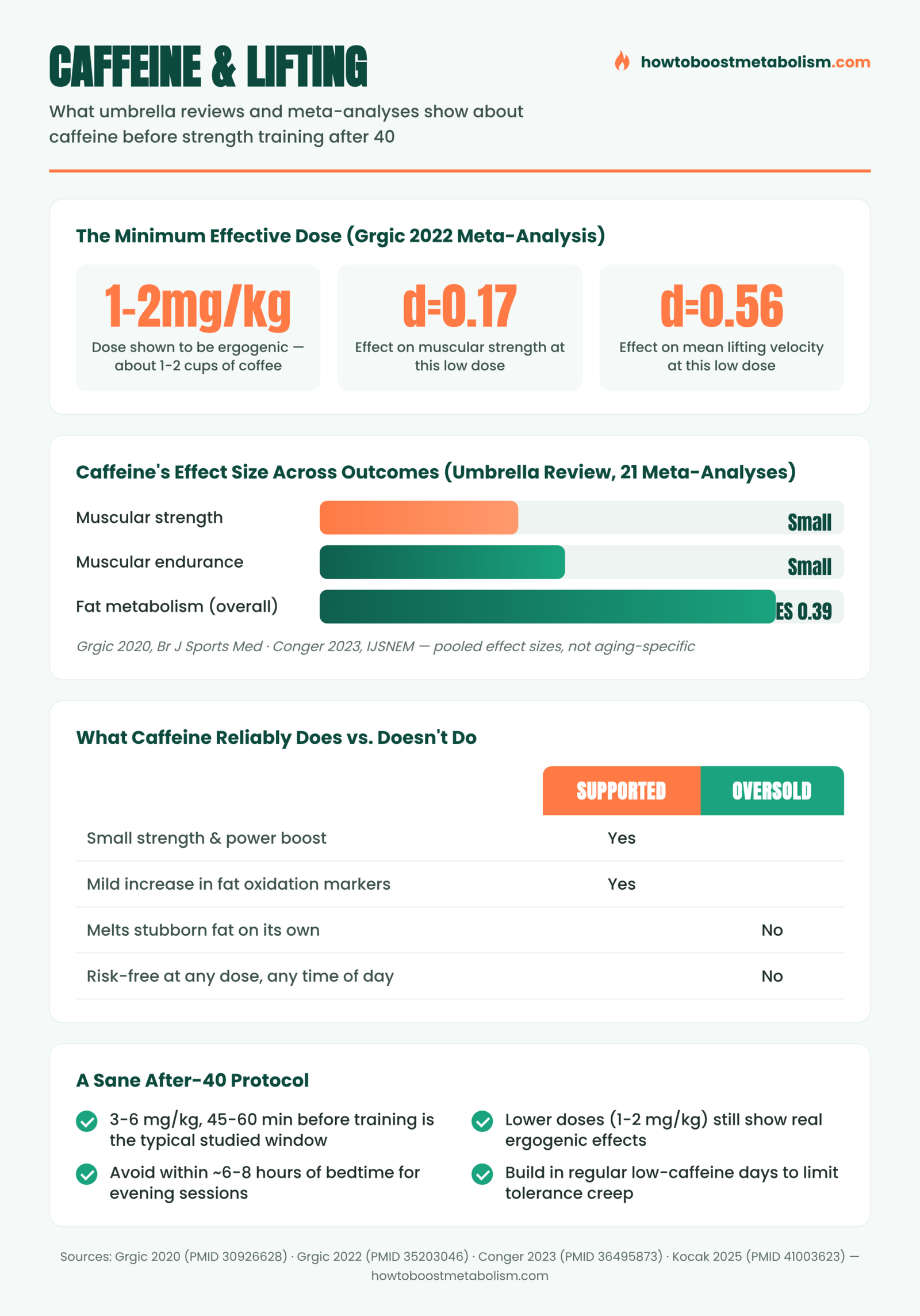
Related: Caffeine isn’t the only variable that affects next-morning readiness — see our breakdown of HRV and strength training recovery.
Frequently Asked Questions
How much caffeine should I take before a strength workout?
Research shows a real ergogenic effect starting at just 1-2 mg/kg of body weight (roughly 80-160 mg for most adults, or about one to two regular cups of coffee), with most studies using doses up to 3-6 mg/kg. More isn’t necessarily better — the minimum-dose research found meaningful benefits well below the doses used in many commercial pre-workout products.
Does caffeine actually help burn fat?
A 2023 meta-analysis of 94 studies found a small-to-moderate overall effect of caffeine increasing fat metabolism markers, more consistently seen in blood biomarkers than in whole-body measurements of fat actually being burned. It’s a real but modest effect — not a substitute for a structured training and nutrition plan.
Is caffeine before an evening workout bad for sleep?
A 2025 meta-analysis found evening caffeine consumption before training measurably reduced sleep efficiency, and athletes consistently reported feeling even more sleep disruption than the objective data showed. If you train in the evening, favoring a lower dose or an earlier cutoff time is a reasonable precaution, especially after 40 when sleep tends to be more easily disrupted.
Is caffeine’s effect on strength and power different as you get older?
This specific question hasn’t been well studied — most of the meta-analyses on caffeine and exercise performance are drawn predominantly from young adult populations. The direction of caffeine’s effects is well established, but exact magnitudes in lifters over 40 or 50 are less certain, so treating the research as a reasonable starting point rather than a precise guarantee is the honest approach.
Can I build a tolerance to caffeine’s performance benefits?
Habitual heavy caffeine users can see a blunted ergogenic response compared with occasional users, though the research on this is mixed and some studies still find a benefit even in regular consumers. Cycling in a lower-caffeine day or two per week is a reasonable, low-cost way to help preserve sensitivity.