Does Lifting Boost Your Mitochondria After 40?
This article may contain affiliate links. If you buy through them, we may earn a small commission at no extra cost to you. See our Affiliate Disclosure and Medical Disclaimer.
“Boost your mitochondria” is one of the most overused phrases in metabolism marketing, usually attached to a supplement rather than to the thing that actually produces measurable mitochondrial changes in muscle biopsies: resistance training. The honest research picture is more interesting — and more useful — than the marketing version, because it turns out lifting weights after 40 changes your muscle’s mitochondria in a specific, partial way, not the sweeping ‘biogenesis explosion’ implied by most supplement copy.
This matters for anyone over 40 trying to decide how to spend limited training time. If resistance training triggered full classical mitochondrial biogenesis, that would be one more reason to prioritize it over cardio for metabolic health. The actual muscle-biopsy data tells a more nuanced story, and it’s worth walking through what was actually measured rather than what gets implied in a headline.
It’s also worth being upfront about why this question is hard to study well. Taking a muscle biopsy is invasive, so sample sizes in this field tend to be small — 14 to 41 people in the studies below, not the thousands you’d see in a large pharmaceutical trial. That’s not a reason to dismiss the findings, but it is a reason to read the conclusions as a solid first draft of the science rather than a final, settled answer.
What “Mitochondrial Biogenesis” Actually Means
In exercise physiology, mitochondrial biogenesis refers to a specific signaling cascade — most famously the protein PGC-1α activating transcription factors like TFAM and NRF1, which in turn drive the production of new mitochondrial components. It’s a defined, measurable pathway, not a vague synonym for “more energy” or “faster metabolism.” That precision matters, because a 2024 review on aging skeletal muscle notes that most of the classic evidence for this pathway comes from aerobic exercise research, and that resistance training’s relationship to it “remains unclear” (Jeong et al., 2024, Life).
What a 10-Week Resistance Training Trial Found in Older Adults
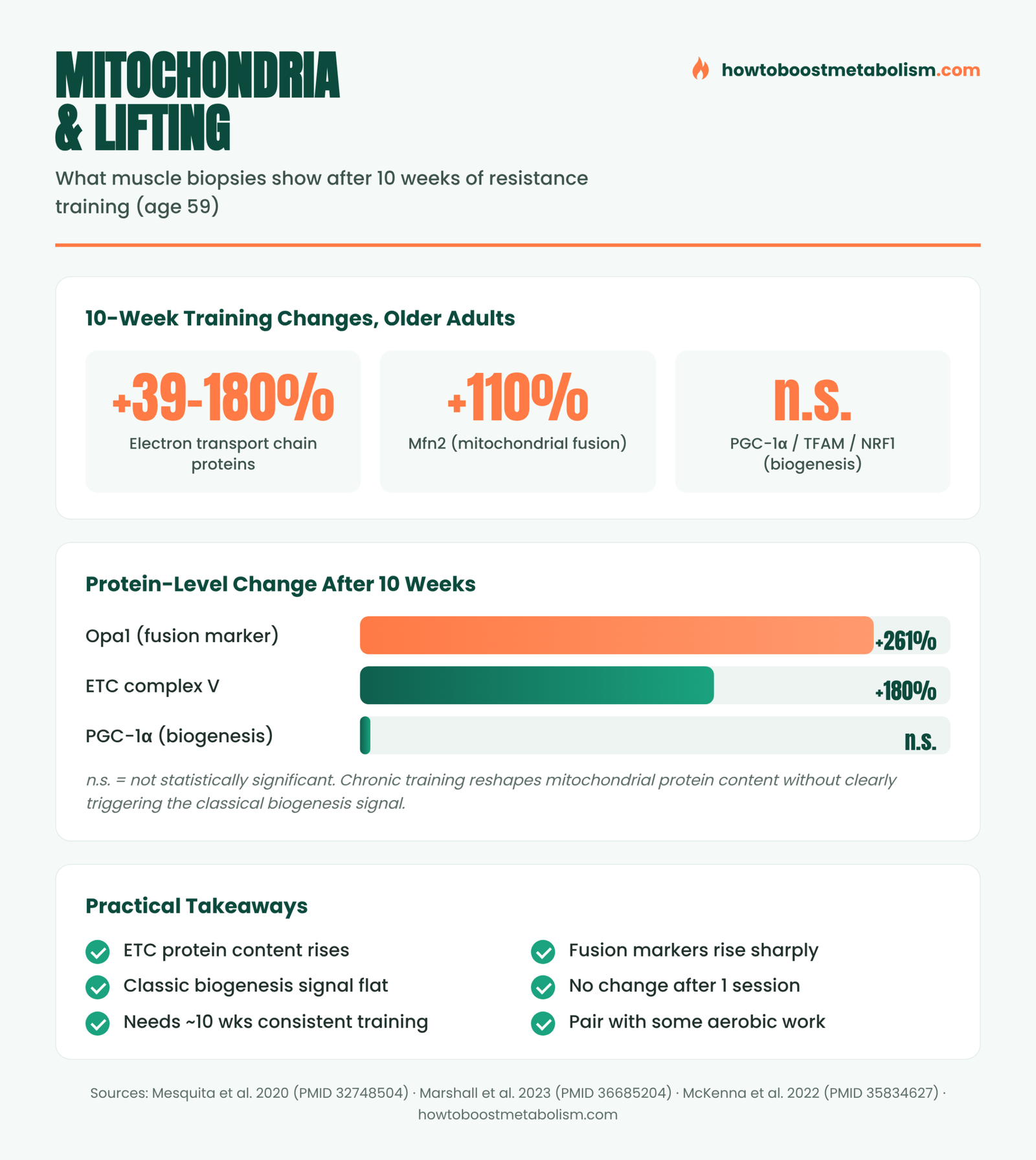
The most directly relevant study took vastus lateralis muscle biopsies from 16 untrained adults averaging 59 years old, before and after 10 weeks of twice-weekly, full-body resistance training, with an additional biopsy 24 hours after the very first session (Mesquita et al., 2020, Physiological Reports). After the full 10 weeks, protein levels of all five electron transport chain complexes rose substantially (39% to 180%, depending on the complex), and markers of mitochondrial fusion — Mfn1, Mfn2, and Opa1 — increased sharply as well (90% to 261%).
Here’s the part that gets left out of most summaries: the classical biogenesis markers — PGC-1α, TFAM, and NRF1 — did not change significantly. The researchers’ own interpretation was that chronic resistance training increased mitochondrial protein content and remodeled mitochondrial shape and networking (fusion), without clearly triggering the textbook biogenesis signaling cascade. That’s a real, measurable, and useful adaptation — just not the same mechanism most marketing copy is referencing when it says “boost your mitochondria.”
Free download
🔥 The Metabolism Starter Kit
3 honest guides: a 7-day reset plan, a foods cheat-sheet and 12 metabolism myths debunked. No spam — unsubscribe anytime.
A Single Workout Doesn’t Move the Needle
If chronic training produces this effect gradually, does a single hard session kick-start it? A separate study took biopsies from both masters athletes (lifelong endurance-trained, average age 74) and untrained older adults (average age 69) before a single resistance session, and again at 1 hour and 48 hours afterward (Marshall et al., 2023, Frontiers in Physiology). Despite the masters athletes showing dramatically higher baseline mitochondrial content — about 45% higher citrate synthase activity, higher electron transport chain protein levels, and higher PGC-1α, TFAM, and AMPK signaling than the untrained group — a single resistance training session did not significantly alter any marker of mitochondrial content, biogenesis, or quality control in either group, acutely or 48 hours later.
Put the two studies together and a coherent picture emerges: resistance training’s mitochondrial benefits in older adults are a slow, cumulative remodeling process (measurable at 10 weeks), not something triggered session by session. And the athletes’ advantage in that second study — built over years of aerobic training, not resistance work — hints that the two training modes may be building mitochondrial capacity through different, complementary routes.
Strength Gains Track With Respiratory Capacity, Not Just Signaling
A third study, in 41 middle-aged adults (mean age 50) completing a 10-week resistance training program, measured muscle mitochondrial respiratory capacity directly using high-resolution fluo-respirometry (McKenna et al., 2022, Journal of Applied Physiology). Maximal oxidative phosphorylation capacity increased significantly with training, and that increase correlated meaningfully with strength gains (r values of 0.40 to 0.78 across several markers). Interestingly, this study also found no significant change in the classical biogenesis transcription signal — consistent with the biopsy findings above — even though respiratory function itself clearly improved.
At a Glance: Four Studies, One Pattern
| Study | Finding |
|---|---|
| Mesquita 2020 (10 wks, age 59, n=16) | ETC proteins +39–180%; fusion markers up; PGC-1α/TFAM/NRF1 unchanged |
| Marshall 2023 (acute, 1h & 48h, n=14) | No change in any mitochondrial marker after a single session |
| McKenna 2022 (10 wks, age 50, n=41) | Respiratory capacity up, correlated with strength; biogenesis signal unchanged |
| Jeong 2024 (review) | Resistance training’s effect on classical biogenesis pathway still unclear vs. aerobic exercise |
What This Means in Practice
- Resistance training measurably increases electron transport chain protein content and mitochondrial fusion markers in muscle after 40, which is a real, biopsy-confirmed adaptation.
- It does not clearly trigger the classical PGC-1α/TFAM/NRF1 biogenesis pathway in the way aerobic training is better known to.
- These changes build over roughly 10 weeks of consistent training, not from any single session.
- Strength gains track with improved mitochondrial respiratory function, giving a practical reason to care about this even without a biogenesis-pathway signal.
- Combining resistance training with some aerobic work remains the most evidence-consistent approach, since the two appear to influence muscle mitochondria through at least partly different routes.
What a Training Plan Built Around This Actually Looks Like
None of the studies above tested different training volumes against each other, so there’s no biopsy-backed answer for “how many sets per week maximize mitochondrial protein content.” What they do agree on is the basic shape of an effective program: full-body resistance training performed at least twice a week, sustained for a minimum of 10 weeks before expecting measurable change, using loads and effort levels typical of standard hypertrophy or strength programming rather than anything exotic. If you’re already following a structured approach like the one in our guide to progressive overload after 40, you are very likely already doing enough volume to drive this adaptation — the missing piece for most people isn’t technique, it’s consistency over the 10-week window these studies used.
Free download: our Metabolism Starter Kit — a protein calculator, a 7-day meal framework, and a one-page supplement checklist, with zero hype.
Get the Free Starter Kit →Why This Matters More Than It Sounds Like It Should
Mitochondria aren’t just about endurance — they’re the machinery that determines how efficiently a cell can burn fat and glucose for fuel at rest, which is a core piece of what people mean when they talk about “metabolism” in the first place. Skeletal muscle is the largest mitochondria-rich tissue in the body by mass, and age-related declines in mitochondrial content and function in muscle are consistently linked to insulin resistance and the kind of slow metabolic decline this site covers elsewhere. That’s the real reason researchers keep studying whether resistance training — something most people over 40 are already being told to do for bone density and strength — carries a bonus metabolic benefit at the cellular level.
The honest version of that story, based on the data above, is “yes, but specifically and partially, not completely.” Resistance training builds more electron transport chain machinery — the actual protein complexes that burn fuel to make ATP — and reshapes how mitochondria network together through fusion. It just doesn’t appear to do this primarily through the PGC-1α pathway that aerobic exercise is best known for engaging. Two different tools, aimed at overlapping but not identical parts of the same cellular problem.
What About Mitochondrial Supplements?
None of the four studies referenced here tested a supplement layered on top of training, so they can’t directly confirm or rule out whether something like CoQ10, NAD+ precursors, or creatine changes these specific biopsy markers when combined with lifting. What they do confirm is that the training stimulus itself — with no pill involved — produces a real, measurable mitochondrial protein change in muscle after 40. That’s a useful baseline to keep in mind before assuming a supplement is doing the heavy lifting that the workout itself is already responsible for.
Where the Research Still Falls Short
All four studies here involve small samples (14 to 41 participants) and training periods capped at 10 weeks — nobody has biopsy data tracking these markers over a full year or more of consistent lifting. There is also no trial directly comparing resistance-only, aerobic-only, and combined training on these specific mitochondrial markers in the same group of older adults, which means the “combine both” recommendation above is a reasonable inference from separate studies, not a single head-to-head result.
If you’re already changing up your training to chase these adaptations, pairing it with a structured eating window is one of the better-studied ways to support metabolic flexibility without adding another supplement. Anabolic Fasting combines a fasting protocol with resistance-training guidance aimed at building muscle while managing body fat — read the plan and judge for yourself whether the approach fits your schedule.
Learn More →Affiliate link — we may earn a commission at no extra cost to you. Disclosure
Related reading: our look at VO2 max and longevity alongside strength training digs into the aerobic side of this equation, and how accurate resting metabolic rate testing actually is is useful context if you’re trying to track whether any of this shows up on a calorimetry test. See also our breakdowns of taurine and metabolic aging and how sleep debt affects muscle protein synthesis after 40, two other factors that interact with the same cellular machinery discussed here.
Frequently Asked Questions
Does resistance training increase mitochondrial biogenesis?
Not in the classic sense most people mean. A 10-week trial in older adults found that resistance training significantly increased electron transport chain proteins and mitochondrial fusion markers, but did not significantly change PGC-1α, TFAM, or NRF1 — the specific signaling proteins that define classical ‘mitochondrial biogenesis.’ Muscle got more mitochondrial protein content without necessarily triggering that specific pathway.
Is cardio better than lifting for mitochondria?
The comparative data favors aerobic training for the classic biogenesis pathway. A study comparing lifelong endurance-trained masters athletes to untrained older adults found the athletes had roughly 45% higher citrate synthase activity and significantly higher PGC-1α, TFAM, and AMPK signaling at baseline. That’s a difference built from years of aerobic training, not a single modality claim, but it does suggest aerobic work has a clearer, better-mapped relationship to this specific pathway.
Does one resistance training session change your mitochondria right away?
No. A controlled study measuring muscle biopsies 1 and 48 hours after a single resistance session found no significant change in any marker of mitochondrial content, biogenesis, or quality control in either older adults or masters athletes. Mitochondrial remodeling from resistance training, where it happens, appears to require weeks of repeated training, not a single workout.
Should someone over 40 do both cardio and weights for mitochondrial health?
The available evidence points that way, though no trial has directly proven an optimal combination. Resistance training reliably builds electron transport chain protein content and mitochondrial respiratory capacity, which correlates with strength gains; long-term aerobic training is linked to higher mitochondrial density and better-preserved classical biogenesis signaling into later life. Combining both is a reasonable, evidence-consistent approach even though the exact dosing has not been nailed down in a single study.
Do mitochondrial supplements make lifting more effective for metabolism?
The biopsy studies referenced here tested training alone, not supplements layered on top, so they cannot answer that question directly. What the data does show is that the muscle adaptation to resistance training itself — more electron transport chain protein, improved respiratory capacity — is a real, measurable, drug-free lever that doesn’t depend on any supplement to occur.
This article summarizes published exercise-physiology research and is for educational purposes only. It is not personalized medical or training advice. See our Medical Disclaimer.