
Pull-Ups vs. Lat Pulldowns After 40: What EMG Shows
This article may contain affiliate links. If you buy through them, we may earn a small commission at no extra cost to you. See our Affiliate Disclosure and Medical Disclaimer.
If you’ve ever stood in a gym after 40 staring at a pull-up bar you can no longer use, and a lat pulldown machine you can, you’ve probably wondered which one is actually worth your time. The internet’s answer is usually moral: pull-ups are “real,” pulldowns are for beginners who haven’t earned it yet. The electromyography (EMG) data tells a much less judgmental story — and if you’re training a back that’s carrying 20, 30, or 40 years of wear, the less judgmental story is the one that’s actually useful.
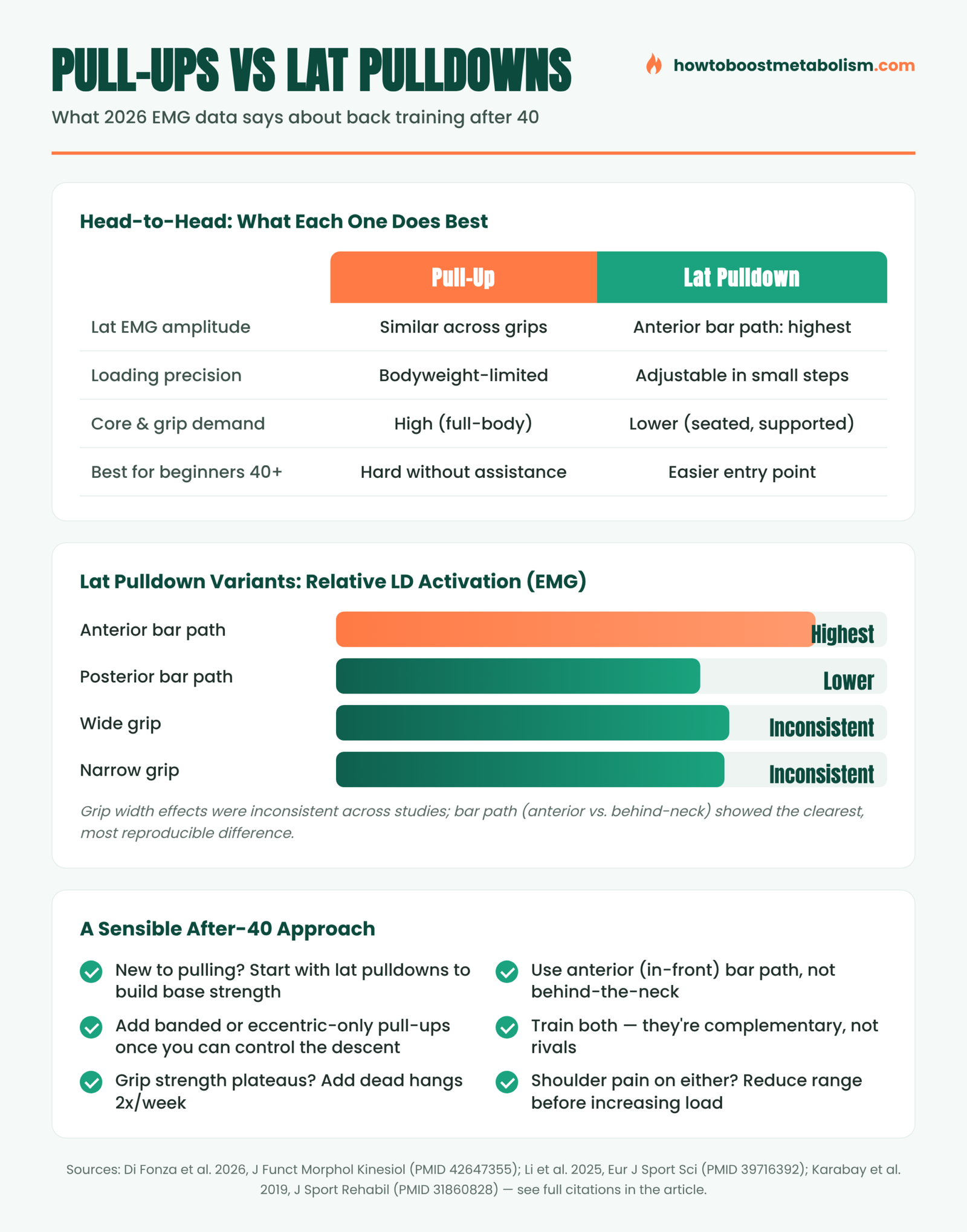
A 2026 narrative review in the Journal of Functional Morphology and Kinesiology pulled together 23 EMG studies on pulling exercises specifically to answer this kind of question: which configurations most consistently produce the highest latissimus dorsi (LD) activation (Di Fonza et al., 2026). The short version is not flattering to pull-up purists: an anterior (in-front-of-the-body) lat pulldown was the configuration most consistently associated with greater LD amplitude, while pull-up variations — different grip widths and hand positions — showed broadly similar LD activation across the board. Grip width on the pulldown itself was inconsistent across studies, so “wide grip for width, narrow for thickness” is mostly gym folklore, not something the EMG data cleanly supports.
What a Back Muscle Actually Cares About
EMG measures electrical activity in a muscle during a contraction — it’s a reasonable proxy for how hard a muscle is working in a given exercise, but it is not a direct measurement of long-term muscle growth or strength gain. The 2026 review is explicit about that limitation: its conclusions describe “acute EMG amplitude rather than longitudinal training outcomes,” and should be treated as a starting point for exercise selection, not a verdict on which exercise builds more muscle over a year of training. With that caveat in place, the review’s biggest practical finding is this: across pull-up grip variations (wide, narrow, neutral, chin-up supinated grip), the data didn’t show one configuration clearly out-activating the others for the lats. If you’ve been agonizing over grip width on your pull-up bar for “lat gains,” the EMG literature doesn’t currently back that up.
The review also flagged the seated cable row as interesting: a narrower grip and a lower shoulder-abduction angle were each associated with higher LD amplitude in separate studies — but those two variables haven’t been tested together, so stacking them into one “optimal” row setup is an extrapolation, not a tested protocol. And the inverted row — a bodyweight row using a barbell or straps — produced the single highest LD reading in the dataset, but from one small, unreplicated study, so it’s a lead worth trying, not a conclusion worth building a program around.
| Question | Pull-Up | Lat Pulldown |
|---|---|---|
| Builds the lats as well? | Yes — similar across grips | Yes — slightly favored (anterior path) |
| Easy to load progressively? | Limited to bodyweight + added weight/bands | Easy — 2.5–5 lb increments |
| Good first exercise after 40 with no training base? | Usually too hard unassisted | Yes, lower barrier to entry |
| Builds grip and core stability? | Yes, substantially | Minimal — seated, supported |
| Joint-friendly for shoulders with some wear? | Can aggravate if mobility is limited | Easier to control range of motion |
The Training Data: Can Pulldowns Actually Make You Better at Pull-Ups?
Two 2025 randomized trials out of Tongji University asked a more practical version of this question: if you can’t do many pull-ups, does training on the lat pulldown machine actually transfer? In the first, 25 male college students trained lat pulldowns for eight weeks, and the group that combined this with mild brain stimulation improved pull-up performance more than resistance training alone — but both groups that trained lat pulldowns got measurably better at pull-ups (Li et al., 2025). In the second, 34 recreationally active men trained lat pulldowns for eight weeks, either on a stable machine or with added joint instability; the instability group ended up with superior pull-up endurance and less wasted antagonist muscle co-activation (Li et al., 2025).
Put simply: in both trials, nobody practiced pull-ups during the eight-week intervention, and both groups still got better at pull-ups afterward. That’s a meaningful, if modest, piece of evidence that the lat pulldown isn’t just a “consolation prize” exercise — it can function as genuine preparation for a pull-up, which matters a lot if you’re 45, haven’t done a pull-up since high school, and don’t want to spend six months failing at dead hangs before you see progress.
Rebuilding pulling strength from scratch after 40 is exactly the kind of slow, compounding project where consistent training and recovery nutrition both matter. Anabolic Fasting is a structured program built around training technique and nutrient timing for people trying to add muscle without piling on fat in the process.
Check the Program →Affiliate link — we may earn a commission at no extra cost to you. Disclosure
Free download
🔥 The Metabolism Starter Kit
3 honest guides: a 7-day reset plan, a foods cheat-sheet and 12 metabolism myths debunked. No spam — unsubscribe anytime.
Shoulder Health: The Part the Grip-Width Debate Usually Ignores
A systematic review of scapular stabilizer activity during closed kinetic chain exercises — the category that includes pull-ups, since your hands are fixed and your body moves — found that exercise selection changes the ratio of upper trapezius to middle/lower trapezius and serratus anterior activity (Karabay et al., 2019). That ratio matters because a shoulder that overworks the upper trapezius relative to its stabilizers is a setup for the kind of nagging shoulder impingement that gets more common, not less, after 40. A separate controlled study on four closed kinetic chain shoulder exercises found that adding instability (via suspension straps) changed shoulder muscle activation levels measurably compared to the same exercises on stable surfaces (De Mey et al., 2014).
Practically, this means the pull-up vs. lat pulldown question isn’t only about the lats. If your shoulders already feel cranky overhead, a controlled lat pulldown with a full, pain-free range of motion is often the more conservative starting point, specifically because you can dial back range and load independently — something a bodyweight pull-up doesn’t let you do nearly as precisely.
A Program That Actually Uses Both
If you can already do pull-ups
- Keep pull-ups as your primary vertical pulling movement, 2–3 sets of 4–8 reps, 1–2x per week.
- Use the lat pulldown as a volume accessory afterward — higher reps (10–15), anterior bar path, when you’re already fatigued from the pull-up sets.
- Rotate grip occasionally for joint variety, not because any single grip is proven superior for lat growth.
If you can’t yet do a strict pull-up
- Make the anterior-path lat pulldown your main back exercise, progressing load every 1–2 weeks within a 6–10 rep range.
- Add banded pull-ups or an assisted pull-up machine 1x per week specifically to practice the movement pattern.
- Add dead hangs (even 10–20 seconds) to build grip and shoulder tolerance without the full pulling demand.
- Reassess your unassisted pull-up capacity every 6–8 weeks — the training data above suggests this transfer genuinely happens over roughly that timeframe.
If grip is your limiting factor on either exercise, it’s worth reading our breakdown of dead hangs and grip tendon health after 40 and where you stand on grip strength norms for your age and sex. And if the whole machines-vs-free-weights debate interests you beyond just this one exercise pair, we covered the broader question in machines vs. free weights after 40.
What the Evidence Doesn’t Settle
None of the EMG studies in the 2026 review followed people for months to measure actual muscle growth differences between pull-ups and lat pulldowns — they measured electrical activity during a single contraction, which correlates with training stimulus but isn’t the same thing as a hypertrophy outcome. The training RCTs above are encouraging but small (25 and 34 young male college students, not a 40-plus population), so the specific numbers — how many weeks, how much transfer — shouldn’t be read as guaranteed for someone a few decades older with different recovery capacity and joint history. The honest summary: both exercises clearly train the same muscle group effectively, lat pulldowns are a legitimate stepping stone toward pull-ups rather than a lesser substitute, and neither exercise has a decisive, well-replicated EMG advantage once you account for all the variables in play.
Common Mistakes People Make Switching Between the Two
The most common mistake is using poor form to chase the “harder” exercise. A half-range, momentum-driven pull-up with the shoulders shrugged up around the ears isn’t training the lats much better than a controlled lat pulldown — it’s mostly training the upper trapezius and whatever swing you can generate. If you can’t control a pull-up through a full range without your shoulders rising to your ears at the top, that’s a signal to spend more time on pulldowns and assisted variations before loading the full bodyweight movement.
The second common mistake runs the other way: staying on the lat pulldown machine indefinitely out of comfort, never progressing toward any bodyweight pulling capacity at all. The two 2025 training trials above suggest an eight-week block of structured pulldown work is enough to move the needle on pull-up performance in previously untrained people — so if you’ve been doing pulldowns for a year with zero attempts at a dead hang or an assisted pull-up, you’re likely leaving a trainable capacity on the table, not protecting yourself from anything.
A third mistake, more specific to training after 40: treating grip width changes as a substitute for progressive overload. Swapping from a wide grip to a neutral grip on the lat pulldown doesn’t reliably change the training stimulus to your lats in a way the EMG literature can currently confirm — increasing the weight, the reps, or the control of the eccentric portion of the lift does. If your back training has stalled, the fix is more often in the numbers on the plate than in the shape of the handle.
Equipment Notes for Training at Home
A pull-up bar is inexpensive and takes up almost no space, but it only offers one loading option — your bodyweight plus whatever you can safely strap or hold onto. A cable lat pulldown setup, even a compact home-gym version, lets you load in small increments, which matters more as you get into your 40s and 50s and want finer control over week-to-week progression than “add 10 more pounds of bodyweight” can offer. If you’re deciding what to add to a home setup, a resistance band system or an assisted pull-up band is usually the better first purchase if your goal is building toward an unassisted pull-up, while a cable column or adjustable pulley system is the better choice if your goal is simply building a stronger, more resilient back over time, regardless of whether you ever do a strict pull-up.
Free download: our Metabolism Starter Kit — a protein calculator, a 7-day meal framework, and a one-page supplement checklist, with zero hype.
Get the Free Starter Kit →Related: Training at home instead of the gym? See our guide to the best pull-up bars for over 40.
Frequently Asked Questions
Do pull-ups build more muscle than lat pulldowns?
Not according to current EMG data. A 2026 review found pull-up grip variations produced broadly similar latissimus dorsi activation to each other, and an anterior-path lat pulldown was actually the configuration most consistently linked to the highest activation. EMG amplitude isn’t a direct measure of long-term muscle growth, so this should be read as evidence they’re comparably effective, not proof that pulldowns are superior for hypertrophy.
Will doing lat pulldowns actually help me get my first pull-up?
Two 2025 randomized trials in young men found that eight weeks of lat pulldown training alone — without any pull-up practice — improved pull-up performance and endurance. It’s reasonable evidence that pulldowns build genuine transferable strength, though the trials were done in college-age men, not a 40-plus population.
I’m over 40 and have shoulder pain on pull-ups — should I avoid them?
Not necessarily avoid them forever, but it’s reasonable to back off and build a pain-free base first. Research on closed kinetic chain shoulder exercises shows that exercise choice changes the balance between the upper trapezius and the scapular stabilizing muscles, and a controlled lat pulldown lets you manage range of motion and load independently in a way a bodyweight pull-up doesn’t.
Does grip width on the lat pulldown matter for lat growth?
Based on the available EMG studies, grip width effects were inconsistent — some studies favored wider, some narrower, with no clear, reproducible winner. Bar path (pulling to the front of the body versus behind the neck) showed a more consistent effect, with an anterior path linked to higher activation.
Can I just do lat pulldowns forever and skip pull-ups entirely?
You can build a strong, well-developed back that way — the exercises appear comparably effective for the lats. But pull-ups also demand grip, core, and shoulder stability that a seated, supported machine doesn’t train, so including some bodyweight pulling work (even assisted) adds a functional-strength benefit the pulldown alone doesn’t fully replace.