Do You Really Need a Deload Week After 40?
This article may contain affiliate links. If you buy through them, we may earn a small commission at no extra cost to you. See our Affiliate Disclosure and Medical Disclaimer.
Open almost any strength training plan aimed at people over 40 and you’ll find a built-in “deload week” — a week of lighter weights or fewer sets, inserted every 4 to 8 weeks like clockwork. The logic sounds reasonable: you’re older, your joints need more recovery, so plan for it before your body forces the issue. But when researchers have actually tested planned deloads against simply continuing to train, the results are messier — and more useful — than the blanket advice suggests.
| Question | Short answer |
|---|---|
| What a deload usually means | A week of reduced volume, intensity, or both — not complete rest |
| Effect on muscle size | Essentially none in controlled trials, even after a full week off |
| Effect on strength | A 1-week full stop cost some strength in one trial; reduced-volume deloads didn’t |
| Age 40+ recovery claim | Not supported by the one trial that directly compared young vs. master lifters |
| Best use case | Scheduled before it’s needed, not as a reaction to feeling beat up |
What a "Deload" Actually Means — Before We Argue About Whether You Need One
“Deload” gets used loosely enough that it’s worth pinning down. In the research, a deload isn’t necessarily a week off the gym entirely. It can mean cutting the number of sets per exercise roughly in half, dropping the load you’re lifting to 50-60% of normal while keeping the movement pattern, reducing how many days you train that week, or some combination of all three. The shared idea is a planned, temporary reduction in training stress — scheduled in advance, not improvised the day you feel wrecked.
That distinction matters because the two main studies on this topic tested genuinely different protocols, and they didn’t agree with each other.
The Evidence Against a Full Stop: What a 2024 Trial Found
A 2024 study from the Applied Muscle Development Laboratory (PMID 38274324) put 39 resistance-trained adults through a 9-week training block. Half trained continuously the entire time. The other half stopped lifting completely for one week at the midpoint — a true deload in the strictest sense. The researchers tracked muscle thickness in the quadriceps and calves with ultrasound, plus strength, power, and local muscular endurance.
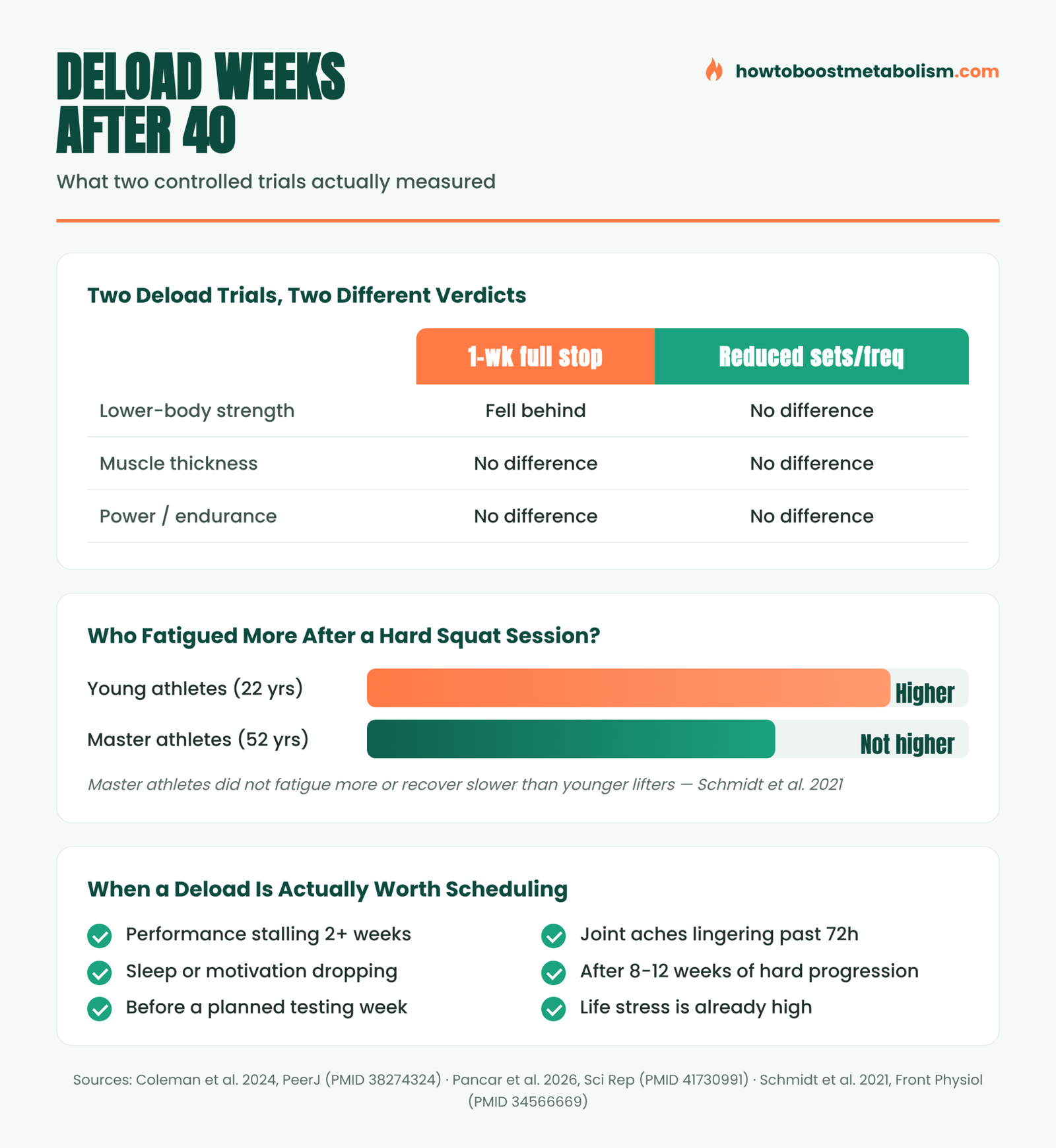
The result split down the middle. Muscle growth, power output, and muscular endurance came out statistically identical between the two groups — the week off cost nothing on those measures. But the group that trained continuously ended up with meaningfully greater gains in both isometric and dynamic lower-body strength than the deload group, along with slightly better self-reported readiness to train. The honest summary from the authors: a full week off “appears to negatively influence measures of lower body muscle strength but has no effect on lower body hypertrophy, power or local muscular endurance.” Not a disaster, but not free, either.
Free download
🔥 The Metabolism Starter Kit
3 honest guides: a 7-day reset plan, a foods cheat-sheet and 12 metabolism myths debunked. No spam — unsubscribe anytime.
A Second Trial Reaches a More Reassuring Verdict
A 2026 study (PMID 41730991) tested a gentler version of the same idea. Instead of stopping entirely, 19 untrained men trained one arm and one leg continuously for 8 weeks while the opposite limb followed the identical program but dropped to a single, lighter set in weeks 4 and 8 instead of the usual 6-8 sets. Muscle thickness was tracked by ultrasound and strength-endurance by 10-rep-max testing.
This time, there was essentially no difference between the two conditions. Both the continuously trained and the reduced-volume limbs showed statistically similar increases in muscle thickness and strength-endurance, with the effect sizes the researchers reported described as small across the board. Scaling volume down for two planned weeks, rather than stopping outright, didn’t cost the lifters anything measurable.
Put the two trials side by side and a pattern emerges: the more aggressive the deload (a complete stop), the more likely it is to cost you something, specifically strength. The milder version (fewer sets, same frequency) looks closer to a free lunch. That’s a meaningfully different takeaway than “deload weeks are good” or “deload weeks are pointless” — it depends entirely on how hard you deload.
The "I’m Over 40, So I Need More Recovery" Assumption — Actually Tested
Here’s the part that surprised us most. A 2021 study (PMID 34566669) directly compared recovery from a hard eccentric squat session between young lifters (average age 22) and master athletes (average age 52) matched for relative strength. Researchers tracked maximal force, jump height, muscle soreness, creatine kinase (a blood marker of muscle damage), and perceived performance capability before training and again at 24, 48, and 72 hours afterward.
If the “older lifters need way more recovery” assumption were simply true across the board, you’d expect the 52-year-olds to show bigger strength drops, more soreness, and a slower climb back. That isn’t what happened. The study’s own conclusion states plainly that the master athletes “neither reach higher fatigue levels nor recover more slowly than the younger athletes.” If anything, the younger group showed higher post-exercise blood lactate and more soreness in this particular comparison.
That doesn’t mean age never affects recovery — this was one study, with eight master athletes, looking at a single type of session. Sleep quality, injury history, total training load, and how hard someone actually trains all matter more than a birthday. But it’s a useful corrective to the idea that turning 40 automatically means your recovery clock resets to half speed.
So… Do You Need One? A Practical Framework
Given all that, the honest answer is: probably, occasionally — but not on autopilot, and not as a full week off by default. A few practical guidelines that match what the evidence actually shows:
- If you’re going to deload, favor reducing sets, not stopping entirely — the milder approach preserved every outcome measured, while a complete week off cost some strength in the other trial.
- Schedule it proactively, roughly every 6-10 weeks of hard progressive training, rather than only reacting once you’re already beat up.
- Don’t deload just because you turned 40 — deload because of specific signals (see the checklist below), the same ones a 25-year-old would also need to respect.
- If you take a full week completely off, expect a small, temporary strength dip — not muscle loss — and know that it typically returns within a session or two of resuming training.
Signs a Deload Is Actually Worth Scheduling Soon
- Your working weights have stalled or dropped for two or more consecutive weeks despite consistent effort
- Joint or tendon soreness is lingering well past 72 hours after sessions that didn’t used to cause that
- Sleep quality or motivation to train has been sliding for a week or more
- You’re 8-12 weeks into a hard progressive block without a planned break
- Non-training life stress is unusually high right now
Signs You Can Probably Skip It For Now
- Lifts are still moving up session to session, even slowly
- Soreness resolves within 48 hours like it normally does
- Sleep, appetite, and mood are all tracking normally
- You’ve already had a lighter week recently from travel, illness, or a busy stretch
How to Structure a Deload If You Decide to Take One
Based on what actually held up in the research, the version worth copying looks like this: keep your normal training frequency and the same exercises, but cut your sets per movement roughly in half for one week, and drop the load you’re using by about 10-20%. That’s close to the protocol that showed no downside at all. Reserve a true week completely off the gym for when you’re genuinely sick, traveling without access to a gym, or dealing with an injury flare — not as a routine monthly ritual, since that’s the version most likely to cost you strength, per the 2024 trial above.
Common Mistakes
- Treating every "off" feeling as a reason to deload. Normal, resolving soreness and fatigue are part of training, not a red flag.
- Deloading every single week. If you’re backing off constantly, you were never training hard enough to need recovery from in the first place.
- Stopping entirely for multiple weeks "to be safe." The evidence suggests this is the version most likely to cost you strength, not the version that protects you.
- Skipping protein and sleep during the deload week. The reduced training load doesn’t reduce your need for the recovery inputs that actually drive adaptation.
A Note on Training Experience
Neither trial above used true beginners, and that matters. People relatively new to lifting tend to recover faster and adapt from almost any stimulus, including a week of reduced training, because nearly everything is still a novel stress to the body. The closer someone is to their genetic ceiling for strength and muscle — typically after several years of consistent, progressive training — the more a missed week can show up on the bar, simply because there’s less unused adaptive capacity to coast on. If you’ve been lifting seriously for less than a year, you likely have more room to experiment with deload timing without noticing much either way.
Bottom Line
A planned, modest reduction in training volume every several weeks appears to cost nothing measurable in the research so far, and may help some lifters manage joint wear and motivation over the long run. A full week of complete rest is a different animal — it looks safe for muscle size and endurance, but it can cost you a bit of strength, and the data doesn’t support the idea that people over 40 inherently need it more than younger lifters do. Schedule deloads around specific signals and training phases, not around a birthday.
Related Reading
If overtraining is more the concern than recovery timing specifically, see our honest breakdown of the real signs of overtraining after 40 — and why a cortisol test usually doesn’t settle it. If you’re wondering what happens when you stop training for longer than a planned week, we cover that separately in how fast you actually lose muscle when you stop training after 40. And if your deload question is really about how long you rest between sets rather than between training blocks, that’s a different topic we cover in rest periods between sets after 40.
If a structured program with built-in recovery phases sounds more useful than guessing week to week, Old School New Body‘s F4X system for adults 40+ lays out a full progression with planned lighter phases. A caution first: some marketing claims on its landing page about aging rates and muscle loss percentages are not backed by cited sources, so treat those figures as marketing, not data — the training structure itself is the useful part.
Check Availability →Affiliate link — we may earn a commission at no extra cost to you. Disclosure
Free download: our Metabolism Starter Kit — a protein calculator, a 7-day meal framework, and a one-page supplement checklist, with zero hype.
Get the Free Starter Kit →Related: How close you train to failure directly affects how much fatigue accumulates and how badly you need a deload — we break down the research in training to failure vs. reps in reserve after 40.
Related: Planning a deload is a low-tech way to do what HRV tracking is trying to achieve — see our article on HRV and strength training recovery after 40.
Frequently Asked Questions
Do I need a deload week every month?
Not automatically. The research doesn’t support deloading on a fixed calendar regardless of how training is going. A reasonable approach is roughly every 6-10 weeks of hard progressive training, or sooner if you notice stalling performance, lingering soreness, or dropping motivation.
Will I lose muscle if I take a full week off?
The controlled trials on this found no measurable loss in muscle thickness after a single week completely off training. One trial did find a small strength dip in the group that stopped entirely, but muscle size itself held steady.
Do people over 40 actually need more recovery time than younger lifters?
A direct comparison of trained lifters in their 20s versus their 50s found the older group did not fatigue more or recover more slowly after a hard squat session. Sleep, training load, and injury history appear to matter more than age alone.
What’s the difference between a deload and just detraining?
A deload is a short, planned reduction in training volume or intensity, typically a week, while you keep training. Detraining refers to stopping or substantially cutting back training for a longer stretch — weeks to months — which has different and larger effects on muscle and fitness.
Is it better to reduce sets or reduce weight during a deload?
The trial that reduced sets per exercise (while keeping frequency the same) found no downside on any outcome measured. The trial that stopped training entirely for a week found a small strength cost. If you want to deload with the least risk, cutting volume rather than stopping completely looks like the safer bet based on the current evidence.