Compression Garments After Lifting: Do They Actually Help?
This article may contain affiliate links. If you buy through them, we may earn a small commission at no extra cost to you. See our Affiliate Disclosure and Medical Disclaimer.
Walk into any gym after 2015 and you’ll see compression sleeves, tights, and full-body suits on lifters who are decades apart in age and experience level. The pitch is simple: squeeze the muscle, and it recovers faster. For years, the research seemed to back that up. Then, in 2025, the most carefully instrumented trial on the topic to date looked directly at the underlying biology — and found nothing. Here’s what actually happened, and what it means if you’re deciding whether $60 compression tights are worth adding to your post-lifting routine after 40.
This is a useful case study in how exercise science evidence evolves. A claim can be well-supported by the available literature for years, then get genuinely complicated — not debunked, complicated — by a single better-designed study that measures the right outcome for the first time. That’s exactly what happened here, and it’s worth walking through both eras of evidence rather than just picking a side.
The Older Case For Compression: Two Meta-Analyses, Modest Benefits
The strongest historical evidence for compression garments comes from two meta-analyses published about three years apart. A 2014 analysis in the British Journal of Sports Medicine pooled 12 studies measuring delayed onset muscle soreness (DOMS), strength, power, and creatine kinase (a blood marker of muscle damage) at 24, 48, or 72 hours after exercise. Compression garments showed a moderate effect on all four: DOMS severity (Hedges’ g = 0.403), muscle strength (g = 0.462), muscle power (g = 0.487), and creatine kinase (g = 0.439), all statistically significant (Hill et al., 2014).
A broader 2017 meta-analysis in Sports Medicine pooled 23 peer-reviewed studies and found an overall small-to-moderate benefit across strength, power, and endurance recovery (effect size 0.38). The benefit was notably larger specifically for strength recovery (ES = 0.62) and specifically after resistance exercise rather than running or cycling, with the largest effects showing up more than 24 hours after training (Brown et al., 2017). Neither study found that garment pressure (above or below 15 mmHg) or whether someone was a trained athlete versus untrained changed the result much. On the strength of these two papers, “compression garments speed recovery” became a reasonably well-supported claim — the kind of claim this site would normally be comfortable repeating.
The 2025 Trial That Complicates the Story
The problem with both meta-analyses above is that they’re built almost entirely on perceived recovery and performance measures — soreness ratings, jump height, strength tests. Neither looked at what’s actually happening inside the muscle. A 2025 study in Medicine & Science in Sports & Exercise did exactly that: 20 resistance-trained adults (5 women, 15 men) performed a leg-press session, then wore either commercial compression tights or no tights for a 5-hour recovery window. Researchers measured muscle protein synthesis markers, muscle blood flow, blood lactate, blood glucose, perceived recovery, muscle soreness, and two performance tests (countermovement jump, isometric mid-thigh pull) at baseline, immediately post-exercise, and at 1, 5, and 24 hours afterward.
The result: no significant interaction between groups on any physiological, performance, or perceptual measure. Both the compression and no-compression groups showed the expected post-exercise changes over time — rising muscle protein synthesis markers, rising blood flow and lactate, falling blood glucose, more soreness, reduced jump height — but compression didn’t change the size or speed of any of those changes compared to training with no tights at all (Leabeater et al., 2025). This is a small trial (n=20), so it can’t overturn two meta-analyses on its own — but it’s the first study in this body of research to look at the actual molecular recovery process rather than just soreness scores and jump tests, and what it found was nothing.
Free download
🔥 The Metabolism Starter Kit
3 honest guides: a 7-day reset plan, a foods cheat-sheet and 12 metabolism myths debunked. No spam — unsubscribe anytime.
Why Would the Molecular Data and the Meta-Analyses Disagree?
A few honest possibilities, none of which the current research fully settles. First, perceived recovery and actual tissue repair aren’t the same thing — compression garments provide real sensory input (pressure, warmth, reduced muscle oscillation) that can genuinely make soreness feel less bothersome without speeding up the underlying biology, and several studies in the older meta-analyses relied heavily on self-reported soreness. Second, publication bias in a crowded commercial-interest research area (compression garment companies fund some of this research) could inflate the older pooled effect sizes somewhat, though neither meta-analysis above disclosed obvious industry sponsorship issues. Third, a broader 2018 meta-analysis comparing recovery techniques head-to-head in Frontiers in Physiology (99 studies) found massage and cold exposure outperformed compression garments specifically for reducing inflammatory markers like IL-6 and C-reactive protein, suggesting compression may simply be one of the weaker tools in the recovery toolbox even where it does work (Dupuy et al., 2018).
There’s also a statistical-power angle worth flagging honestly: the 2025 trial had only 20 participants split across two groups, which makes it reasonably well-powered to detect large differences but poorly powered to rule out a genuinely small effect. A small, real benefit on the order of what the older meta-analyses suggested (effect sizes around 0.4–0.6) could exist and still be statistically indistinguishable from zero in a sample this size. The honest conclusion isn’t “compression garments do nothing, proven” — it’s “the best current molecular evidence doesn’t support a meaningful recovery benefit, and the older performance-based evidence for a modest benefit hasn’t yet been explained at the biological level.” Both things can be true while the field waits for a larger mechanistic trial.
At a Glance: What the Evidence Actually Supports
| Outcome | What the evidence shows | Key sources |
|---|---|---|
| Perceived soreness / comfort | Likely small real benefit | Hill 2014, Dupuy 2018 |
| Strength/power return (24h+) | Possible moderate benefit (older data); not replicated at molecular level | Hill 2014, Brown 2017, Leabeater 2025 |
| Muscle protein synthesis markers | No measured benefit | Leabeater 2025 |
| Reducing inflammation (IL-6, CRP) | Weaker than massage or cold exposure | Dupuy 2018 |
The Proposed Mechanism: Why Would Squeezing Help At All?
Compression garment manufacturers typically cite two physiological mechanisms. The first is improved venous return — external pressure theoretically helps blood (and the metabolic byproducts of exercise, like lactate) move back toward the heart more efficiently, rather than pooling in the lower limbs. The second is reduced muscle oscillation — tight-fitting fabric limits the amount a muscle bounces and vibrates under load, a mechanism with more support in running and jumping research than in resistance training specifically. Both mechanisms are plausible and have some supporting physiology, but the 2025 trial’s finding — no difference in muscle blood flow between compression and no-compression groups during the actual recovery window — is a direct test of the venous-return theory, and it didn’t hold up. Blood flow rose after exercise in both groups by a similar amount, compression garment or not.
This doesn’t necessarily mean the mechanism is false in all contexts — compression’s circulatory effects are better established for conditions like chronic venous insufficiency and for long-haul flights (where medical-grade compression stockings reduce clot risk) than for a few hours after a resistance training session. The jump from “compression helps circulation in a clinical, sedentary context” to “commercial athletic compression gear speeds post-lifting recovery” is exactly the kind of inferential leap that marketing copy makes and controlled trials are built to test — and the most rigorous test so far didn’t support it for this specific use case.
It’s also worth noting that compression garment research sits in a crowded, commercially interested corner of sports science — several manufacturers fund or co-author studies on their own products, which doesn’t automatically invalidate the findings but is a reason to weight independently funded, mechanistic trials like the 2025 study somewhat more heavily than marketing-adjacent performance studies when the two disagree.
A Practical Buying Note, If You Decide to Use Them Anyway
Given the mixed picture, if you already like how compression gear feels, there’s little reason to stop using it — just set expectations correctly. A few practical points worth knowing before buying: graduated compression (tighter at the ankle or wrist, looser moving up the limb) is the design most studies actually tested, rather than uniform-pressure fabric; garment pressure in the 15–20 mmHg range is typical for commercial recovery wear and, per the 2017 meta-analysis above, pressure within that general range doesn’t appear to matter much either way; and full-leg or full-arm sleeves worn for several hours post-training (not brief 10-minute wear) is the protocol the research actually tested, so very short wear windows are largely untested.
One population where compression deserves a slightly different conversation: lifters after 40 who also deal with mild lower-leg swelling, varicose veins, or long periods of standing at work. For that group, compression socks have a separate, better-established medical rationale around venous health that’s independent of post-workout muscle recovery entirely — worth discussing with a physician if swelling or vein symptoms are a daily concern, rather than treating it purely as a training-recovery decision.
So Should You Wear Them After Lifting?
If you already own compression gear and find it comfortable, there’s no evidence here that it’s doing harm, and a reasonable chance it’s providing a modest, mostly perceptual recovery benefit — which still has value; feeling less sore can mean you’re more willing to stay consistent with training, and consistency is the single biggest driver of results covered throughout this site. What the current evidence does not support is treating compression garments as a meaningful tool for accelerating the actual repair process in your muscle after a hard session after 40. If your budget or attention is limited, the better-supported levers are sleep (see our piece on sleep debt and muscle protein synthesis after 40), protein intake, and training consistency — not garments.
Cold water immersion is sometimes proposed as a stronger alternative; we cover the honest evidence for that separately in cold water immersion after strength training, including the well-known caveat that cold exposure may blunt muscle-building adaptations if used too soon after a hypertrophy-focused session.
If what you’re really after is a structured recovery-and-training framework rather than recovery gadgets, programs designed for lifters over 35–40 build deliberate recovery windows into the training plan itself. Old School New Body is one such program (F4X protocol) that structures training frequency and intensity for recovery capacity at this age — worth a look if you’re optimizing the training side of recovery, not just the gear side.
Check It Out →Affiliate link — we may earn a commission at no extra cost to you. Disclosure
Related Reading
For more on what actually moves recovery after 40, see our breakdown of glutamine for muscle recovery, our honest look at overtraining signs and cortisol after 40, and cold water immersion after strength training.
Free download: our Metabolism Starter Kit — a protein calculator, a 7-day meal framework, and a one-page supplement checklist, with zero hype.
Get the Free Starter Kit →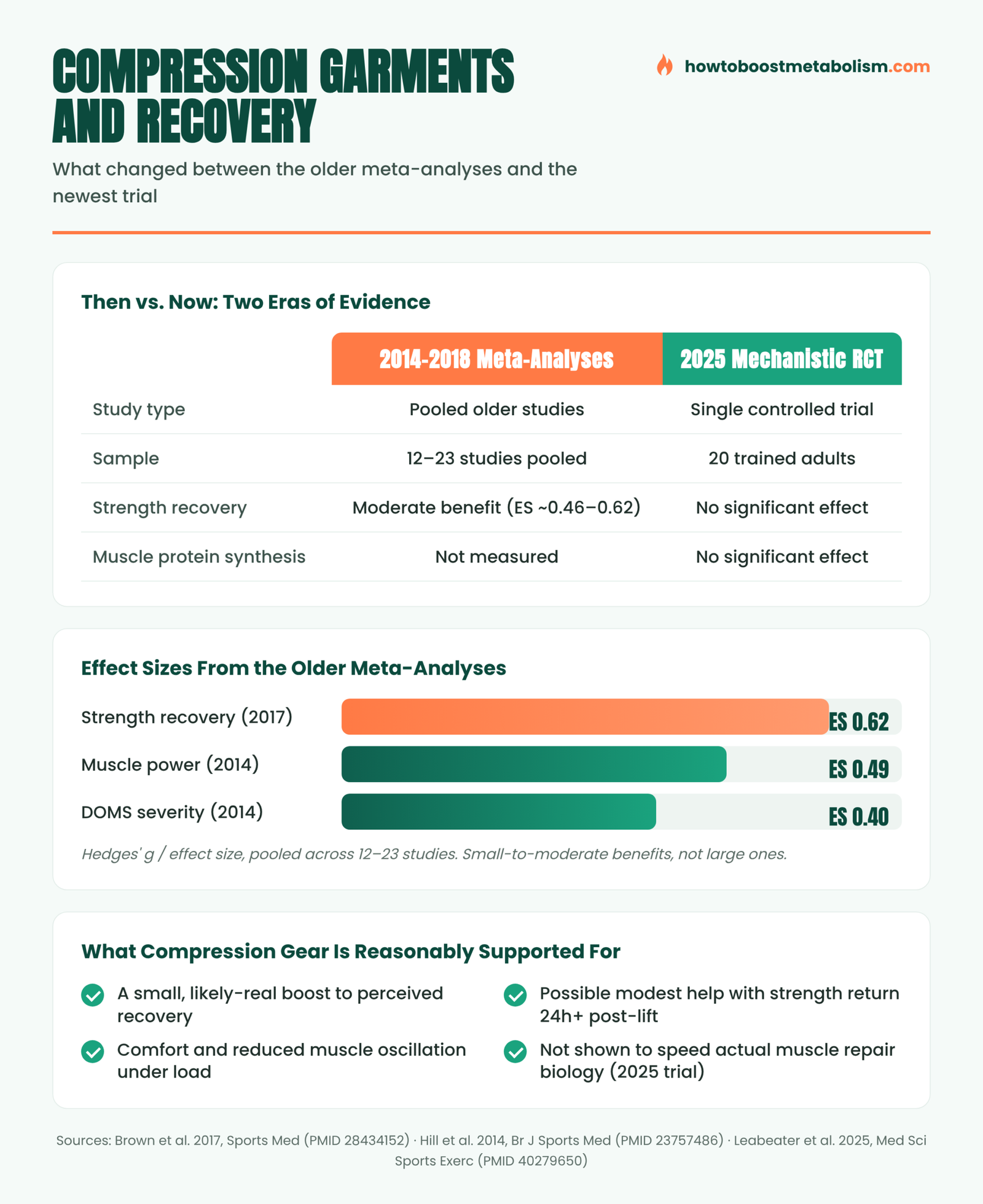
Frequently Asked Questions
Do compression garments reduce muscle soreness after lifting?
Older meta-analyses (2014, 2017) found a moderate statistical benefit for reducing soreness and speeding perceived recovery. A more recent and more detailed 2025 trial measuring the actual muscle repair process found no measurable physiological benefit, so the honest answer is: possibly a small, mostly subjective benefit, not a well-proven biological one.
What pressure level of compression garment works best?
The 2017 meta-analysis specifically tested whether pressure above or below 15 mmHg changed outcomes and found no significant difference. There’s no strong evidence that a specific pressure level is required for whatever benefit compression garments provide.
Should I wear compression gear during my workout or only afterward?
Most of the research cited here, including the 2025 trial, tested post-exercise wear specifically — garments worn during a multi-hour recovery window after training, not during the lifting session itself. That’s the use case the evidence actually speaks to.
Are compression garments better than cold water immersion for recovery?
The available comparative evidence (the 2018 Frontiers in Physiology meta-analysis of 99 studies) found massage and cold exposure outperformed compression garments specifically for lowering inflammatory markers. For soreness and perceived fatigue, compression still showed a benefit, just a smaller one.
Is there any downside to wearing compression garments after lifting?
None of the studies reviewed here reported adverse effects from properly fitted compression garments. The main practical downsides are cost and comfort/heat in warm climates, not safety.
This article is for educational purposes and does not constitute medical advice. See our Medical Disclaimer.