Myokines: How Strength Training Signals Your Whole Body
This article may contain affiliate links. If you buy through them, we may earn a small commission at no extra cost to you. See our Affiliate Disclosure and Medical Disclaimer.
If you still think of a muscle as nothing more than a rope that pulls on a bone, the last two decades of exercise physiology have some news for you. Working muscle also behaves like a gland. It manufactures and releases small signaling proteins — myokines — directly into your bloodstream every time you train, and those proteins talk to your fat tissue, your liver, your immune system, and even your brain. This isn’t metaphor or supplement-marketing poetry. It’s measurable biochemistry, and resistance training after 40 is one of the more reliable ways to turn the signal up.
This article focuses on two of the best-studied myokine-adjacent hormones — myostatin and follistatin — because they have the most direct, repeatedly replicated human data tying them to resistance training, muscle mass, and age. We’ll also be honest about where the myokine story gets oversold, because it does, often.
What Is a Myokine, and Why Does It Matter After 40?
The term “myokine” describes any cytokine or peptide that skeletal muscle releases in response to contraction. The concept moved from curiosity to mainstream physiology after researchers established that muscle-derived interleukin-6 (IL-6) spikes dramatically during exercise and has effects far from the muscle itself — on the liver’s glucose output, on fat tissue, and on inflammation. Since then, researchers have cataloged dozens of myokines. A 2022 narrative review in International Journal of Molecular Sciences summed up the shift in thinking plainly: resistance training turned out to be “a powerful stimulus to enhance myokine release,” and different training styles stimulate different myokines (Zunner et al., 2022).
Why does this matter specifically after 40? Because the biological backdrop changes. Muscle mass and strength trend downward with age (sarcopenia), low-grade chronic inflammation tends to creep up, and insulin sensitivity often worsens. Myokine signaling sits right at the intersection of all three. If resistance training’s muscle-building effect runs partly through myokine signaling, understanding that pathway tells you something practical: how you train may matter for more than just the mirror.
The Brakes and the Gas Pedal: Myostatin and Follistatin
Myostatin is a myokine that actively suppresses muscle growth — think of it as a built-in brake. Follistatin is a protein that binds and blocks myostatin, acting like a release on that brake. The ratio between the two is one of the more direct molecular explanations researchers have for why some training stimuli build more muscle than others.
The best current summary of this comes from a 2023 systematic review and meta-analysis in Physiology & Behavior, which pooled 26 randomized studies, 36 separate training interventions, and 768 participants ranging from 18 to 82 years old. The result was consistent and large: resistance training decreased circulating myostatin by a standardized mean difference of -1.31 (95% CI -1.74 to -0.88) and increased follistatin by +2.04 (95% CI 1.51 to 2.52), both highly significant (p = 0.001). Critically, subgroup analysis found the effect held regardless of age (Khalafi et al., 2023). This is one of the few places in exercise endocrinology where the age-group caveat that shows up in almost every other study — “effect seen in young adults, unclear in older adults” — doesn’t apply. The myostatin/follistatin shift from lifting weights isn’t just a young person’s phenomenon.
Free download
🔥 The Metabolism Starter Kit
3 honest guides: a 7-day reset plan, a foods cheat-sheet and 12 metabolism myths debunked. No spam — unsubscribe anytime.
What Happens in Actual Middle-Aged Lifters, Not Just Pooled Data
Meta-analyses are useful for the big picture, but a single well-designed trial in the exact population you care about is worth reading closely. A 2019 study in the European Journal of Applied Physiology randomized 40 middle-aged men (average age 46.5 ± 3.1 years — squarely in the “after 40” bracket this site covers) into upper-body-only, lower-body-only, combined upper+lower, or non-training control groups, training three sessions a week for eight weeks.
| Group (men, avg. 46.5 yrs) | Muscle mass change | Follistatin change | Myostatin change |
|---|---|---|---|
| Upper body only | +0.76 kg muscle mass | Follistatin ↑0.27 ng/mL | Myostatin ↑0.07 ng/mL (no drop) |
| Lower body only | +0.90 kg muscle mass | Follistatin ↑0.24 ng/mL | Myostatin ↓0.11 ng/mL |
| Combined (upper + lower) | +1.38 kg muscle mass | Follistatin ↑0.50 ng/mL | Myostatin ↓0.34 ng/mL |
| Control (no training) | No significant change | No significant change | No significant change |
Two things stand out. First, every training group beat the control group on muscle mass — training itself, not genetics or luck, drove the gains. Second, the men doing combined upper- and lower-body work in the same program saw the largest shift in both directions (follistatin up the most, myostatin down the most), and the researchers noted the change was significantly larger for the combined group than for either single region alone (Bagheri et al., 2019). Interestingly, the upper-body-only group didn’t see a statistically significant myostatin decrease at all — only follistatin rose. That’s a useful, honest detail: not every training split moves both hormones equally, and training more total muscle mass in a session appears to matter.
Older Women See the Same Signaling — Even Into Their 70s
A concern with any “after 40” claim is whether the effect fades further out — in your 60s, 70s, 80s. A randomized controlled trial published in 2026 in the Journal of the International Society of Sports Nutrition specifically tested this in 96 healthy women aged 65 and older, none with insulin resistance, over a 12-week program. Participants were split into control, resistance exercise only, essential amino acid (EAA) supplementation only, or resistance exercise plus EAA.
The combined resistance-exercise-plus-EAA group showed the clearest improvement in both the follistatin-to-myostatin ratio and measured muscle fitness, outperforming exercise alone or supplementation alone (Jeong et al., 2026). The honest takeaway here isn’t “you need amino acid pills to get a myokine response from lifting” — resistance exercise alone still worked in this trial. It’s that the hormonal machinery behind muscle-protective myokine signaling is still responsive in healthy women in their mid-60s to late 70s, and pairing training with adequate protein intake appears to amplify it rather than being required for it to exist at all.
IL-6: The Original Myokine, and a Nuance Worth Understanding
Interleukin-6 (IL-6) deserves a specific mention because it illustrates how confusing myokine coverage can get if context is dropped. IL-6 has a well-established reputation as a pro-inflammatory marker — doctors measure chronically elevated IL-6 as a sign of ongoing low-grade inflammation linked to conditions ranging from cardiovascular disease to insulin resistance. That is the same molecule muscle releases, in a sharp, short-lived spike, during and immediately after a hard training session.
The distinction physiologists draw is between acute, exercise-induced IL-6 (a transient spike that falls back to baseline within hours and appears to have largely anti-inflammatory downstream effects, including stimulating anti-inflammatory signaling and glucose uptake) and chronically elevated IL-6 at rest (a sustained, low-level elevation tied to poor metabolic health). Confusing the two — assuming that because “IL-6 is inflammatory,” exercise-induced IL-6 must be harmful — is one of the more common misreadings of this research when it circulates outside physiology journals. The practical point for a lifter after 40 is simple: a brief post-workout IL-6 spike from training is a normal, well-tolerated signaling event, not the same thing as the chronic inflammation your annual bloodwork is screening for.
Does Any of This Mean Myokines Prevent Disease or Extend Your Life?
This is the part where myokine coverage online tends to get ahead of the evidence, so it’s worth being direct. The lab measurements in these studies are circulating concentrations of myostatin and follistatin in blood — biomarkers that correlate with, and mechanistically plausibly contribute to, muscle growth. They are not the same thing as a clinical outcome like reduced mortality, prevented diabetes, or reversed sarcopenia in a diagnosed patient. The broader myokine field also includes dozens of other signaling molecules beyond myostatin and follistatin — some linked in preliminary human and animal research to metabolic and even cognitive effects, including the kind of muscle-brain signaling discussed in our piece on resistance training and brain health after 40 — but most of that broader web of mechanisms is still being mapped, and causal human trials lag behind the cell and animal work considerably.
What the myostatin/follistatin data does support, fairly solidly: resistance training measurably shifts the hormonal environment that governs whether your body builds or breaks down muscle tissue, in a favorable direction, across a wide age range, in both men and women, using totally ordinary training programs — not exotic protocols, drugs, or supplements. That’s a meaningful, evidence-backed reason to lift, even without reaching for bigger claims the data doesn’t make yet.
A Practical Takeaway From the Training-Split Data
If the goal is maximizing this particular signaling pathway, the clearest signal in the data above is training a meaningful amount of total muscle mass per session or per week — full-body or upper+lower splits outperformed single-region training for the myostatin/follistatin shift in the Bagheri trial. That lines up with general muscle-building advice already covered in our guide to body recomposition after 40, and complements what we cover on spreading protein across meals after 40, since the EAA-plus-training combination performed best in the older-women trial above. None of this requires training every day — the studies cited here used 3 sessions per week.
Programs that pair structured resistance training with a deliberate approach to muscle retention and recomposition are built around exactly this kind of training stimulus. If you want a done-for-you framework instead of designing your own split, Old School New Body is a program built specifically for lifters over 35–40 combining resistance training with recovery-minded programming. Note: some of the claims on its sales page (about aging rate or muscle loss statistics) are marketing copy, not cited research — judge the program on its training structure, not those numbers.
Check It Out →Affiliate link — we may earn a commission at no extra cost to you. Disclosure
Related Reading
If myokine signaling and age-related muscle loss interest you, see our breakdown of sarcopenic obesity — losing muscle while gaining fat, our guide to how fast you lose muscle when you stop training after 40, and our comparison of EAA versus whey protein for muscle after 40.
Free download: our Metabolism Starter Kit — a protein calculator, a 7-day meal framework, and a one-page supplement checklist, with zero hype.
Get the Free Starter Kit →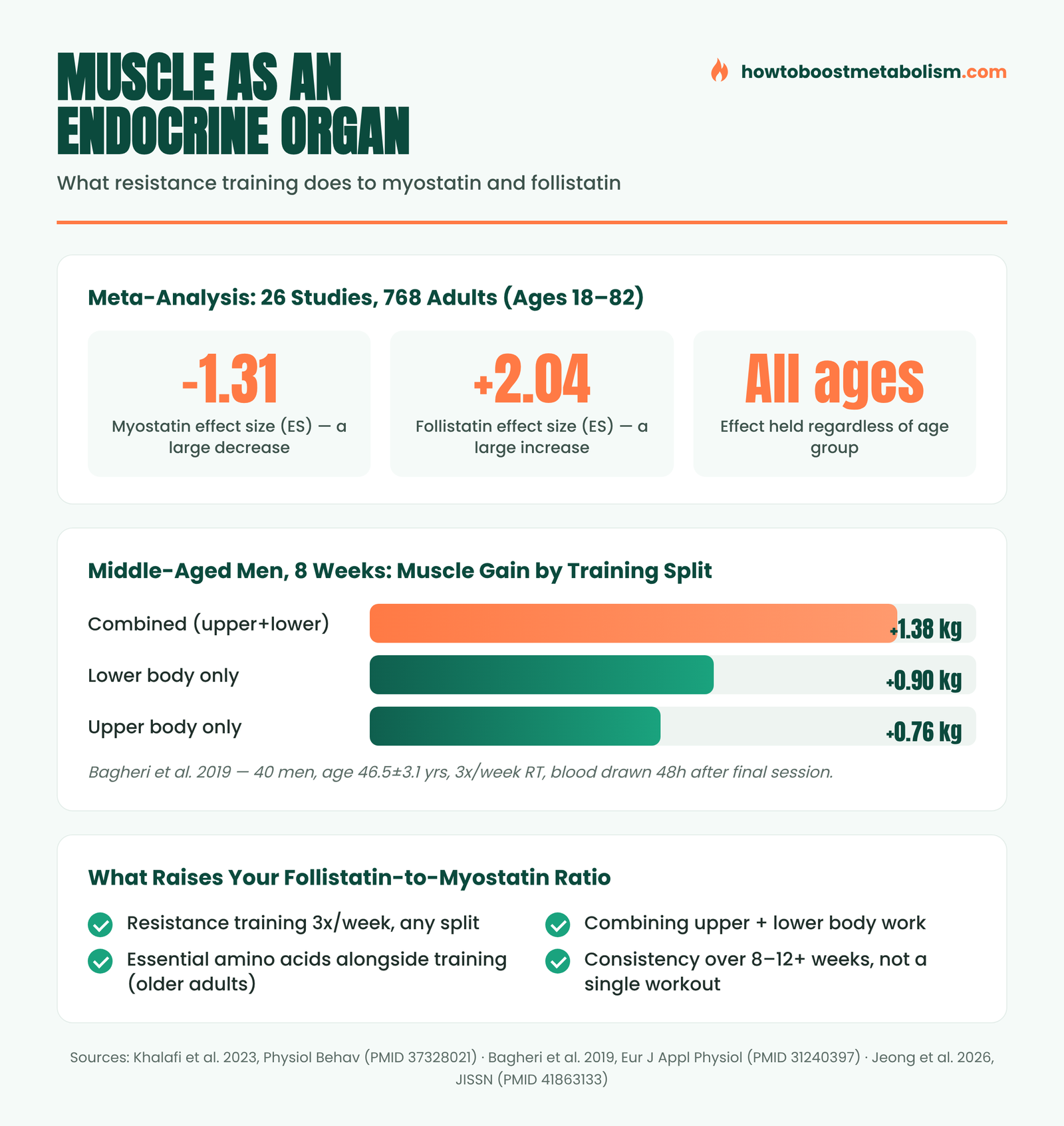
Related: Once you understand how muscle signals the rest of the body, the next practical question is how to tell if you’re actually losing it — see our guide to sarcopenia screening and how to know if you have low muscle mass.
Frequently Asked Questions
What exactly is a myokine?
A myokine is a signaling protein or cytokine released by skeletal muscle in response to contraction. Myokines travel through the bloodstream and act on other tissues — fat, liver, immune cells, and possibly the brain — which is why researchers now describe muscle as functioning like an endocrine organ during and after exercise.
Do myostatin and follistatin levels change after just one workout?
Most of the studies cited here measured changes after weeks of consistent training (8 to 12 weeks), not after a single session. Acute, single-workout changes in these specific hormones are less consistently documented than the adaptations seen from repeated training over time.
Does this mean supplements that claim to ‘block myostatin’ work?
No. The research here is about resistance training’s natural effect on circulating myostatin and follistatin. Over-the-counter supplements marketed as “myostatin inhibitors” (often containing things like epicatechin or follistatin-mimicking peptides) have not shown the same level of controlled, replicated human evidence as resistance training itself, and some health authorities have raised safety concerns about unregulated peptide products specifically.
Is the myostatin/follistatin effect different for men and women?
The 2023 meta-analysis (768 participants) found the myostatin-lowering, follistatin-raising effect held across age groups, and the 2026 trial specifically in women 65 and older found a similar favorable shift. The available data doesn’t point to a meaningfully different direction of effect between sexes, though most individual trials have smaller, mixed-sex or single-sex samples.
How much training is enough to get this effect?
The clearest human data used ordinary programs: three resistance training sessions per week, 8 to 12 weeks, training a substantial amount of muscle mass per week (the combined upper+lower group in the Bagheri trial saw the biggest shift). There’s no evidence in this body of research that more exotic or higher-frequency protocols are required.
This article is for educational purposes and does not constitute medical advice. Myokine research is an active, evolving field; talk to a physician before starting a new exercise program, especially if you have an existing medical condition. See our Medical Disclaimer.