Strength Training and Bone Density in Men After 40
This article may contain affiliate links. If you buy through them, we may earn a small commission at no extra cost to you. See our Affiliate Disclosure and Medical Disclaimer.
Osteoporosis gets framed almost entirely as a women’s health issue, and for good biological reasons — estrogen decline after menopause accelerates bone loss in a way nothing in men’s physiology quite matches. But that framing has a side effect: men with low bone density are diagnosed later, treated less often, and frequently don’t think to ask about it at all. Here’s what the actual resistance-training research shows for men specifically, including one of the only trials to run a full year in men old enough for this to matter most.
Why This Gets Overlooked
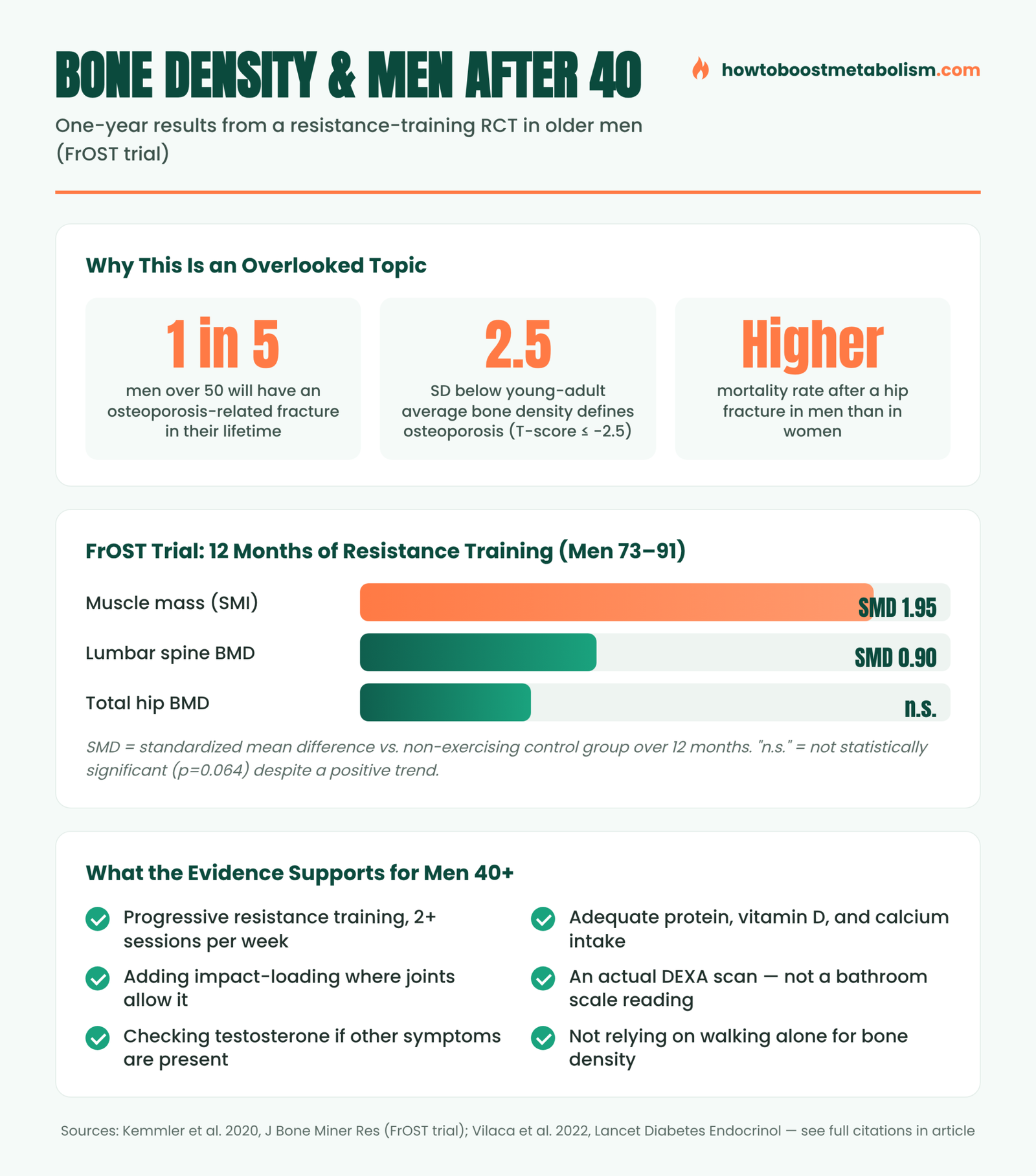
A 2022 review in the Lancet Diabetes & Endocrinology (Vilaca et al., 2022) put it bluntly: “osteoporosis in men is a common but often overlooked disorder by clinicians.” The diagnostic threshold is the same as for women — a bone mineral density (BMD) T-score of −2.5 or lower at the hip or spine, measured by DEXA, compared against a young-adult reference population. Men generally start with bigger, denser bones and lose density more slowly than women do, so they fracture less often overall. But the same review notes something that should change how seriously this gets taken: men have a higher mortality rate after a fracture than women do. A separate 2021 review in the same journal (Rizzoli et al., 2021) puts the lifetime risk at roughly one in five men over 50 experiencing an osteoporotic fracture — a number most men have never heard attached to themselves.
What Two Systematic Reviews Found
A 2013 systematic review in Osteoporosis International (Bolam et al., 2013) pooled eight controlled trials specifically in middle-aged and older men, covering walking, resistance training, resistance plus impact-loading, and resistance plus Tai Chi. The pattern that emerged: walking alone had limited effect on bone density, while resistance training — alone or combined with impact-loading activities — was the most consistently osteogenic (bone-building) intervention. The authors were careful to flag that five of the eight trials scored below 50% on their quality rating scale, so this isn’t a slam-dunk, high-certainty verdict — it’s a consistent pattern across imperfect studies.
A more recent 2023 systematic review in Archives of Rehabilitation Research and Clinical Translation (Hu et al., 2023) screened over 12,000 records down to 13 publications from 6 trials specifically in men with a densitometric diagnosis of osteopenia or osteoporosis. Their conclusion echoed the 2013 review: resistance training was the most effective modality, partly by replacing fat tissue with muscle, with some trials also showing direct bone density improvement. Whole-body vibration and traditional Chinese exercise forms produced only minimal benefit by comparison.
| Exercise type | What the reviews found | Bottom line |
|---|---|---|
| Walking / general aerobic activity | Limited effect on BMD in both reviews | Good for cardiovascular health, not a strong bone-building stimulus alone |
| Resistance training alone | Most consistently osteogenic modality | Best-supported single intervention for men |
| Resistance training + impact-loading | Most effective combination in the 2013 review | Strongest pattern, where joints tolerate it |
| Whole-body vibration / Tai Chi | Minimal benefit in the 2023 review | Not a substitute for resistance training |
Free download
🔥 The Metabolism Starter Kit
3 honest guides: a 7-day reset plan, a foods cheat-sheet and 12 metabolism myths debunked. No spam — unsubscribe anytime.
The Best Single Trial: FrOST, One Year in Men 73–91
The most rigorous individual trial behind these reviews is the Franconian Osteopenia and Sarcopenia Trial, or FrOST (Kemmler et al., 2020, Journal of Bone and Mineral Research). Researchers randomized 43 sedentary community-dwelling men aged 73 to 91, all with osteopenia or osteoporosis plus low muscle mass (osteosarcopenia), to either 12 months of low-volume, high-intensity resistance training on machines twice a week, or a non-exercising control group. Both groups received adequate whey protein, vitamin D, and calcium supplementation, isolating the exercise variable itself.
The results, after one year: lumbar spine bone density was maintained in the exercise group and declined significantly in the control group — a significant between-group difference (SMD 0.90, p<0.001). Skeletal muscle mass index rose in the exercise group and fell in controls, an even larger effect (SMD 1.95, p<0.001). Leg-press strength improved dramatically more in the exercise group (SMD 1.92, p<0.001). Total hip bone density, however, did not differ significantly between groups (p=0.064) — a positive trend that didn’t reach statistical significance, likely in part because the trial only had 43 participants. The training was also notably safe: only 2 dropouts, a 95% attendance rate, and zero training-related injuries over the full year — in men up to 91 years old.
The FrOST trial paired resistance training with protein, vitamin D, and calcium — not training alone. Steve and Becky Holman’s Old School New Body is built around that same combination for the 40-plus crowd: a structured strength program designed to be joint-friendly while still providing the progressive loading stimulus the research above points to for bone and muscle. It’s a general fitness program, not a bone-density treatment, and we’re not presenting the marketing copy’s aging statistics as verified fact — just noting the training approach aligns with what the trials above actually tested.
Learn More →Affiliate link — we may earn a commission at no extra cost to you. Disclosure
Why the Hip Result Matters More Than It Looks Like It Does
It would be easy to read “spine BMD improved, hip BMD didn’t” as resistance training being only half-effective. But hip fractures are the ones most associated with major loss of independence and higher mortality in older adults, which is exactly why that non-significant trend is worth being honest about rather than glossing over. The most likely explanation isn’t that resistance training doesn’t reach the hip — it’s that a single-year trial with 43 participants has limited statistical power to detect a smaller effect at a site that remodels more slowly than the spine. Longer trials, or larger ones, would be needed to say definitively whether hip BMD responds on a similar timeline. Until then, the spine and muscle mass results are the clearest wins; the hip result is a “probably helps, not yet proven at this site” rather than a “doesn’t work.”
What This Looks Like in Practice
None of the trials above used exotic programming. FrOST used machine-based resistance training twice weekly, progressive in intensity, with adequate protein and vitamin D as a baseline. The 2013 and 2023 reviews pointed to the same general pattern across different programs: consistent, progressive resistance work, sometimes paired with impact-loading activities like stair climbing or light jumping where joints tolerate it. None of the research supports relying on walking alone, or on whole-body vibration platforms, as a substitute for actual resistance training if bone density is the goal.
If you want the grip-strength side of this picture — a related, highly trainable marker that correlates with overall skeletal and muscular health — see our breakdowns of grip strength standards by age and sex and why grip strength predicts longevity. If power training interests you specifically for bone health, our piece on plyometric training after 40 covers the impact-loading side of this equation in more depth. And if you’re a woman reading this on behalf of a male partner, our article on strength training and bone density after menopause covers the female-specific version of this same question, including the landmark LIFTMOR trial.
How This Differs From the Women’s Research You May Have Seen
If you’ve read about the landmark LIFTMOR trial — heavy barbell-based lifting dramatically improving bone density in postmenopausal women with osteopenia — it’s tempting to assume the men’s story is identical, just with a different hormone in the background. It isn’t quite. LIFTMOR specifically tested very heavy barbell lifts (deadlifts, overhead presses, back squats) at high intensity, while FrOST used machine-based training at a lower overall volume but higher relative intensity and effort. Women’s bone loss after menopause is driven primarily by a sharp, well-defined drop in estrogen over a few years; men’s bone loss is slower and more gradual, tied more to age-related declines in testosterone, activity level, and overall health over decades rather than one hormonal cliff. That’s part of why men’s bone research lags behind women’s — the “urgent before-and-after” window that makes trials easier to fund and recruit for simply doesn’t exist for men in the same way, even though the long-term risk is real.
Low testosterone does matter for bone health in men, but the FrOST trial didn’t test testosterone supplementation — it tested resistance training with adequate protein, vitamin D, and calcium, full stop. If you’ve had bloodwork showing clinically low testosterone (not just “lower than you’d like”), that’s a separate conversation to have with a doctor; it isn’t something this body of exercise research speaks to directly.
What a Reasonable Starting Week Looks Like
None of the trials above required a complicated split. A practical, research-aligned starting point for a man in his 40s or 50s with no current bone-density diagnosis looks like two to three resistance sessions a week, hitting the major muscle groups and loading the hips and spine specifically — squats or leg presses, deadlifts or hip hinges, rows, and presses — progressing the weight gradually over months rather than weeks. Adding lower-impact loading, like stair climbing, light jumping, or rucking with a weighted pack, fits the “resistance training plus impact-loading” combination the 2013 review flagged as most effective, for those whose joints tolerate it. None of this needs to be extreme: the FrOST participants were in their 70s and 80s, trained twice a week, and had zero training-related injuries over a full year.
Getting an Actual Diagnosis, Not a Guess
A home bathroom scale that estimates “bone mass” through bioelectrical impedance is not a diagnostic tool and shouldn’t be treated as one. The only way to know your actual bone density is a DEXA (dual-energy X-ray absorptiometry) scan, which produces the T-score used in the official diagnostic threshold discussed above. Most men are never screened for this unless they’ve already had a low-trauma fracture, a visible height loss, or a doctor specifically orders it due to risk factors like long-term steroid use, low testosterone, smoking, or heavy alcohol use. If any of those apply to you, bringing up a DEXA scan with your doctor — rather than waiting for a fracture to prompt one — is a reasonable, low-cost step.
It’s also worth noting what a DEXA scan can tell you that a resistance-training program alone can’t: whether you actually have a problem worth addressing in the first place. Starting a progressive resistance program is a reasonable default for general health regardless of bone status — the muscle mass and strength gains in the FrOST trial were larger and more consistent than the bone density changes, and those benefits apply whether or not you have osteopenia. But if a fracture, unexplained height loss, or a strong family history of osteoporosis is part of your picture, a scan turns a vague worry into an actual number you can track over time, the same way the researchers in these trials did.
Free download: our Metabolism Starter Kit — a protein calculator, a 7-day meal framework, and a one-page supplement checklist, with zero hype.
Get the Free Starter Kit →Related: For more on exercise and men’s health screening after 40, see our honest look at strength training and PSA.
Frequently Asked Questions
Does resistance training actually improve bone density in men?
The evidence points that way for the spine specifically. In a one-year randomized trial of men aged 73 to 91 (the FrOST trial), lumbar spine bone density was maintained in the resistance-training group and declined significantly in the non-exercising control group — a statistically significant difference. Total hip bone density showed a positive trend that did not reach statistical significance in that same trial, likely due to the small sample size.
Is osteoporosis really a concern for men, not just women?
Yes, though it’s diagnosed and discussed far less often in men. A 2022 review in the Lancet Diabetes & Endocrinology describes osteoporosis in men as common but frequently overlooked by clinicians, and notes that men have a higher mortality rate after a fracture than women do, even though they fracture less often overall.
What’s the actual diagnostic criteria for osteoporosis in men?
The same as in women: a bone mineral density T-score of −2.5 or lower at the hip or lumbar spine, measured by a DEXA scan and compared to a young-adult reference population. This can only be determined with an actual DEXA scan, not a home scale’s bioelectrical impedance estimate.
Does walking help bone density as much as lifting weights?
Based on two systematic reviews specifically in men, no. Walking and other general aerobic activity showed limited effect on bone mineral density, while resistance training — alone or combined with impact-loading activities — was consistently the most effective modality for bone health in men.
How often do I need to train to see the bone benefits seen in research?
The FrOST trial used resistance training twice a week for 12 months and found significant improvements in spine bone density and muscle mass. That’s a reasonable, well-supported frequency to start with — the trials reviewed here did not test higher frequencies as necessary for a bone-density benefit.