Plantar Fasciitis After 40: Does Strength Training Help?
This article may contain affiliate links. If you buy through them, we may earn a small commission at no extra cost to you. See our Affiliate Disclosure and Medical Disclaimer.
Heel pain that’s sharpest with your first steps out of bed, then eases a little as you walk it off, only to flare up again after you’ve been standing for a while — if that sounds familiar and you’re over 40, you’re in very good company. Plantar fasciitis is one of the most common reasons adults in this age bracket end up searching for answers at 11pm, and the internet is full of stretching routines, frozen water bottles, and $80 night splints. What gets mentioned far less often is that one of the better-designed trials on this condition didn’t test a stretch or a gadget — it tested strength training. Here’s what that trial, and the broader evidence around it, actually found, including the parts that don’t make for a great headline.
| Quick Fact | What the Evidence Shows |
|---|---|
| What it is | Overload injury of the plantar fascia, the thick band of tissue along the bottom of the foot |
| Who it hits hardest | Adults 40–60, especially with higher body weight, limited ankle flexibility, or jobs spent on their feet |
| Best-tested exercise approach | High-load, slow unilateral heel raises (towel under the toes), every other day |
| Honest timeline | Faster improvement by 3 months vs. stretching alone; similar outcomes by 12 months either way |
| What it won’t fix on its own | Obesity, prolonged standing, and stiff ankles — the underlying risk factors keep contributing unless addressed too |
Why Plantar Fasciitis Becomes More Common After 40
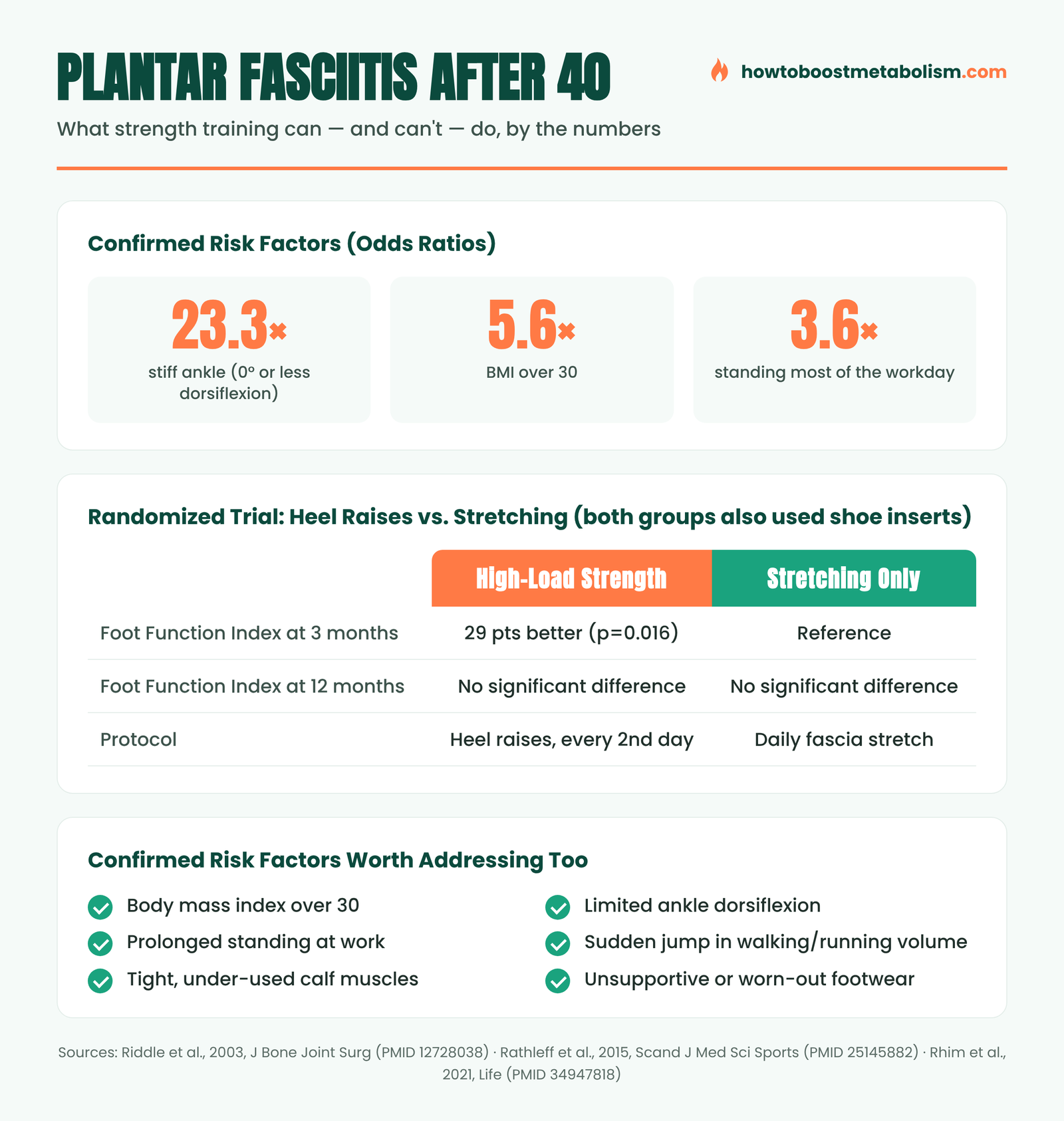
Plantar fasciitis isn’t exclusively a problem of middle age — runners in their 20s get it too — but its prevalence climbs noticeably through the 40s and 50s. A well-known matched case-control study that’s still widely cited in orthopedic literature looked specifically at what separates people who develop plantar fasciitis from people who don’t, using the same age range and sex for comparison so the risk factors it identified weren’t just a proxy for “getting older” (Riddle et al., 2003, Journal of Bone and Joint Surgery). The numbers are striking: people with essentially no ankle dorsiflexion — meaning very limited ability to bring the foot up toward the shin — had an adjusted odds ratio of 23.3 compared with people who had more than 10 degrees of flexibility. A body mass index over 30 carried an odds ratio of 5.6. Spending most of the workday on your feet carried an odds ratio of 3.6.
None of those three risk factors are unique to people over 40, but all three become statistically more common as decades go by: ankles tend to stiffen with less varied movement, body composition tends to shift, and plenty of people in this age bracket are deep into careers that keep them standing — retail, healthcare, teaching, the trades. That combination is a big part of why plantar fasciitis clusters where it does, and it also explains why treatments that only target the fascia itself, without addressing ankle stiffness or the mechanical load it’s under, tend to have mixed track records.
The Study That Changed the Exercise Conversation
For years, the default exercise advice for plantar fasciitis was stretching — calf stretches, towel stretches, rolling a tennis ball under the arch. A randomized controlled trial out of Denmark tested something different: progressive, high-load strength training, using a deceptively simple setup of unilateral heel raises performed with a rolled towel under the toes to bias the load onto the plantar fascia (Rathleff et al., 2015, Scandinavian Journal of Medicine & Science in Sports). Forty-eight patients with ultrasound-confirmed plantar fasciitis were randomized into two groups. Both groups got the same shoe inserts. One group did daily plantar-fascia-specific stretching; the other did the heel-raise protocol every second day, slowly increasing the load over the study period.
At the three-month mark — the trial’s primary endpoint — the strength-training group’s Foot Function Index score was 29 points lower (better) than the stretching group’s, a difference the authors called statistically significant (95% CI: 6–52, p = 0.016). In plain terms: people doing the heel raises reported meaningfully less pain and disability after three months than people doing the stretches, even though both groups were also wearing the same inserts.
Free download
🔥 The Metabolism Starter Kit
3 honest guides: a 7-day reset plan, a foods cheat-sheet and 12 metabolism myths debunked. No spam — unsubscribe anytime.
The Honest Timeline: Faster Relief, Not a Permanent Edge
This is the part that tends to get left out when this study gets summarized into a headline. The advantage for strength training was specific to the three-month checkpoint. At one month, six months, and twelve months, the trial found no statistically significant difference between the two groups (p > 0.34 at every later follow-up). By twelve months, the strength group’s average Foot Function Index was 22 (95% CI: 9–36) and the stretching group’s was 16 (95% CI: 0–32) — overlapping ranges, not a clear winner.
So the honest summary isn’t “strength training cures plantar fasciitis and stretching doesn’t.” It’s closer to: a simple, progressive loading protocol seems to get people feeling noticeably better sooner than stretching alone, but over the course of a full year, both approaches tend to land in a similar place. If you’re the kind of person who wants faster relief and doesn’t mind a bit more effort up front, that three-month head start is a meaningful, real finding. If you’re someone who finds stretching easier to stick with consistently, the twelve-month data suggests you’re not giving up much by choosing it instead.
What We Still Don’t Know
It’s worth being upfront about the limits of this evidence, because plantar fasciitis research as a field has acknowledged gaps. A 2021 review that specifically set out to summarize every systematic review and meta-analysis published on plantar fasciitis up to that point — 96 reviews in total, covering epidemiology, diagnosis, and treatment — concluded that “evidence on topics such as … exercise therapy … for treatment options for plantar fasciitis are lacking and warrant future research” (Rhim et al., 2021, Life (Basel)). The same review did find consistent agreement across the literature on two things: that a higher body mass index is a real risk factor, and that extracorporeal shockwave therapy has decent evidence behind it as a treatment — which is useful context if conservative loading exercise alone isn’t moving the needle for you after several weeks.
What this means practically is that the Rathleff trial, good as it is, is a single trial of 48 people. It’s one of the better-designed pieces of evidence specifically comparing an exercise approach to another exercise approach, which is exactly why it gets cited so often — but “the best study we have” and “a large, settled body of evidence” are two different things. Treat the heel-raise protocol as a reasonable, low-cost, low-risk first option worth trying for several weeks, not as a guaranteed fix.
A Practical, Low-Risk Protocol to Try
If you want to replicate the general structure of the trial above (this is general information, not personalized medical advice — see a physical therapist if pain is severe, worsening, or not improving after 3–4 weeks):
- Stand on the affected foot with a rolled towel under your toes so your toes are slightly extended upward.
- Rise onto the ball of that foot slowly (about a 3-second lift), pause briefly at the top, then lower slowly (about a 3-second descent).
- Hold onto something for balance if needed — this is about loading the fascia and calf, not testing your balance.
- Start with body weight only, aiming for a set of 8–12 controlled reps, done every other day (not daily — the tissue needs recovery time between sessions).
- Add load gradually over several weeks (a backpack, a weighted vest, or a dumbbell held on the same side) once body-weight reps feel clearly manageable.
- Pair it with your usual shoe inserts if you use them, and keep doing it consistently for at least 8–12 weeks before judging whether it’s helping.
Addressing the underlying risk factors at the same time — working on ankle dorsiflexion with simple wall-based ankle stretches, and if relevant, working toward a lower body weight — is where the Riddle data suggests the bigger long-term payoff actually lives, even though it’s less exciting than a single named exercise.
When to See a Professional Instead of DIY-ing It
- Pain that’s severe, sudden in onset, or came with a specific injury (a possible fascia tear needs different management than overuse).
- Numbness, tingling, or pain that radiates — this can point to a nerve issue rather than plain plantar fasciitis.
- No improvement at all after 4–6 weeks of a consistent loading program plus inserts.
- You have diabetes, peripheral neuropathy, or circulation problems, where self-managing foot pain carries more risk.
- You’re considering a cortisone injection or shockwave therapy — both have evidence behind them but are decisions worth making with a clinician, not from a blog post.
Common Mistakes People Make With Plantar Fasciitis After 40
- Doing a single stretch or exercise for a week, feeling no change, and giving up — the trial above ran for months, not days.
- Pushing through sharp pain during the heel-raise protocol instead of backing off the load — discomfort is expected, sharp pain is not.
- Ignoring ankle stiffness and body weight entirely while focusing only on the foot itself, even though both were independently linked to risk in the case-control data.
- Jumping straight back into running or high-impact training the moment pain eases, rather than ramping volume back up gradually.
- Assuming new shoes alone will solve it, when the actual trial used inserts as a baseline for both groups and tested exercise as an addition on top.
Free download: our Metabolism Starter Kit — a protein calculator, a 7-day meal framework, and a one-page supplement checklist, with zero hype.
Get the Free Starter Kit →Carrying extra weight is one of the two strongest, independently confirmed risk factors for plantar fasciitis in the research above — right alongside stiff ankles. If sustainable weight management is part of your plan alongside the exercises, The Mediterranean Diet is a structured, quiz-based eating plan built around a dietary pattern with a strong overall track record for weight and metabolic health (not foot pain specifically — no plan can promise that). Heads up: it includes a recurring subscription charge after the initial plan, so check the pricing terms before you start.
See the Plan →Affiliate link — we may earn a commission at no extra cost to you. Disclosure
Related Reading
If tendon and connective-tissue health in general is on your radar, our breakdown of eccentric training for tendon health after 40 covers a closely related loading strategy used for Achilles and patellar tendon issues. For the recovery side of things, see our guide to foam rolling and recovery after 40, and if walking volume is part of your routine, our piece on how many steps per day make sense after 50 covers how to build volume back up without overloading healing tissue.
Frequently Asked Questions
Is plantar fasciitis caused by weak muscles?
Not exactly. Plantar fasciitis is an overload injury of the connective tissue (the plantar fascia) that runs along the bottom of your foot, not a muscle tear. But the muscles and tendons around it — your calves, your foot’s intrinsic muscles, your Achilles — all share the load with that fascia. When those structures are weak or stiff, the fascia absorbs more strain than it’s built for. That’s the logic behind using strength training as treatment: it’s not about building a bigger muscle, it’s about sharing the workload more evenly.
How long does plantar fasciitis take to heal with exercise?
In the randomized trial discussed above, the strength-training group reported meaningfully better function at 3 months than the stretching group. But by 6 and 12 months, both groups had improved to a similar degree. A realistic expectation is weeks to a few months for a noticeable change, and up to a year for the kind of full, stable resolution most people are hoping for — regardless of which specific exercise approach you use.
Can I keep strength training my whole body while I have plantar fasciitis?
In most cases, yes, with modifications. Upper-body work, seated or machine-based lower-body work, and non-impact cardio are usually fine. The exercises to modify or pause are the ones that load the foot directly under high impact or repeated stretch — running, jumping, and in some cases heavy standing calf raises until the acute pain settles. This is exactly the kind of judgment call a physical therapist can help you make quickly rather than by trial and error.
Do I need new shoes or orthotics, or is exercise enough?
The research base on inserts is actually larger than the research base on exercise alone, and the trial we cite used shoe inserts in BOTH groups — strength training was tested as an addition, not a replacement. If you have access to an over-the-counter insert or a podiatrist-fitted orthotic, using one alongside a loading exercise, rather than instead of it, matches what’s actually been studied.
Is it safe to start the heel-raise protocol on my own after 40?
For most otherwise-healthy adults, a slow, pain-guided progression of unilateral heel raises is low-risk. The usual self-check is: some discomfort during the exercise is acceptable if it settles within 24 hours and doesn’t get worse week over week; sharp pain, swelling, or pain that lingers into the next day is a signal to back off and get it checked, particularly if you have diabetes, nerve issues in your feet, or a prior Achilles injury.
This article is for general educational purposes and is not a substitute for personalized medical advice. See our Medical Disclaimer for more information.