Vitamin B12, Metabolism & Fatigue After 40
This article may contain affiliate links. If you buy through them, we may earn a small commission at no extra cost to you. See our Affiliate Disclosure and Medical Disclaimer.
If you’ve spent months doing everything “right” — eating reasonably, moving regularly, sleeping enough — and you’re still dragging through most afternoons, it’s worth asking a question that gets far less attention than carbs, cortisol, or calorie counting: is your body actually getting enough vitamin B12? It’s not a trendy supplement story, and it won’t “boost your metabolism” the way some marketing pages imply. But a real, common, and fixable deficiency can absolutely make you feel like your metabolism has stalled, especially after 40.
What B12 Actually Does (and Doesn’t Do)
Vitamin B12 (cobalamin) is required for making red blood cells, maintaining the protective coating around nerves, and supporting the enzymatic reactions that convert food into usable cellular energy. None of that is the same thing as “revving up” your metabolic rate the way a stimulant or a miracle-tonic sales page might imply. If you’re not deficient, taking more B12 than you need won’t give you extra energy on top of what you already have — the research on B12 supplementation in people with normal levels simply doesn’t show that effect.
What B12 deficiency does reliably cause is fatigue, and fatigue is very good at masquerading as a slow metabolism. If you’re tired enough, you move less, you’re less motivated to resistance train, and your resting energy expenditure can genuinely drop simply because you’re less active overall — a very different causal chain than the direct “this nutrient speeds up your metabolism” story that gets sold.
Why This Becomes More Relevant After 40
Absorption gets harder with age, not just intake
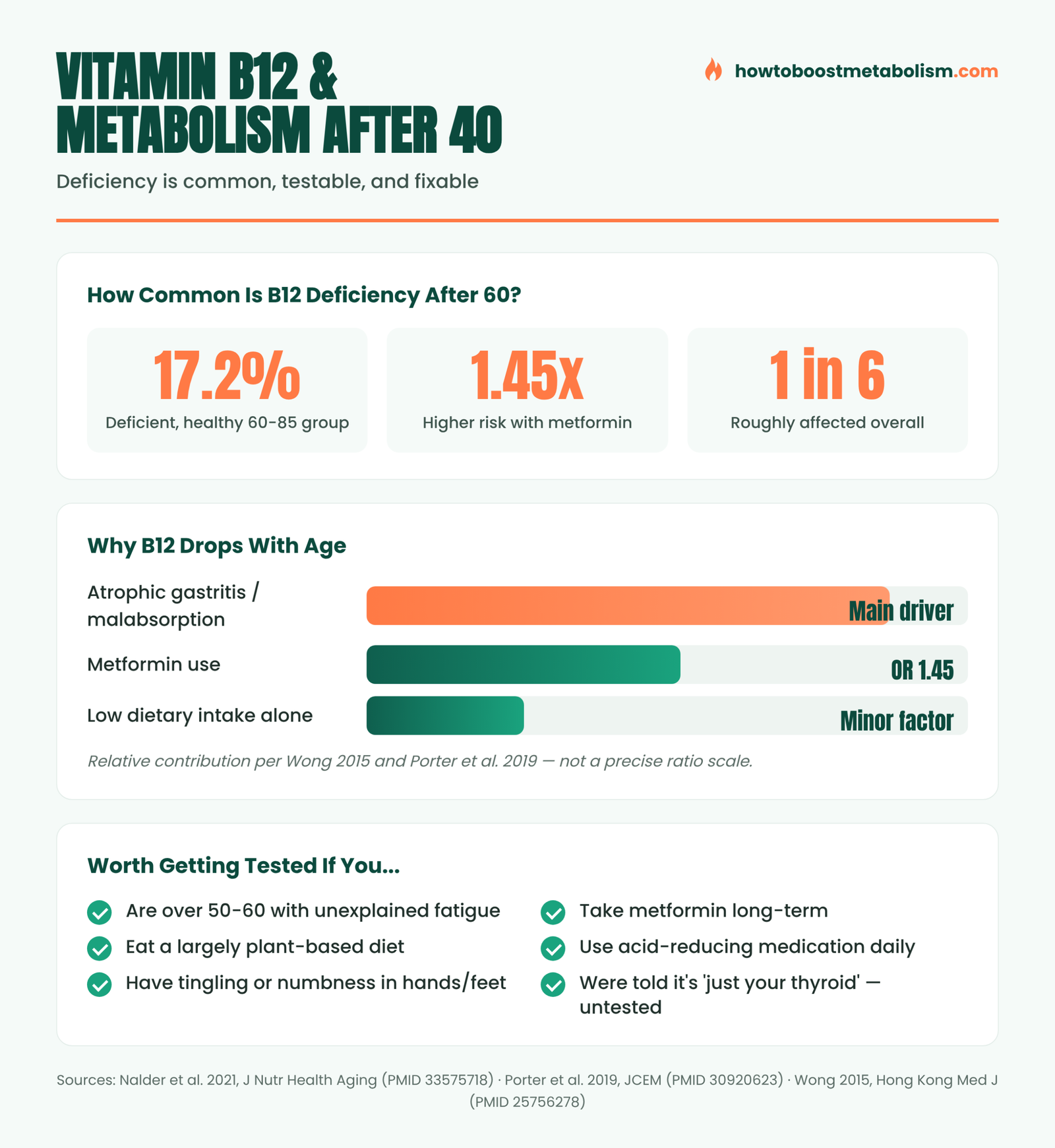
B12 absorption from food requires adequate stomach acid and a protein called intrinsic factor. A detailed review on B12 deficiency in older adults explains that the dominant cause of deficiency in this age group isn’t usually inadequate dietary intake — it’s atrophic gastritis, an age-related decline in stomach acid production that impairs the release of B12 from food even when you’re eating plenty of it, alongside a rising prevalence of pernicious anemia with age (Wong, 2015, Hong Kong Med J). This is exactly why someone can eat a diet that looks nutritionally fine on paper and still become deficient over time.
Metformin adds a second, well-documented risk factor
If you’re managing type 2 diabetes or prediabetes with metformin, there’s a second mechanism worth knowing about. A large cohort study of over 4,100 community-dwelling older adults found that metformin use was associated with meaningfully higher odds of B12 deficiency (odds ratio 1.45, 95% CI 1.03 to 2.02) and B6 deficiency, and — more strikingly — that metformin use was independently associated with worse performance on two separate cognitive assessments, a relationship the researchers suggest B vitamin depletion may partly explain (Porter et al., 2019, J Clin Endocrinol Metab). Importantly, the same study found that regularly eating B-vitamin-fortified foods helped offset this risk even in people with hyperglycemia — this is a manageable interaction, not a reason to stop a prescribed medication without talking to your doctor.
It’s genuinely common — not a rare edge case
A cross-sectional study of nearly 2,000 cognitively healthy adults aged 60-85 found B12 deficiency (defined as under 148 pmol/L) in 17.2% of participants — close to one in six — and linked low B12 specifically to poorer memory performance in men, with elevated homocysteine and methylmalonic acid (byproducts that build up when B12 is low) associated with worse scores on attention and memory testing more broadly (Nalder et al., 2021, J Nutr Health Aging). This wasn’t a study of people who were already sick or malnourished — it was a general sample of healthy older adults, which is exactly the point: deficiency at this scale is easy to miss because it doesn’t announce itself dramatically.
| Measure | Finding | Source |
|---|---|---|
| General population prevalence (60-85, cognitively healthy) | 17.2% | Nalder et al. 2021 |
| Metformin users, risk vs. non-users | OR 1.45 (95% CI 1.03-2.02) | Porter et al. 2019 |
| Main driver of deficiency in older adults | Atrophic gastritis / malabsorption, not just low intake | Wong 2015 |
| Typical oral repletion dose (diagnosed deficiency) | ~1 mg/day for 1 month, then maintenance | Wong 2015 |
Free download
🔥 The Metabolism Starter Kit
3 honest guides: a 7-day reset plan, a foods cheat-sheet and 12 metabolism myths debunked. No spam — unsubscribe anytime.
Who Should Actually Get Tested
- Anyone over 50-60 with unexplained fatigue, brain fog, tingling or numbness in the hands or feet, or balance changes.
- Long-term metformin users, especially if you haven’t had B12 checked in the past year or two.
- Anyone following a largely plant-based or vegan eating pattern without consistent B12 supplementation or fortified foods — see our related coverage of boosting metabolism on a vegan diet and metabolism foods for vegetarians for more on the nutrient gaps that plant-forward eating patterns need to plan around.
- Anyone on long-term acid-reducing medication (proton pump inhibitors or H2 blockers), since stomach acid is part of how B12 gets released from food in the first place.
- Anyone whose fatigue has been attributed to a thyroid issue without B12 ever being checked — the symptoms genuinely overlap, which is part of what makes our broader guide to metabolism and hypothyroidism worth reading alongside this one if fatigue is your main complaint.
The one thing every source above agrees on: this needs an actual blood test, not a guess based on symptoms. Fatigue has dozens of plausible causes, including the kind of iron and ferritin issues we cover in iron, ferritin, and exercise performance after 40 — B12 is one specific, testable, and very fixable piece of that broader picture, not an automatic explanation for every tired afternoon.
What Actually Helps Once Deficiency Is Confirmed
Treatment is genuinely one of the more reassuring parts of this topic. The review on screening mentioned above describes oral B12 replacement working about as well as injections for most people — including many with pernicious anemia, which used to be treated almost exclusively with shots — typically starting around 1 mg (1,000 mcg) daily for the first month, then stepping down to a lower maintenance dose (Wong, 2015). B12 is water-soluble, meaning your body excretes what it doesn’t use, and it’s considered to carry a wide safety margin even at doses well above the standard daily requirement.
None of this means supplementing B12 “just in case” is a shortcut to more energy if your levels are already normal — the deficiency research above is specifically about people who tested low, not a general population taking extra B12 for an energy boost. If fatigue is your main concern and you haven’t had this checked, that blood test is a more useful next step than adding another bottle to your supplement shelf on a guess.
Food Sources Worth Knowing, Even If You End Up Needing a Supplement
B12 occurs naturally almost exclusively in animal-derived foods, which is one reason absorption problems and plant-forward eating patterns both show up repeatedly in the deficiency research above. Useful sources and roughly how they compare per typical serving:
| Food | Approx. B12 per serving | Practical note |
|---|---|---|
| Clams, cooked (3 oz) | ~84 mcg | Far above daily need; occasional servings go a long way |
| Beef liver (3 oz) | ~70 mcg | Very concentrated source if you eat organ meat |
| Salmon, cooked (3 oz) | ~2.6 mcg | Solid everyday source for regular fish eaters |
| Plain yogurt (1 cup) | ~1.1 mcg | Easy, frequent small contribution |
| Large egg | ~0.6 mcg | Modest but adds up across a few eggs a week |
| Fortified breakfast cereal (1 serving) | Varies, often 1.5-6 mcg | The main reliable source for vegans without supplements |
The adult Recommended Dietary Allowance is 2.4 mcg per day, so on paper even modest intake from animal foods covers it comfortably. The research above is really about two separate groups for whom intake isn’t the bottleneck: people who don’t eat enough B12-containing foods to begin with (largely plant-based eaters without fortification or supplements), and people who eat plenty but can’t absorb it efficiently because of age-related stomach changes or a medication interaction. Diet changes help the first group far more directly than the second.
Distinguishing This From Other Common Causes of “Low Energy” After 40
B12 deficiency is one specific, testable explanation for fatigue — not the default explanation for every tired week. Sleep debt, iron deficiency, thyroid dysfunction, depression, and simply under-eating protein or total calories while trying to lose weight can all produce a near-identical feeling of low energy and mental fog. This is exactly why the recommendation throughout this article is a blood panel, not a single supplement bought on a hunch — a clinician ordering a basic metabolic and nutrient panel can usually tell within one visit whether B12 is actually part of the picture, rule out or confirm the other common culprits at the same time, and save you months of guessing.
Where Diet Fits — and Where It Doesn’t
If your deficiency risk is more about intake than absorption — a largely plant-based eater without supplementation being the clearest example — shifting toward a nutrient-dense eating pattern with reliable B12 sources (fortified foods, dairy, eggs, or a dedicated supplement) genuinely helps close the gap. If your risk is mainly age-related malabsorption or a metformin interaction, diet alone usually isn’t enough to fix it — supplementation or medical guidance becomes the more relevant lever, regardless of how well-structured your meals otherwise are.
A consistent, nutrient-dense eating pattern won’t fix an absorption problem on its own, but it removes dietary gaps as a contributing factor and supports overall energy and metabolic health alongside any treatment your doctor recommends. The Mediterranean Diet plan is a structured way to build that kind of pattern without starting from a blank page. (Heads up: this program includes a recurring subscription charge after the initial plan — check the pricing terms before you sign up.)
Check the Plan →Affiliate link — we may earn a commission at no extra cost to you. Disclosure
Free download: our Metabolism Starter Kit — a protein calculator, a 7-day meal framework, and a one-page supplement checklist, with zero hype.
Get the Free Starter Kit →Related: Fatigue and brain fog aren’t always a B12 issue — we also looked at whether lifting weights itself measurably affects brain health after 40.
Related: Fatigue and lab markers both get confusing after a hard training block — our article on why resistance training can push AST and ALT above the normal range covers a related diagnostic mix-up worth knowing about.
Frequently Asked Questions
Does vitamin B12 deficiency actually slow down metabolism?
Not in the sense of lowering your calorie burn directly — B12 isn’t a fat-burning nutrient and no credible research supports marketing claims that it “boosts metabolism” on its own. What it does is support the cellular machinery (energy production, red blood cell formation, nerve function) that makes you feel energetic enough to move, exercise, and build muscle in the first place. Low B12 producing fatigue, brain fog, and low motivation can easily look and feel like a “slow metabolism” even though the mechanism is different.
Who’s actually at risk for B12 deficiency after 40?
Several overlapping groups: people over 50-60 (due to naturally declining stomach acid and a condition called atrophic gastritis that impairs absorption from food), anyone on long-term metformin for type 2 diabetes, people on acid-reducing medications, and anyone eating a largely plant-based diet without B12 supplementation or fortified foods, since B12 occurs naturally almost exclusively in animal products.
I take metformin — should I be worried about B12?
It’s worth discussing with your doctor rather than worrying alone. A large cohort study of older adults found metformin use was associated with a meaningfully higher risk of B12 deficiency, and that this deficiency was independently linked with worse cognitive test performance. Many diabetes care guidelines already recommend periodic B12 monitoring for long-term metformin users for exactly this reason — it’s a known, manageable interaction, not a reason to stop a prescribed medication on your own.
What are the actual symptoms of B12 deficiency, and how is it diagnosed?
Symptoms are notoriously vague and easy to blame on something else — fatigue, brain fog, tingling or numbness in the hands or feet, balance problems, and mood changes. Diagnosis isn’t perfectly straightforward either: a review on screening in older adults notes that serum B12 cutoffs have real limitations, and that homocysteine or methylmalonic acid blood tests are more sensitive but aren’t perfectly standardized either. The practical takeaway is that this requires an actual blood test ordered by a clinician, not guesswork from symptoms alone.
How much B12 do I actually need, and can I get too much?
The same review on screening in older adults describes a typical treatment approach of around 1 mg (1,000 mcg) of oral B12 daily for the first month in diagnosed deficiency, then a lower maintenance dose — and notes that oral dosing can work as well as injections for most people, including many with pernicious anemia. B12 is water-soluble and considered to have a strong safety margin with minimal toxicity risk even at high doses, but “how much you need” is still a question for bloodwork and a clinician, not a flat number that applies to everyone.