Trap Bar vs. Barbell Deadlift After 40: Which Wins?
This article may contain affiliate links. If you buy through them, we may earn a small commission at no extra cost to you. See our Affiliate Disclosure and Medical Disclaimer.
Walk into almost any gym after 40 and you’ll see this exact debate playing out at the rack: pick up the straight barbell for a conventional deadlift, or step inside the hexagonal “trap bar” and pull from there instead. Both are loaded hip-hinge exercises that build real strength, but they are not biomechanically identical — and the differences are big enough that, after 40, they can matter for your lower back, your knees, and how much weight you can actually move. Two separate research teams have put both bars under a force plate and EMG electrodes to find out exactly what changes. Here’s what they found, and how to use it.
What Actually Changes When You Step Inside the Frame
A straight barbell sits in front of your shins, which pulls your center of mass slightly forward and forces your torso into a more pronounced forward lean to keep the bar over your mid-foot. A trap (hex) bar surrounds you, so the load sits directly in line with your hips rather than out in front of them. That single geometry change does three things at once: it shortens the lever arm between the weight and your lower back, it lets your torso stay more upright, and it shifts your hand position from a mixed or double-overhand grip in front of your thighs to a neutral, hip-level grip. None of that makes one bar “better” by default — it just changes which joints absorb the work, which is exactly what the research below measured directly instead of guessing.
The Research: Hex Bar vs. Straight Bar, Head to Head
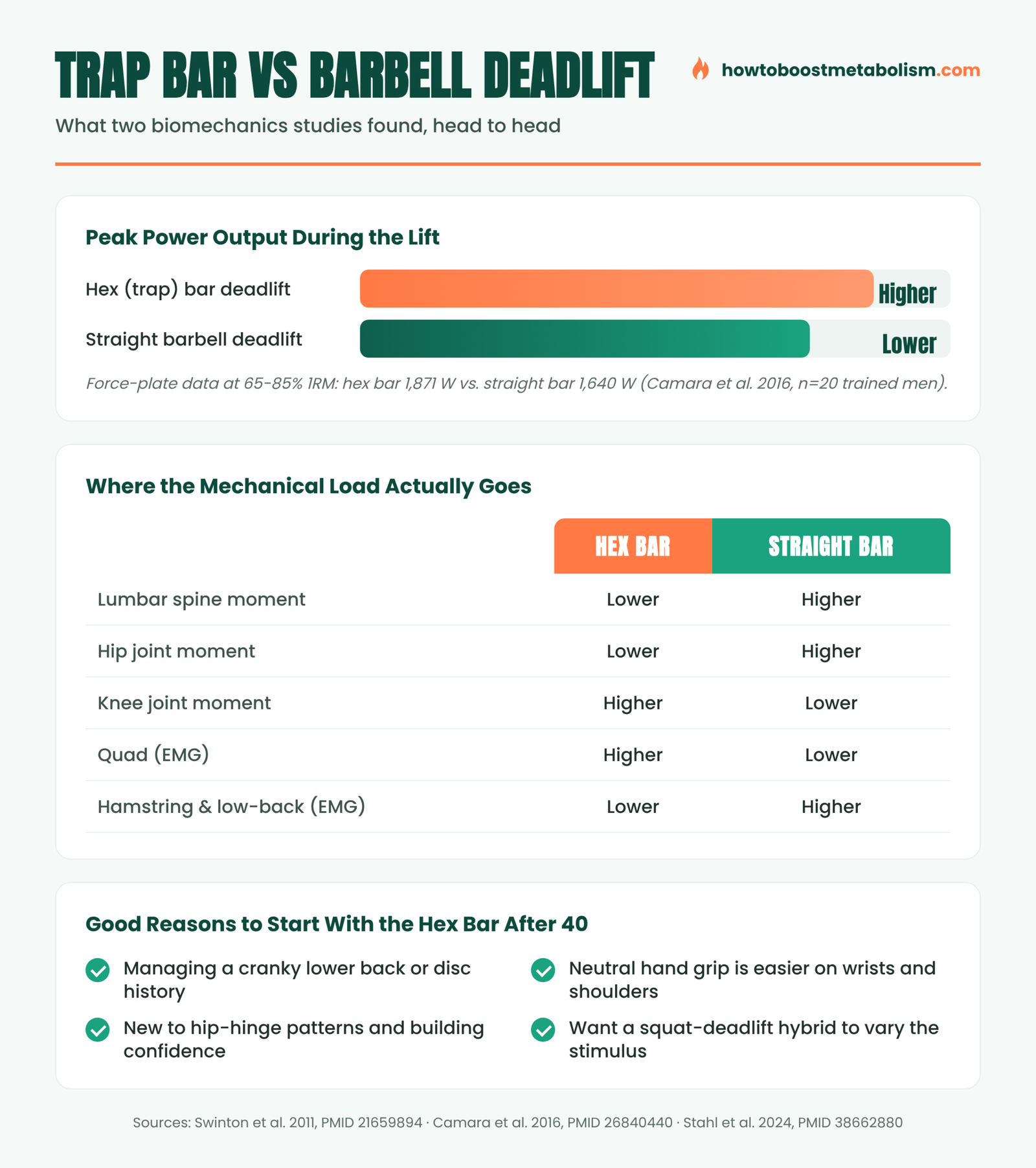
The most cited comparison comes from Swinton and colleagues (2011), who had 19 competitive powerlifters perform both lifts across a range of submaximal loads (PMID 21659894). The headline finding: these lifters could move more weight with the hex bar than the straight bar (265 ± 41 kg vs. 245 ± 39 kg for a 1-rep max, p < 0.05). More relevant for anyone managing an aging back, the hex bar also produced significantly lower peak moments — essentially, lower mechanical stress — at the lumbar spine, hip, and ankle, while the moment at the knee went up. Peak power was higher with the hex bar across the board (roughly 4,872 W vs. 4,388 W at maximal loads).
A second study by Camara and colleagues (2016) tested 20 men with deadlifting experience using surface EMG at the quadriceps, hamstrings, and erector spinae (PMID 26840440). Here, the two bars produced statistically identical 1-rep maxes (181.4 kg vs. 181.1 kg) — a genuinely different result from Swinton’s powerlifters, and a useful reminder that “the hex bar lets you lift more weight” isn’t a universal law, it depends on the lifter and the load range tested. What Camara’s team did confirm consistently: the hex bar produced significantly greater quadriceps activation during both the lifting and lowering phases, while the straight bar produced significantly greater hamstring and lower-back (erector spinae) activation. The hex bar also produced higher peak force, power, and bar velocity at every load tested.
Where the Load Actually Goes
Put plainly: the straight barbell asks more of your hips and lower back, while the hex bar asks more of your quads and knees. If your training priority is building the specific hip-hinge strength you’d use to lift a heavy box off the floor, the straight bar trains that pattern more directly. If you’re trying to get strong through a hip-hinge movement while deliberately reducing spinal loading — a common goal after a back injury, a disc flare-up, or just general caution about lumbar wear and tear — the hex bar’s lower spinal moment is the more useful data point of the two studies.
Free download
🔥 The Metabolism Starter Kit
3 honest guides: a 7-day reset plan, a foods cheat-sheet and 12 metabolism myths debunked. No spam — unsubscribe anytime.
How the Trap Bar Deadlift Compares to the Squat
A newer study helps explain why the hex bar deadlift often feels closer to a squat than a conventional deadlift. Stahl and colleagues (2024) directly compared the hex bar deadlift to the back squat (PMID 38662880) and found that bar design and position create a more balanced moment arm at the hip and knee during the hex bar lift, whereas the back squat is a more hip-dominant exercise. In their words, the two exercises are biomechanically distinct enough to program deliberately rather than treat as interchangeable — but the hex bar deadlift sits in a middle ground between a conventional deadlift and a squat, which is exactly why some coaches use it as a bridge exercise for lifters who struggle with either pattern alone.
| At a Glance | Hex (Trap) Bar | Straight Barbell |
|---|---|---|
| Hand position | Neutral grip, at the hip | Mixed/overhand grip, in front of shins |
| Torso angle | More upright | More forward lean |
| Spinal demand | Lower peak lumbar moment | Higher peak lumbar moment |
| Knee demand | Higher — more quad involvement | Lower — more hip/hamstring involvement |
| Peak power & velocity | Generally higher | Generally lower |
| Learning curve | Easier for most beginners | Requires more hip-hinge technique work |
| Equipment access | Less common in commercial gyms | Available almost everywhere |
Why This Trade-Off Matters More After 40
None of this means the straight bar deadlift is dangerous or that everyone over 40 should abandon it — plenty of lifters in their 40s, 50s, and beyond deadlift conventionally for decades without issue, and the hip-hinge pattern itself is valuable for everyday function (picking things up off the floor, loading groceries, playing with grandkids). What changes with age is tolerance for cumulative spinal loading and the cost of a setback: a tweaked back at 28 might cost you a week; the same tweak at 48 can cost you a month of training momentum, which is a real setback if you’re also trying to preserve muscle mass and bone density. That’s the practical argument for having both tools available rather than picking a permanent side: use the hex bar on weeks when your back feels cranky or when you want to push loads and power output, and keep the straight bar in rotation to maintain the specific hip-hinge strength and grip demands that a true deadlift trains.
This is also where grip and bracing come in. A neutral trap-bar grip is noticeably easier on the wrists and forearms than a mixed-grip straight bar pull, which is one reason lifters managing grip fatigue or wrist discomfort often gravitate toward it. If heavy straight-bar pulls are already part of your plan, pairing them with the right support gear — covered in our breakdown of lifting belts for safety and performance after 40 — matters more than the bar you choose.
Who Should Choose Which
A simple way to decide, based on what the research actually measured rather than gym folklore:
- New to deadlifting, or over 40 and starting strength training from scratch: start with the hex bar. The more upright torso and lower spinal demand make the learning curve more forgiving.
- Managing a lower-back history, disc issue, or general lumbar caution: the hex bar’s lower peak lumbar moment (Swinton et al.) makes it the more conservative choice.
- Training specifically for hip-hinge strength, grip, or a sport that demands it: the straight bar trains the pattern you’ll actually use, and keeps hamstring and erector spinae strength from becoming the weak link.
- Chasing more power output or trying to move heavier loads safely: both studies found higher peak force, power, and velocity with the hex bar — a reasonable case for using it on top-set days.
- Already strong in one pattern but weak in the other: that’s the clearest sign to program both across the week rather than defaulting to the one that feels easiest.
How to Program Either One Safely After 40
Treat whichever bar you choose as a skill, not just a weight to load up. Warm up with several progressively heavier sets before touching your working weight, brace your core before every rep rather than only on the heavy ones, and stop a set the moment your lower back rounds instead of staying rigid — technique breakdown, not muscle fatigue, is what turns a deadlift into an injury. A sensible starting structure for most lifters over 40 is 3-4 sets of 5-8 reps, one to two times per week, leaving at least one clear rest day between heavy pulling sessions. If you’re alternating bars, don’t do both as maximal efforts in the same week — use one as your primary lift and the other as a lighter technique or power-focused accessory.
If your knees are the limiting factor rather than your back — which can happen with the hex bar’s higher knee demand — our guide to knee sleeves for squatting after 40 covers what actually helps versus what’s just marketing. And if grip strength is the thing giving out before your legs or back do on either lift, grip strength is worth training on its own — it’s one of the more trainable markers linked to long-term function.
Common Mistakes People Make With Both Lifts
- Letting the hips shoot up first on either lift, turning it into a stiff-legged pull that overloads the lower back instead of sharing the work with the legs.
- Starting the hex bar too far from “neutral” — standing in the back of the frame turns it into a more squat-dominant movement, standing too far forward turns it into more of a straight-bar pull.
- Using the straight bar’s higher power numbers from these studies as a reason to always chase 1-rep maxes; both studies used submaximal-to-maximal loads in controlled settings, not an invitation to max out weekly.
- Ignoring grip as a separate variable — switching bars for comfort while still using straps on every set defeats one of the main benefits (see our breakdown of carries vs. deadlifts for grip and spinal loading).
- Comparing yourself to someone else’s bar preference instead of your own back, knees, and goals — the research above shows real trade-offs, not a universally “better” option.
If what you actually want is a complete, structured strength program built for lifters over 40 — not just one exercise swap — Old School New Body’s F4X method lays out a full progression using exactly this kind of compound-lift thinking. (Note: some of the before/after claims on that program’s sales page aren’t backed by cited research, so treat the marketing copy skeptically and judge it on the training structure itself.)
Check Availability →Affiliate link — we may earn a commission at no extra cost to you. Disclosure
Free download: our Metabolism Starter Kit — a protein calculator, a 7-day meal framework, and a one-page supplement checklist, with zero hype.
Get the Free Starter Kit →At a Glance: What the Evidence Actually Supports
Across both biomechanics studies, two findings replicated consistently: the hex bar produces a lower peak lumbar spine moment than the straight bar, and the hex bar produces higher peak force, power, and bar velocity at comparable loads. The one finding that did not replicate was whether the hex bar lets you lift more weight — Swinton’s powerlifters pulled more with the hex bar, Camara’s recreational lifters pulled the same amount with either. Neither bar was shown to be unsafe; they were shown to distribute load differently, which is the actual decision-relevant information for someone training after 40.
Related: If you’re comparing deadlift variations, see our biomechanics breakdown in Sumo vs. Conventional Deadlift After 40.
Frequently Asked Questions
Is the trap bar deadlift easier than the barbell deadlift?
It’s generally more forgiving for beginners because the more upright torso and neutral grip reduce the technical demands on the lower back, but “easier” doesn’t mean lighter — research shows lifters often produce more force, power, and bar velocity with the hex bar, not less.
Which deadlift is better for a bad back after 40?
Based on Swinton et al. (2011), the hex bar produced a lower peak lumbar spine moment than the straight barbell, which is why many coaches recommend it first for lifters managing lower-back sensitivity. That said, this is biomechanical data from a controlled study, not personalized medical advice — check with a doctor or physical therapist if you have an existing back condition.
Does the trap bar deadlift build the same muscles as the barbell deadlift?
Mostly the same muscle groups, but in different proportions. Camara et al. (2016) found significantly greater quadriceps activation with the hex bar and significantly greater hamstring and erector spinae (lower back) activation with the straight bar.
Can I just switch to the trap bar and skip the barbell deadlift entirely?
You can, and many lifters do well training the hex bar exclusively. The trade-off is that you’ll do less direct work for your hamstrings and spinal erectors, and you won’t build the specific mixed-grip, forward-leaning hip-hinge pattern the straight bar trains — which matters if you have a sport or job that demands that exact movement.
How much weight should a beginner over 40 start with on either lift?
Start with an empty or lightly loaded bar and spend several sessions on form before adding meaningful weight. There’s no universal starting number because it depends entirely on your current strength and hip-hinge technique — a qualified coach or physical therapist can assess your form in person far more reliably than any online guide.