Zinc and Magnesium for Sleep: Does Timing Actually Matter?
This article may contain affiliate links. If you buy through them, we may earn a small commission at no extra cost to you. See our Affiliate Disclosure and Medical Disclaimer.
ZMA — a combination of zinc monomethionine aspartate, magnesium aspartate, and vitamin B6, taken before bed — has been marketed since the late 1990s as a shortcut to deeper sleep, better recovery, and even a natural testosterone boost. It’s one of the most recognizable “stack” names in the supplement aisle. The honest question is whether taking zinc and magnesium together, specifically at night, does more than either mineral alone — and whether the original hype around it ever actually held up. It mostly didn’t, though the sleep angle has aged better than the hormone angle.
At a Glance
| Claim | What the Evidence Actually Shows |
|---|---|
| ZMA boosts testosterone/anabolic hormones | Not supported — the original study found no hormone difference |
| ZMA improves strength gains | Not supported — no difference in 1-RM or muscular endurance vs. placebo |
| Magnesium improves sleep quality | Reasonably well supported across several controlled trials |
| Zinc alone improves sleep | Weaker, less consistent evidence than magnesium |
| Taking both together at night beats either alone | Not directly tested — no head-to-head trial exists |
Where ZMA Actually Came From
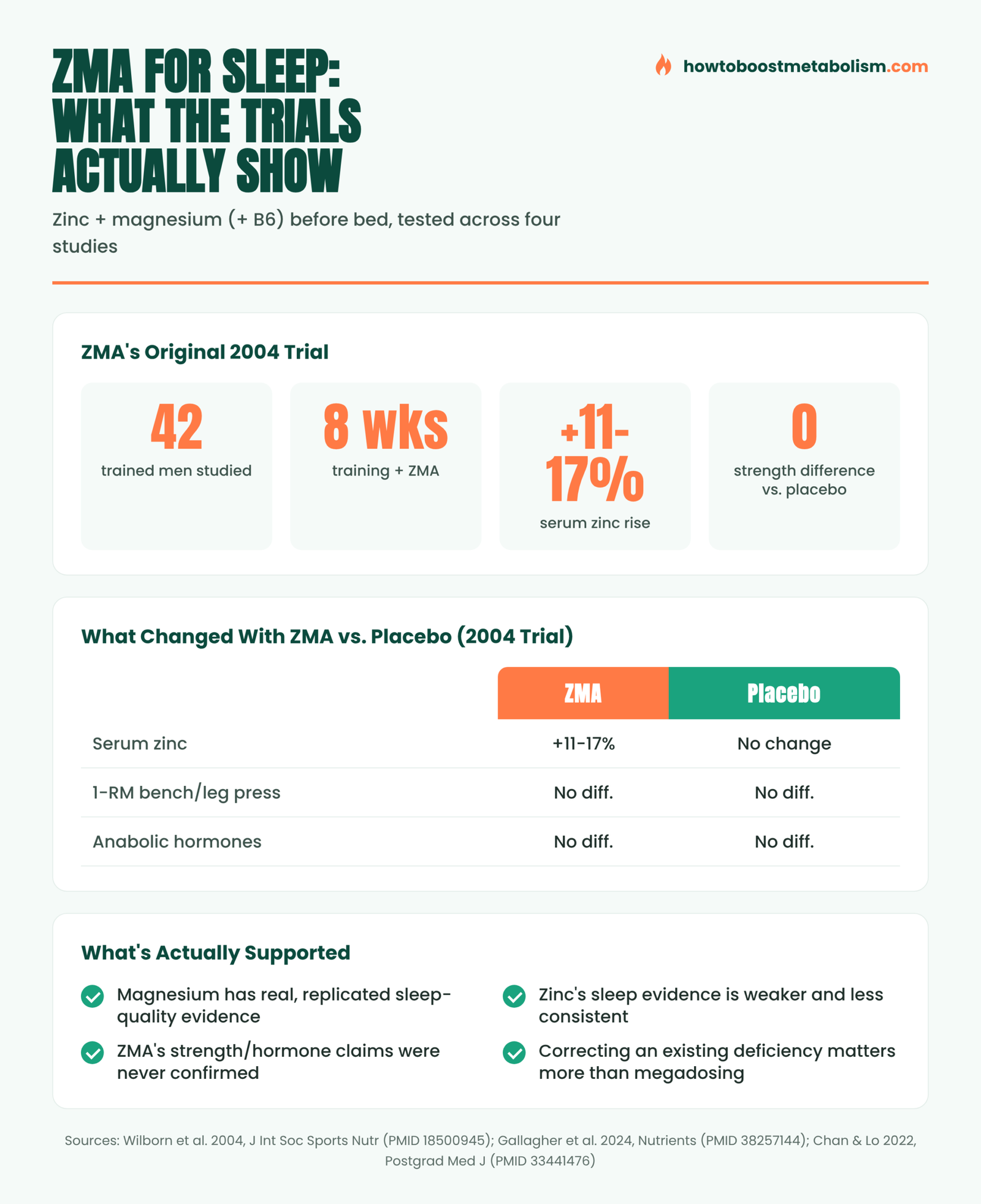
The idea that zinc and magnesium together could boost recovery and hormones traces back to a 2000 study in American football players, but the most frequently cited controlled follow-up is a 2004 trial from Baylor University’s Exercise & Sport Nutrition Lab (https://pubmed.ncbi.nlm.nih.gov/18500945/). Forty-two resistance-trained men were split into a ZMA group or a placebo group, taking their supplement 30–60 minutes before sleep during 8 weeks of standardized resistance training.
Related: Sleep and Metabolism
The result was almost entirely negative for the headline claims. Serum zinc rose by 11–17% in the ZMA group, which makes sense — they were taking zinc. But there was no significant difference between groups in anabolic or catabolic hormone levels, body composition, bench press or leg press 1-rep max, muscular endurance, or anaerobic cycling power. The researchers’ own conclusion was that ZMA supplementation “does not appear to enhance training adaptations” beyond what training and diet alone produced. That’s the study the entire ZMA-for-performance claim rests on, and it’s a null result.
Free download
🔥 The Metabolism Starter Kit
3 honest guides: a 7-day reset plan, a foods cheat-sheet and 12 metabolism myths debunked. No spam — unsubscribe anytime.
The Sleep Angle Is a Separate, More Recent Question
Performance claims aside, a more specific and more recent question is whether ZMA helps you sleep better, particularly around the stress of training. A 2024 study in Nutrients (https://pubmed.ncbi.nlm.nih.gov/38257144/) tested ZMA against both a placebo and a no-pill control in sixteen trained men during two nights of partial sleep deprivation (just 4 hours of sleep per night), then measured morning weightlifting performance and subjective fatigue.
See also: Ashwagandha vs L-Theanine for Cortisol and Weight
The result: no significant main effect of ZMA on performance values or subjective fatigue ratings compared to placebo or no-pill control, and no significant relationship between the dose of zinc or magnesium absorbed and the outcomes measured. In a scenario specifically designed to stress-test ZMA’s claimed recovery benefit — real sleep restriction, trained lifters, objective bar-speed measurements — the supplement didn’t move the needle.
So Does Magnesium (Without the “Z”) Actually Help Sleep?
Here the picture improves. A 2022 systematic review and meta-analysis in the Postgraduate Medical Journal pooled 31 randomized controlled trials of sleep-related dietary supplements (https://pubmed.ncbi.nlm.nih.gov/33441476/). It found subjective sleep quality was significantly improved by amino acid supplementation, melatonin, and vitamin D — and separately, individual magnesium trials not included in that specific pooled estimate have shown benefits for self-reported poor sleepers using forms like magnesium-L-threonate and magnesium bisglycinate in more recent randomized trials.
See also: MEV, MAV, MRV
Zinc’s standalone sleep evidence is thinner and more mixed than magnesium’s. Most of the positive zinc-sleep data comes from populations with a diagnosed or likely zinc deficiency (older adults, certain clinical groups), where correcting a genuine shortfall improves multiple things at once, sleep included. In people who already get enough zinc from food — which, in the typical U.S. diet, includes more people than you’d expect given how often zinc deficiency is marketed as common — adding more doesn’t reliably move sleep measures.
Free download: our Metabolism Starter Kit — a protein calculator, a 7-day meal framework, and a one-page supplement checklist, with zero hype.
Get the Free Starter Kit →What About Taking Them Together, Specifically at Night?
This is the part ZMA marketing has always implied but never actually tested: that zinc and magnesium taken together, at a specific time, produce a combined benefit bigger than either mineral alone. No published trial has run that head-to-head comparison — ZMA vs. magnesium-only vs. zinc-only vs. placebo, in the same study. Every ZMA trial tests the combination against a placebo or no-pill control, which can’t tell you whether the magnesium is doing the work, the zinc is doing the work, both are, or neither is beyond a mild relaxation/placebo effect from a bedtime ritual.
Further reading: Vitamin D and Muscle Strength After 40
The honest mechanistic case for timing magnesium near bedtime is reasonable: magnesium is involved in regulating the nervous system’s “rest” pathways, and taking it shortly before sleep rather than, say, with breakfast, lines up with when you’d want any calming effect to show up. But “reasonable mechanism” and “proven combined effect over splitting the minerals up or taking either alone” are different claims, and only the first one currently has support.
Why Form Matters More Than Most Labels Admit
Not all magnesium supplements are created equal, and this matters more for the sleep question than most marketing admits. Magnesium oxide — the cheapest, most common form on store shelves — has notoriously poor absorption and is mostly known for its laxative effect rather than any calming benefit. The forms used in the more promising sleep trials are different: magnesium glycinate (bound to the amino acid glycine, which has its own mild calming properties), magnesium threonate, and magnesium bisglycinate. If you’ve tried “magnesium for sleep” before and felt nothing, it’s worth checking whether you were actually taking oxide.
Zinc’s absorbability varies less dramatically between forms, but zinc picolinate and zinc bisglycinate are generally considered somewhat better absorbed than zinc oxide. ZMA specifically uses zinc monomethionine aspartate, chosen originally for absorption rather than any unique sleep-specific property — there’s nothing about that particular zinc salt that makes it behave differently for sleep than any other reasonably absorbable form.
A Sensible Dosing Range, If You Decide to Try It
For magnesium, most sleep-focused trials use somewhere between 200 and 400 mg of elemental magnesium in the evening, which is a reasonable starting range for most healthy adults. The Institute of Medicine’s tolerable upper intake level for supplemental (non-food) magnesium is 350 mg/day for adults, so higher-dose protocols should be approached cautiously and ideally with a doctor’s input, especially for anyone with kidney issues, since the kidneys are what clear excess magnesium.
For zinc, 15–30 mg in the evening covers what most of the ZMA-style protocols use, and sits comfortably under the adult upper intake level of 40 mg/day from all sources combined, including food. Taking zinc on an empty stomach can cause nausea in some people, so pairing it with a small amount of food, rather than strictly fasted, is a reasonable adjustment that doesn’t appear to meaningfully affect absorption.
A Practical, Honest Approach
- If you suspect a magnesium shortfall, it has the better individual evidence base of the two for sleep, and a glycinate or L-threonate form is generally well tolerated at bedtime.
- Don’t expect a testosterone or strength boost from ZMA specifically — the study that claim is based on found no such effect, and no later trial has overturned that.
- Check your zinc intake from food first. Oysters, beef, pumpkin seeds, and legumes cover most people’s needs; supplementing on top of an already-adequate diet is unlikely to add a sleep benefit.
- Long-term zinc supplementation can interfere with copper absorption at higher doses, so more isn’t automatically better — stick to standard label doses rather than stacking multiple zinc sources.
- Treat the “timing” part as a reasonable habit, not a proven multiplier. Taking magnesium in the evening as part of a wind-down routine is a sensible default; expecting it to meaningfully outperform taking it earlier in the day isn’t supported by direct evidence.
Signs You Might Actually Be Low on Either Mineral
The people most likely to notice a real benefit from supplementing either mineral are the ones who are actually running low — which is a meaningfully different group than “everyone who trains hard.” Magnesium deficiency markers can include muscle cramps, fatigue, and in more pronounced cases, sleep disturbance itself, though these overlap with so many other causes that they’re not reliable on their own. Heavy sweating from frequent intense training, a diet low in leafy greens, nuts, and whole grains, and certain medications (including some diuretics and proton-pump inhibitors) can all increase magnesium needs or losses.
Zinc status is harder to judge from symptoms alone, since early deficiency is often subtle. Diets low in meat, shellfish, and legumes carry more risk, as does heavy alcohol use, which impairs zinc absorption and increases excretion. A blood test is the only way to know your status with any confidence; guessing based on how tired you feel after a hard training block is unreliable in either direction, since overtraining itself causes fatigue regardless of mineral status.
The Bigger Picture for Sleep and Recovery
Supplements are, at best, a small lever next to the basics that actually move sleep quality and workout recovery: consistent sleep and wake times, enough total sleep duration, managing training volume so you’re not chronically under-recovered, and eating enough protein and total calories to support repair. If you’re relying on a nightly ZMA capsule to compensate for five hours of sleep and poor training management, the mineral stack is not going to close that gap — the 2024 sleep-deprivation trial makes that fairly clear.
That doesn’t make these minerals useless — magnesium in particular has a more defensible place in a recovery routine than most supplements marketed for sleep. It just means the realistic expectation is a modest assist for people who are genuinely running low, layered on top of good sleep habits, not a standalone fix that substitutes for them. Treat the “Z” in ZMA as the part of the formula still waiting on its own supporting evidence, and the “M” as the part worth taking seriously.
Related: Another popular supplement with mixed resistance-training evidence is beta-alanine — we reviewed what the direct trials show about beta-alanine and strength training.
ZMA timing is a small optimization; the sleep-and-recovery problem after 40 is usually solved by not overreaching in the gym in the first place. Old School New Body is built around that idea — brief, moderate-load workouts with built-in recovery — and it’s the program we point beginners over 40 toward. One honest caveat: ignore the age-related statistics on its sales page — they aren’t sourced — and judge the program by its structure, not the copy.
A training approach that leaves room to recover:
Check Availability →Affiliate link — we may earn a commission at no extra cost to you. Disclosure
Frequently Asked Questions
Does ZMA actually help you sleep better?
The direct evidence is weak. A 2024 trial testing ZMA during partial sleep deprivation found no significant benefit to performance or fatigue versus placebo or no pill. Magnesium alone has better sleep-quality evidence than the zinc-magnesium combination has been shown to add.
Does ZMA boost testosterone?
No — the foundational 2004 study that popularized ZMA found no significant difference in anabolic or catabolic hormone levels between the ZMA group and placebo after 8 weeks of training.
Is it better to take zinc and magnesium together or separately?
No study has directly compared the combination against each mineral alone, so there’s no evidence that taking them together produces a bigger effect than taking the one with better evidence — magnesium — on its own.
What’s the best time to take magnesium for sleep?
Evening or shortly before bed is a reasonable, low-risk choice given magnesium’s role in calming nervous system activity, though no trial has proven evening dosing specifically outperforms other times of day.
Can too much zinc be harmful?
Yes — chronic high-dose zinc supplementation can interfere with copper absorption and immune function over time. Sticking to standard label doses rather than combining multiple zinc sources is the safer approach.
Curious about other recovery supplements with more hype than evidence? See our honest look at magnesium glycinate and whether zinc actually affects your metabolism. If cortisol and overtraining are part of why you’re not sleeping, our guide to overtraining signs after 40 covers the bigger picture, and pre-sleep protein for muscle after 40 looks at what else to consider before bed.
This article is for educational purposes and is not medical advice. Chronic sleep problems can have many underlying causes, including sleep apnea, anxiety, and other medical conditions that supplements won’t address. If sleep issues persist, talk to a doctor. See our full Medical Disclaimer.