

Does Creatine Hurt Your Kidneys or Liver? The Evidence
This article may contain affiliate links. If you buy through them, we may earn a small commission at no extra cost to you. See our Affiliate Disclosure and Medical Disclaimer.
If you’ve ever mentioned taking creatine to a doctor, a worried relative, or a comment-section stranger, you’ve probably heard some version of the same warning: “Be careful, that stuff is hard on your kidneys.” It’s one of the most persistent myths in sports nutrition — persistent enough that it shows up in medical offices as often as it does online.
The claim isn’t baseless on its face. Standard blood panels really do show higher serum creatinine in people who supplement with creatine, and serum creatinine is the exact marker doctors use to screen for kidney trouble. The problem is that this single fact gets stretched into a conclusion the evidence doesn’t support. Here’s what randomized controlled trials, not forum threads, actually show about creatine, your kidneys, and your liver.
See also: Does Creatine Help Your Brain After 40?
Where the Myth Comes From: Serum Creatinine 101
Creatine itself isn’t the worrying part — creatinine is. Creatinine is a waste byproduct your muscles make when they break down creatine (and phosphocreatine) for energy. Your kidneys filter it out of your blood continuously, and because that filtration rate is fairly stable in healthy people, doctors use blood creatinine as a proxy for kidney filtration capacity (estimated glomerular filtration rate, or eGFR).
You may also find this useful: creatine after 40
Supplementing with creatine increases the total pool of creatine in your muscles, which means more of it gets converted to creatinine and shows up in your blood — even though your kidneys are filtering exactly as well as before. It’s the nutritional equivalent of eating more protein and seeing your urea numbers tick up: a byproduct of higher intake, not evidence that an organ is failing.
That distinction matters enormously, because a doctor glancing at creatinine alone, without knowing you supplement, can misread a harmless shift as a red flag. It’s a real, well-documented source of false alarms — which is exactly why researchers stopped relying on creatinine alone and started measuring actual filtration markers directly.
What the Randomized Trials Actually Show
The 2026 Meta-Analysis: 19 RCTs, Three Real Kidney Markers
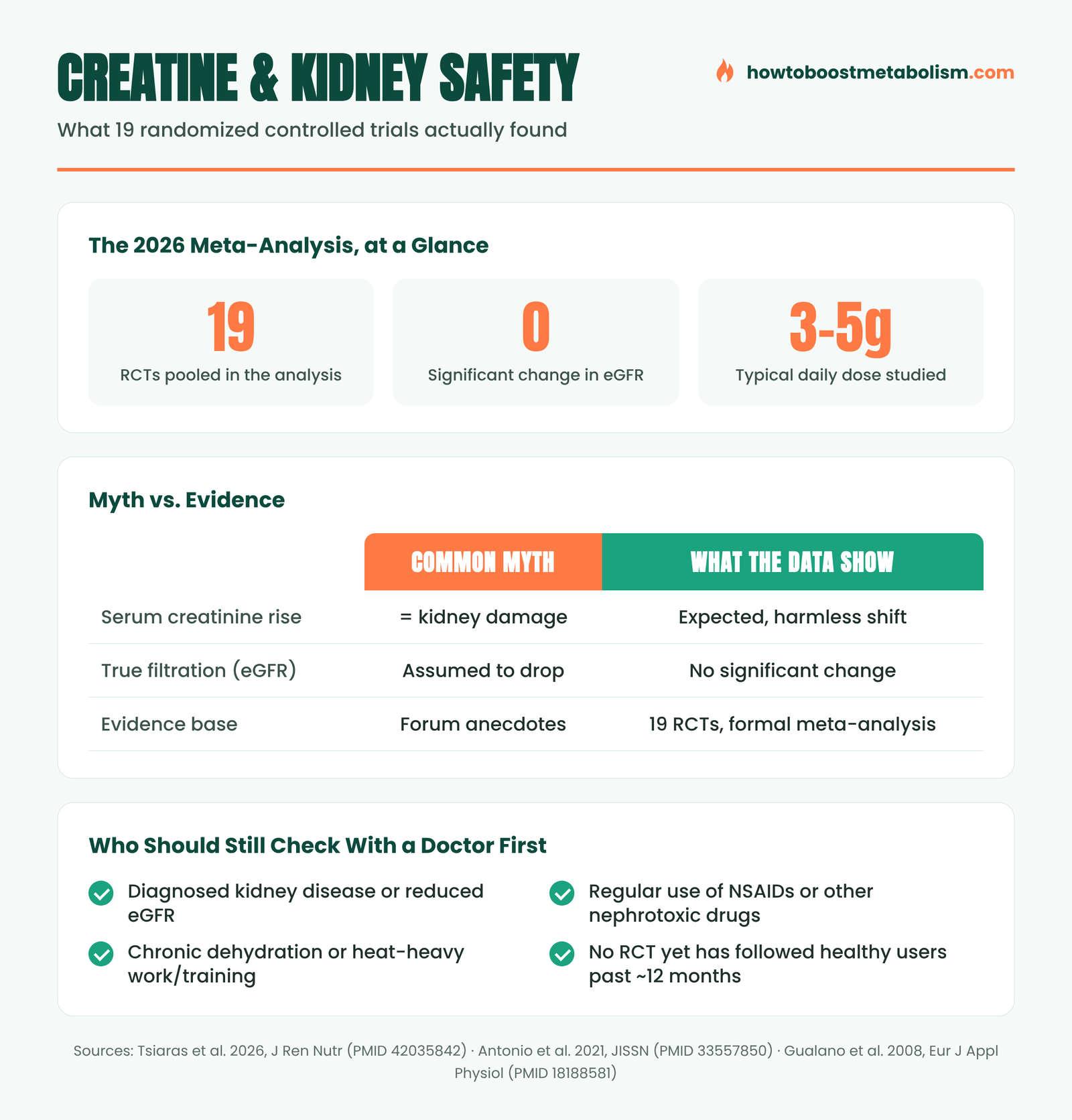
The most direct answer so far comes from a 2026 systematic review and meta-analysis in the Journal of Renal Nutrition (Tsiaras et al., 2026, https://pubmed.ncbi.nlm.nih.gov/42035842/), which pooled 19 randomized controlled trials plus one double-blind crossover study. Instead of trusting creatinine in isolation, the researchers tracked three outcomes: serum creatinine, blood urea, and estimated glomerular filtration rate (eGFR) — the actual measure of how well kidneys are filtering.
See also: creatine gummies vs powder
The result: creatine supplementation was associated with a small rise in serum creatinine (about 0.13 mg/dL on average) — but no significant difference in urea and no significant difference in eGFR between creatine and placebo groups. In plain terms, the one marker that moved is the one that’s expected to move with higher creatine intake, while the markers that would actually signal kidney stress didn’t budge. The authors’ own conclusion was careful, not triumphant: they called for longer-term RCTs beyond one year, since none of the pooled trials ran that long.
A Closer Look: Does Filtration Capacity Actually Change?
An earlier randomized, double-blind, placebo-controlled trial from Brazil gives a useful close-up (Gualano et al., 2008, European Journal of Applied Physiology, https://pubmed.ncbi.nlm.nih.gov/18188581/). Eighteen healthy men took either ~10 g/day of creatine or a placebo for three months while doing supervised aerobic training. The researchers measured cystatin C, a kidney-filtration marker that — unlike creatinine — isn’t affected by how much creatine you’re taking. Cystatin C decreased over the study in both groups, suggesting filtration rate, if anything, improved slightly with training. There was no meaningful difference between the creatine and placebo groups on any other renal marker measured.
Related: Does Creatine Cause Weight Gain?
Liver Function: The Less-Discussed Half of the Myth
The kidney story gets most of the attention, but the “creatine is hard on your organs” myth usually bundles in the liver too. A controlled trial out of the University of Nottingham tested this directly (Robinson et al., 2000, British Journal of Sports Medicine, https://pubmed.ncbi.nlm.nih.gov/10953902/). Forty-eight healthy young adults took either a short, high-dose loading protocol (20 g/day for five days) or a longer, lower-dose protocol (3 g/day for nine weeks). Researchers measured hematology, plus markers of liver, kidney, and muscle damage. Every single measured value stayed within the normal reference range throughout. Serum creatinine ticked up the day after loading, as expected, then returned fully to baseline. The authors concluded there was no evidence of hepatic (liver), renal, or hematological harm from either protocol.
The Field’s Own Consensus Statement
In 2021, eleven researchers from the International Society of Sports Nutrition — people who have spent careers studying creatine specifically — co-authored a position paper addressing the field’s most common myths directly (Antonio et al., 2021, Journal of the International Society of Sports Nutrition, https://pubmed.ncbi.nlm.nih.gov/33557850/). “Does creatine cause kidney damage / renal dysfunction?” is listed as question #3 of twelve. Their summary: at commonly recommended doses (3-5 g/day, or about 0.1 g per kg of body weight per day), creatine is “relatively well tolerated,” including in older adults and several patient populations studied.
One honest caveat worth flagging: several of that paper’s authors disclose creatine-industry ties (research funding, advisory roles, speaking fees) in their conflict-of-interest statement. That doesn’t make the underlying data wrong — the RCT evidence above comes from independent groups too, and points the same direction — but it’s a reason to weight the independently-funded trials more heavily than any single industry-linked summary, and we’ve tried to do exactly that here.
You may also find this useful: vitamin D and muscle strength after 40
What About Women Specifically?
Most creatine safety data historically came from male or mixed-sex samples. A 2020 systematic review and meta-analysis closed that gap by pooling studies that monitored adverse outcomes specifically in female participants (de Guingand et al., 2020, Nutrients, https://pubmed.ncbi.nlm.nih.gov/32549301/). Across 29 studies and 951 women, there were no deaths or serious adverse events, and no significant difference in total adverse events between creatine and control groups.
Free download
🔥 The Metabolism Starter Kit
3 honest guides: a 7-day reset plan, a foods cheat-sheet and 12 metabolism myths debunked. No spam — unsubscribe anytime.
At a Glance: Claim vs. Trial Evidence
| Claim | What the Trial Evidence Actually Shows |
|---|---|
| Serum creatinine rises with supplementation | True — expected byproduct of higher creatine turnover, not organ damage |
| eGFR (true filtration rate) drops | Not supported — no significant change across 19 pooled RCTs |
| Liver enzymes/function are harmed | Not supported — hepatic markers stayed in normal range in controlled trials |
| Safe for women specifically | Supported by dedicated meta-analysis — no excess adverse events found |
| Safe for anyone with existing kidney disease | Unknown / not established — these trials studied healthy people |
| Safe past 12 months of continuous daily use | Not yet directly tested — authors call for longer RCTs |
Does the Form of Creatine Change the Safety Picture?
Shelves are full of “advanced” creatine forms — hydrochloride, ethyl ester, buffered, and more — each marketed as gentler on the kidneys or more absorbable than plain creatine monohydrate. That marketing claim isn’t backed by the trials above: essentially all of the kidney and liver safety data discussed in this article was generated using creatine monohydrate specifically, because it’s the form that’s been studied in the overwhelming majority of RCTs for decades. Switching to a novelty form doesn’t buy you extra safety margin — it mostly buys you a higher price tag and a form with far less safety data behind it, which is the opposite of reassuring if kidney health is your actual concern.
Who Should Still Be Cautious
None of this is a blanket “creatine is harmless for everyone” statement, and treating it that way would be its own kind of dishonesty. The existing RCTs were run in healthy adults, usually for a few weeks to a few months. That evidence doesn’t automatically transfer to:
- Anyone with diagnosed kidney disease or a known reduced eGFR — talk to your nephrologist or physician before starting, full stop.
- People taking medications that are themselves hard on the kidneys (certain NSAIDs, some diuretics, specific prescription drugs) — combined load matters even if creatine alone doesn’t.
- Anyone who trains or works in conditions where chronic dehydration is a real risk — adequate fluid intake is part of using creatine sensibly, not optional.
- Long-term, multi-year continuous use — the honest answer is that nobody has run a multi-year RCT yet, so “probably fine based on shorter trials” is the accurate claim, not “definitely fine forever.”
Using Creatine Sensibly, Not Fearfully
If you’ve been avoiding creatine purely out of kidney worry, and none of the caution flags above apply to you, the evidence suggests that worry is disproportionate to the actual risk shown in controlled trials. A sensible approach looks like this:
- Stick to studied doses — 3-5 g/day of creatine monohydrate is the dose used in the vast majority of the safety trials above, not a “more must be better” megadose.
- Drink enough water. Creatine pulls some water into muscle cells; it isn’t a dehydration risk on its own, but showing up under-hydrated to hard training sessions never helps any organ system.
- Get a baseline kidney panel if you have any personal or family history of kidney issues, and mention your supplement use to whoever reviews your labs — so a harmless creatinine bump doesn’t get misread.
- Reassess periodically rather than assuming “set and forget” forever, especially if your health status, medications, or hydration habits change.
What actually moves the needle on body composition and strength long-term isn’t the supplement in isolation — it’s pairing a well-tolerated basic like creatine with a structured, progressive strength program you’ll actually stick with for months, not weeks.
If you want creatine working inside an actual structured strength framework rather than sitting in a cupboard, Old School New Body’s F4X method is a simple, time-efficient program built for people over 40 who want a consistent routine — not a 60-minutes-a-day commitment. (Note: this program’s own marketing page cites some muscle-loss statistics we can’t independently verify in the primary literature — judge the program on its training structure, not its sales-page numbers.)
See the Program →Affiliate link — we may earn a commission at no extra cost to you. Disclosure
What We Still Don’t Know
In the interest of the same honesty we’re asking you to apply to the myth itself: the evidence above is genuinely reassuring for healthy adults over supplementation windows of weeks to several months, which is what the RCTs actually tested. It is not proof that creatine is risk-free over a decade of continuous use, and it says nothing specific about people who already have compromised kidney function. The 2026 meta-analysis’s own authors flagged the lack of long-term trials as the field’s biggest open question — and that’s the honest state of the science today, not a reason to panic about the gap.
Free download: our Metabolism Starter Kit — a protein calculator, a 7-day meal framework, and a one-page supplement checklist, with zero hype.
Get the Free Starter Kit →Related: Kidney and liver safety aren’t the only creatine myths worth fact-checking — we also dug into whether creatine actually causes hair loss, and the evidence is thinner than the forum warnings suggest.
Frequently Asked Questions
Does creatine actually damage your kidneys?
In the randomized controlled trials run so far — including a 2026 meta-analysis of 19 RCTs — creatine supplementation did not produce a significant change in eGFR (the actual measure of kidney filtration) or in blood urea. It does raise serum creatinine slightly, but that appears to reflect higher creatine turnover, not reduced kidney function.
Why does my creatinine go up on creatine, then?
Creatinine is a waste product made when creatine is broken down in muscle. Supplementing increases your body’s total creatine pool, so more creatinine is produced and shows up in blood tests — even when actual kidney filtration (eGFR) is unchanged.
Is creatine safe for people with existing kidney disease?
The safety trials cited here were done in healthy adults. If you have diagnosed kidney disease or a reduced eGFR, this evidence doesn’t directly apply to you — talk to your physician or nephrologist before supplementing.
Can creatine hurt your liver?
Controlled trials that measured hepatic function markers alongside kidney markers found no evidence of liver harm at commonly studied doses (3-5 g/day, or short-term loading protocols up to 20 g/day for five days).
Is it safe to take creatine for years at a time?
That’s the honest open question. Existing RCTs mostly run weeks to a few months. The authors of the most recent meta-analysis specifically called for RCTs extending beyond one year — those don’t exist yet, so long-term safety is inferred from short-term data and a long history of real-world use, not directly proven.
This article is for informational purposes and is not medical advice. If you have kidney disease, liver disease, or take medications that affect kidney function, talk to your doctor before starting creatine. See our Medical Disclaimer.