
Creatine Timing: Before or After Your Workout After 40?
This article may contain affiliate links. If you buy through them, we may earn a small commission at no extra cost to you. See our Affiliate Disclosure and Medical Disclaimer.
Walk into any supplement forum and you’ll find a confident, specific rule: take your creatine within 30 minutes after training, never before, or you’re wasting it. It sounds precise enough to be true. The actual research on creatine timing is a lot messier than that rule suggests — and if you’re over 40 and trying to decide whether you need to plan your supplement around your workout clock, the honest answer is probably not as much as the forums claim.
It matters because supplement timing myths have a cost beyond wasted thought. If you believe you have to hit a narrow 30-minute window or the supplement ‘doesn’t count,’ a missed window becomes an excuse to skip the dose entirely that day — and since creatine’s benefit comes from consistent, accumulated muscle saturation over weeks, skipped days are the actual thing that undermines results, not an imperfect clock.
Related: Creatine After 40
Where the ‘after is better’ rule actually comes from
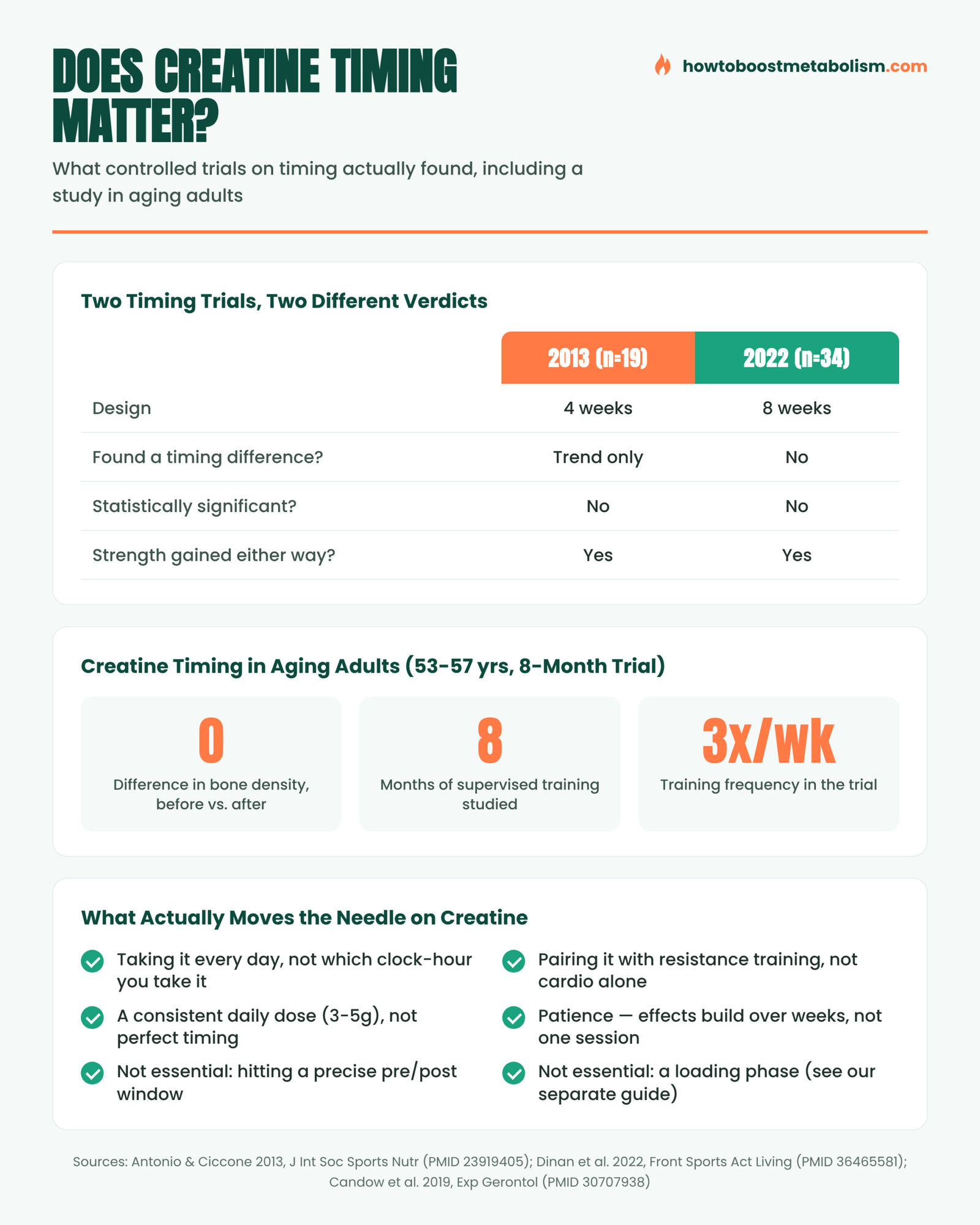
The timing debate traces largely to one small but influential study. In 2013, researchers at Nova Southeastern University randomly assigned 19 recreational male bodybuilders to take 5 grams of creatine either immediately before or immediately after their workouts for four weeks, while following an identical training program (Antonio & Ciccone, 2013, J Int Soc Sports Nutr, PMID 23919405). Both groups gained fat-free mass and bench press strength — that part wasn’t in question. Using a statistical technique called magnitude-based inference, the post-workout group showed a numerically larger average gain in fat-free mass (2.0 kg vs. 0.9 kg) and bench press (7.6 kg vs. 6.6 kg). The authors themselves were careful to call this a trend, not a significant interaction — the formal statistical test for a difference between groups did not reach significance. That nuance got lost by the time the finding reached supplement marketing copy.
What happened when a larger, longer study tried to replicate it
A 2022 trial out of Lindenwood University and the Mayo Clinic Health System set out to test the same question with nearly twice the sample size and twice the duration (Dinan et al., 2022, Frontiers in Sports and Active Living, PMID 36465581). Thirty-four trained men and women were randomized to a placebo, a pre-workout creatine dose, or a post-workout creatine dose, all co-ingested with protein and carbohydrate, over 8 weeks of structured resistance training. The result: every group that took creatine — before or after — gained similar fat-free mass (about 1.3 kg), similar upper- and lower-body strength, and lost similar fat mass. The researchers’ conclusion was direct: the timing of creatine monohydrate did not exert any additional influence over the measured outcomes. When the sample size and duration increased, the timing effect that showed up as a trend in 2013 disappeared.
Free download
🔥 The Metabolism Starter Kit
3 honest guides: a 7-day reset plan, a foods cheat-sheet and 12 metabolism myths debunked. No spam — unsubscribe anytime.
The one study that actually tested this in people over 40
Almost all creatine-timing research, including both trials above, has been conducted in people in their 20s. There’s exactly one controlled trial that tested pre- vs. post-exercise creatine timing specifically in an older population, and it’s worth knowing about (Candow, Forbes & Vogt, 2019, Experimental Gerontology, PMID 30707938). Aging adults in their mid-50s were randomized to take creatine immediately before resistance training, immediately after, or a placebo, training three days a week for eight months — a much longer and more realistic window than most supplement studies. The outcome measured was bone mineral density and content, not muscle mass, but the timing comparison is the relevant piece here: there was no meaningful difference between the before-training and after-training groups on any bone outcome. For the specific demographic this site is written for, this is the closest thing available to direct evidence, and it points the same direction as the larger 2022 trial — timing around the workout isn’t the lever that matters.
A 2026 wrinkle worth being honest about
Not every new data point points the same way, and it would be dishonest to pretend otherwise. A small 2026 crossover pilot study had 11 physically active men complete strength testing sessions after taking a single dose of creatine either before, during, or after a single training bout (Ben Maaoui et al., 2026, Nutrients, PMID 42280432). In this acute, one-session design, taking creatine before training produced better strength performance than taking it during or after. It’s worth being clear about what this does and doesn’t show: it’s a single-session acute performance study with 11 people, not a multi-week trial measuring muscle or strength adaptation over time, so it doesn’t contradict the larger chronic-adaptation trials above — it’s a different question (does timing affect how you perform in the next hour?) than the one that matters for long-term progress (does timing affect how much muscle and strength you build over months?). A 2021 review from the University of São Paulo’s sports nutrition group summarized the field honestly: some emerging evidence leans toward a post-exercise edge, but methodological limitations across the literature currently prevent a solid conclusion either way (Ribeiro et al., 2021, Nutrients, PMID 34445003).
At a glance: what actually moves your results
| Factor | What the evidence shows |
|---|---|
| Taking creatine daily, consistently | Strong evidence this is what drives results |
| Taking it specifically before vs. after training | No meaningful difference in the two largest trials, including the one in older adults |
| Pairing it with resistance training | Yes — the muscle-building benefit depends on the training stimulus being present |
| A loading phase (20g/day for a week) | Speeds up saturation but isn’t required — see our separate loading-phase guide |
| A single acute pre-workout dose for a one-off performance boost | Some early signal in a small 2026 pilot, not yet established for long-term gains |
Common mistakes people make with creatine timing
- Skipping days because the ‘ideal window’ doesn’t fit the schedule. This is the single biggest mistake, and it’s the opposite of what the research supports. A missed dose costs you far more than taking it an hour earlier or later ever could.
- Stacking it with caffeine right before training and blaming creatine for jitters. Creatine itself has no stimulant effect; if a pre-workout dose is mixed into a caffeinated pre-workout blend, the caffeine is almost always the culprit for any jittery feeling, not the creatine.
- Assuming more frequent dosing throughout the day beats one daily dose. Splitting creatine into multiple small doses doesn’t meaningfully speed up muscle saturation once you’re past an initial loading period, and it just adds complexity for no proven benefit.
- Cycling on and off every few weeks ‘to keep it working.’ There’s no evidence creatine stops working with continuous use, and cycling just means repeatedly losing and re-saturating your muscle stores, which works against consistency, the one variable that does matter.
A practical, no-stress protocol
If you want a single paragraph to act on: take 3 to 5 grams of creatine monohydrate every day, attached to whatever daily habit is easiest to remember — your post-workout shake, your morning coffee, dinner, whatever sticks. Don’t bother with a separate pre- vs. post-workout ritual unless you genuinely enjoy the structure of it; the evidence doesn’t reward the extra effort. Expect to notice strength and recovery differences over 3 to 4 weeks of consistent use, not immediately, and expect a small, normal rise in body water weight in the first one to two weeks that is not fat gain — our separate guide on the creatine water-retention myth covers that in detail. If you miss a day here or there, just take your normal dose the next day; there’s no need to double up or ‘re-load.’
So what should you actually do?
Pick whichever time you’ll actually remember every single day. There’s no special physiological reason a 40-plus body handles the timing question any differently than a 25-year-old’s — what changes with age is more often recovery capacity and joint tolerance, which is exactly why the Candow team’s choice to study aging adults specifically, rather than extrapolating from younger lifters, is the most relevant data point here, even though its primary outcome was bone density rather than muscle. For most people that’s right around a workout, simply because it’s already a fixed part of the routine — stacking it onto your pre- or post-workout shake or protein snack removes the need to remember it separately. On rest days, take it with any meal. If you currently skip days because your ‘perfect window’ doesn’t line up with your schedule, that inconsistency is costing you far more than any timing effect ever would — the 2022 trial and the aging-adults trial both used daily dosing regardless of precise clock timing, and that’s the behavior the evidence actually supports.
If you’re building this into a broader strength habit
Creatine is one of the few supplements with genuinely strong evidence behind it, but it’s a supporting player — it works best layered onto a consistent resistance-training routine, not as a substitute for one. If you’re looking for a structured program that bakes consistency in rather than relying on willpower, Old School New Body is built specifically around the F4X method for adults over 40, with the goal of building strength and muscle without the joint-wrecking volume that most mainstream bodybuilding programs assume you can still recover from. One honest caveat worth repeating from our other coverage of this program: some of the statistics on its sales page about age-related muscle loss are presented without a cited source and shouldn’t be taken as verified research — the program’s structure and authors are real, but treat those specific landing-page numbers with appropriate skepticism.
See the F4X strength-training approach built around training smart, not longer, after 40:
See the Program →Affiliate link — we may earn a commission at no extra cost to you. Disclosure
Related reading: our separate guides to the creatine loading phase, the creatine water-retention myth, creatine and cognitive function after 40, and whether protein timing matters cover the other pieces of the ‘does timing matter’ question in more depth.
Free download: our Metabolism Starter Kit — a protein calculator, a 7-day meal framework, and a one-page supplement checklist, with zero hype.
Get the Free Starter Kit →Related: Worried creatine might be hard on your kidneys or liver? We dug into what 19 randomized trials actually say about creatine and kidney safety — the short answer may surprise you.
Frequently Asked Questions
Is it true that creatine only works if you take it right after your workout?
No. The two largest controlled trials comparing pre- vs. post-workout creatine timing — including one specifically in adults in their 50s — found no meaningful difference in strength, body composition, or bone outcomes between taking it before or after training.
Does it matter at all when I take creatine?
Not much, based on the current evidence. What matters far more is taking it every single day, consistently, alongside a resistance-training program. A perfectly timed dose taken three days a week beats a theoretically optimal window you only hit sporadically.
What about the 2026 study that found timing does matter?
That was a small, single-session pilot study (11 participants) measuring acute performance in one workout, not long-term muscle or strength gains over weeks or months. It’s an interesting early signal worth watching, not a reason to overhaul a habit that the larger chronic trials show works fine either way.
Should I take creatine on rest days too?
Yes. Since daily consistency — not clock-hour timing — is what the evidence supports, taking your dose with a meal on rest days keeps your muscle creatine stores saturated and is simpler than trying to time it around training that isn’t happening that day.
Do I need to do a loading phase to get the timing benefit?
No — loading and timing are separate questions. A loading phase affects how quickly your muscles reach saturation, not whether pre- or post-workout dosing is superior. See our dedicated guide on whether loading is actually necessary.
This article is for educational purposes and is not medical advice. Consult a qualified healthcare provider before starting a new supplement or training program. See our Medical Disclaimer.