Dead Hangs After 40: Grip & Tendon Health, Honestly
This article may contain affiliate links. If you buy through them, we may earn a small commission at no extra cost to you. See our Affiliate Disclosure and Medical Disclaimer.
Scroll through enough fitness content and you’ll eventually hit the claim: hang from a pull-up bar for a minute a day and you’ll “decompress” your spine, reset your shoulders, and undo a day of sitting. It’s a satisfying idea — a free, 60-second fix for an aging body. It’s also, as far as we could find searching the published exercise science literature, not a claim backed by any direct study.
That doesn’t mean dead hangs are worthless. It means the real, evidence-backed case for them is different from the one usually made online — and arguably more useful, because it’s about grip strength, forearm endurance, and tendon loading, three things that matter a great deal for lifters and active people after 40.
This matters for how you should think about adding the exercise to your week. If you’re hanging from a bar hoping to undo hours of desk-sitting in sixty seconds, you’re likely to be disappointed, because that specific mechanism hasn’t been demonstrated. If you’re hanging to build a stronger grip, more resilient forearm tendons, and a bit more shoulder-girdle control under load, the evidence lines up much better with what you’re actually doing in the gym.
The Claim We Couldn’t Verify: “Spinal/Shoulder Decompression”
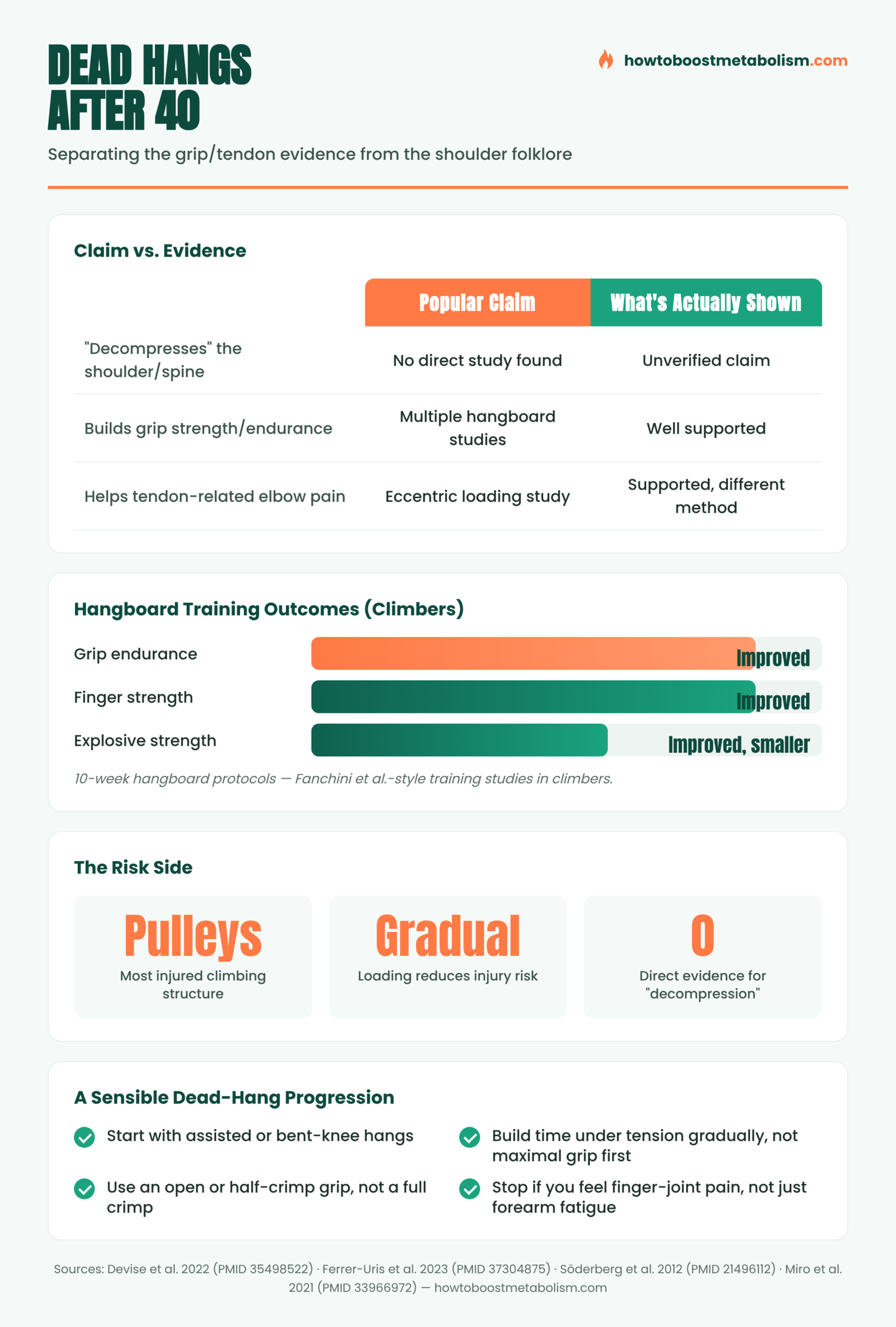
We searched directly for research on dead hangs, passive hanging, or traction exercises producing measurable spinal or shoulder-joint “decompression” effects. We found none. That’s worth saying plainly, because the claim is repeated constantly and sounds physiologically plausible — gravity pulling on a relaxed joint does create some passive traction in the moment. What’s missing is any controlled study showing that effect produces a lasting benefit, reduces pain, or improves posture over time. Until that evidence exists, treat the decompression claim as folklore, not fact — even though the exercise itself may still be worth doing for other, better-supported reasons below.
What Dead Hangs and Hangboard Training Actually Build: Grip
The strongest evidence for dead-hang-style training comes from rock climbing research, where hangboard protocols (controlled, progressive dead-hang training on a fingerboard) are studied directly as a training tool. A study comparing different hangboard training intensities found consistent improvements in finger grip strength, stamina, and endurance across protocols (Devise et al., 2022, Front Sports Act Living).
A separate study used electromyography to map which forearm muscles actually activate during maximal isometric dead hangs across different grip positions (open hand, half-crimp, full crimp), finding distinct coordination patterns depending on grip — useful information if your goal is targeting specific finger flexor and extensor muscles rather than just “hanging” in general (Ferrer-Uris et al., 2023, PeerJ).
None of this is climbing-specific trivia. Grip strength is one of the most consistently measured markers of overall strength and function as people age, and a dead hang is simply an efficient, equipment-light way to load the forearm and finger flexors directly — the same muscles that fatigue first during farmer’s carries, deadlifts, and pull-ups.
Free download
🔥 The Metabolism Starter Kit
3 honest guides: a 7-day reset plan, a foods cheat-sheet and 12 metabolism myths debunked. No spam — unsubscribe anytime.
The Tendon Health Connection (a Real One, Just Not the One You Heard)
The tendon-health case for grip-focused hanging work isn’t about the shoulder — it’s about the forearm tendons that attach near the elbow and are the usual site of what’s casually called “tennis elbow” (lateral epicondylalgia). A randomized-controlled trial tested eccentric training — a controlled, lengthening-phase loading method related in principle to how a dead hang loads the finger flexor tendons under body weight — in people with this condition, and found it improved hand strength compared with standard care (Söderberg et al., 2012, Scand J Med Sci Sports). Tendons generally respond well to progressive, controlled loading; the mechanism behind why eccentric and isometric loading helps tendinopathy is one of the better-replicated findings in sports medicine, even though the specific study above used a dedicated eccentric protocol rather than a plain dead hang.
The practical takeaway: loading the forearm tendons gradually — whether through eccentric wrist curls, grip trainers, or progressive dead hangs — is a reasonable, evidence-aligned way to build tendon resilience in that area. Hanging from a bar isn’t a magic shortcut past the general principle; it’s one convenient way to apply it.
| Claim | Evidence Status | Verdict |
|---|---|---|
| “Decompresses” shoulder/spine | No direct supporting study found | Treat as unverified |
| Builds finger/grip strength | Multiple hangboard training studies | Well supported |
| Improves grip endurance | Consistent across training protocols | Well supported |
| Helps elbow tendon pain (indirectly) | Eccentric loading RCT in tendinopathy | Supported mechanism |
| Risk of finger pulley injury | Documented in climbers under heavy load | Real, manage with progression |
The Risk Side Nobody Mentions: Finger Pulley Injuries
The same hanging and gripping demands that build forearm strength are also the leading cause of finger injuries in rock climbers — specifically to the pulley system, a set of connective-tissue bands that hold the finger flexor tendons close to the bone (Miro et al., 2021, Wilderness Environ Med). Climbers get hurt this way almost exclusively through aggressive crimp-grip loading at high intensity, often without a gradual build-up. For a general lifter adding dead hangs to a routine, the lesson isn’t to avoid them — it’s to progress load and grip intensity the same way you would with any other new exercise, rather than jumping straight to a maximal one-minute hang on day one.
Active Hang vs. Passive Hang: A Technique Distinction Worth Knowing
Coaches typically describe two versions of a dead hang. In a passive hang, you let your shoulders ride up toward your ears and your shoulder blades relax — this is the version most associated with the (unverified) decompression claim, because it’s the most purely gravity-driven position. In an active hang, you pull your shoulder blades down and slightly back before hanging, engaging the muscles around the shoulder blade rather than letting the joint simply dangle.
Neither version has dedicated research behind the specific outcomes people claim for it, but the distinction still matters practically. If you have any history of shoulder impingement or instability, an active hang — with the shoulder blades engaged — is the more conservative starting point, because a fully passive hang puts the shoulder in a more vulnerable, less controlled position under your full body weight. As grip and shoulder tolerance improve, you can experiment with brief passive hangs, but there’s no evidence you’re missing out on anything measurable by sticking with the active version long-term.
Why Grip Capacity Matters More as You Get Older
Forearm and grip strength are among the most consistently measured physical capacities that decline with age, which is a large part of why grip strength shows up repeatedly in longevity and functional-independence research. Day-to-day tasks — carrying groceries, opening jars, holding onto a railing, catching yourself if you trip — all depend on forearm and hand strength that most training programs never directly target. A deadlift or a pull-up trains grip indirectly as a side effect, but it’s rarely the limiting factor in those movements the way it is in a dedicated hang.
That’s the practical case for adding a small, deliberate dose of hanging or grip work to a program after 40: not because it reverses aging or decompresses anything, but because it’s an efficient, low-equipment way to directly train a capacity that otherwise gets trained only incidentally, if at all.
Common Mistakes to Avoid
- Going straight to a maximal hang. The temptation is to see how long you can hang on day one. That’s exactly the aggressive, unprogressed loading pattern linked to finger pulley strain in climbers.
- Using a full crimp grip by default. A closed crimp (fingers bent sharply at the middle joint) concentrates far more force on the pulleys than an open-hand or half-crimp grip. Save the crimp grip for later, if at all.
- Ignoring shoulder position entirely. Letting the shoulders dump into a fully passive, unguarded position before you have any hanging tolerance is a common way to aggravate an existing shoulder issue, independent of any claimed decompression benefit.
- Expecting a dead hang to fix posture on its own. Posture is influenced by strength, habit, and daily movement patterns far more than by one 30-second hang. Treat this as a grip and tendon exercise, not a posture cure.
What This Looks Like for Someone Who Has Never Hung From a Bar
If you can’t comfortably support your bodyweight at all yet, that’s a completely normal starting point and not a sign that hanging is a bad fit for you. The fix isn’t to force it — it’s to reduce the load until the movement is manageable, the same way you would with any other new strength exercise. A resistance band looped over the bar and under one foot, or a box under your feet so you can bear partial weight through your legs, both let you practice the grip and shoulder positioning of a hang while controlling exactly how much bodyweight you’re supporting. Over a few weeks, you gradually remove that assistance as grip and shoulder tolerance build.
A Sensible Way to Add Dead Hangs After 40
- Start with short, sub-maximal hangs (10–20 seconds) using an open-hand grip, which places less concentrated stress on any single finger pulley than a full crimp.
- If a full bodyweight hang is uncomfortable on the shoulders at first, use a band for assistance or bend your knees to take some weight off, and build tolerance over 2–3 weeks.
- Progress time under tension before progressing grip difficulty — add 5–10 seconds per set before switching to a harder grip position.
- Do 2–3 sets, 2–3 times a week, either as a standalone grip session or tacked onto the end of an upper-body training day.
- Stop immediately if you feel sharp pain at a specific finger joint, as opposed to ordinary forearm fatigue — that’s the pulley-injury warning sign, not a sign to push through.
Free download: our Metabolism Starter Kit — a protein calculator, a 7-day meal framework, and a one-page supplement checklist, with zero hype.
Get the Free Starter Kit →For related reading, see our guides to grip strength as a longevity marker, loaded carries and farmer’s walks after 40, and isometric training for joint health after 40 if tendon-friendly loading in general is what brought you here.
Frequently Asked Questions
Do dead hangs really decompress your spine or shoulders?
We could not find a published study directly testing or confirming that claim. There is some passive traction happening in the moment from gravity, but no controlled research shows a lasting decompression effect, reduced pain, or improved posture from regular dead hangs. Treat it as an unverified popular claim, not an established benefit.
What do dead hangs actually improve, based on real research?
Grip strength and forearm endurance, most directly. Hangboard training studies in climbers consistently show improvements in finger grip strength, stamina, and endurance, and the muscle-activation pattern changes depending on which grip you use.
Are dead hangs safe for elbow or wrist tendon issues?
Progressive, controlled loading of forearm tendons is a well-supported approach to tendon health in general, including for tennis-elbow-type pain. If you have an existing tendon injury, start very conservatively (short, light hangs) and consider checking with a physical therapist before loading it aggressively.
What’s the biggest risk with dead hangs?
Finger pulley strain or injury from gripping too hard, too soon, especially with a closed crimp grip. This is the most common hand injury in climbers who train hanging exercises aggressively. Progress gradually and use an open-hand grip while you’re building tolerance.
How often should I do dead hangs?
Two to three short sessions a week is enough to build grip and forearm capacity over time. There’s no evidence that daily maximal hangs are necessary, and doing them too often without recovery raises the risk of the pulley strain described above. Treat it like any other accessory exercise that needs recovery time between sessions, not a daily habit to maximize.