Does Spermidine Really Boost Metabolism? The Human Data
This article may contain affiliate links. If you buy through them, we may earn a small commission at no extra cost to you. See our Affiliate Disclosure and Medical Disclaimer.
Spermidine has become one of the biggest supplement trends of the last few years, marketed as a “cellular renewal” compound that triggers autophagy — your body’s internal cleanup process — and turns back the metabolic clock. Some of the underlying science is genuinely exciting and comes from serious labs. Some of what’s being sold on the back of that science does not hold up once you read the actual human trials. Here’s the honest version.
What Is Spermidine, and Why the Hype?
Spermidine is a naturally occurring polyamine — a small molecule your own cells produce and that’s also present in certain foods, including wheat germ, aged cheeses, mushrooms, soybeans and fermented soy products like natto, and whole grains. Spermidine levels in the body tend to decline with age, and in cell and animal research it’s one of the more reliable triggers of autophagy, the process cells use to clear out damaged components. That mechanistic story — declining with age, inducible with a naturally occurring compound, linked to a process implicated in aging biology — is exactly the kind of narrative that supplement marketing is built to amplify.
The Foundational Science Is Real — and Mostly Not in Humans
The landmark paper is a 2016 study in Nature Medicine (PMID 27841876) led by Frank Madeo’s group, which found that dietary spermidine extended lifespan in mice and improved cardiac function through autophagy-dependent mechanisms. It’s a rigorous, influential piece of work — but it’s an animal study. The same paper also looked at human data from a prospective cohort and found an association between higher dietary spermidine intake and better cardiovascular outcomes, which strengthened the case for follow-up human research.
That follow-up came in 2018, when the same research network published a prospective population-based study in the American Journal of Clinical Nutrition (PMID 29955838) tracking dietary spermidine intake and mortality in a community cohort (the Bruneck study) over many years. People with higher dietary spermidine intake had lower all-cause mortality. This is genuinely useful evidence — but it’s observational, meaning it shows an association in people eating spermidine-rich foods as part of their overall diet, not proof that spermidine itself, isolated and in pill form, causes the benefit. People who eat more wheat germ, mushrooms, and aged cheese may simply eat better diets overall.
Free download
🔥 The Metabolism Starter Kit
3 honest guides: a 7-day reset plan, a foods cheat-sheet and 12 metabolism myths debunked. No spam — unsubscribe anytime.
Where the Story Gets Complicated: Pills Don’t Raise Your Levels
This is the part most spermidine marketing leaves out entirely, and it’s the single most important finding for anyone considering a supplement rather than a food swap.
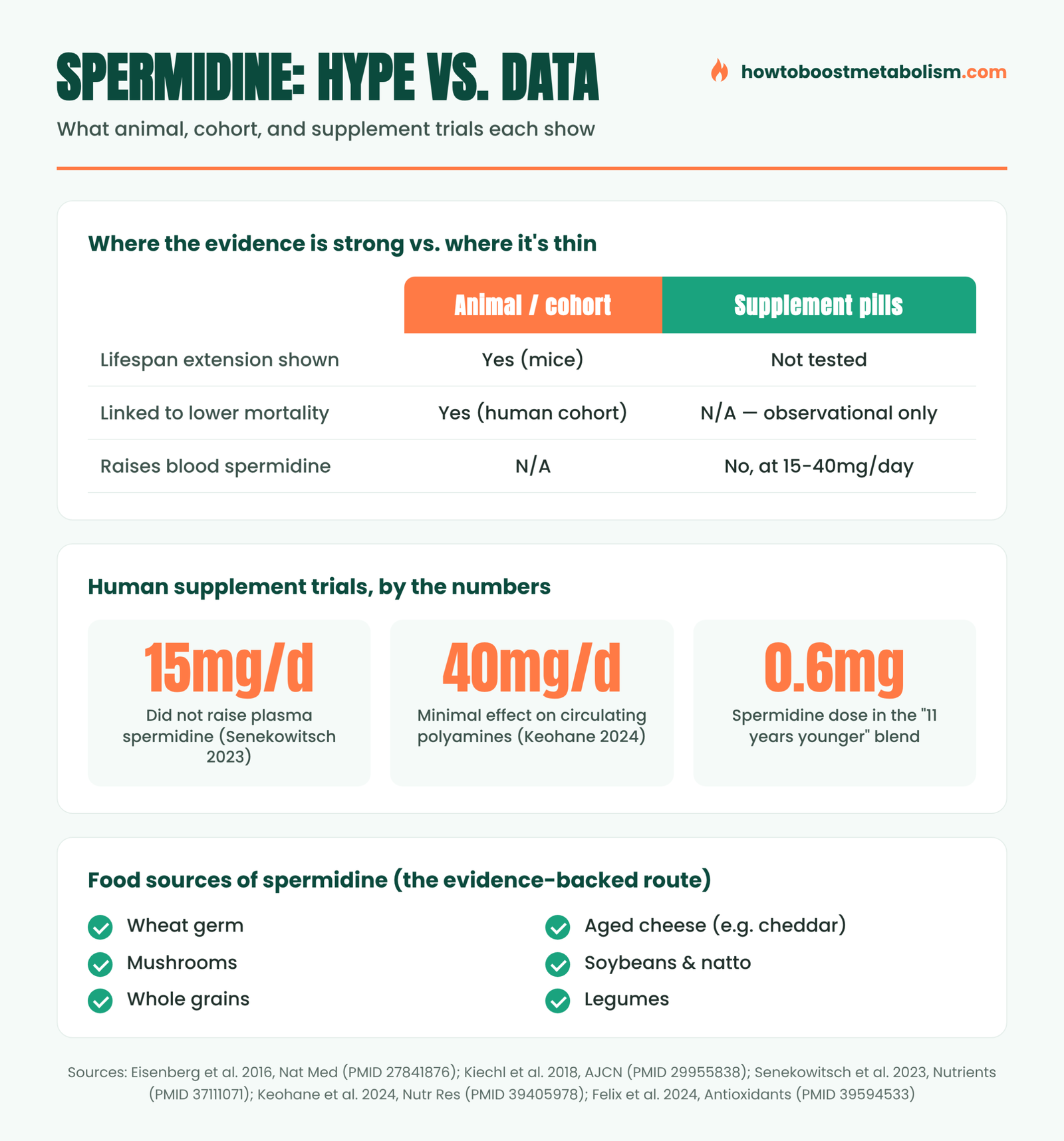
A 2023 randomized, placebo-controlled, triple-blinded crossover trial in Nutrients (PMID 37111071) gave 12 healthy adults 15 mg/day of oral spermidine for five days and measured blood and saliva levels directly. The result: spermidine supplementation did not raise plasma or saliva spermidine levels at all. It did raise plasma levels of spermine, a related metabolite, suggesting the body converts spermidine to spermine before it ever reaches general circulation. The researchers’ own conclusion was blunt: it’s “rather unlikely that spermidine supplements with doses <15 mg/day exert any short-term effects.”
A 2024 trial in Nutrition Research (PMID 39405978) pushed the dose higher — 40 mg/day of a high-purity spermidine supplement, for up to 28 days, in 37 healthy older men — specifically to test whether a bigger dose would finally move the needle. It confirmed the supplement was safe and well-tolerated, with no adverse effects. But it found no substantial change in serum or urine polyamine concentrations either. The body, it seems, tightly regulates how much spermidine actually circulates, regardless of how much you swallow — at least at the doses tested so far.
What About That “11 Years Younger” Study?
If you’ve seen spermidine ads citing a human trial that reduced biological age by 11 years, this is almost certainly the one: a 2024 randomized controlled trial in Antioxidants (PMID 39594533) that found a daily supplement blend decreased biological age by 11 years over two months, measured using an “Immunity Clock” model, alongside improved immune function and reduced oxidative-inflammatory markers. That’s a striking result, and it’s a real randomized trial — but the honest detail that matters is what was actually in the capsules: a blend of AM3 (150 mg), hesperidin (50 mg), and just 0.6 mg of spermidine — a dose roughly 25 to 65 times smaller than the amounts tested (and found ineffective at raising blood levels) in the pharmacokinetic trials above. AM3 is a yeast-derived immune compound with its own independent research history; it, not the trace amount of spermidine, is the most plausible driver of this result. Marketing that cites this study as evidence for a standalone spermidine supplement is citing a study that barely tested spermidine at all.
None of this means AM3 itself is necessarily a miracle either — it’s simply a different, less-hyped ingredient with its own separate research history in immune-aging studies, and one small 41-person trial is not the last word on anything. The point here isn’t to swap one unproven supplement story for another; it’s to be precise about which ingredient a given result actually supports, something that’s easy to lose once a headline number gets detached from the study behind it.
Food vs. Pills — Where the Real Evidence Points
More recent cohort work keeps reinforcing the dietary angle rather than the supplement one: a 2026 analysis from the PREDIMED-Plus Mediterranean-diet trial cohort (PMID 42859229) linked higher dietary spermidine intake to better liver-function and cardiometabolic markers in older adults with metabolic syndrome — in people eating a Mediterranean-style diet, not taking an isolated supplement. That lines up with the original 2016 and 2018 findings: the evidence base for spermidine is consistently strongest when it comes from food within an overall healthy dietary pattern, and weakest — arguably absent — when it comes from an isolated pill.
| Factor | Spermidine-rich foods | Spermidine supplement pills |
|---|---|---|
| Strength of evidence | Strong (cohort + mechanistic) | Weak (no human efficacy trial) |
| Raises blood spermidine | N/A — part of overall diet | No, at 15-40mg/day tested |
| Realistic cost | Groceries you’d buy anyway | $25-50+/month |
| Confounding risk | Moderate (overall diet quality) | Low relevance if no uptake |
Why Doesn’t a Bigger Dose Just Work?
It’s a fair question: if 15 mg/day doesn’t move blood spermidine, why not just take more? The 2024 trial already tried that, nearly tripling the dose to 40 mg/day for a full 28 days, and still found no substantial change in circulating polyamines. The likely explanation is that your gut and liver aggressively metabolize dietary and supplemental spermidine before much of it ever reaches general circulation — some gets converted to spermine, as the 2023 trial showed, and gut bacteria themselves produce and consume polyamines as part of normal metabolism, which may buffer against large swings from what you eat or swallow. A 2026 study in mBio (PMID 42720309) on polyamines derived from gut bacteria extending host lifespan in animal models adds another layer: some of spermidine’s benefit in animal studies may run through the gut microbiome rather than through what reaches your bloodstream directly, which would help explain why a straightforward higher-dose pill doesn’t simply scale up the effect.
A Practical, Evidence-Aligned Approach
If the dietary cohort data is the solid part of this story, the practical move is straightforward: build more of the actual foods into your week rather than looking for a pill shortcut. A roughly Mediterranean-style pattern — whole grains, legumes, mushrooms, a modest amount of aged cheese, and fermented soy if you eat it — delivers spermidine alongside fiber, polyphenols, and a dozen other compounds that have their own independent evidence base. That combination is also simply easier to sustain than a supplement regimen with an unproven mechanism, and it doesn’t carry the same risk of being swapped out the moment a flashier “autophagy activator” trend shows up next year.
Our Honest Verdict
Weigh the full chain of evidence and the pattern is consistent, not contradictory: strong mouse data, a plausible mechanism, a supportive human cohort for dietary intake, and then a wall of negative results the moment researchers actually measured what an isolated pill does to your blood. That’s not spermidine being debunked — it’s spermidine being exactly as well-studied as the evidence currently allows, with the supplement industry running several steps ahead of what any human trial has actually shown.
The cell and animal biology behind spermidine and autophagy is legitimate and worth watching — this isn’t a case of junk science. But right now, in 2026, there is no published human trial showing that an isolated spermidine supplement, at the doses actually sold, does anything measurable to blood spermidine levels, let alone metabolism or aging. The single widely-cited positive human trial tested a different compound (AM3) at 250 times the dose of its trace spermidine. If you want to act on the genuinely solid part of this research — the dietary cohort data — the evidence-backed move is eating more wheat germ, mushrooms, aged cheese, legumes, and whole grains, not buying a spermidine capsule.
The foods most consistently linked to higher dietary spermidine — whole grains, legumes, aged cheese, mushrooms — overlap heavily with a Mediterranean-style eating pattern. If you want a structured way to actually eat that way instead of supplementing around it, this is the most evidence-aligned option we’ve found.
Learn More →Affiliate link — we may earn a commission at no extra cost to you. Disclosure
Honest note: this program includes a recurring subscription (rebill) component — read the billing terms on the order page carefully before purchasing, and know what you’re committing to beyond the initial payment.
Free download: our Metabolism Starter Kit — a protein calculator, a 7-day meal framework, and a one-page supplement checklist, with zero hype.
Get the Free Starter Kit →For more on separating genuine longevity-nutrition evidence from marketing, see our guides on metabolism and aging and what "metabolic age" actually means. If you are building a broader supplement stack around healthy aging, our pieces on taurine and metabolism and vitamin D and muscle strength cover two nutrients with considerably stronger human supplementation evidence than spermidine currently has.
Frequently Asked Questions
Does spermidine actually extend lifespan in humans?
That’s unproven. The lifespan-extension finding comes from a 2016 mouse study (PMID 27841876). The related human data is observational: higher dietary spermidine intake was linked to lower mortality in a population cohort (PMID 29955838), which shows an association, not proof of cause and effect from supplementation.
Do spermidine supplements actually raise spermidine levels in your blood?
Not at the doses tested so far. A 2023 pharmacokinetic trial found 15mg/day did not raise plasma or saliva spermidine (PMID 37111071), and a 2024 trial found 40mg/day for 28 days had minimal effect on circulating polyamines (PMID 39405978), despite both doses being safe and well-tolerated.
What about the study showing spermidine made people 11 years younger?
That 2024 trial (PMID 39594533) tested a blend containing 150mg of AM3, 50mg of hesperidin, and only 0.6mg of spermidine — a trace amount compared to doses already shown not to raise blood levels. The result is better attributed to AM3 than to spermidine.
What foods are highest in spermidine?
Wheat germ, aged cheeses like cheddar, mushrooms, soybeans and fermented soy products like natto, whole grains, and legumes are commonly cited food sources, and these overlap closely with a Mediterranean-style dietary pattern.
Is it worth buying a spermidine supplement?
Based on current human trial data, there’s no demonstrated benefit from isolated spermidine pills at commercially available doses — they haven’t been shown to even raise blood spermidine levels. The stronger, evidence-backed approach is eating more spermidine-rich foods as part of an overall healthy diet.
This article is for general educational purposes and is not medical advice. Supplements are not reviewed by the FDA for safety or efficacy before sale. Talk to a qualified healthcare provider before starting any new supplement. See our Medical Disclaimer.