Myo-Reps vs. Straight Sets: Faster Muscle Gains After 40?
This article may contain affiliate links. If you buy through them, we may earn a small commission at no extra cost to you. See our Affiliate Disclosure and Medical Disclaimer.
If your training window has shrunk since your twenties — kids, work, a body that needs more warm-up and more recovery — you’ve probably seen myo-reps and rest-pause training pitched as the fix: the same muscle growth as a full workout, in a fraction of the time. That’s a bold claim, and bold claims about training methods are exactly what we check against the actual trials before recommending anything. Here’s what the research says, plainly.
What Are Myo-Reps and Rest-Pause, Exactly?
Both are ways of extending a working set past what a single straight set would normally allow, using short rests instead of a long break between sets.
Rest-pause training typically means you take a set close to or at failure, rest for a short 10–20 seconds, then squeeze out a few more reps with the same weight. You might repeat that two or three times before truly resting.
Myo-reps work similarly but with a specific structure: one “activation” set of roughly 12–15 reps close to failure, followed by several mini-clusters of 3–5 reps with only 10–20 seconds of rest between them, continuing until performance drops off noticeably. The idea in both cases is the same: keep the muscle under enough tension and metabolic stress to drive growth, while cutting out the dead time of waiting 2–3 minutes between conventional sets.
Both methods grew out of the same practical observation gym-goers have made for decades: the first few reps of a fresh set aren’t doing much, and the real stimulus comes from the reps closest to failure. If that’s true, the argument goes, maybe you can skip most of the easy reps and chain together just the hard ones, using a short rest instead of a long one to let just enough phosphocreatine resynthesize to keep going. Whether that logic actually survives contact with a controlled trial is a separate question from whether it sounds plausible — which is exactly why it’s worth checking the data instead of the theory.
The Core Claim: Same Muscle, Less Time
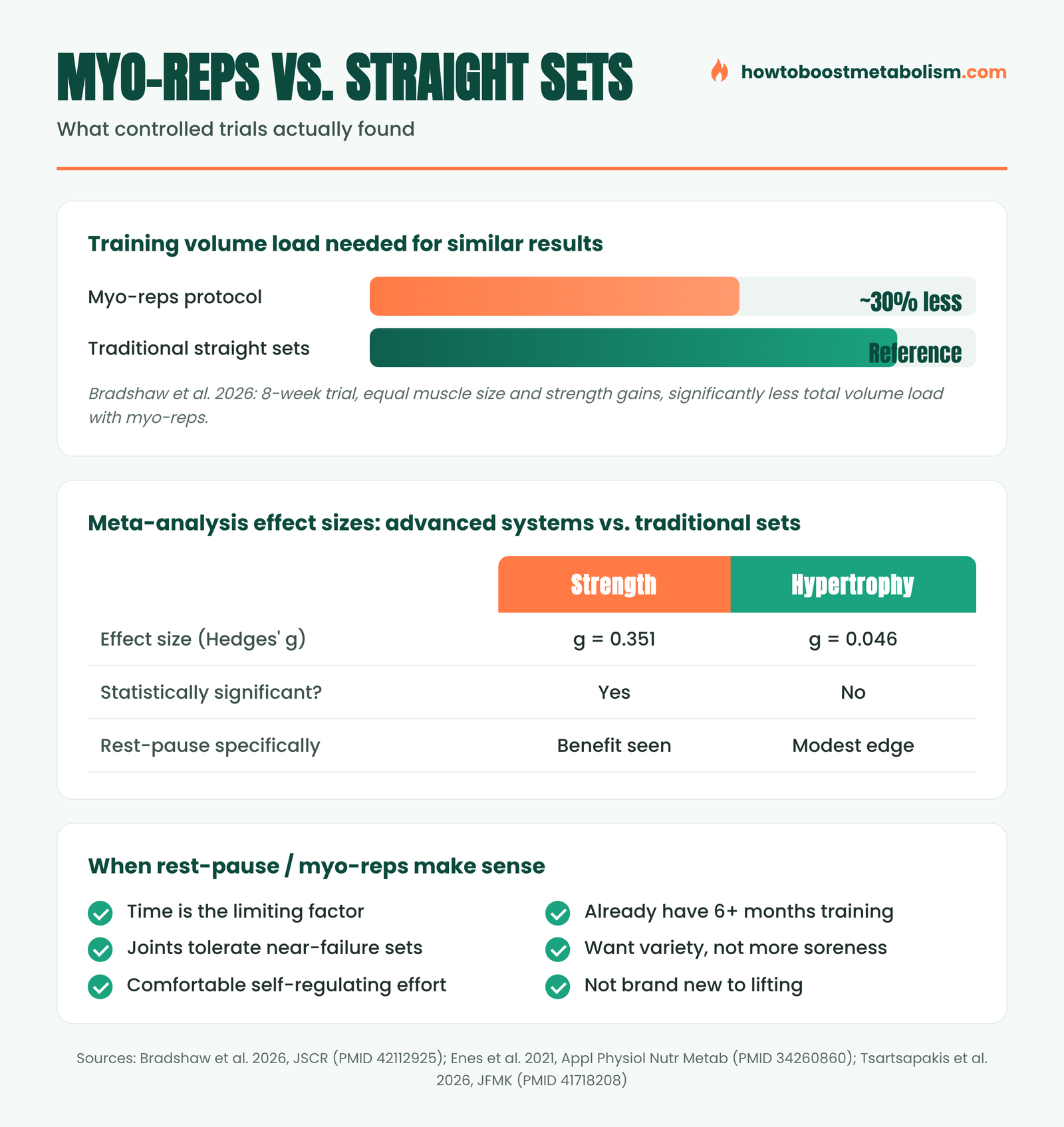
The most direct recent test comes from a 2026 trial in the Journal of Strength and Conditioning Research (PMID 42112925). Researchers compared a myo-reps protocol against traditional straight sets on the bench press over 8 weeks in resistance-trained men. The result: no significant difference in muscle size, maximal strength, or strength endurance between the two groups — but the myo-reps group did it with about 30% less total training volume (volume load, meaning sets × reps × weight). An earlier acute comparison in the same study found no difference in muscle excitation (EMG) or bar velocity between the two methods, just a significantly shorter session.
A separate 2021 trial in Applied Physiology, Nutrition, and Metabolism (PMID 34260860) compared rest-pause, drop sets, and traditional training head-to-head over 8 weeks with total volume equalized across groups. Muscle thickness gains were statistically similar across all three methods — but rest-pause produced a slightly larger improvement in 1-rep-max back squat strength than traditional training. In other words: when total volume is matched, rest-pause doesn’t necessarily build more muscle, but it may nudge strength up a bit more efficiently.
A 2026 trial in Scandinavian Journal of Medicine & Science in Sports (PMID 42340141) compared progressive-overload rest-pause against progressive-overload drop sets over 8 weeks and found both added essentially identical lean mass (1.2 kg vs. 1.4 kg, no significant difference between groups) and similar strength gains on the bench press. Body fat didn’t meaningfully change in either group — these are muscle-building protocols, not fat-loss ones.
Free download
🔥 The Metabolism Starter Kit
3 honest guides: a 7-day reset plan, a foods cheat-sheet and 12 metabolism myths debunked. No spam — unsubscribe anytime.
What a 2026 Meta-Analysis Adds
A systematic review and meta-analysis in the Journal of Functional Morphology and Kinesiology (PMID 41718208) pooled 23 studies comparing advanced resistance training systems — including rest-pause, drop sets, cluster sets, and tempo-controlled training — against traditional multi-set training in recreationally trained adults. Pooled across all outcomes, advanced systems showed a small but statistically significant edge (g = 0.159). Broken down by outcome, the picture gets more specific: strength showed a moderate, significant benefit (g = 0.351), while hypertrophy showed only a small, non-significant effect (g = 0.046). Rest-pause specifically showed a modest hypertrophy advantage within that pool, while velocity-based training and eccentric overload drove most of the strength benefit. The honest takeaway: these methods aren’t a shortcut to more muscle than well-executed traditional training gives you — their real edge is efficiency and, to a smaller degree, strength.
| Dimension | Myo-reps / rest-pause | Traditional straight sets |
|---|---|---|
| Total session time | Shorter (less rest between efforts) | Longer (full rest between sets) |
| Muscle growth (volume-matched) | Similar | Similar |
| Strength gains | Slightly favored in some trials | Equal or slightly behind |
| Perceived effort (RPE) | Higher | Lower |
| Lactate accumulation | ~37% lower than traditional (Almeida 2024) | Reference |
| Best for | Time-crunched, experienced lifters | Beginners, those building a base |
Why It Feels Harder Even When the Numbers Look Similar
A 2024 crossover study in Frontiers in Sports and Active Living (PMID 39534528) measured something that explains why these methods have a reputation for brutal: despite producing roughly 37–38% lower blood lactate after a session compared to traditional training, participants’ rated perceived exertion (RPE) was consistently higher for rest-pause and a related high-density method than for traditional sets (8.5 and 8.6 out of 10, versus 6.0). The discomfort is real and partly psychological — pushing repeatedly through short rests at high effort simply feels harder, even when the underlying physiological strain, as measured by lactate, is actually lower.
Myo-Reps, Rest-Pause, Cluster Sets, Drop Sets: Telling Them Apart
These terms get used loosely enough online that it’s worth being precise, because the differences matter for how hard a session actually feels. A drop set drops the weight and keeps going immediately with no rest at all. A cluster set, which we cover in a separate guide, breaks a single set into smaller clusters with slightly longer rests (often 15–45 seconds) specifically to preserve bar speed and power, not just to extend volume. Rest-pause sits in between — short pauses, same weight, no formal cluster structure. Myo-reps adds the most structure of the four: one fatiguing activation set, then a defined series of small clusters at the same short rest interval, continuing until a drop-off rule is hit. None of the trials above found one of these clearly superior to the others for hypertrophy when volume was matched — the real differences show up in how fast they feel, how much they tax your joints per session, and how much thinking you have to do mid-set to follow the structure correctly.
How to Program It After 40
- Reserve rest-pause/myo-reps for 1–2 exercises per session, not the whole workout — the mental and joint demand adds up fast.
- Pick exercises where failure is safe to approach: machines, cables, dumbbells, or a spotted barbell lift — not an unspotted heavy squat or bench.
- Keep rest between mini-clusters genuinely short, around 10–20 seconds, or you’re just doing a slow straight set.
- Stop a myo-reps sequence when rep speed clearly slows or form breaks down, not by a fixed cluster count.
- Expect 1–2 fewer total sets per muscle group per week if volume output per set is higher — track volume load, not just set count.
- Deload these methods more readily than straight sets; the higher RPE accumulates fatigue faster even when lactate is lower.
- Log how a session actually feels the next day, not just the weight on the bar — if recovery is consistently worse than with straight sets at similar volume, that’s your signal to dial back frequency, not push through it.
Who Should Wait
If you’re newer to structured lifting, the research above was done in resistance-trained participants — people who already had a base of consistent training. Our guide on newbie gains covers why early strength increases come mostly from neural adaptation, not advanced intensification techniques — meaning straight sets with good form and progressive overload will do more for a new lifter than rest-pause ever will. Layer on intensity techniques once your technique is solid and you have a realistic sense of what “close to failure” actually feels like for you.
Joint health is the other practical filter, especially after 40. Pushing repeatedly close to failure on a loaded knee, shoulder, or lower back with almost no rest between efforts is a very different stress than a straight set with full recovery, even at identical total volume. If you’re managing an existing tendon or joint issue, it’s worth reading our guide on eccentric training and tendon health after 40 before adding rest-pause or myo-reps to a lift that already bothers you, and consider reserving these techniques for machine or cable exercises where the failure point is controlled and a spotter isn’t required.
Short on training time but still want a structured muscle-building plan built for lifters over 40? Old School New Body’s F4X approach is built around brief, efficient sessions rather than long gym time.
Check Availability →Affiliate link — we may earn a commission at no extra cost to you. Disclosure
Honest note: the authors of Old School New Body are real coaches, but some marketing claims on the sales page (such as specific aging-rate statistics) aren’t backed by cited sources — treat those figures as marketing, not science, and judge the program on its training structure instead.
Free download: our Metabolism Starter Kit — a protein calculator, a 7-day meal framework, and a one-page supplement checklist, with zero hype.
Get the Free Starter Kit →The Bottom Line
Myo-reps and rest-pause training don’t appear to build meaningfully more muscle than well-executed straight sets when total volume is matched — the 2026 meta-analysis puts the hypertrophy advantage at a small, non-significant g = 0.046. What they reliably do is cut session time by roughly 30% while producing similar results, with a small but real edge for strength (g = 0.351) and a possible modest hypertrophy nudge specific to rest-pause. If a packed schedule is the real obstacle to training consistently, that’s a legitimate reason to use these methods — not because they’re magic, but because the best program is still the one you can actually finish.
For related training-structure questions, see our guides on cluster sets vs. traditional sets, supersets vs. straight sets, and training volume landmarks (MEV/MAV/MRV). If you want to understand how fast you should be moving the weight itself, our piece on rep tempo and time under tension is a natural next read.
Frequently Asked Questions
Do myo-reps build muscle faster than traditional sets?
Not faster in terms of more muscle per week — controlled trials (PMID 42112925) found similar muscle size and strength gains between myo-reps and traditional straight sets over 8 weeks. What myo-reps reliably save is time: the same study found about 30% less total training volume was needed to get there.
Is rest-pause training better for strength or muscle size?
The evidence leans toward strength. A 2026 meta-analysis (PMID 41718208) found a significant moderate benefit for strength (g = 0.351) across advanced training systems, but only a small, non-significant hypertrophy effect (g = 0.046), with rest-pause specifically showing a modest hypertrophy edge.
Why does rest-pause training feel so much harder than straight sets?
Despite producing 37-38% lower blood lactate than traditional training in one trial (PMID 39534528), perceived effort (RPE) was rated noticeably higher. The physiological strain, as measured by lactate, may actually be lower — but the repeated pushes through short rests near failure feel more demanding.
Should beginners use myo-reps or rest-pause training?
Probably not yet. The supporting trials were done in resistance-trained participants with an existing base of training experience. Beginners get most of their early progress from learning movement patterns and neural adaptation, which straight sets with good form deliver just as well, with less joint and fatigue cost.
How much rest should I take between myo-rep clusters?
Most protocols use roughly 10-20 seconds between mini-clusters after the initial activation set. Longer rests start to resemble a slow traditional set rather than a true myo-reps sequence.
This article is for general educational purposes and is not medical advice. Check with a qualified healthcare provider or trainer before starting a new training protocol, especially if you have joint or cardiovascular concerns. See our Medical Disclaimer.