The Step-Up Exercise: Complete Form & Loading Guide
This article may contain affiliate links. If you buy through them, we may earn a small commission at no extra cost to you. See our Affiliate Disclosure and Medical Disclaimer.
The step-up looks like one of the simplest exercises in the gym: step up onto a box, step back down, repeat. But it is also one of the most misunderstood. Some lifters treat it as a light warm-up movement, others treat it as a knee-destroyer to avoid, and plenty of gym-floor advice about step height and loading isn’t backed by anything beyond opinion. Here is what the actual research on step-up biomechanics and training outcomes says, and how to use it well after 40.
What the Step-Up Actually Trains
The step-up is a single-leg (or near-single-leg) exercise that drives your body weight, plus any added load, upward using one leg at a time, while the opposite leg provides balance and a smaller assist. It primarily loads the quadriceps, glutes, and hamstrings of the working leg, with a meaningful hip-stability demand from the standing leg and hip abductors. Because you’re stepping up onto a fixed surface rather than squatting down and back up, the movement also closely mirrors a real-world task such as climbing stairs, stepping onto a curb, or getting out of a low chair, which is part of why it shows up so often in rehabilitation and functional-training programs for older adults.
Step-Up vs. Lunge vs. Squat: What the EMG Data Actually Shows
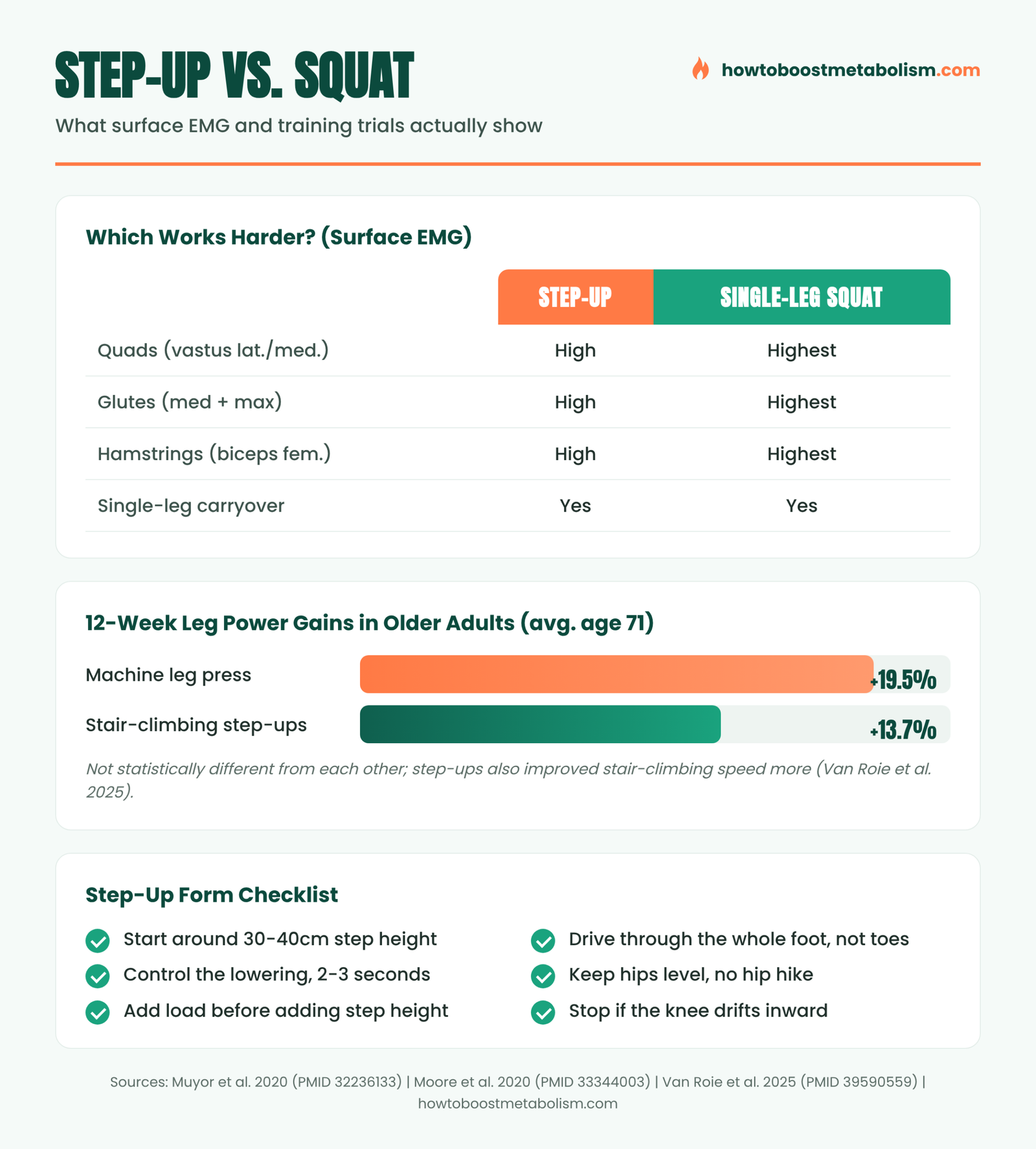
A 2020 study published in PLoS One measured surface electromyography (EMG) in the gluteus medius, gluteus maximus, biceps femoris, vastus lateralis, vastus medialis, and rectus femoris while 20 physically active adults performed the lateral step-up, forward lunge, and single-leg (“monopodal”) squat, all at a matched relative load (Muyor et al., 2020, PLoS One, PMID 32236133). The single-leg squat produced significantly higher EMG activity than both the step-up and the lunge in every muscle measured except the rectus femoris, a moderate-to-large difference (Cohen’s d above 0.6). Across all three exercises, the vastus lateralis and vastus medialis showed the highest activity, followed by the glutes.
That is a useful reality check: the step-up is not a harder or more intense stimulus than a well-performed single-leg squat. What it offers instead is accessibility. Most people can load a step-up with dumbbells or a barbell more easily and more safely than they can load a free-standing single-leg squat, which demands far more balance.
Free download
🔥 The Metabolism Starter Kit
3 honest guides: a 7-day reset plan, a foods cheat-sheet and 12 metabolism myths debunked. No spam — unsubscribe anytime.
The Step-Up as a Glute Builder
If your goal leans more toward hip and glute strength specifically, the step-up has real evidence behind it. A systematic review and meta-analysis in the International Journal of Sports Physical Therapy pooled data from 56 studies to identify which common therapeutic exercises reliably generate “high” activity, above 40 percent of maximum voluntary isometric contraction, in the gluteus medius and gluteus minimus, the smaller hip muscles that stabilize the pelvis during walking, stairs, and single-leg stance (Moore, Semciw and Pizzari, 2020, PMID 33344003). The lateral step-up was one of a short list of exercises that met that bar for the middle gluteus medius segment, alongside the single-leg bridge and resisted side-stepping. In other words, if hip stability or glute activation is the specific goal, the step-up earns its place on evidence, not just gym-floor tradition.
Step Height: Why It Matters More Than Most Lifters Think
Step height changes two things at once: how much knee and hip flexion the working leg has to produce force through, and how much balance and hip-stability demand is placed on you at the top of the movement. A taller step increases both: more range of motion for the muscles to work through, but also more time spent in a less stable position. There is no single research-backed correct height for everyone, because it depends on leg length, mobility, and training goal, but a clinical trial in older adults used a step height of 30-40 cm, roughly knee height, as the training stimulus, which is a reasonable, well-tested starting point for most adults rather than something to guess at.
Step-Ups and Leg Power: Why This Matters More as You Age
Leg power, meaning how quickly you can produce force rather than just how much force you can produce, declines faster with age than maximum strength does, and that decline shows up more in single-joint, lower-limb movements than in more complex multi-joint ones (Bean et al., 2018, Experimental Gerontology, PMID 29859263). That is part of why a 2025 randomized trial in the Journal of Strength and Conditioning Research is worth paying attention to: it compared 12 weeks of machine-based resistance training against a stair-climbing/step-up protocol in adults averaging 71 years old, training twice a week (Van Roie, van Uffelen and Delecluse, 2025, PMID 39590559). Leg-extensor power increased by 19.5 percent in the machine-training group and 13.7 percent in the step-up group, a difference the researchers couldn’t confirm was statistically meaningful either way, while the step-up group improved more on actual stair-climbing speed. Both groups improved similarly on walking speed, sit-to-stand performance, and jump height.
The honest takeaway isn’t that step-ups beat the gym or vice versa; it is that a simple, loadable, single-leg movement pattern like the step-up can build real functional leg power in older adults, competitively with machine training, while also directly transferring to the task, climbing stairs, it most resembles.
Lateral vs. Forward Step-Up: Does Direction Matter?
You’ll see the step-up performed two main ways: forward (facing the box, stepping straight up) and lateral (standing beside the box, stepping up and over sideways). The EMG research referenced above specifically used the lateral version and still found the working leg’s quadriceps and glutes doing most of the work, with a somewhat larger hip-stability demand than you’d get from a forward step-up, because the movement path crosses the body’s midline. The forward version is generally the easier starting point for most people since it is more intuitive and keeps the torso squarer to the box; the lateral version is a reasonable progression once you’re comfortable with balance and want to add more frontal-plane hip-stability work. Neither is clearly superior for straightforward muscle building; the choice mostly comes down to which movement pattern you want to reinforce and how it feels on your particular knees and hips.
Who Should Build Step-Ups Into Their Program (and Who Should Be Cautious)
Step-ups are a reasonable default for most adults looking to build single-leg strength, improve balance, and train a movement pattern that directly transfers to stairs and daily life. They tend to be a good fit if you’re newer to unilateral training and want something less balance-demanding than a single-leg squat, if you’re specifically targeting hip and glute strength, or if you’re working around a bilateral exercise (like a back squat) that currently bothers a joint. They’re worth approaching more cautiously, or starting at a very modest step height and body weight only, if you have an active knee injury, significant balance issues, or vertigo, since the movement does require standing, shifting weight, and briefly balancing on one leg at the top. In those cases, a physical therapist can help you find a safe starting point, or a supported version (holding a rail or using a much shorter step) can bridge the gap.
| Variable | Lower demand | Higher demand | Practical takeaway |
|---|---|---|---|
| Step height | Lower demand, more stable | Taller demand, less stable | Start ~knee height (30-40cm) |
| Load added | Light dumbbells | Barbell / heavy dumbbells | Progress load before height |
| Best for | Beginners, knee-sensitive | Experienced lifters | Both, at the right dose |
| Primary muscles | Quads, glutes, hamstrings | Same, more hip stability | – |
Common Mistakes That Make Step-Ups Worse
- Using momentum. Pushing off the ground leg or bouncing out of the bottom turns a controlled strength exercise into a hop, and you lose most of the single-leg benefit.
- Picking a step that’s too tall for your current mobility. If you can’t step up without your knee caving inward or your trunk lurching forward, the step is too high for now; lower it and add load instead.
- Letting the trailing leg do the work. If you can feel your back foot driving you up, you’re closer to doing a reverse lunge than a true step-up.
- Skipping the controlled descent. The lowering phase is where a lot of the stability and eccentric-strength benefit comes from; stepping straight down without control wastes it.
How to Add Step-Ups to Your Program
- Weeks 1-2: Bodyweight step-ups, step height about knee height, 2-3 sets of 8-10 per leg, focused on balance and control.
- Weeks 3-6: Add light dumbbells held at your sides, same height, 3 sets of 8-12 per leg.
- Weeks 6+: Progress load (dumbbells, then a loaded backpack or barbell if your gym allows a step-up variation) before you progress step height. Most people get more out of a heavier load at a moderate height than a taller box with light weight.
Step-ups pair naturally with other single-leg and unilateral work. If you’re building a leg day around this kind of training, it is worth reading our guides to unilateral training after 40 and the Bulgarian split squat, which sits a notch harder on the same spectrum of single-leg movements.
If you’d rather follow a structured, done-for-you program than piece together single-leg work on your own, Old School New Body is built specifically for lifters over 35-40 who want a clear, progressive plan.
Check Availability →Affiliate link — we may earn a commission at no extra cost to you. Disclosure
Honest note: some of the marketing claims on that program’s landing page, like fixed statistics about how fast the average body ages without training, aren’t backed by a cited source we could verify; treat those as marketing, not research. The underlying training approach, structured progressive strength work for adults over 35-40, is a reasonable one.
Free download: our Metabolism Starter Kit — a protein calculator, a 7-day meal framework, and a one-page supplement checklist, with zero hype.
Get the Free Starter Kit →Also worth checking on your way out: our self-tests for spotting a strength imbalance between your legs, which pairs well with any single-leg exercise you’re adding to your routine.
Frequently Asked Questions
Is the step-up a good exercise for bad knees?
Often, yes, within a pain-free range. Because you control your own step height and tempo, you can regulate how much knee flexion and load the joint sees, which is why step-ups show up in several knee-osteoarthritis and ACL-rehab exercise programs. That said, being generally knee-friendly isn’t the same as being guaranteed pain-free for your specific knee; if a given depth or load reproduces sharp pain, reduce the height or load rather than pushing through it, and check with a physical therapist if pain persists.
What step height should I start with?
A box or step around 30-40 cm (roughly 12-16 inches, about knee height) is a reasonable starting point for most adults; it is the height used in a 2025 trial that had older adults build leg power through stair-climbing-style step-ups. Shorter is fine if balance or knee comfort is a concern, and you can always raise the step once the movement feels controlled and pain-free.
Is the step-up really a unilateral exercise, or does the back leg help?
It genuinely works one leg at a time in the sense that the lead leg does most of the force production, but unlike a true single-leg squat, the trailing leg does provide some assistance and balance support, especially as you push through the top. If your goal is to isolate one side as much as possible, a rear-foot-elevated split squat or single-leg press puts more of the demand on the lead leg alone.
Should I do step-ups instead of squats, or alongside them?
Alongside, for most people. Surface EMG research comparing the step-up, forward lunge, and single-leg squat found the single-leg squat produced higher muscle activity across the quadriceps, hamstrings, and glutes than the step-up or lunge, so step-ups aren’t a stronger stimulus than a well-loaded squat pattern. What they add is single-leg loading, hip stability demand, and a movement pattern that maps directly onto stairs and daily function, which a bilateral squat doesn’t train the same way.
How much weight should I use on step-ups?
Enough that the last 2-3 reps of a set of 8-12 feel genuinely challenging while your form stays clean: no significant forward lean, no knee caving inward, no using momentum to pop off the step. Many lifters progress load faster than step height; it is generally safer to add weight at a moderate, controlled step height than to keep raising the box until balance becomes the limiting factor instead of leg strength.
This article is for educational purposes and is not a substitute for personalized medical or physical-therapy advice. See our Medical Disclaimer.