Does Cardio Cancel Out Your Strength Gains?
This article may contain affiliate links. If you buy through them, we may earn a small commission at no extra cost to you. See our Affiliate Disclosure and Medical Disclaimer.
If you lift weights and also do cardio, you’ve probably heard the warning: combining the two will “cancel out” your strength gains. It’s one of the most repeated claims in gym culture, and like most gym folklore, it’s built on a real phenomenon that’s been exaggerated past what the research actually shows. The effect is real. It’s also smaller, more conditional, and far more manageable than the warning implies.
This matters most for exactly the audience most likely to be doing both: people over 40 trying to build or preserve muscle while also caring about cardiovascular health, VO2 max, and long-term heart disease risk. You don’t get to opt out of cardio at this age for the sake of “protecting gains” — so the real question is how to structure both so neither one undermines the other more than it has to.
At a Glance
| Question | Short Answer |
|---|---|
| Is the interference effect real? | Yes, but modest — concurrent training still builds significant muscle and strength |
| What matters most? | Cardio modality (running interferes more than cycling), your sex, and training status |
| Does it affect women the same way? | Lower-body strength interference has been found in men but not significantly in women |
| Best fix | Favor low-impact cardio, separate sessions when possible, prioritize lifting order if combined |
| Should 40+ lifters skip cardio to protect gains? | No — the fitness and longevity cost outweighs a modest hypertrophy trade-off |
Where the “Interference Effect” Actually Comes From
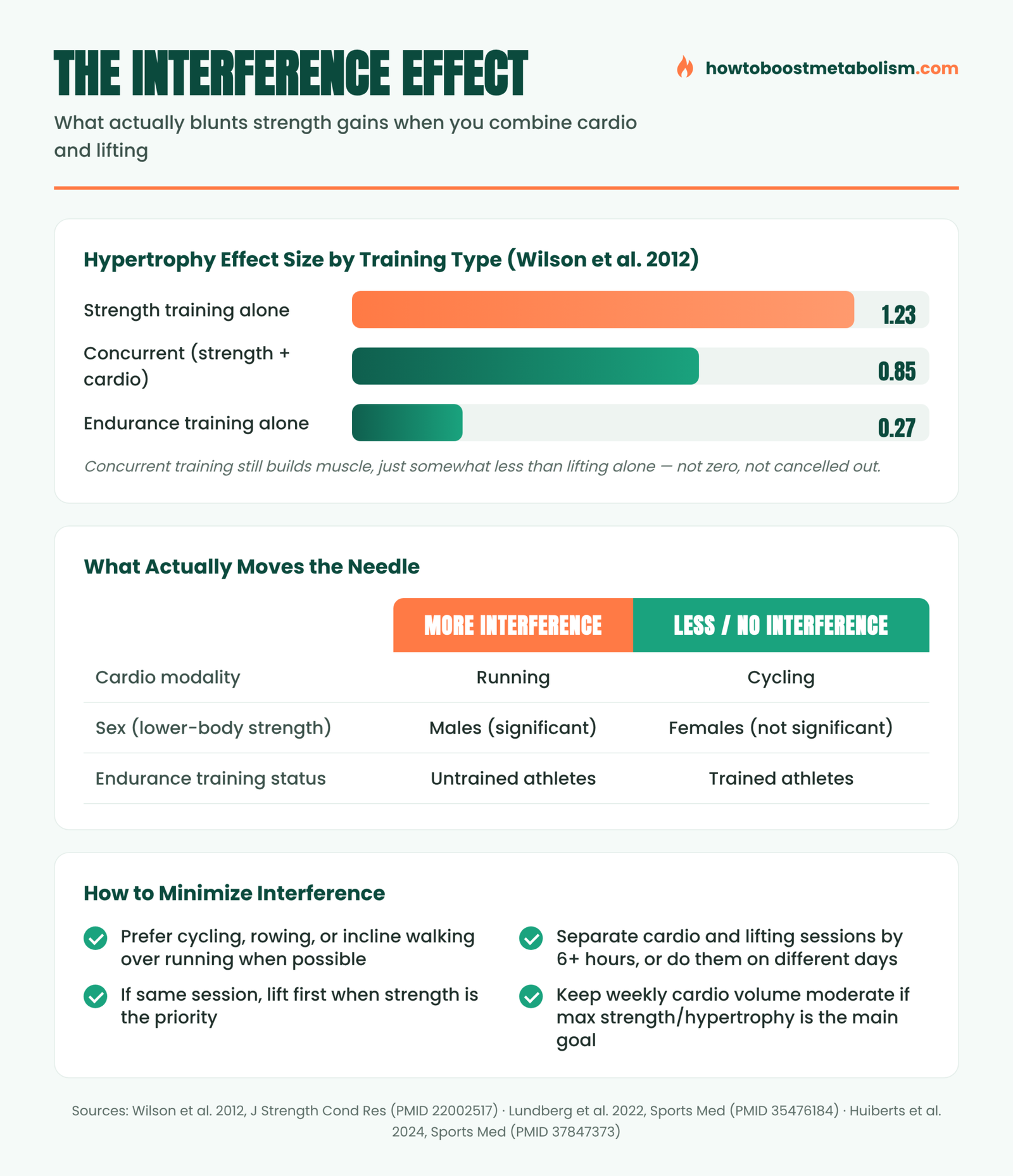
The term comes from a foundational 2012 meta-analysis in the Journal of Strength and Conditioning Research (PMID 22002517), which pooled 21 studies and 422 effect sizes comparing strength training alone, endurance training alone, and the two combined (“concurrent” training). The hypertrophy effect size for strength training alone was 1.23; for concurrent training, it was 0.85; for endurance training alone, just 0.27. In plain terms: concurrent training still built substantially more muscle than cardio alone, and both concurrent and strength-only training were significantly better than endurance training by itself. The strength-only group did outperform the concurrent group, which is the real, measurable interference effect — but “somewhat less muscle growth” is a very different message than “your gains are cancelled out.”
The same study found something more useful than the headline number: the interference wasn’t uniform. It showed up specifically when the endurance component was running, not cycling. Running is weight-bearing and involves a high degree of eccentric muscle damage in the same lower-body muscles targeted by squats, lunges, and leg presses, which may explain why it competes more directly for recovery resources. Cycling, being non-impact and more joint-friendly, showed no comparable interference in this analysis.
Free download
🔥 The Metabolism Starter Kit
3 honest guides: a 7-day reset plan, a foods cheat-sheet and 12 metabolism myths debunked. No spam — unsubscribe anytime.
What a More Recent, More Precise Look Found
A 2022 systematic review and meta-analysis in Sports Medicine (PMID 35476184) went a level deeper, looking specifically at muscle fiber size rather than whole-muscle measurements. Pooling 15 studies, it found a small but statistically significant negative effect of concurrent training on overall fiber hypertrophy (standardized mean difference of -0.23, p=0.05) compared with strength training alone. When the researchers broke this down by fiber type, the negative effect was concentrated in type I (slow-twitch, endurance-oriented) fibers, and again, specifically when the cardio was running rather than cycling. Type II fibers — the ones most responsible for strength and power — showed no significant interference at all.
Put together, the two most relevant meta-analyses on this topic agree on the same practical conclusion from two different angles: the interference effect concentrates in specific fibers and specific cardio modalities, not across the board. If your cardio of choice is already cycling, rowing, swimming, or incline walking, you may be dealing with close to zero measurable interference in the first place.
The Detail Most Articles Skip: It Depends on Your Sex
A 2024 meta-analysis in Sports Medicine (PMID 37847373), pooling 59 studies and 1,346 participants, specifically examined whether concurrent training affects men and women differently. The result was striking: concurrent training produced significantly blunted lower-body strength gains in men (effect size -0.43, p=0.03) but showed no significant interference in women at all (effect size +0.08). Upper-body strength, power, and VO2max gains didn’t differ meaningfully by sex. The same analysis found that training status mattered for cardio adaptations specifically: untrained people doing concurrent training saw smaller VO2max improvements than trained athletes did, but this didn’t hold for strength or hypertrophy outcomes.
This is a genuinely underreported finding. Most of the gym folklore around the interference effect was built on research pools that skewed male, and the practical warnings got generalized to everyone. If you’re a woman in your 40s or 50s doing both strength training and cardio, the best current evidence suggests you may be dealing with less lower-body interference than the general warnings imply — one more reason the blanket “cardio kills your gains” framing oversimplifies a more nuanced picture.
Why Interference Happens at All: The Signaling Conflict
At the cellular level, the proposed explanation for the interference effect is a conflict between two signaling pathways. Resistance training primarily activates mTOR (mechanistic target of rapamycin), which drives muscle protein synthesis and hypertrophy. Endurance training primarily activates AMPK (AMP-activated protein kinase), which drives mitochondrial biogenesis and endurance adaptations. There’s long-standing evidence from cell and animal studies that AMPK activation can blunt mTOR signaling, which would mean a hard cardio session close to a lifting session could theoretically dampen the muscle-building response to that workout.
This mechanism is real and well documented at the molecular level, but it’s also become somewhat overstated as a practical warning. The molecular interference window appears to be real but time-limited — AMPK activation from a single cardio session doesn’t stay elevated indefinitely, which is part of why separating sessions by several hours, or doing them on different days, meaningfully reduces the overlap. It’s also why high-impact, high-volume endurance work (think marathon training) shows more interference in the research than moderate, shorter cardio sessions most people are actually doing alongside a lifting program.
A Practical Weekly Template
For someone over 40 trying to build muscle and stay cardiovascularly fit without obsessing over every variable above, a reasonable week looks something like this:
- 3-4 resistance training sessions, full-body or upper/lower split, with at least one rest or cardio-only day between sessions hitting the same muscle groups hard.
- 2-3 cardio sessions, prioritizing cycling, rowing, incline walking, or swimming over running if minimizing interference matters to you.
- On overlapping days, lift first, then do cardio afterward, or separate the two by 6+ hours (morning cardio, evening lifting, or vice versa).
- One genuinely easy day with light walking or full rest, since recovery capacity — not any single training variable — is usually the actual limiting factor once total weekly volume climbs.
None of this needs to be precise to work. The research differences between “optimal” and “good enough” scheduling are measured in fractions of an effect size — meaningful in a research context, barely noticeable over months of consistent training in real life.
How to Structure Both Without Losing Either
| If Your Priority Is… | Practical Adjustment |
|---|---|
| Maximum strength/hypertrophy, cardio for health only | Choose cycling/rowing over running; keep cardio to 2-3 moderate sessions/week; lift first if same-day |
| Balanced strength + endurance goals | Separate hard sessions by 6+ hours or different days where possible; don’t chase personal bests in both simultaneously |
| VO2max / cardiovascular health as the main goal | Interference on cardio adaptations from lifting is minimal in the research — lift freely |
| Over 40, want both without overthinking it | Any reasonable combination beats skipping either one — the health cost of dropping cardio outweighs a modest hypertrophy trade-off |
For most people reading this, the practical answer is simple: don’t let a gym myth talk you out of cardiovascular exercise you need for long-term health, and don’t let a vague fear of “interference” stop you from lifting hard. If you want to optimize at the margins, the research points to specific, easy levers — cardio modality and session timing — rather than avoiding one activity altogether.
If you want a structured approach built around training efficiently for both muscle and fat loss without guesswork, Anabolic Fasting is one option worth a look. The vendor’s framing — “build muscle and burn fat simultaneously” — is marketing language, not a guarantee, but the underlying idea of structuring fasting windows around focused training sessions lines up with what the research above actually supports: smart session structure matters more than avoiding cardio altogether.
Learn More →Affiliate link — we may earn a commission at no extra cost to you. Disclosure
Related Reading
For the training-frequency side of this same question, see our breakdown of full-body vs. split routines after 40. If cardio specifically means steady-state zone 2 work for you, we covered the fat-loss evidence for that separately in our zone 2 cardio guide, and if it means intervals, see HIIT vs. steady cardio for metabolism. And if VO2max itself is part of why you do cardio at all, we broke down the longevity research in VO2max as a longevity marker.
Free download: our Metabolism Starter Kit — a protein calculator, a 7-day meal framework, and a one-page supplement checklist, with zero hype.
Get the Free Starter Kit →Practical Takeaways
- The interference effect is real but modest: concurrent training’s hypertrophy effect size (0.85) is well above endurance training alone (0.27), just somewhat below strength training alone (1.23).
- Running interferes more than cycling in the available research, likely due to muscle damage overlap with lower-body lifting.
- Men showed significantly blunted lower-body strength gains from concurrent training in one large meta-analysis; women did not.
- Fiber-level analysis shows the effect concentrates in type I fibers, not the type II fibers most responsible for strength and power.
- For most lifters over 40, the cardiovascular health benefits of regular cardio outweigh a modest hypertrophy trade-off — the fix is smarter structuring, not elimination.
Frequently Asked Questions
Should I stop doing cardio to maximize muscle growth?
For almost everyone, no. The interference effect found in research is modest, and the cardiovascular and metabolic health benefits of regular cardio — particularly after 40 — are well established and substantial. The better strategy is adjusting cardio modality and timing, not eliminating it.
Is running really worse than cycling for lifters?
In the research reviewed above, yes — both the 2012 and 2022 meta-analyses found interference effects specific to running and not cycling, likely because running’s weight-bearing impact and eccentric muscle damage compete more directly with the same lower-body muscles used in lifting.
Should I do cardio and lifting in the same session?
Either approach is reasonable. If you do combine them in one session, the common recommendation is to lift first if strength/hypertrophy is your priority, since fatigue from cardio can reduce lifting performance more than the reverse. Separating them by several hours or different days removes most same-session fatigue interactions entirely.
Does the interference effect apply to fat loss too?
The research on interference specifically examines strength, power, and hypertrophy outcomes, not fat loss. Combining cardio and resistance training is generally supportive of fat-loss goals, since both contribute to the calorie deficit and resistance training helps preserve the muscle mass that cardio alone doesn’t protect as well.
Does this apply differently to people over 50?
The studies reviewed here weren’t age-restricted to older adults specifically, but there’s no evidence the basic pattern (modest interference, modality-dependent, more pronounced in men) reverses with age. If anything, the case for keeping both cardio and resistance training in your routine gets stronger after 50, given the added importance of cardiovascular health and bone-loading exercise.
This article is for general educational purposes and is not medical advice. Talk to your doctor before starting a new exercise program. See our Medical Disclaimer for more.