
Creatine Loading Phase: Is It Necessary or Can You Skip It?
This article may contain affiliate links. If you buy through them, we may earn a small commission at no extra cost to you. See our Affiliate Disclosure and Medical Disclaimer.
Open almost any creatine product and you’ll see the same ritual recommended: start with a ‘loading phase’ of 20 grams a day for about a week, then drop down to a smaller daily maintenance dose. It sounds like a mandatory first step. It isn’t. The loading phase changes how fast creatine works, not whether it works — and the research that this entire protocol comes from says so directly.
This article goes straight to that source study, lays out the actual numbers, and gives you a clear way to decide whether loading is worth it for you personally, or whether you’re better off skipping it.
A Quick Refresher: What Creatine Actually Does
Creatine is stored mostly in skeletal muscle as phosphocreatine, where it acts as a fast-access reserve for regenerating ATP — the molecule your muscle cells burn for energy during short, intense efforts like a heavy lift or a sprint. More stored creatine means a bigger reserve of that fast-access fuel, which is the mechanism behind creatine’s two best-documented effects: modestly more strength and power output during resistance training, and slightly faster recovery between hard sets or sprints. It is one of the most extensively studied supplements in sports nutrition, and one of the few with a genuinely consistent evidence base behind it rather than a handful of small, conflicting trials.
None of that changes based on whether you load it or not. The loading question is purely about the timeline to reach a saturated muscle creatine store — not about whether creatine works, or how well it works once you get there.
Where the Loading Protocol Actually Comes From
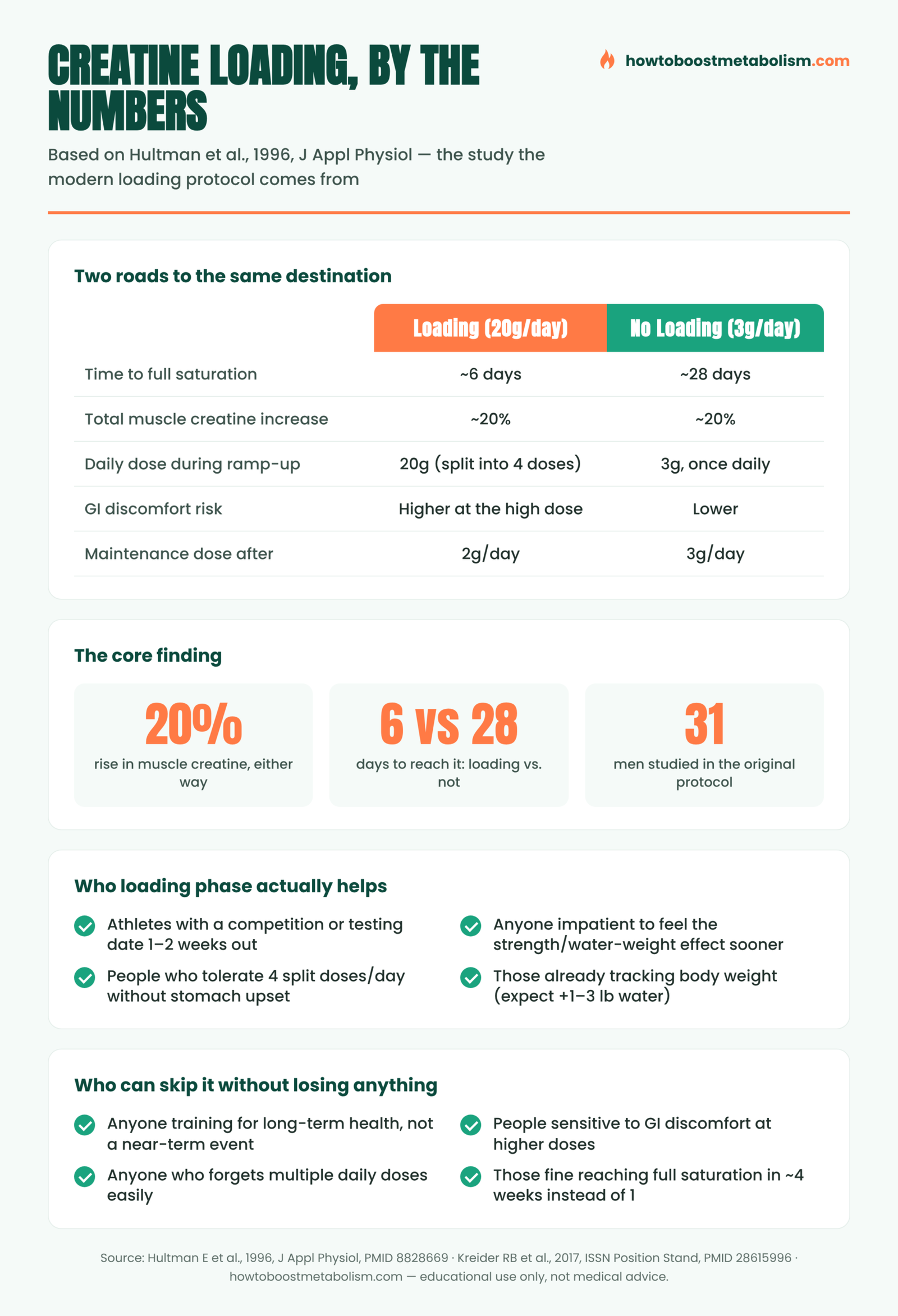
The 20g-for-6-days protocol traces back to a 1996 study in the Journal of Applied Physiology (Hultman et al., PMID 8828669), which remains the clearest head-to-head comparison of fast versus slow creatine loading. Researchers gave 31 men creatine at different doses and schedules and directly measured muscle creatine concentration via biopsy before and after.
The result, in the study’s own numbers: muscle total creatine concentration rose by approximately 20% after 6 days of supplementation at 20 grams per day. When that elevated level was then maintained with just 2 grams per day afterward, it stayed elevated — the muscle didn’t need the high dose to keep its stores topped up, only to fill them in the first place.
Here’s the part most marketing copy leaves out: a separate group in the same study took creatine at just 3 grams per day, with no loading phase at all, for 28 days. Their muscle creatine concentration rose by the same approximately 20% — just gradually over four weeks instead of six days. The researchers’ own conclusion was direct: 3 grams a day is, in the long run, likely to be as effective at raising muscle creatine levels as the higher loading dose. Same destination, different travel time.
| Protocol | Muscle Creatine Increase | Time to Saturation | Trade-off |
|---|---|---|---|
| Loading (20g/day, 6 days) | ~20% | ~6 days | Faster, but 4 doses/day and higher GI-discomfort odds |
| No loading (3g/day, 28 days) | ~20% | ~28 days | Slower, but simpler and gentler on the stomach |
Free download
🔥 The Metabolism Starter Kit
3 honest guides: a 7-day reset plan, a foods cheat-sheet and 12 metabolism myths debunked. No spam — unsubscribe anytime.
So Why Does Everyone Still Recommend Loading?
Mostly because faster matters to some people, and the extra cost is small. If you have a specific event — a competition, a strength test, a vacation where you want to look and feel fuller — getting to full muscle saturation in under a week instead of a month is a legitimate reason to load. Creatine also tends to make you hold roughly 1 to 3 pounds of extra water weight as your muscle cells pull in more fluid along with the creatine; loading just makes that happen in week one rather than spread gradually across month one. If you want to know ahead of time whether that water-weight shift is something to worry about, we cover it directly in our piece on the creatine-and-water-retention myth.
For general background on creatine’s safety and effectiveness profile — not specific to loading, but relevant context — the International Society of Sports Nutrition’s 2017 position stand (Kreider et al., PMID 28615996) remains one of the most comprehensive reviews available, and it does not treat loading as mandatory for creatine to be effective — only as an optional way to reach saturation faster.
The Honest Downsides of Loading
- GI discomfort: 20 grams in one sitting is enough to cause bloating or mild stomach upset in some people. Splitting it into 4–5 smaller doses across the day largely solves this, but it’s an extra thing to manage.
- Faster water-weight gain: if you’re weighing yourself daily and don’t want a 1–3 lb jump to catch you off guard in week one, loading will surprise you more than the gradual approach will.
- No performance advantage once saturated: after both approaches reach full muscle saturation (week one for loading, week four for the slow approach), there’s no evidence the loading group ends up ahead in strength or performance outcomes once both groups are saturated.
- More to remember: four doses a day for a week is simply more logistics than one scoop a day for a month.
Does It Matter How You Split the Loading Doses?
If you decide to load, how you spread the 20 grams across the day matters more than when exactly you take it relative to training. Taking the full 20 grams in a single serving is the most common cause of the bloating and mild stomach upset some people report during loading — the dose simply exceeds what a single serving comfortably handles for a lot of people. Splitting it into four 5-gram servings spaced through the day, ideally with food, is the standard fix and works well for most people who still want the faster timeline. There’s no strong evidence that taking creatine specifically before versus after a workout changes its effectiveness meaningfully; consistency day to day matters far more than precise timing around any single training session.
A Practical Decision Guide
Load if:
- You have a specific date (a meet, a test, an event) within the next 1–2 weeks where you want creatine’s effects already in place.
- You don’t mind splitting doses across the day for about a week.
- You’re not currently tracking body weight closely, or you’re prepared for a quick 1–3 lb water-weight shift.
Skip loading and just start at a steady dose if:
- You’re training for general, ongoing health and strength with no near-term event.
- You’ve had stomach issues with supplements before, or simply want the simplest possible routine.
- You’re fine reaching full muscle saturation in about four weeks rather than one.
Either path lands you in the same place: a maintenance dose of roughly 3–5 grams per day, taken consistently, for as long as you want the benefit. The loading phase is a convenience feature, not a requirement — closer to choosing express shipping than to a mandatory step in the recipe.
Does the Loading Phase Change Who Creatine Works For?
No — and this is a separate question from the loading debate that’s worth clearing up while we’re here. Creatine’s benefits aren’t limited to young male powerlifters, which is the stereotype the supplement carries. Research in older adults has looked at creatine specifically for preserving muscle mass and strength during resistance training programs designed to counter age-related muscle loss, and research in women has not found the response to differ meaningfully by sex. Whether you load or not, the people who tend to notice the clearest benefit are those who pair creatine with actual resistance training — not those taking it passively and expecting it to do the work of a workout on its own.
This matters for the loading decision specifically because it reframes the stakes: loading doesn’t determine whether creatine will work for you. Your training does. Loading only determines whether the modest performance and recovery benefits creatine provides show up in week one of your program or closer to week four. For most people building a long-term habit, that’s a minor scheduling detail, not a make-or-break decision.
Free download: our Metabolism Starter Kit — a protein calculator, a 7-day meal framework, and a one-page supplement checklist, with zero hype.
Get the Free Starter Kit →What This Doesn’t Mean
This isn’t a claim that creatine itself is risk-free for everyone or appropriate for every person — talk to your doctor before starting any new supplement, particularly if you have kidney issues, since creatine is processed through the kidneys. It’s also not a claim that loading is harmful; for most healthy adults it’s simply an optional, faster route to the same muscle creatine level that a steady low dose reaches more slowly. The actual research draws a narrow, specific conclusion — same endpoint, different timeline — and that’s exactly the conclusion this article is making, nothing broader. It’s also not a verdict on any particular brand or form of creatine; the loading-versus-no-loading comparison applies to creatine monohydrate specifically, the form almost all of the underlying research (including the Hultman study) was conducted with, and the form the ISSN position stand continues to recommend as the best-studied and most cost-effective option on the market.
Related reading: If you’re deciding between forms, see our comparison of creatine gummies vs. powder, and if the water-weight question above raised a flag, read our full breakdown of the creatine and water retention myth. For how creatine fits into training after 40 specifically, see creatine and metabolism after 40, and if you want a brand-specific option, our California Gold creatine review covers one widely available product.
Related: Like creatine loading, protein timing is a case where an acute lab finding doesn’t always hold up in longer real-world trials. We compared the two in our breakdown of whether spreading protein evenly across meals actually builds more muscle.
Related: Curious whether a supplement can do what creatine does for muscle preservation? We put HMB to the same test — here’s what the research actually shows about HMB and muscle loss after 40.
Creatine only pays off when there’s consistent resistance training behind it. Old School New Body is a follow-along program built around short, F4X-style strength sessions for adults over 35 — a simple option if you want a structured plan to pair with your daily dose.
Learn More →Affiliate link — we may earn a commission at no extra cost to you. Disclosure
Frequently Asked Questions
How much creatine is in a standard loading phase?
The classic loading protocol, from the research this article is based on, is 20 grams per day (usually split into four 5-gram doses) for 5–6 days, followed by a 2–5 gram per day maintenance dose. Some programs use 0.3g per kilogram of body weight per day instead of a flat 20g — for a 70kg (154 lb) person, that works out to about 21g/day, close to the same number.
Will I gain weight from creatine loading?
Likely yes, in the first week — typically 1 to 3 pounds (0.5–1.5 kg), almost entirely water pulled into your muscle cells along with the extra creatine, not fat. This is the same water-retention effect we cover in our dedicated piece on creatine and water retention, and it’s a normal, expected part of how creatine works, not a sign anything is wrong.
Does skipping the loading phase mean creatine won’t work as well?
No — it means it will work just as well, more slowly. The Hultman research (PMID 8828669) found that 3g/day for 28 days raised muscle creatine content by the same roughly 20% that 20g/day for 6 days achieved. The destination is the same; loading just gets you there in under a week instead of about a month.
Is the loading phase harder on your stomach?
For some people, yes. Splitting the higher daily dose into 4–5 smaller servings across the day (rather than taking it all at once) is the standard way to reduce the bloating or mild GI discomfort some people report during loading. If you’d rather avoid that entirely, skipping the loading phase and starting at a steady 3–5g/day avoids the issue altogether.
Do I need to keep ‘loading’ creatine indefinitely?
No. Loading is only the first 5–6 days, to saturate your muscle creatine stores faster. After that, both the loading and non-loading paths converge on the same ongoing maintenance dose — typically 3–5 grams per day — for as long as you want to keep taking it.
This article is for educational purposes only and is not medical advice. Talk to your doctor before starting any new supplement, especially if you have kidney concerns. See our Medical Disclaimer.