What to Eat on Ozempic: High-Protein Food List
This article may contain affiliate links. If you buy through them, we may earn a small commission at no extra cost to you. See our Affiliate Disclosure and Medical Disclaimer.
If you’ve started Ozempic, Wegovy, Zepbound, or Mounjaro, you’ve probably noticed the strangest part isn’t losing your appetite — it’s realizing you have almost no room left in the day for food that doesn’t count. That’s the real problem this food list solves. GLP-1 medications are remarkably effective at reducing hunger, but the research on what people actually lose while on them is more complicated than the before-and-after photos suggest, and what you eat in that smaller window of appetite determines a lot of it.
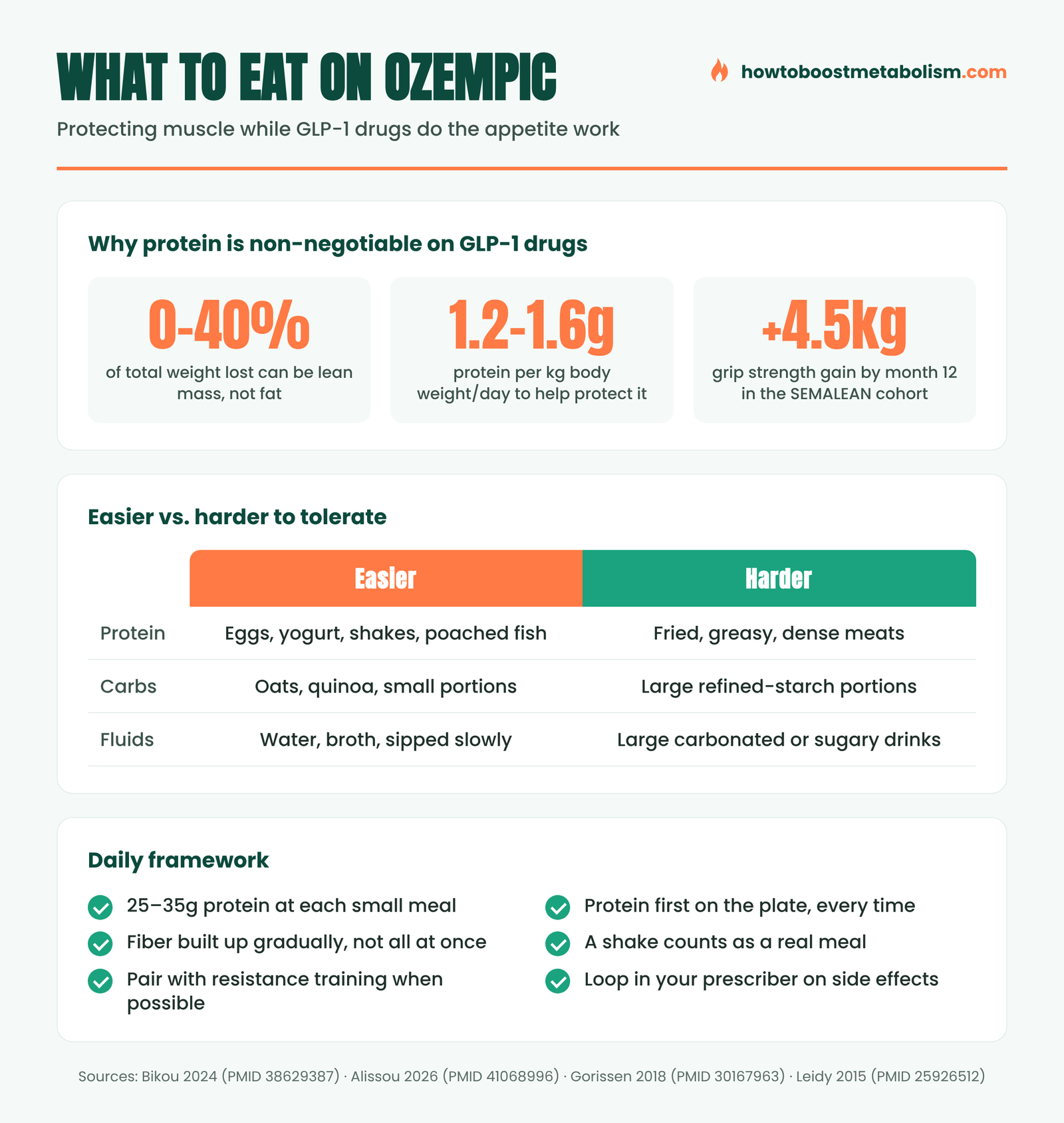
A pooled analysis of GLP-1 trials found that lean mass — muscle, not just fat — made up anywhere from a small share to as much as 40% of total weight lost, depending on the study and how closely diet and activity were managed (Bikou et al., 2024, Expert Opinion on Pharmacotherapy, PMID 38629387). A newer study following people on semaglutide for a full year (the SEMALEAN cohort) found lean mass dropped by about 3 kg through month seven before stabilizing, while grip strength — a decent proxy for functional muscle quality — actually improved by around 4.5 kg by month 12, which suggests that what you do with the rest of your routine (protein, resistance training) matters as much as the drug itself (Alissou et al., 2026, Diabetes, Obesity and Metabolism, PMID 41068996, PMC12673431). A 2026 BMJ Open trial protocol — LEAN-PREP — was designed specifically to test whether structured resistance training plus a protein target can blunt this lean-mass loss in people on semaglutide or tirzepatide (PMID 42020128, PMC13110620). None of this means the drugs are a bad choice — it means the food (and movement) choices around them are not optional extras.
The core problem: not enough room for protein
Protein is the single most studied nutrient for preserving lean mass during intentional weight loss, mainly because it supplies the amino acids your body needs to maintain muscle tissue and because it is the most satiating macronutrient per calorie, which helps when you’re already eating less (Leidy et al., 2015, PMID 25926512). The practical issue on a GLP-1 drug is volume: if your entire day’s intake drops from, say, 2,200 calories to 1,300, and you still try to eat the way you used to — a little protein alongside a lot of starch, sauce, and snacks — the protein gets squeezed out first, because it’s rarely the most calorie-dense or craveable part of a smaller meal.
The fix is to flip the order you build a plate in. Protein goes on first, in a specific amount, before anything else — not as a side thought after you’ve decided what sounds appealing. Most clinical nutrition guidance for preserving lean mass during active weight loss lands around 1.2–1.6 grams of protein per kilogram of body weight per day (roughly 0.55–0.75 g per pound), which for a 170-lb adult is about 95–130 grams spread across the day — a real target, not a vague “more protein” suggestion.
What to eat: the practical list
Protein sources that are easier to tolerate
Because GLP-1 drugs slow stomach emptying, dense or greasy protein (fried chicken, fatty steak, heavy cream sauces) is more likely to trigger nausea than lighter, simply prepared protein. Reported better-tolerated choices include:
- Eggs, egg whites, or egg-white-heavy omelets
- Plain Greek yogurt or cottage cheese (lower-fat versions tend to sit better than full-fat)
- Poached, baked, or grilled white fish and chicken breast rather than fried versions
- A clean whey or plant protein shake on days your appetite is lowest — often the easiest way to hit a protein number without having to physically chew and digest a large meal
- Tofu and tempeh, cooked simply (steamed, baked, or lightly stir-fried rather than deep-fried)
- Bone broth or a protein-fortified broth on days when solid food feels like too much
Whole-food protein should be the foundation whenever your appetite allows it — amino acid composition varies a lot between sources, and animal proteins like whey and eggs supply the fullest spread of essential amino acids per gram compared with most single plant proteins (Gorissen et al., 2018, Amino Acids, PMID 30167963, PMC6245118). That said, a well-chosen protein powder is one of the most realistic tools specifically for the GLP-1 situation — small volume, high protein density, easy to adjust to taste and tolerance.
If you’re vegan or avoiding dairy
Plant proteins generally supply a narrower amino acid profile per gram than animal sources, so portion sizes need to run a little higher, and blended sources (pea plus rice, for example) close the gap better than a single plant protein on its own (Gorissen et al., 2018, PMID 30167963). Comparisons of animal versus plant protein in resistance-trained adults have generally found no meaningful difference in lean mass or strength outcomes when total protein and training are matched (Lim et al., 2021, Nutrients, PMID 33670701, PMC7926405) — so a vegan approach is not a disadvantage, it just takes a bit more planning on quantity.
Carbohydrates and fats: smaller, not zero
There’s no research support for cutting carbs or fat to near-zero on a GLP-1 drug — the goal is simply to make sure protein gets its share of a much smaller daily total. Reasonable choices: a small serving of intact whole grains (oats, quinoa, brown rice) rather than refined starches that offer less fullness per calorie; cooked vegetables, which tend to be gentler on a slow-emptying stomach than large raw salads for some people; and modest amounts of healthy fat (olive oil, avocado, nuts) added to a dish rather than eaten as a large standalone portion, since concentrated fat is one of the more common nausea triggers.
Fiber: important, but dosed carefully
Constipation is one of the most frequently reported GLP-1 side effects, driven by slower gut transit combined with simply eating and drinking less overall. Soluble fiber from foods — berries, cooked vegetables, legumes, chia or ground flax — along with consistent water intake is usually the first-line fix clinicians recommend. Going in the opposite direction and adding a large fiber supplement dose on top of an already slow-emptying gut can occasionally make bloating worse, so start low and build gradually rather than taking a full adult dose on day one.
| Food group | Better-tolerated choices | What to go easy on |
| Protein | Eggs, Greek yogurt, poached fish, whey or plant shakes | Fried, greasy, or very dense meats |
| Carbs | Oats, quinoa, small portions of brown rice | Large refined-starch portions, sugary drinks |
| Fat | Olive oil, avocado in moderate amounts | Fried food, heavy cream sauces |
| Fiber | Berries, cooked vegetables, chia, legumes (built up slowly) | A large fiber supplement dose started all at once |
| Fluids | Water sipped through the day, broths | Large volumes of carbonated or very sugary drinks |
Free download
🔥 The Metabolism Starter Kit
3 honest guides: a 7-day reset plan, a foods cheat-sheet and 12 metabolism myths debunked. No spam — unsubscribe anytime.
A simple daily framework, not a meal plan
Because appetite varies so much day to day on these medications, a rigid meal plan tends to fail fast. A framework is more realistic: aim for 25–35 grams of protein at each of 3 smaller meals or 4 mini-meals, let vegetables and a small starch fill in what’s left of your appetite, and treat a protein shake as a legitimate meal on days solid food doesn’t appeal — not a consolation prize. If you’re also strength training (which the LEAN-PREP protocol above is specifically testing as a lean-mass protector), eating your highest protein meal within a couple of hours of training is a reasonable, low-effort habit, even though the exact timing window matters less than hitting the daily total.
Free download: our Metabolism Starter Kit — a protein calculator, a 7-day meal framework, and a one-page supplement checklist, with zero hype.
Get the Free Starter Kit →What this list won’t fix on its own
Food choices reduce the risk of excess muscle loss and ease side effects — they don’t eliminate either one, and they’re not a substitute for resistance training, which has the strongest evidence of anything for protecting lean mass during weight loss. If nausea, constipation, or appetite loss become severe enough to limit your ability to eat a reasonably varied diet, that’s a conversation for your prescriber, not something to manage around indefinitely with food substitutions alone.
For more on why GLP-1-related muscle loss happens and how to counter it with training, see our guide to preventing muscle loss on GLP-1 medications. If you want to support GLP-1 activity through diet and lifestyle rather than medication, our piece on boosting GLP-1 naturally covers the habits with real evidence behind them. And if you are deciding between whey and plant protein for your shakes, our full whey vs. plant protein comparison breaks down the amino acid and cost differences in more detail.
Related: Pair your food plan with movement: our muscle-protecting strength training plan for GLP-1 users covers frequency, protein, and warning signs.
Exercise, especially strength work, helps protect muscle while on GLP-1 medication. 7 Minute Ageless Body Secret offers short daily workouts aimed at women over 40. Talk to your doctor before starting a new program while on medication.
Learn More →Affiliate link — we may earn a commission at no extra cost to you. Disclosure
Frequently Asked Questions
Why does muscle loss matter so much on GLP-1 drugs like Ozempic or Zepbound?
Clinical trials show that lean mass can account for roughly a quarter to as much as 40% of the total weight lost on GLP-1 medications, depending on the study and how much resistance training and protein intake were controlled for. Since muscle is what keeps your resting metabolism from dropping further and keeps you strong and mobile as you age, losing a large share of it works against the long-term goal — a smaller body that still functions well. The food choices below exist to protect that muscle while the drug does its job on appetite and fat.
How much protein should I eat per day while on a GLP-1 medication?
Most research on preserving lean mass during intentional weight loss points to roughly 1.2–1.6 grams of protein per kilogram of body weight per day, spread across meals, which is higher than the general population’s intake target. Because GLP-1 drugs sharply reduce appetite, hitting that number usually means prioritizing protein first on your plate — before vegetables or starches — simply because there is less total food volume available in a day.
What foods are hardest to tolerate on Ozempic, Wegovy or Zepbound?
Greasy, fried, and very rich foods tend to cause the most nausea because GLP-1 drugs slow stomach emptying; a food that would normally move through in an hour can sit much longer, which is exactly when nausea shows up. Very large meals cause the same problem by sheer volume. Carbonated drinks and very sugary foods are commonly reported as poorly tolerated as well, though tolerance varies a lot from person to person and tends to improve somewhat as your dose stabilizes.
Do I need a fiber supplement if I’m eating less food overall on a GLP-1 drug?
Constipation is one of the most commonly reported side effects of GLP-1 medications, partly because slower gut transit combined with lower total food and fluid intake reduces stool bulk. A soluble fiber source and consistent water intake are usually the first fix clinicians suggest; a supplement can help close the gap on days your food volume is very low, but whole-food fiber from vegetables, berries, and legumes should still do most of the work when your appetite allows it.
Should I take a multivitamin while losing weight quickly on Ozempic or similar drugs?
If you are eating noticeably less food for an extended period, it becomes harder to get the normal range of vitamins and minerals from diet alone, which is why many obesity-medicine clinicians recommend a daily multivitamin as a simple insurance policy during rapid, medication-assisted weight loss. It is not a substitute for real food, but it is a reasonable, low-cost safeguard — worth mentioning to the prescriber at your next check-in rather than adding on your own without their awareness of your full regimen.
This article is for general information and does not replace advice from your prescribing physician or a registered dietitian. Always discuss diet changes, supplements, and side effects of GLP-1 medications with your own healthcare provider. See our Medical Disclaimer.