Sarcopenia Treatment: What Actually Works After Diagnosis
This article may contain affiliate links. If you buy through them, we may earn a small commission at no extra cost to you. See our Affiliate Disclosure and Medical Disclaimer.
If you landed here after reading our guide to sarcopenia screening, you already know the SARC-F quiz and the bathroom-scale “muscle mass” reading are both rough instruments. Say the number came back concerning, or a clinician confirmed low muscle mass, strength, or physical performance using the EWGSOP2 criteria. The next question is the one that actually matters: now what? This is where a lot of well-meaning advice turns vague — “eat more protein, lift some weights” — without saying how much of either, or what the evidence says you can realistically expect.
This matters more than it might seem, because sarcopenia isn’t just a cosmetic muscle-tone issue. Low muscle mass and strength are tied to higher fall risk, slower recovery from illness or surgery, and reduced independence in daily tasks — which is exactly why getting the treatment response right, rather than guessing at it, is worth the extra attention this article gives it.
First: Sarcopenia Is Treatable, Not Just Manageable
Unlike some age-related conditions, sarcopenia responds to intervention at almost any age studied in trials, including people in their 70s, 80s, and 90s. That’s the genuinely good news. The treatment that has by far the most randomized evidence behind it is not a supplement or a drug — it’s progressive resistance training combined with adequate protein intake. The question this article focuses on is what “adequate” actually means in the research, and how much benefit protein adds on top of training alone.
What a 2024 Meta-Analysis of 10 Trials Actually Found
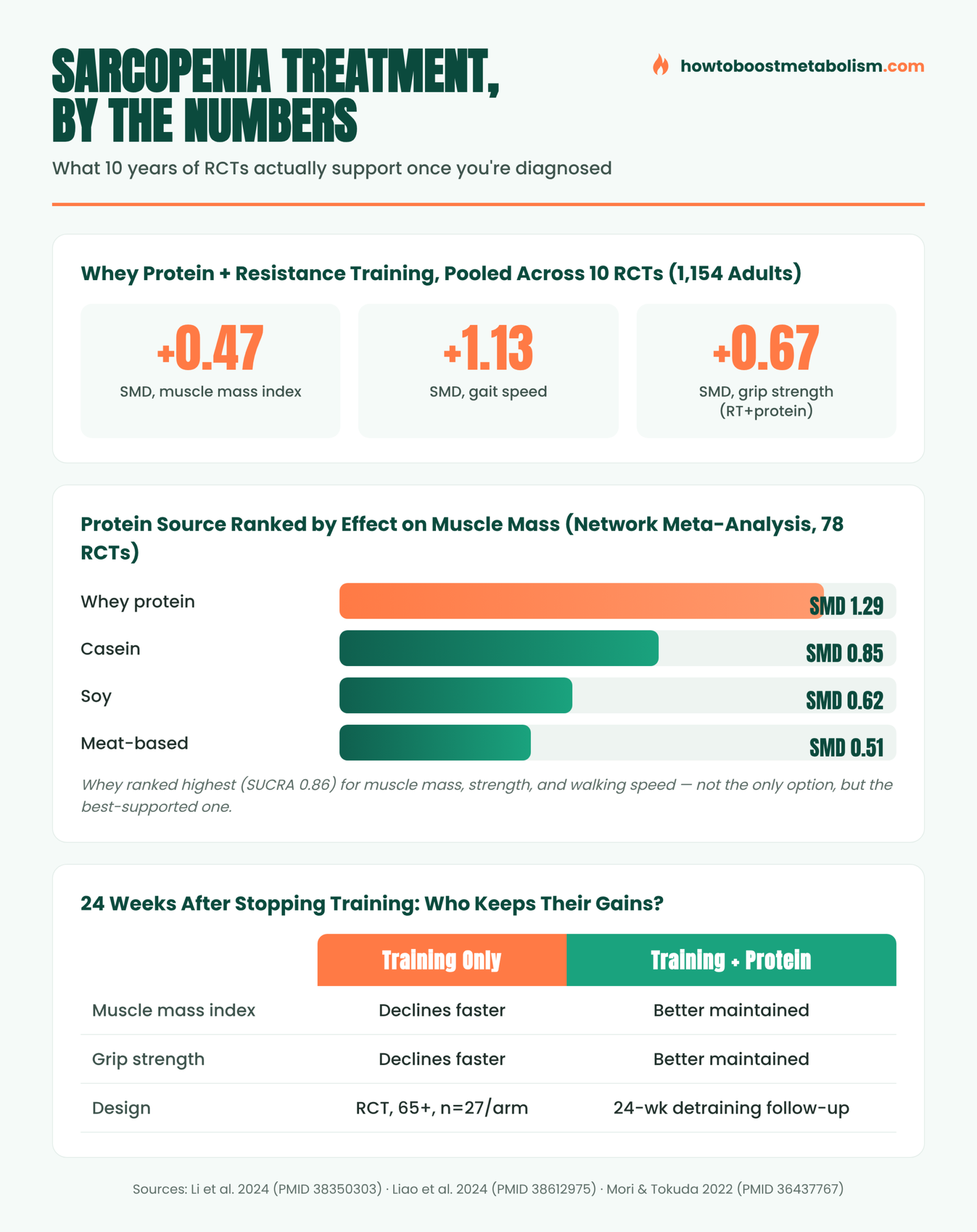
A 2024 systematic review and meta-analysis pooled 10 randomized controlled trials covering 1,154 older adults diagnosed with sarcopenia by EWGSOP or AWGS criteria (Li et al., 2024, J Nutr Health Aging). Comparing whey protein supplementation against placebo or routine care, the pooled effect sizes were:
| Outcome | Effect size | Result |
|---|---|---|
| Appendicular skeletal muscle mass index | SMD 0.47 (95% CI 0.23–0.71) | Significant increase |
| Appendicular skeletal muscle mass | SMD 0.28 (95% CI 0.11–0.45) | Significant increase |
| Gait speed | SMD 1.13 (95% CI 0.82–1.44) | Large, significant increase |
| Handgrip strength (protein + resistance training) | SMD 0.67 (95% CI 0.29–1.04) | Significant, training required |
Notice the pattern in that last row: the grip-strength benefit showed up specifically in the whey-protein-plus-resistance-training group, not from protein alone. That distinction runs through almost every trial in this field, and it’s the single most important thing to take from this article if you read nothing else: protein without training moves muscle mass and gait speed; strength gains need the training stimulus too.
Free download
🔥 The Metabolism Starter Kit
3 honest guides: a 7-day reset plan, a foods cheat-sheet and 12 metabolism myths debunked. No spam — unsubscribe anytime.
Which Protein Actually Works Best? A Head-to-Head Comparison
Not all protein supplements are equal, and a 2024 network meta-analysis tried to settle which one helps most. It pooled 78 randomized trials covering 5,272 older adults undergoing resistance training (Liao et al., 2024, Nutrients), comparing whey, casein, milk, meat, soy, and peanut-based supplements head-to-head using a frequentist network meta-analysis. Whey came out on top across every outcome that mattered: muscle mass (SMD 1.29, 95% CI 0.96–1.62), handgrip strength (SMD 1.46, 95% CI 0.92–2.00), and walking speed (SMD 0.73, 95% CI 0.39–1.07), with the highest SUCRA ranking probability (0.86) of any protein type tested.
That doesn’t mean other protein sources do nothing — casein and soy also showed meaningful effects in the same analysis, just smaller ones on average. If whey doesn’t agree with you or you’re following a plant-based diet, soy-based supplementation still has real trial support behind it; it’s simply not the top performer in this particular ranking.
Hitting a protein target every single day — especially split evenly across meals, which separate research suggests matters for muscle protein synthesis — is a logistics problem as much as a willpower one. If you’d rather follow a structured eating plan than calculate grams at every meal, this Mediterranean-style program walks through a day-by-day framework (heads up: it includes a recurring subscription charge after the initial plan, so check the terms before signing up).
See the Plan →Affiliate link — we may earn a commission at no extra cost to you. Disclosure
The Honest Catch: What Happens When You Stop Training
Most sarcopenia coverage stops at “start lifting and eating more protein” and never addresses what happens when life gets in the way and training stops — an injury, a hospital stay, a few months of travel. A 2022 randomized controlled trial out of Japan directly tested this (Mori & Tokuda, 2022, J Nutr Health Aging). Eighty-one community-dwelling adults 65 and older, all screened for sarcopenia, were split into three groups for 24 weeks: resistance training plus leucine-enriched whey protein (11.0g protein, 2,300mg leucine, twice weekly), resistance training alone, and protein supplementation alone. Everyone’s total protein intake was controlled to at least 1.2g/kg of ideal body weight per day.
After the 24-week intervention, the combined group showed significantly greater improvements in both muscle mass index and grip strength than either single-intervention group. But the more useful finding came next: researchers then tracked everyone through a 24-week de-training period — no supervised training at all. At the end of that follow-up, the combined training-plus-protein group had lost significantly less muscle mass and strength than the training-only group (p < 0.05 and p < 0.01 respectively). In plain terms: protein doesn’t just add a small boost during active training — it appears to blunt how fast you lose ground once training stops.
How Much Protein, Realistically?
Across these trials, the protein doses that produced benefit cluster in a fairly narrow, unglamorous range: roughly 1.2g per kilogram of body weight per day as a floor, with specific supplement doses in the 20–40g range per serving and leucine content in the 2–3g range shown to matter for triggering muscle protein synthesis in older adults, whose muscle tends to respond less efficiently to a given protein dose than younger muscle (a phenomenon researchers call anabolic resistance). For a 70kg (154 lb) adult, 1.2g/kg works out to about 84g of protein spread across the day — roughly 25–30g per meal, three to four times daily, rather than one large serving at dinner.
A Simple Starting Framework
- Get a baseline: if you haven’t already, work through the official EWGSOP2 screening steps (strength → muscle mass → physical performance) with a clinician rather than relying on a bathroom scale reading.
- Target roughly 1.2–1.5g of protein per kg of body weight daily, split across 3–4 meals rather than concentrated in one.
- Start progressive resistance training for the major muscle groups 2–3x per week — body weight, resistance bands, or machines are all reasonable starting points; the trials above used standard gym equipment.
- If a whey-based supplement fits your diet and digestion, the evidence currently favors it over other protein sources for this specific purpose — but any consistent protein source paired with training beats either alone.
- Re-screen every few months using the same method you used the first time, so you’re comparing apples to apples.
What the Actual Training Protocol Looked Like
One detail that rarely makes it into summaries: the resistance training used in these trials wasn’t exotic or especially intense. Typical protocols ran two to three sessions per week, targeting major muscle groups — legs, chest, back, shoulders — with machines or resistance bands at a load the participant could lift for roughly 10–15 repetitions before fatigue, for 2–3 sets per exercise. Sessions generally lasted 30–45 minutes including warm-up. This matters because it sets a realistic bar for what “doing the training part” actually requires: not a bodybuilding routine, not daily sessions, and not necessarily free weights. Consistency over months mattered far more than intensity in any single session.
Progression still matters, though — the trials that showed the largest strength gains gradually increased resistance as participants got stronger, rather than using a fixed load for the full study period. If a weight stops feeling challenging by the last few reps of a set, that’s usually the signal to add a small amount of resistance, not a sign to stop.
Timing Protein Around Training: Does It Matter?
A related question that comes up constantly: does protein need to be consumed right after a workout to count? The honest answer from the broader sports nutrition literature is that the old “30-minute anabolic window” idea has been substantially walked back — total daily protein intake and how evenly it’s distributed across meals appear to matter considerably more than hitting a narrow post-workout window. The trials discussed above generally had participants take their protein supplement once or twice daily without requiring precise workout-adjacent timing, and still saw the effect sizes reported. If a same-day serving close to training is convenient, there’s no harm in it — it’s just not the make-or-break variable some marketing implies.
A Note for Anyone Also Managing Weight Loss or GLP-1 Medication
Sarcopenia diagnoses are increasingly showing up alongside intentional weight loss, including from GLP-1 medications like semaglutide and tirzepatide, which can cause substantial lean mass loss alongside fat loss if protein intake and resistance training aren’t actively prioritized during treatment. A 2026 randomized trial protocol (the LEAN-PREP study) is specifically testing whether structured resistance training plus protein supplementation can preserve lean mass during GLP-1 therapy — an active and still developing area of research, but one that follows the exact same two-part logic covered in this article: training provides the stimulus, protein provides the raw material, and neither one alone does the full job.
What the Trials Don’t Promise
None of this is a cure in the sense of reversing sarcopenia permanently with a fixed course of treatment — it’s an ongoing maintenance relationship between training, protein, and your muscle, much like blood pressure management is an ongoing relationship with diet and medication rather than a one-time fix. The de-training data above makes that explicit: stop the inputs, and the gains erode, just more slowly if protein intake stays up. The trials also skew toward community-dwelling older adults without severe comorbidities; if sarcopenia is tied to another condition — advanced kidney disease, a cancer diagnosis, severe heart failure — the approach needs to be coordinated with whoever is treating that condition, not run independently.
Free download: our Metabolism Starter Kit — a protein calculator, a 7-day meal framework, and a one-page supplement checklist, with zero hype.
Get the Free Starter Kit →Frequently Asked Questions
Can sarcopenia actually be reversed, or just slowed down?
Trial data shows real increases in muscle mass, strength, and gait speed with combined resistance training and protein supplementation — not just a slower decline. Whether that counts as “reversal” depends on how severe the starting point was, but the direction of change in these RCTs is genuinely positive, not merely less-negative.
Is whey protein required, or can I just eat more protein-rich food?
The research specifically testing supplements used standardized whey doses because that makes dosing consistent and measurable in a trial. There’s no evidence that a supplement is biologically superior to getting the same grams of protein from food — eggs, dairy, fish, poultry, legumes — if you can realistically hit your daily target that way. A supplement is mainly a convenience tool for closing a gap, not a requirement.
How long before I’d expect to see a difference?
The trials cited above ran 12 to 24 weeks and measured meaningful changes in that window. That doesn’t mean nothing happens sooner — strength typically improves within the first 4–6 weeks of consistent resistance training — but muscle mass changes visible on a scan generally take longer to accumulate.
I already have low muscle mass — is it safe to start lifting weights?
In the trials discussed here, supervised progressive resistance training was the intervention, not a contraindication, even in frail adults in their 70s–90s. That said, starting under some form of guidance (a physical therapist, a trainer experienced with older or deconditioned adults, or a structured program) and progressing gradually is the approach used in essentially all of these studies, not an unsupervised jump into heavy lifting.
Does this same approach apply if sarcopenic obesity, not just low muscle mass, is the issue?
Largely yes, with one nuance: our sarcopenic obesity guide covers how GLP-1 medications and simultaneous fat gain complicate the picture — protein needs may run higher, and preserving muscle during intentional weight loss takes more deliberate attention than muscle gain alone.
Related Reading
- How sarcopenia is actually screened and diagnosed
- Sarcopenic obesity: when you lose muscle and gain fat at once
- Does HMB actually help preserve muscle after 40?
- Vitamin D’s real role in muscle strength and sarcopenia
Medical disclaimer: this article is for educational purposes and summarizes published research. It is not a substitute for individualized medical advice. See our Medical Disclaimer and Affiliate Disclosure.