Forearm and Wrist Training After 40: What Actually Works
This article may contain affiliate links. If you buy through them, we may earn a small commission at no extra cost to you. See our Affiliate Disclosure and Medical Disclaimer.
If you’ve noticed your grip isn’t what it used to be — jar lids fight back, a heavy grocery bag makes your forearms burn faster than your legs do, or your hands tire out before your back does on a deadlift — you’re not imagining it. Grip and forearm strength tend to decline earlier and faster than overall muscle mass as people move through their 40s and beyond, and most strength programs do almost nothing to address it directly. This article looks at what actually improves forearm and wrist strength after 40, what’s mostly marketing, and where the line is between “train it” and “see a professional about it.”
Already lifting but want a complete, structured program built around the realities of training after 40 — not just one body part? Old School New Body lays out a full strength framework (the F4X method) designed specifically for lifters over 40, so grip and forearm work fits into a bigger plan instead of being an afterthought.
Check Availability →Affiliate link — we may earn a commission at no extra cost to you. Disclosure
Why Your Forearms Feel Like They’re Falling Behind
Grip strength gets outsized attention in aging research for a practical reason: it’s cheap and fast to measure with a hand dynamometer, and it tracks closely with how capable someone is at everyday tasks — carrying, opening, catching themselves when they stumble. A 2019 meta-analytical review in Gerontology pooled exercise-training studies in healthy community-dwelling adults 60 and older and found that structured exercise training reliably produced measurable improvements in handgrip strength, even though most of the programs reviewed were not forearm-specific — they were general strength or multicomponent programs (Reinders et al., 2019, PMID 31499496). In other words: training in general helps grip, but the effect is a side benefit of broader strength work, not a guarantee that your grip specifically is getting the attention it needs.
That matters because most popular strength programs are built around big compound lifts — squats, deadlifts, presses, rows — that train grip incidentally rather than directly. Your forearms get worked every time you hold a barbell, but almost never through their full, varied range of motion (flexion, extension, radial and ulnar deviation, rotation), and almost never to the point of direct, progressive overload the way your biceps or quads are. For most lifters under 40, that incidental work is probably enough. After 40, with grip strength already declining faster than other measures and tendons recovering more slowly, a little bit of direct, deliberate attention tends to pay off more than it used to.
Two Jobs, Not One: Flexors, Extensors, and the Tennis Elbow Connection
“Forearm training” sounds like one thing, but it’s really at least two separate jobs that most lifting programs handle very unevenly. The flexor muscles on the palm side of your forearm are responsible for crushing grip — the squeeze you use on a barbell, a pull-up bar, or a jar lid — and they get trained constantly just from pulling exercises. The extensor muscles on the back of your forearm, which lift your knuckles and stabilize your wrist against the pull of the flexors, get almost no direct work in a typical program built around rows, curls, and deadlifts.
This imbalance is more than a cosmetic detail. The extensor carpi radialis brevis — one of the main wrist extensors — is the muscle most consistently implicated in lateral epicondylar tendinopathy, better known as tennis elbow, which becomes dramatically more common after 40 regardless of whether someone plays tennis. A randomized trial specifically tested adding an isolated, slow eccentric wrist-extensor exercise to standard physical therapy for chronic lateral epicondylosis and found it added benefit over standard treatment alone (Peterson et al., 2010, PMID 20579907). The honest takeaway isn’t “never grip anything heavy” — it’s that balancing crushing-grip work with dedicated extensor work, done slowly and under control, is one of the more evidence-backed ways to keep that joint healthy as you keep training.
| Muscle group | Typical training status | How to actually train it |
|---|---|---|
| Flexors (crushing grip) | Trained constantly by pulling exercises | Direct work: farmer’s carries, dead hangs, grippers |
| Extensors (knuckle lift / wrist stability) | Almost never trained directly | Reverse wrist curls, eccentric extensor work |
| Pinch / thumb strength | Rarely trained at all | Plate pinches, thick-grip holds |
Free download
🔥 The Metabolism Starter Kit
3 honest guides: a 7-day reset plan, a foods cheat-sheet and 12 metabolism myths debunked. No spam — unsubscribe anytime.
What’s Actually Worth Doing
1. Direct wrist curls and reverse wrist curls
The simplest, most direct tool: light dumbbells or a barbell, forearm resting on your thigh or a bench, wrist moving through flexion (palm up, curling the weight toward you) and extension (palm down, lifting the knuckles). Two to three sets of 12–20 controlled reps of each, two to three times a week, is a reasonable starting dose. This is boring, unglamorous, and one of the more directly supported ways to add targeted size and strength to muscles that otherwise never get isolated attention.
2. One grip-specific move: carries or hangs
Farmer’s carries (walking while holding heavy dumbbells or a trap bar) and dead hangs from a pull-up bar both train grip under load for extended time, which crosses over well to real-world “carry the thing without dropping it” strength. If you already have a dedicated article on dead hangs, this is the category that work belongs in — it’s a legitimate grip tool, just not a substitute for direct wrist work.
3. Isometric holds, used honestly
A review of isometric handgrip exercise and training found consistent evidence for one specific, well-studied benefit: a modest reduction in resting blood pressure with regular isometric handgrip training, alongside more limited and mixed evidence for effects on pain sensation, cognition, and blood lipids (Lentini et al., 2022, PMID 35072335). That’s a real, specific effect worth knowing about — it is not evidence that isometric gripper squeezing builds meaningfully more forearm size or strength than dynamic training does. If someone tries to sell you a hand gripper as a blood-pressure device, that part has some real support; if they sell it as a complete forearm program, it doesn’t.
What’s Mostly Noise
- Gimmick grip tools with no progression plan. Stress balls and novelty grippers can be a fine warm-up, but without a way to add resistance over time, they stop producing adaptation quickly.
- Wrist “circles” and loose mobility drills as your only forearm work. Mobility has its place as a warm-up, but it isn’t loaded enough to drive strength or size changes on its own.
- Training through sharp, localized elbow or wrist pain. Mild, generalized forearm fatigue after a session is normal. Sharp pain on the outside of the elbow, numbness, or pain that worsens day to day is a reason to back off and get it looked at, not a reason to grip harder.
How Fast Should You Progress the Load?
The same progressive-overload principle that applies to squats and bench presses applies here, just on a smaller scale. Start with a weight you can control for the full range of motion on every rep — for most people new to direct wrist work, that is surprisingly light, often five to ten pounds for wrist curls and noticeably less for reverse wrist curls, since the extensor muscles are smaller and weaker than the flexors they balance. Add a small amount of weight, or a rep or two, every one to two weeks rather than every session; tendons and the smaller stabilizing structures around the wrist adapt more slowly than muscle tissue does, and pushing load up too quickly is one of the more common ways people turn a helpful habit into an irritated elbow. A simple log — weight, sets, reps, and how the joint felt the next day — makes it easy to tell the difference between normal muscular fatigue and the kind of nagging joint irritation that means you should back off.
It also helps to think of this as a long-term maintenance habit rather than a short program with an end date. Unlike a squat program you might cycle through in twelve weeks, direct forearm and wrist work tends to pay off most as something you keep doing indefinitely, the same way you’d keep doing some form of core or mobility work. The goal isn’t to turn your forearms into a specialty, it’s to make sure one of the body’s most functionally important — and most commonly neglected — areas isn’t the first thing to give out as the decades add up.
A Sensible Way to Add This Without Overhauling Your Program
You don’t need a dedicated forearm day. Tack 10–15 minutes onto the end of two or three sessions a week: a set or two of wrist curls, a set or two of reverse wrist curls, and one grip-specific move (carries one week, hangs the next). Keep the weight modest and the tempo slow, especially on the extensor work — the eccentric, lowering phase is where a lot of the tendon-health benefit appears to come from. Progress the load gradually, the same way you would with any other muscle group, and expect it to take several weeks of consistent work before you notice a real difference, not a single session.
If you already have persistent elbow or wrist pain, this is one of the areas where it’s worth getting an actual diagnosis before you self-program. Eccentric wrist-extensor protocols have real trial support for treating existing tendinopathy, but they’re typically introduced gradually, under guidance, as part of a broader rehabilitation plan — not added cold onto an already-painful joint.
Want a plan that puts this kind of detail-level work inside a complete program, rather than leaving you to guess how it fits with everything else you’re doing? Grip strength is also one of the most studied longevity markers in aging research — worth understanding on its own, separate from the muscle-building side of things covered here. If you’re deciding between grip tools, wrist wraps and lifting straps solve a different problem than direct forearm training does — supporting a lift, not building the muscle. And if you already do dead hangs as part of your grip work, here is what the evidence actually supports about dead hangs for tendon health, separate from some of the more exaggerated claims made about them.
Free download: our Metabolism Starter Kit — a protein calculator, a 7-day meal framework, and a one-page supplement checklist, with zero hype.
Get the Free Starter Kit →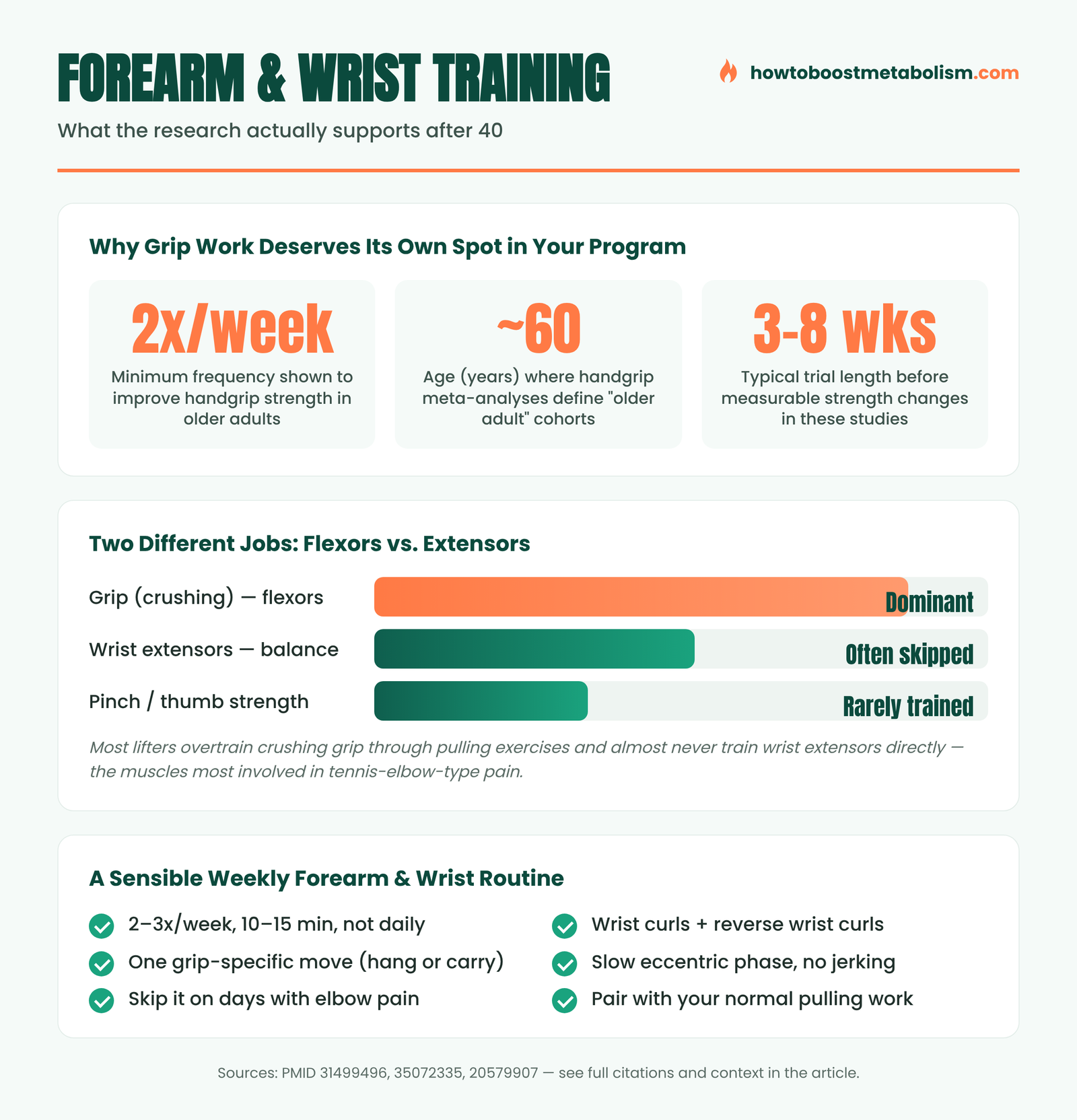
The Bottom Line
Forearm and wrist strength is one of the more neglected corners of most lifting programs, and the neglect gets more costly after 40 as grip tends to decline faster than other measures of strength. The fix isn’t exotic: direct wrist curls and reverse wrist curls, one grip-specific carry or hang movement, done two to three times a week with progressive, modest loading, covers the vast majority of the benefit the research actually supports. Isometric handgrip work has a real, specific blood-pressure benefit worth knowing about, separate from its contribution to size or strength. And if you already have elbow pain, slow eccentric wrist-extensor work has genuine clinical trial support as part of treatment — but that’s a conversation to have with a professional, not a program to improvise.
Related: Grip and wrist strength also matter for the front squat’s rack position — see our comparison of front squat vs. back squat after 40 for the full biomechanical trade-offs between the two.
Frequently Asked Questions
Do I need special equipment to train my forearms and wrists?
No. A pair of dumbbells, a resistance band, or even a towel and a bucket of rice can cover the basics — wrist curls, reverse curls, and static holds all work with minimal gear. Specialty tools like a Captains of Crush gripper or a fat bar are useful add-ons, not requirements.
How often should I train my forearms after 40?
Two to three short sessions a week is enough for most people, and that’s on top of whatever grip work you’re already doing incidentally during pulling exercises like rows, pull-ups, or deadlifts. Forearm muscles recover quickly, but tendons recover more slowly, so more isn’t automatically better.
Will wrist curls actually make my grip stronger?
They’ll make your forearm flexors and extensors bigger and stronger, which supports grip endurance, but direct grip training — dead hangs, farmer’s carries, dynamometer or gripper work — carries over to “squeeze strength” more specifically. The two types of training complement each other rather than substitute for one another.
I have early tennis elbow symptoms. Should I still train my forearms?
Often yes, but the type of exercise matters. Randomized trials on lateral epicondylar tendinopathy have specifically used slow, controlled eccentric wrist-extensor exercise as a treatment, not just a risk to avoid — not aggressive gripping under load. If you have diagnosed elbow pain, this is a conversation for a physical therapist or doctor, not a program you build from a blog post.
Does grip strength really matter if I’m not a climber or an athlete?
Yes — grip strength is one of the most consistently used proxies for overall muscular health and functional capacity in aging research, because it’s easy to measure and correlates with how well people can carry groceries, open jars, and catch themselves if they trip. Training it is less about sport performance and more about staying functionally capable for everyday life.